


Asian stock markets rose broadly, with "high market trading" leading to new highs in the stock market, while gold and silver fell, and the US dollar stabilized as the RMB strengthened

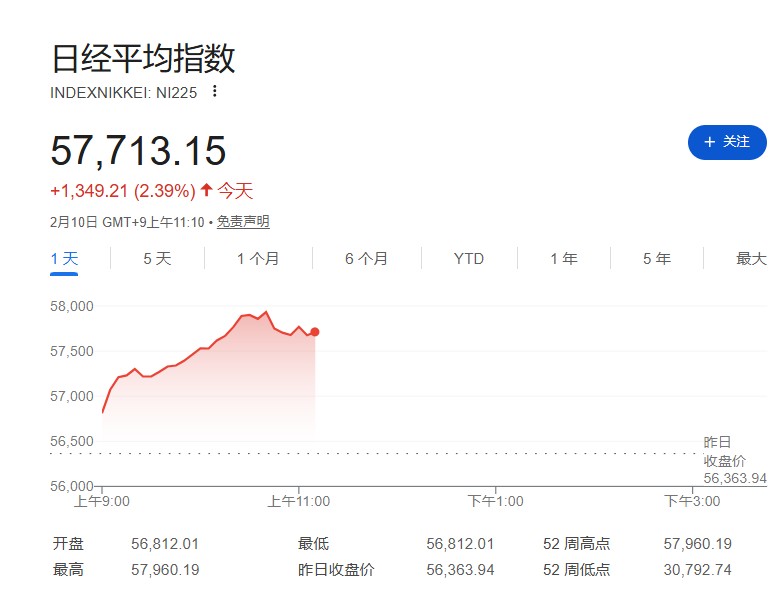
On Tuesday, Asian stock markets rallied across the board, led by Japan. The Nikkei 225 index surged over 2%, reaching a new historical high for three consecutive days, with markets in South Korea and Australia also rising. Meanwhile, commodities saw a significant decline, with gold dropping 1% and silver plummeting 2.5%. Market focus has shifted to the upcoming key U.S. data to assess the Federal Reserve's policy path
On February 10th, Tuesday, Asian stock markets continued their strong performance, with the Japanese stock market leading the way. Over the past weekend, Japanese Prime Minister Fumio Kishida achieved electoral victory, which significantly boosted investor confidence and propelled the benchmark index of Japanese stocks to soar.
The Nikkei 225 index broke through the 57,000-point mark on Tuesday, rising by as much as 2.52% during the session, marking a historic high for the third consecutive day. Market analysts pointed out that investors are actively engaging in "Kishida trades," betting that his victory will bring about a continuity of market-friendly policies. Meanwhile, the MSCI Asia-Pacific (excluding Japan) index rose by 0.4%, reflecting an overall optimistic sentiment in the regional market.
The performance of U.S. stocks overnight also provided support for Asian markets. With technology stocks stabilizing and rebounding after last week's artificial intelligence (AI) sell-off, the S&P 500 index and the Nasdaq index rose by 0.5% and 0.9%, respectively. However, U.S. stock futures showed slight fatigue during the Asian session on Tuesday, with S&P 500 e-mini futures down 0.1%, indicating signs of momentum exhaustion after the short-term rebound.
Despite the bullish sentiment in the stock market, the commodities and foreign exchange markets presented a different picture. After a significant drop on Monday, the U.S. dollar index stabilized, leading to a notable decline in gold and silver prices, while oil prices also dipped slightly due to position adjustments. Investors are currently shifting their focus to the U.S. retail sales, inflation, and employment data to be released later this week, to further assess the Federal Reserve's policy path.
- The Nikkei 225 index's gains expanded to 2%, setting a new historical high. The Topix index also rose by 1.08%, similarly breaking records.
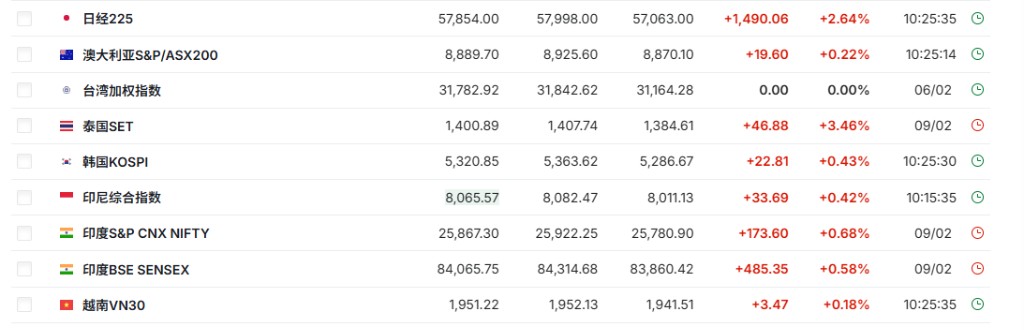
- The South Korean KOSPI index rose by 1.21%, approaching its historical closing high; the Australian S&P/ASX 200 index rose by 0.39%, poised for a third consecutive day of gains.
- The offshore renminbi against the U.S. dollar broke through the 6.91 mark for the first time since May 2023, currently reported at 6.9094, up 57 points intraday.
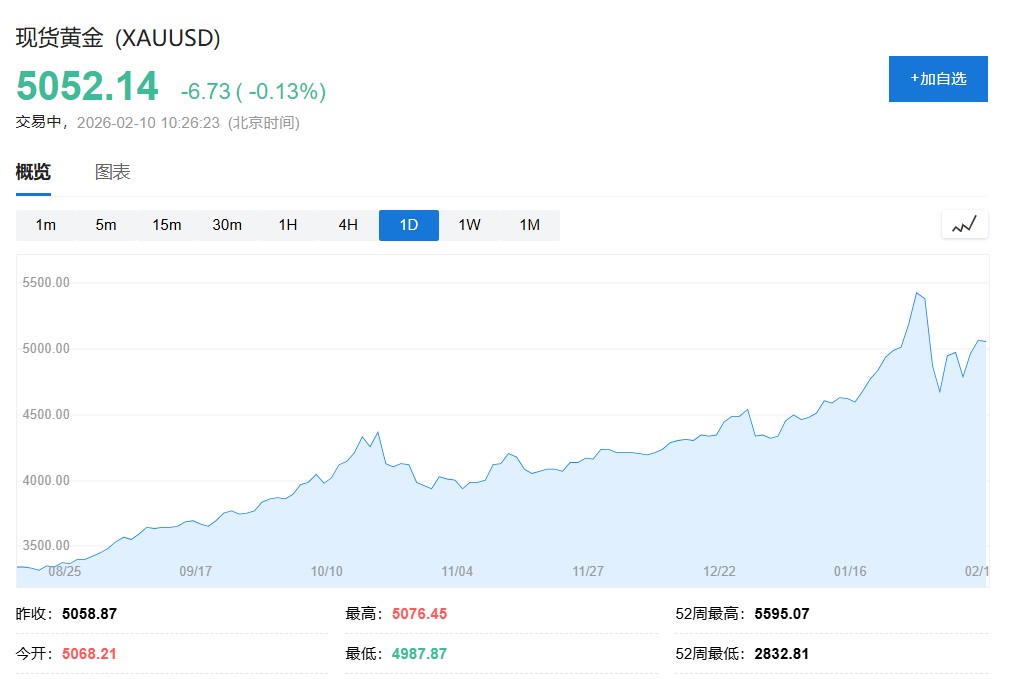
- Spot gold fell by 1% to $5,016.56 per ounce, while silver plummeted by 2.5% to $81.31 per ounce.
- In terms of oil, WTI crude oil futures fell by 0.1% to $64.15 per barrel.
"Kishida trades" dominate the Asian market
The strong performance of the Japanese market was the central theme of the Asian trading session on Tuesday. Fumio Kishida's overwhelming victory in the House of Representatives election eliminated political uncertainty and sparked a surge in buying. The Nikkei 225 index not only broke through the 57,000-point threshold, but the Topix index also rose by 1.08%, setting a new record.
This optimistic sentiment also spread to other Asian markets. The South Korean KOSPI index rose by 1.21%, approaching its historical closing high; the Australian S&P/ASX 200 index rose by 0.39%, poised for a third consecutive day of gains Robeco's global equity head Kees Verbaas holds a positive outlook on the overall economic situation. He stated, "Although we see some cracks, overall we are actually quite optimistic about the economic situation." He pointed out that investment plans from large companies are increasing rather than decreasing, which is generally favorable for economic activity, and specifically emphasized that "many AI supply chains are only possible with the support of emerging markets."
Dollar Stabilizes, Renminbi Strengthens
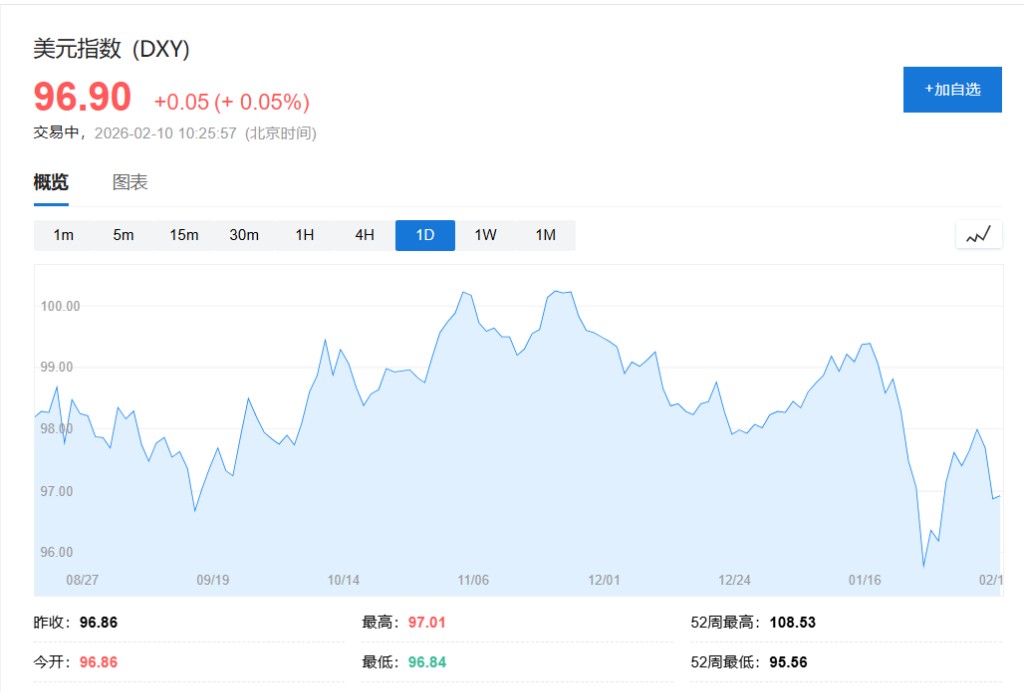
In the foreign exchange market, the dollar index held around 96.97 on Tuesday, close to this month's low. On Monday, the dollar index recorded its largest single-day drop in two weeks, mainly influenced by a Bloomberg report.
In this regard, analysts at Alpine Macro pointed out in a research report, "Enhancing the global status of the Renminbi is being placed on the policy agenda."
In the morning, the offshore Renminbi broke through the 6.91 mark against the dollar for the first time since May 2023, currently reported at 6.9094, up 57 points during the day.
Commodity Retreat: Gold and Silver Down, Oil Prices Slightly Lower
After two consecutive trading days of gains, precious metal prices saw a pullback on Tuesday.
Spot gold fell by 1% to $5,016.56 per ounce, while silver plummeted by 2.5% to $81.31 per ounce. Previously, driven by a weaker dollar, gold prices had reached a historic high of $5,594.82 on January 29. The decline has now narrowed.
In terms of crude oil, WTI crude futures fell by 0.1% to $64.15 per barrel.
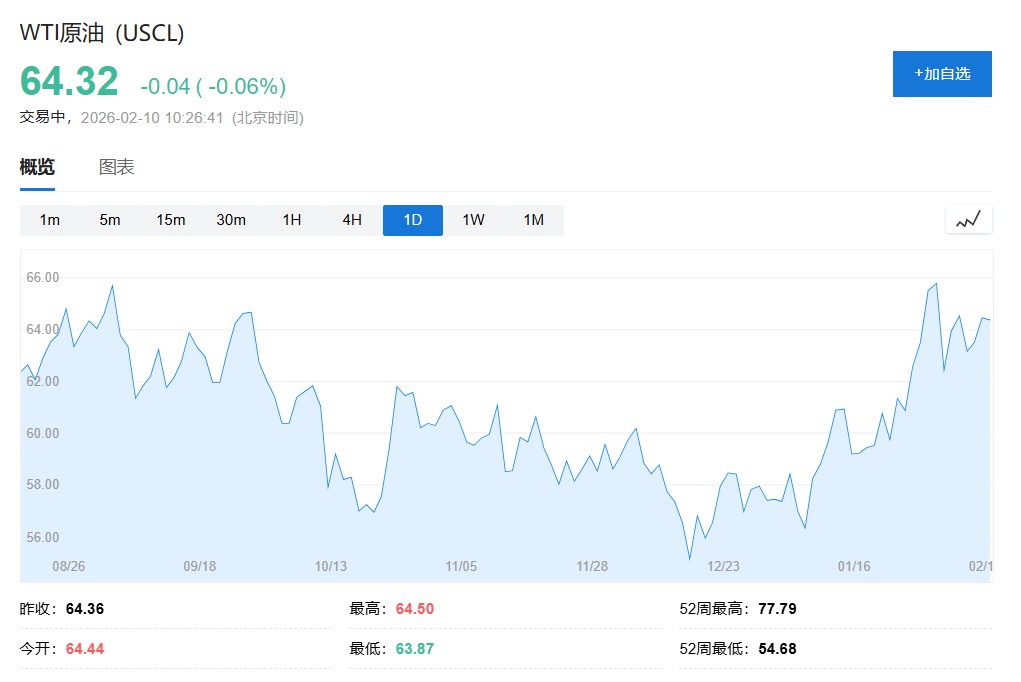
Analysts believe that the drop in oil prices is mainly due to possible position adjustments, but tensions between the U.S. and Iran may limit the decline in oil prices. The U.S. Department of Transportation has issued a maritime advisory recommending U.S. vessels stay away from Iranian waters, citing that Iranian forces have recently attempted to force commercial ships into their waters.
Current market pricing indicates that the Federal Reserve will maintain interest rates until June. CME Group's FedWatch tool shows that the market expects only a 17.7% probability of a 25 basis point rate cut at the Fed's meeting on March 18. White House economic advisor Kevin Hassett stated on Monday that due to the Trump administration's immigration policies slowing labor growth and new AI tools increasing productivity, U.S. job growth may slow in the coming months This statement has also added more attention to the upcoming employment data.
On Tuesday, Asian markets were dominated by "high market early rice trading," with the Nikkei 225 index soaring over 2% to set a new historical high, driving a broad rally in Asian stock markets including South Korea and Australia. In contrast, the commodities market experienced a pullback, with gold falling by 1% and silver plunging by 2.5%. After a noticeable decline, the US dollar index stabilized, and the Chinese yuan strengthened. Investors are closely monitoring the upcoming US employment and inflation data to adjust expectations for a Federal Reserve rate cut in June
