


Which real estate data is improving?

This article analyzes the recent trends in the real estate market, pointing out that sales, prices, and listings of second-hand homes have all improved, but seasonal factors and base effects need to be considered. In terms of new homes, although the launch of new projects has driven up prices, sales area and inventory still face pressure, with no significant improvement observed. The decline in second-hand home sales has narrowed, and the price decline has also decreased, with inventory levels dropping. Overall, the market still requires cautious observation
Core Viewpoints
This article focuses on recent trends in the real estate market. Since the beginning of the year, indicators related to second-hand housing have improved, including a narrowing decline in sales, a narrowing decline in housing prices, and a decrease in listings. However, these improvements are related to seasonal factors, base effects, and the timing of the Spring Festival, and should be viewed objectively. In terms of new housing, the entry of improved properties has driven a continuous rise in new housing prices, but indicators such as sales area and inventory still face pressure, and no signs of improvement have been observed.
Report Summary
I. Second-hand Housing: Marginal Improvement in Prices and Inventory Under Seasonal Influence
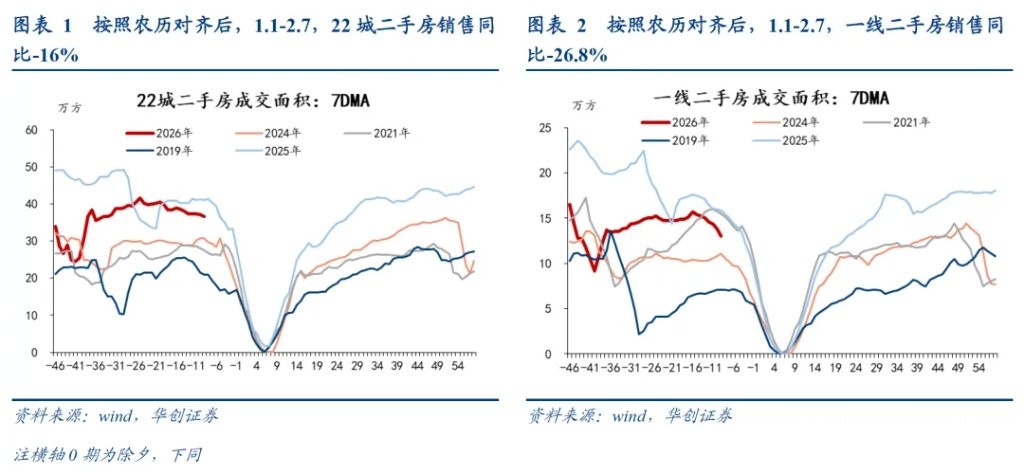
First, sales have narrowed in decline after aligning with the lunar calendar. From January 1 to February 7, the sales area of second-hand housing in 22 cities decreased by 19.9% year-on-year, with first-tier cities down 14.4% year-on-year. However, this is mainly due to the timing of the Spring Festival leading to a high year-on-year reading. After aligning with the lunar calendar, the year-on-year sales of second-hand housing nationwide and in first-tier cities were -16% and -26.8%, respectively. Although this represents a slight improvement from December 2025's -27.9% and -37.4%, the decline remains significant.
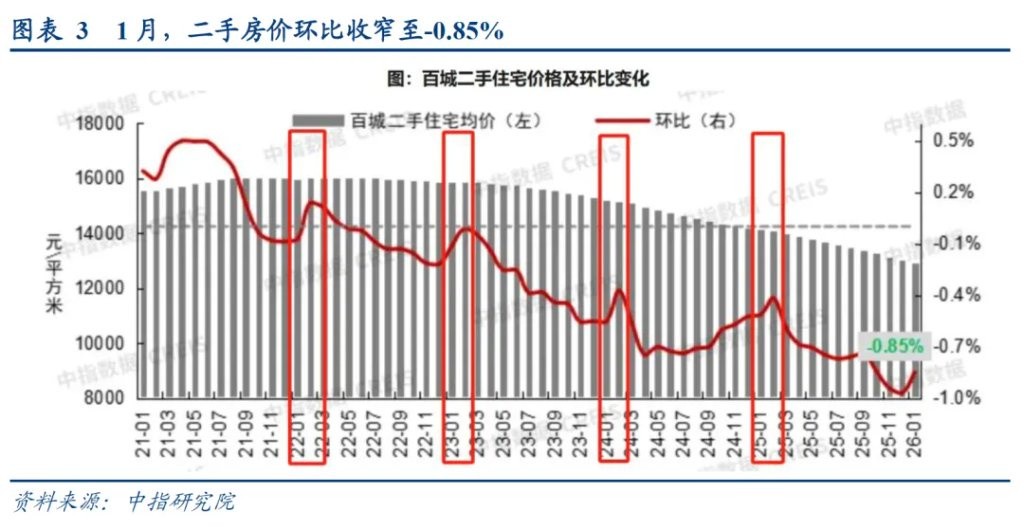
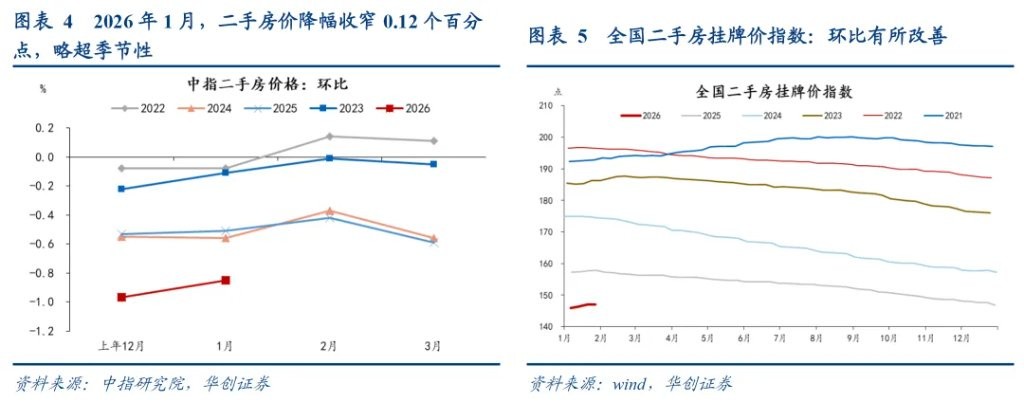
Second, prices have narrowed in decline, slightly exceeding seasonal expectations. Key reference data from the China Index Academy shows that in January 2026, the average price of second-hand housing in 100 cities decreased by 0.85% month-on-month, a narrowing of 0.12 percentage points from December last year. Major cities like Beijing and Shanghai also saw a reduction in price declines. This may be related to seasonal factors; from 2022 to 2025, regardless of the distribution of the Spring Festival, the month-on-month decline in second-hand housing in January and February has seasonally narrowed, with an average monthly narrowing of 0.09 percentage points. In January 2026, the decline narrowed by 0.12 percentage points, slightly exceeding seasonal expectations. Additionally, the Iceberg Index and the second-hand housing listing price index both indicate a narrowing decline in second-hand housing prices.
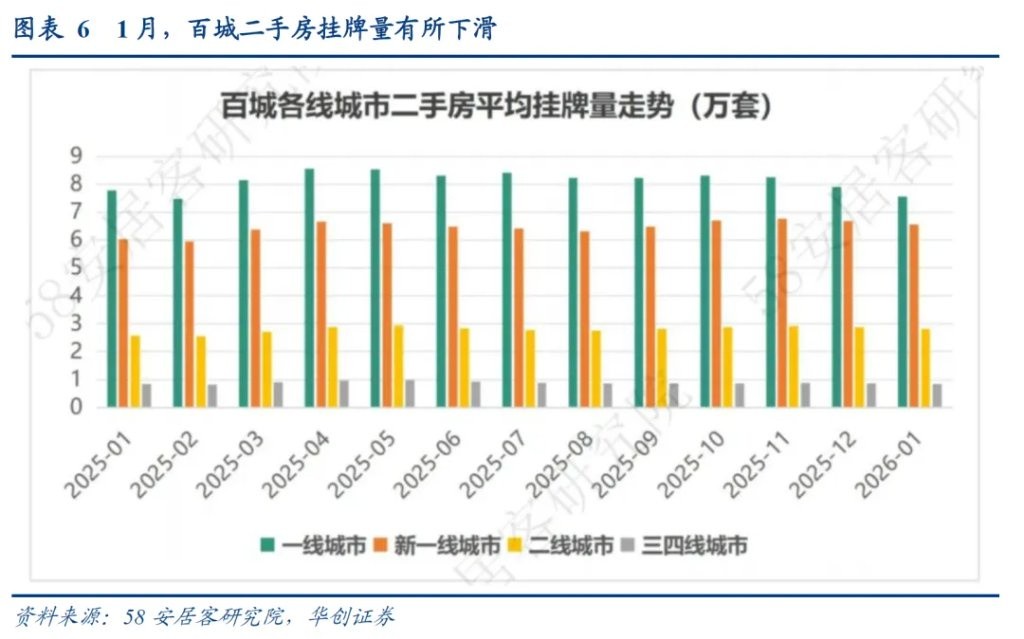
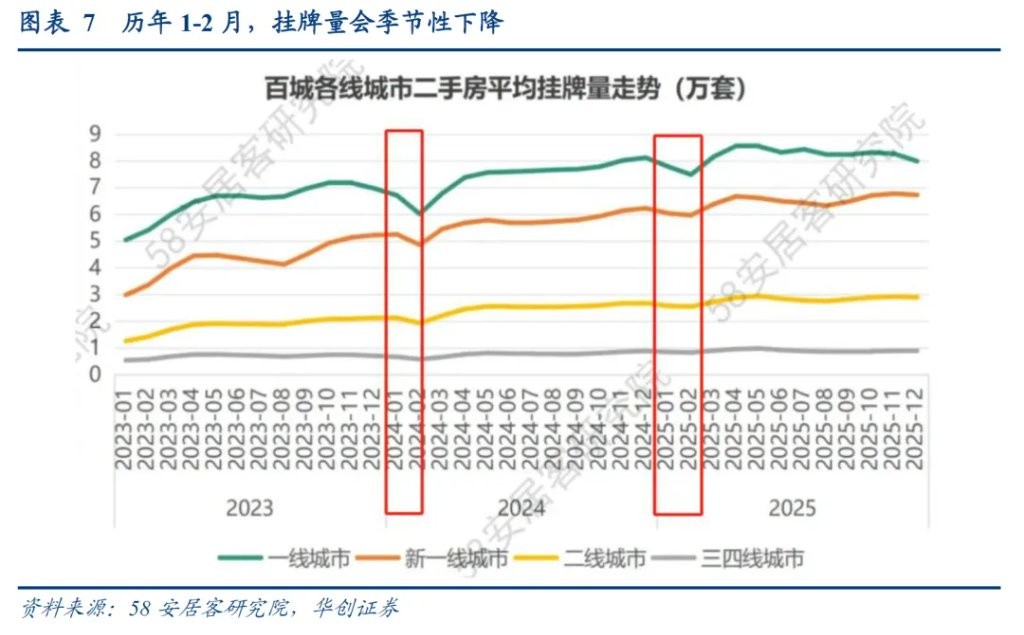
Third, inventory has decreased under seasonal influence. Two indicators are referenced: first, the listing data released by the 58 Anjuke Research Institute shows that in January 2026, the total number of second-hand housing listings in 100 cities reached 2.56 million units, a decline from December last year. Historical data shows that the number of second-hand housing listings typically declines seasonally in January and February each year. Second, according to the data released by the Iceberg Index, in January, the number of second-hand housing listings in 26 cities was 2.93 million units, a decrease of 1.4% from December last year.
II. New Housing: Sales and Inventory Pressure Remain High
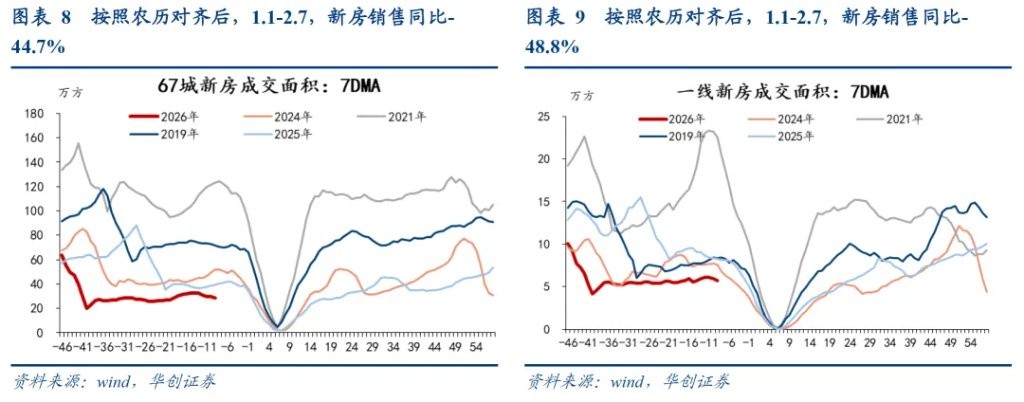
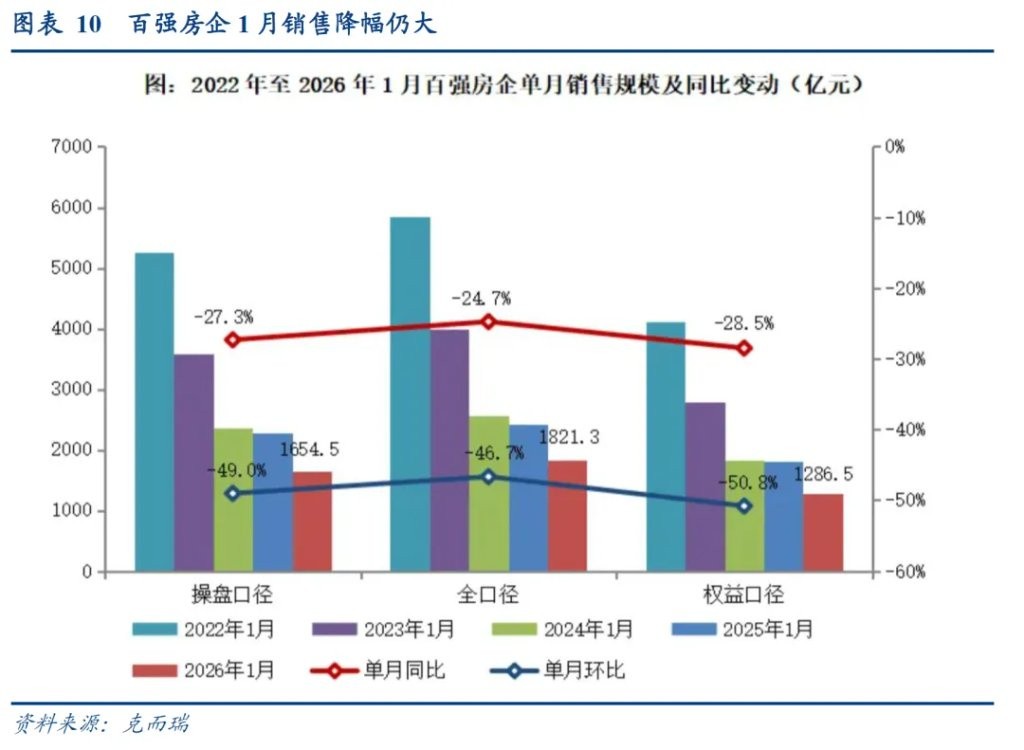
First, sales have continued to decline after aligning with the lunar calendar. From January 1 to February 7, the sales area of new housing in 67 cities decreased by 7.2% year-on-year, and after aligning with the lunar calendar, the year-on-year decline was -44.7%, which is an expansion from December 2025's -27.9%. Additionally, according to data from CRIC, in January 2026, the monthly sales amount of the top 100 real estate companies was 165.45 billion yuan, recording only -27.3% year-on-year under the "assistance" of the Spring Festival timing.
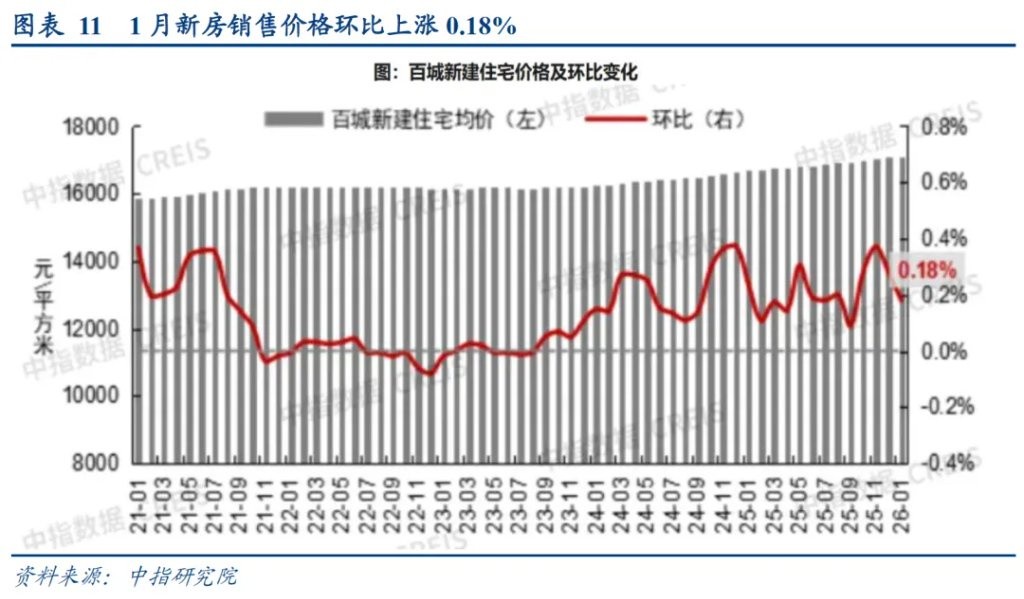
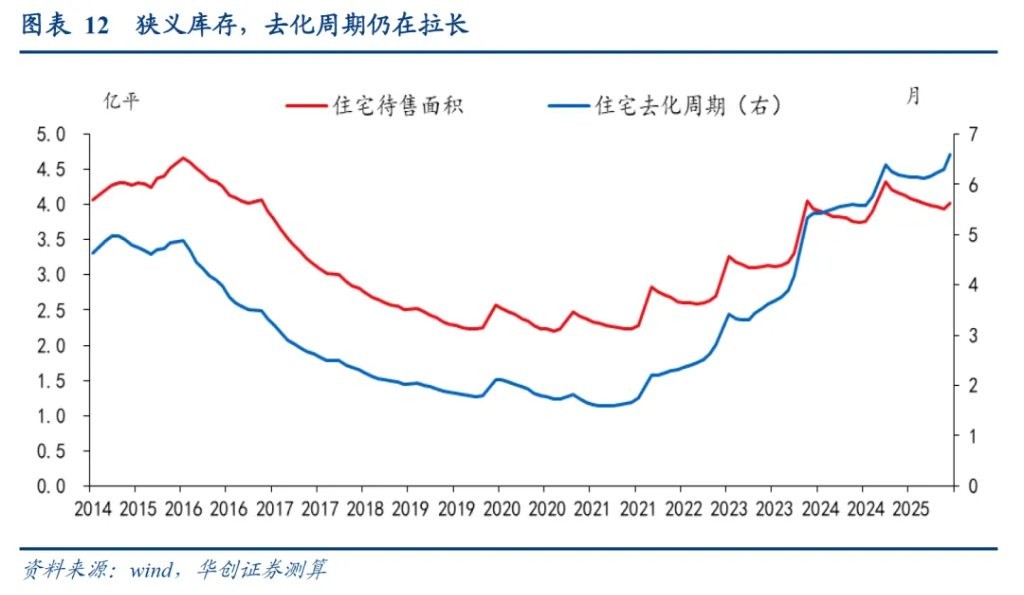
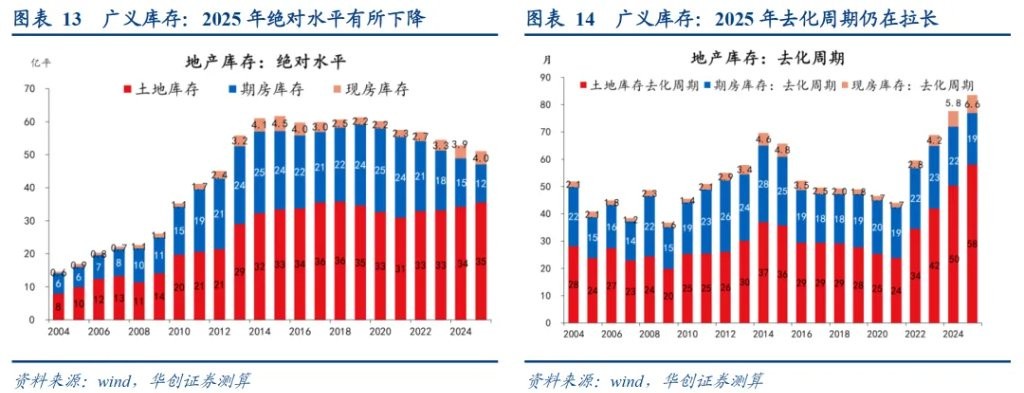
Second, prices: The entry of improved properties has led to continued price increases. According to data from the China Index Academy, in January 2026, the average price of newly built residential properties in 100 cities was 17,000 yuan per square meter, a month-on-month increase of 0.18%, compared to a month-on-month increase of 0.28% in December last year. According to the China Index Academy's interpretation, "In January, cities such as Chengdu, Shanghai, and Hangzhou saw the entry of high-end improved properties, driving a structural month-on-month increase in new housing prices in 100 cities." Third, Inventory: Absolute levels decline, but the de-stocking cycle lengthens. 1) Observing the narrow definition of new housing inventory, which refers to the area of unsold residential properties published by the National Bureau of Statistics, as of December 2025, the area of unsold residential properties is 400 million square meters, basically unchanged from 390 million square meters at the end of 2024. However, due to the continued decline in sales, the de-stocking cycle has lengthened from 5.8 months to 6.6 months. 2) Observing the broad definition of inventory, which continues to consider land inventory (land that has been transferred but not yet started) and pre-sale inventory (properties that have started construction but are not yet completed) based on the narrow inventory. For details, refer to the previous report "Four Questions on Land Inventory." As of the end of December 2025, the total inventory is 5.1 billion square meters, a slight decrease from 5.3 billion square meters in 2024. However, due to the decline in sales, the overall de-stocking cycle has lengthened from 78 months to 84 months.
Report Body
I. Second-hand Housing: Marginal improvement in prices and inventory under seasonal influence
(1) Sales: Decline narrows after aligning with the lunar calendar
From January 1 to February 7, the sales area of second-hand housing in 22 cities increased by 19.9% year-on-year. Among them, first-tier cities increased by 14.4% year-on-year. However, the high year-on-year reading is mainly due to the misalignment of the Spring Festival. After aligning with the lunar calendar, the year-on-year sales of second-hand housing nationwide and in first-tier cities are -16% and -26.8%, respectively. Although this is a slight improvement compared to -27.1% and -31.4% in December 2025 (with a high base in the same period of 2024), the decline remains significant.
(2) Prices: Decline narrows, slightly exceeding seasonal trends
For second-hand housing prices, we focus on three indicators, all pointing to a narrowing of the month-on-month decline:
First, the second-hand housing transaction price data published by the China Index Academy, shows that the average transaction price in January 2026 is 12,900 yuan/square meter, with a month-on-month decline of -0.85%, which is a slight narrowing from -0.97% in December last year. Among them, the average transaction prices in Beijing and Shanghai in January are 63,000 and 55,000 yuan/square meter, respectively, with month-on-month declines of -1.28% and -1.22%, also narrowing from -1.56% and -1.34% in December last year.
The reason may be related to seasonality. From 2022 to 2025, regardless of the distribution of the Spring Festival, the month-on-month decline in second-hand housing in January and February has narrowed. Taking a simple average, the monthly decline has narrowed by 0.09 percentage points, and the decline in January 2026 has narrowed by 0.12 percentage points compared to the previous value, slightly exceeding seasonal trends.
Second, referring to the Iceberg Index (listing price index), the month-on-month change in January 2026 is -0.7%, narrowing from -1.3% in December last year, with first-tier cities showing a month-on-month change of -0.3%, also narrowing from -1.3% in December last year Third, the second-hand housing listing price index published by Wind recorded 147.05 points as of January 26, up 0.1% month-on-month compared to the end of December 2025, while December of last year was -0.9%. Among them, first-tier cities saw a month-on-month change of -0.02%, compared to -1.2% in December of last year, indicating a narrowing decline.
(3) Inventory: Listing volume declines under seasonal influence
For second-hand housing inventory, refer to two indicators:
First, according to the listing data released by 58 Anjuke Research Institute, in January 2026, the total listing volume of second-hand houses in 100 cities reached 2.56 million units, a decrease from December of last year. Historically, there is a seasonal decline in second-hand housing listings every January and February.
Second, referring to the data published by the Iceberg Index, the listing volume of second-hand houses in 26 cities on January 26 was 2.93 million units, down 1.4% from December of last year.
II. New Homes: Sales and Inventory Pressure Remain High
(1) Sales: After aligning with the lunar calendar, the decline is still expanding
From January 1 to February 7, the transaction area of new homes in 67 cities decreased by 7.2% year-on-year. Among them, first-tier cities saw a year-on-year decline of 15.6%. After aligning with the lunar calendar, the year-on-year changes were -44.7% and -48.8%, compared to -27.9% and -37.4% in December 2025, indicating an expanding decline.
In addition, referring to data from CRIC, in January 2026, the monthly sales amount of the top 100 real estate companies was 165.45 billion yuan, recording only -27.3% year-on-year under the "assistance" of the misalignment of the Spring Festival.
 (2) Prices: Improvement projects enter the market, prices continue to rise
According to data from the China Index Academy, the average price of newly built residential properties in 100 cities in January 2026 is 17,000 yuan/square meter, a month-on-month increase of 0.18%, compared to a month-on-month increase of 0.28% in December last year.
According to the China Index Academy's interpretation, "In January, high-end improvement projects were launched in cities such as Chengdu, Shanghai, and Hangzhou, driving a structural month-on-month increase in new home prices across 100 cities."
(3) Inventory: Absolute levels decrease, but the de-stocking cycle lengthens
First, observe the narrow definition of new home inventory, which refers to the area of unsold residential properties published by the National Bureau of Statistics. As of December 2025, the area of unsold residential properties is 400 million square meters, remaining basically flat compared to 390 million square meters at the end of 2024. However, due to a continued decline in sales, the de-stocking cycle has lengthened from 5.8 months to 6.6 months.
Second, observe the broad definition of inventory, which continues to consider land inventory (land that has been transferred but not yet started) and pre-sale inventory (properties that have started construction but are not yet completed) based on the narrow inventory. For detailed methods, refer to the previous report "Four Questions on Land Inventory." As of the end of December 2025, the total inventory is 5.1 billion square meters, a slight decrease from 5.3 billion square meters in 2024. However, due to the decline in sales, the overall de-stocking cycle has lengthened from 78 months to 84 months.
Risk Warning and Disclaimer
The market has risks, and investment should be cautious. This article does not constitute personal investment advice and does not take into account the specific investment goals, financial situation, or needs of individual users. Users should consider whether any opinions, views, or conclusions in this article are suitable for their specific circumstances. Investment based on this is at one's own risk
