


Where will the "great victory" of the Liberal Democratic Party take Japan?

In the Japanese House of Representatives election on February 9, 2026, the Liberal Democratic Party (LDP) won two-thirds of the seats alone for the first time, exceeding market expectations and demonstrating a significant rise in its support rate. Takashi Sato's personal style and radical policies were key to the LDP's victory. In the short term, this will help implement loose monetary and fiscal policies, but in the medium to long term, it faces risks such as fiscal sustainability, uncontrolled inflation expectations, and income distribution inequality
Core Viewpoints
On February 8, in the Japanese House of Representatives election, the Liberal Democratic Party (LDP) independently secured two-thirds of the seats in the House, marking the first time this has occurred in Japan since World War II. In just one year, the LDP's seats in the House of Representatives increased by more than 20%, which is quite rare and worth pondering. Following the LDP presidential election in October last year, Sanae Takaichi and her party's approval ratings began to rise rapidly, but the LDP's "victory" in this election significantly exceeded market expectations. Takaichi's strong personal style and aggressive policy proposals were key to the surge in the LDP's support. In the short term, the LDP's "victory" will remove obstacles to implementing loose monetary and fiscal policies, as well as a "Japan First" foreign policy. However, in the medium to long term, issues such as fiscal sustainability constraints, the risk of inflation expectations "de-anchoring," unequal distribution of corporate profits and household income, and potential backlash risks from the "Japan First" defense and foreign policy are worth noting.
(1) The LDP's First Independent Acquisition of Two-Thirds Majority in the House of Representatives
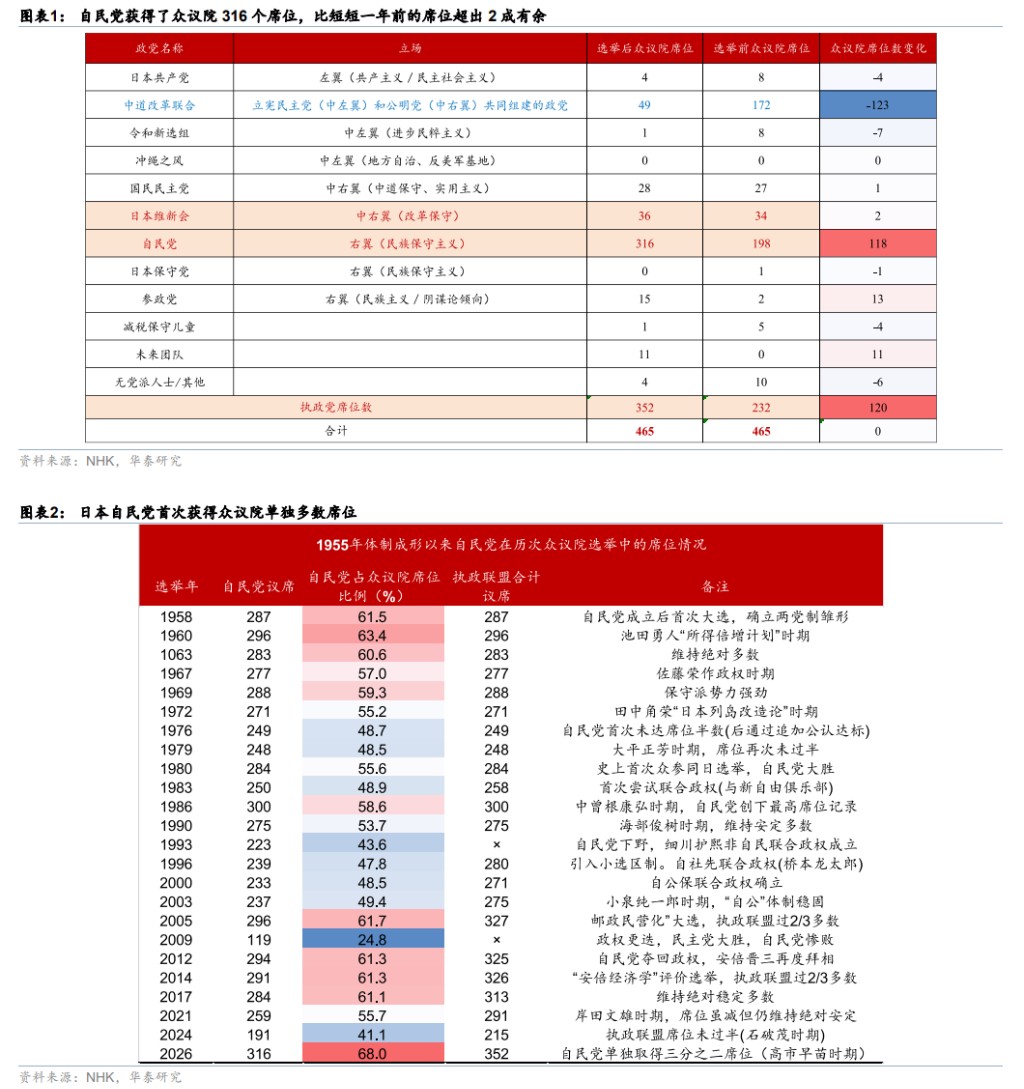
The results of the Japanese House of Representatives election have been announced, with the LDP independently obtaining a two-thirds majority, exceeding the seats from just over a year ago by more than 20%, surpassing market expectations—this is the first time a single party has achieved a two-thirds majority in the House since World War II. On the morning of February 9, 2026, the results of the House of Representatives election showed that the ruling coalition of the LDP and the Japan Innovation Party secured 316 and 36 seats respectively, totaling 352 seats (76% of the total), an increase of 120 seats for the ruling coalition compared to before the election; meanwhile, the center-left "Center Reform Alliance" formed by the Constitutional Democratic Party and the Citizens' Party only obtained 9 seats, significantly lower than the 172 seats before the election, greatly weakening the largest opposition party's power; additionally, the number of seats held by the far-right party, the Japan Restoration Party, increased by 13 to 15 seats, reflecting a trend of accelerated rightward shift in Japanese politics.
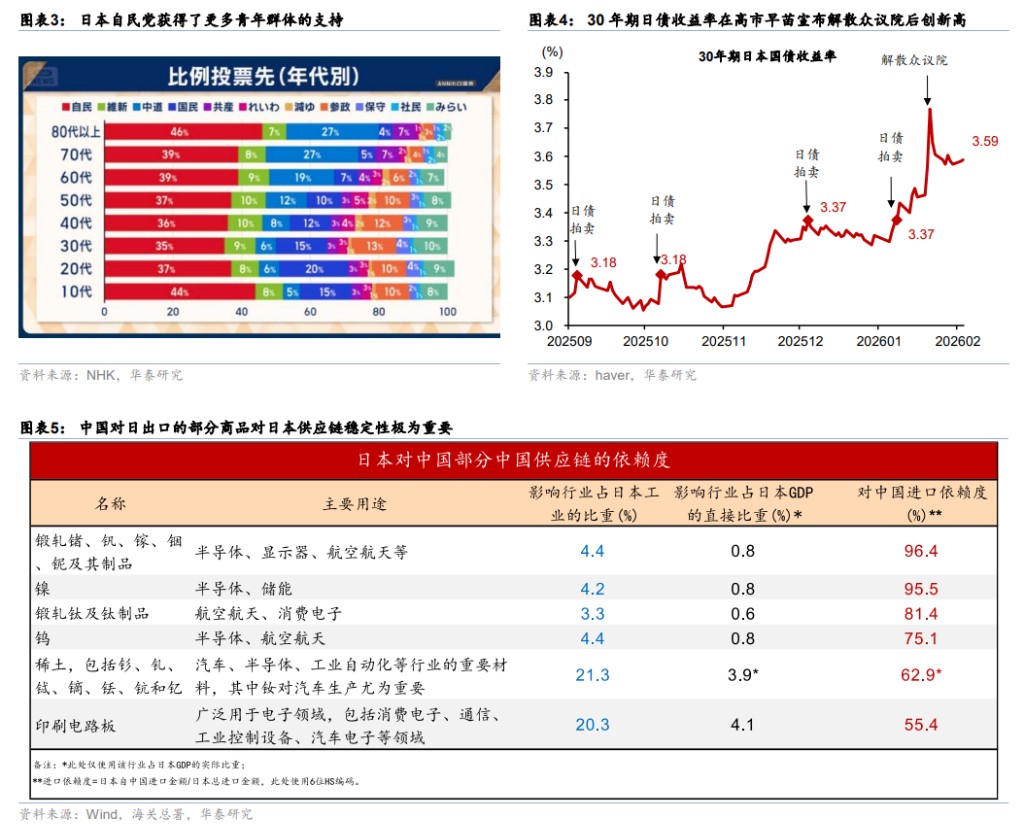
Sanae Takaichi's strong style and radical political proposals were key to the LDP's rapid "turnaround," reflecting the mindset of Japanese voters seeking change in a "K-shaped society," and also indicating Takaichi's potentially radical governing style. Her high support rate among younger voters under 30, who have lighter social responsibilities, also shows a decline in political "stability" in Japan. In just four months after being elected Prime Minister, Takaichi successfully converted her personal approval ratings into support for the LDP, enabling the party to achieve a "turnaround" in the House of Representatives election held just over a year apart—from approximately 40% of the seats to over two-thirds. Furthermore, as social contradictions in Japan intensify, voters are more inclined to support Takaichi, who comes from a common background (rather than traditional political families) and holds radical positions, suggesting that the overall orientation of Takaichi's cabinet may also lean towards radicalism. In the short four months since Takaichi took office, her strong political image and straightforward communication style have attracted a large number of voters, aligning with the overall trend of political leaders' style changes in the context of global political "populism." Takaichi's personal approval rating remains high at 70%, with support among young people (under 30) exceeding 90%, mirroring the public support base of the Mayor of New York City, indicating a decline in political stability and a desire for change among the populace The "return" of young voters in Japan and the rise of nationalist sentiments are also key factors in the Liberal Democratic Party's (LDP) recent "victory." As a center-right political party, the LDP has traditionally been favored by the older demographic in Japan, but the voting structure this time shows a significant increase in support for the LDP among young people, reflecting a trend of rightward shift among Japan's youth under socio-economic changes. According to a survey by Kyodo News, the support rate for the LDP among voters aged 18-59 increased by 8.7 percentage points to 36.6% compared to the last House of Representatives election, with support among those in their 20s rising by 13.2 percentage points to 33.1%. Additionally, the recent rise in Japanese nationalism has also boosted voter support for Sanae Takaichi and the LDP.
(2) The LDP may double down on Japan's current policy orientation of fiscal and monetary easing
After securing two-thirds of the seats in the House of Representatives, the Takaichi cabinet's policy implementation is expected to proceed more smoothly, with both fiscal and monetary policies leaning towards easing. Although the current ruling coalition remains a minority in the House of Councillors, controlling two-thirds of the seats allows the LDP to forcibly pass bills that were previously rejected by the House of Councillors, meaning the LDP will have complete control over the Diet, significantly reducing resistance to policy implementation.
The Takaichi cabinet may continue to promote fiscal expansion policies, increasing defense spending on the expenditure side and expanding support for industrial policies, while on the revenue side, it may push to reduce the food consumption tax within the next two years. Overall, the Takaichi cabinet's fiscal policy is inclined towards expanding domestic demand. Based on past assertions from Sanae Takaichi and the LDP, priority areas for increased spending mainly include defense and subsidies for industries such as semiconductors; tax reduction measures are aimed at alleviating the impact of high inflation on Japanese residents by lowering the food consumption tax. These policies are expected to boost Japan's nominal economic growth in the short term but may increase potential inflationary pressures and fail to address the K-shaped social divide and insufficient economic growth momentum in Japan. Specifically:
Fiscal easing will be further intensified, and on the expenditure side, Japan may continue to expand defense spending. Sanae Takaichi has clearly stated that the defense spending as a percentage of GDP will be raised to 2% by fiscal year 2025, two years ahead of the previous plan, and the Takaichi cabinet is preparing to revise three security-related documents this year, including the "National Security Strategy." The "National Security Strategy" specifies that Japan's cumulative defense spending will increase to 43 trillion yen over the five years ending in fiscal year 2027. Amending this bill suggests that Japan's fiscal spending as a percentage of GDP may further increase, potentially reaching 3%, a 50% increase from the 2% planned for 2025.
Regarding tax reduction, the Takaichi cabinet may promote the reduction of the food consumption tax within two years to alleviate the impact of inflation on residents. Sanae Takaichi has repeatedly mentioned plans to reduce the food consumption tax rate from the current 8% to 0% within two years, equivalent to a fiscal expansion of 0.8 percentage points of GDP. Considering the rising populist sentiments in Japan, it may be difficult to restore the food consumption tax after two years, and the temporary tax exemption measures may become permanent, exacerbating the pressure on Japan's fiscal sustainability Due to Kishi Sanae's resistance to interest rate hikes, monetary policy is likely to remain accommodative, which may cause the Bank of Japan to fall further behind the interest rate curve. In October 2025, after being elected president of the Liberal Democratic Party of Japan, Kishi Sanae stated, "It is still too early to think about exiting deflation," and "The government must be responsible for monetary policy," indicating her dovish stance on monetary policy; Kishi Sanae also explicitly opposed interest rate hikes during the 2024 LDP presidential election campaign.
The diplomatic concepts of "Japan First" and "Make Japan Great Again" may be further strengthened. With the increasingly solid position of the right-leaning Kishi Sanae and the LDP in Japanese politics, Japan may attempt to break through in areas such as military expansion, constitutional revision, and even nuclear issues, leading to potentially more uncertain relations between Japan and neighboring countries, as well as with Europe.
(3) Policy Constraints and Concerns under Supermajority
Although the short-term "victory" of the LDP has reduced resistance to continuing the enhanced version of "Abenomics" domestically, in the medium to long term, Japanese bond yields, supply "shocks," and income distribution "K-shaped" trends may ultimately constrain Kishi's cabinet policies. After the LDP secured two-thirds of the seats in the House of Representatives, the implementation of Kishi's cabinet policies will be smoother, but concerns about fiscal sustainability may lead to upward risks in long-term Japanese bonds, and the vulnerability of Japan's supply chain could constrain Kishi's domestic and foreign policies.
With the LDP controlling the Diet, the implementation of Kishi's enhanced version of "Abenomics" will be smoother. However, market volatility may ultimately constrain fiscal expansion. For example, on January 19, Kishi Sanae announced during her campaign that she would promote a reduction in the food consumption tax, causing the 30-year Japanese bond yield to rise by 31 basis points to 3.77% within just two trading days, prompting the Japanese government to step in to calm the market. Looking ahead, if the government continues to push for large-scale fiscal expansion or disrupts existing fiscal order, it may increase market volatility and even negatively spill over to overseas markets, including U.S. bonds, potentially becoming the ultimate constraint on Japan's fiscal expansion.
Adjustments in foreign policy bring uncertainty and may face constraints—Japan's supply chain resilience may face challenges, and "Japan First" diplomacy and defense policies may provoke resistance from neighboring countries in the Asia-Pacific region and even other countries globally. Japan may exhibit greater uncertainty in its foreign policy; however, the vulnerability of key raw material (such as rare earths) supply chains constrains Japan. If geopolitical friction escalates and leads to supply disruptions, it will objectively limit its foreign policy from taking extreme directions. On January 6, the Chinese Ministry of Commerce announced strengthened export controls on Japan, raising concerns about the stability of Japan's supply chain in the following 1-2 quarters.
The policy tension between Japan and the U.S. may be in the Asia-Pacific region. U.S. Treasury Secretary Janet Yellen stated after the LDP's "victory," "Japan's strengthened capabilities will enhance U.S.-Japan strategic coordination in the Asia-Pacific region and help consolidate U.S. overall influence in Asia." With the LDP's significant victory in the House of Representatives, cooperation between Japan and the U.S. on certain regional issues may strengthen, making trade frictions between Japan and neighboring countries more likely to be amplified The "Japan First" policy tendency in the high market is an important example of the rapid expansion of global fiscal expansion, defense, and re-industrialization spending, reaffirming that the "consumption volume" of global capital expenditure may significantly rise in 2026. Against the backdrop of political polarization, Japan is expected to implement fiscal expansion policies in sync with major economies such as the US and Europe, and this round of fiscal expansion will be more focused on defense autonomy and supply chain security, which will correspondingly lead to a noticeable increase in consumption volume.
The Liberal Democratic Party's "great victory" corroborates and may strengthen the internal differentiation and tension within Japanese society under the K-shaped structure, raising concerns in the medium to long term. The high inflation since the pandemic has "eroded" the purchasing power of Japan's middle and low-income groups; for example, in 2025, Japan's residents' real income is expected to show negative growth year-on-year. In recent years, the overall depreciation of the yen has raised the import costs for small and medium-sized enterprises, while large enterprises have benefited relatively: large enterprises have high overseas revenue, with overseas revenue accounting for about 50% of TOPIX constituent stocks in 2024, while the overseas revenue ratio for TOPIX small stocks is only 22%; Japanese large enterprises have more complete production reserves and supply chains, and their ability to respond to supply chain risks is stronger than that of small and medium-sized enterprises. For instance, against the backdrop of rising uncertainties in the supply chain to China, Japanese large enterprises can more easily navigate export compliance approval processes due to their more robust compliance systems and communication coordination capabilities, while small and medium-sized enterprises, constrained by manpower and budget, often find it difficult to absorb the costs associated with these processes, which may put significant pressure on their supply chains. The K-shaped differentiation in Japanese society may further exacerbate populist sentiments, and on the other hand, it may force the government to formulate more polarized policies to cater to specific groups, creating feedback—this will become a long-term hidden danger to the stability of Japanese policies.
(4) The Liberal Democratic Party's victory is a short-term boon for the Japanese market, but medium to long-term volatility is expected to rise
The Liberal Democratic Party's victory may temporarily make the sentiment in the Japanese stock market more "excited," while suppressing the yen and Japanese bond prices—however, the yen is close to the intervention point, and the space for further depreciation is limited, but the volatility brought about by exchange rate intervention is expected to rise. In the short term, the decrease in internal political uncertainty under the high market government, combined with the dual easing of fiscal and monetary policies, will provide temporary support for the valuation of Japanese risk assets, but at the same time amplify market concerns about the yen's exchange rate and Japan's fiscal sustainability. Japanese bonds may weaken, but expectations of exchange rate intervention may constrain the depreciation space of the yen: on January 23, the joint "interest rate check" signal from the US and Japan had previously driven the yen to appreciate rapidly in the short term, and on the morning of February 9, Japan's top official responsible for foreign exchange affairs stated after the Liberal Democratic Party's victory that the government is highly concerned about exchange rate trends. If the yen breaks through key levels (such as 160 yen/USD), the probability of substantial intervention by Japanese authorities in the foreign exchange market will increase. Considering the yen's exchange rate intervention and the upward risk of Japanese bond yields, it is expected that the volatility of Japanese stocks may increase subsequently.
 Risk Warning and Disclaimer
The market has risks, and investment should be cautious. This article does not constitute personal investment advice and does not take into account the specific investment goals, financial situation, or needs of individual users. Users should consider whether any opinions, views, or conclusions in this article align with their specific circumstances. Investment based on this is at one's own risk
