


Ray Dalio's latest in-depth interview: The United States is on the brink of order collapse and civil war, and gold is the only safe haven ark

Bridgewater's Ray Dalio issues a major warning: the United States is deeply entrenched in the "fifth stage," on the brink of order collapse and civil war. Amid debt imbalance and political polarization, gold has become the only "non-debt liability" safe haven, and should constitute 5%-15% of investment portfolios. Dalio suggests addressing fiat currency devaluation and the impending turbulent cycle through diversified allocation and choosing stable places to live
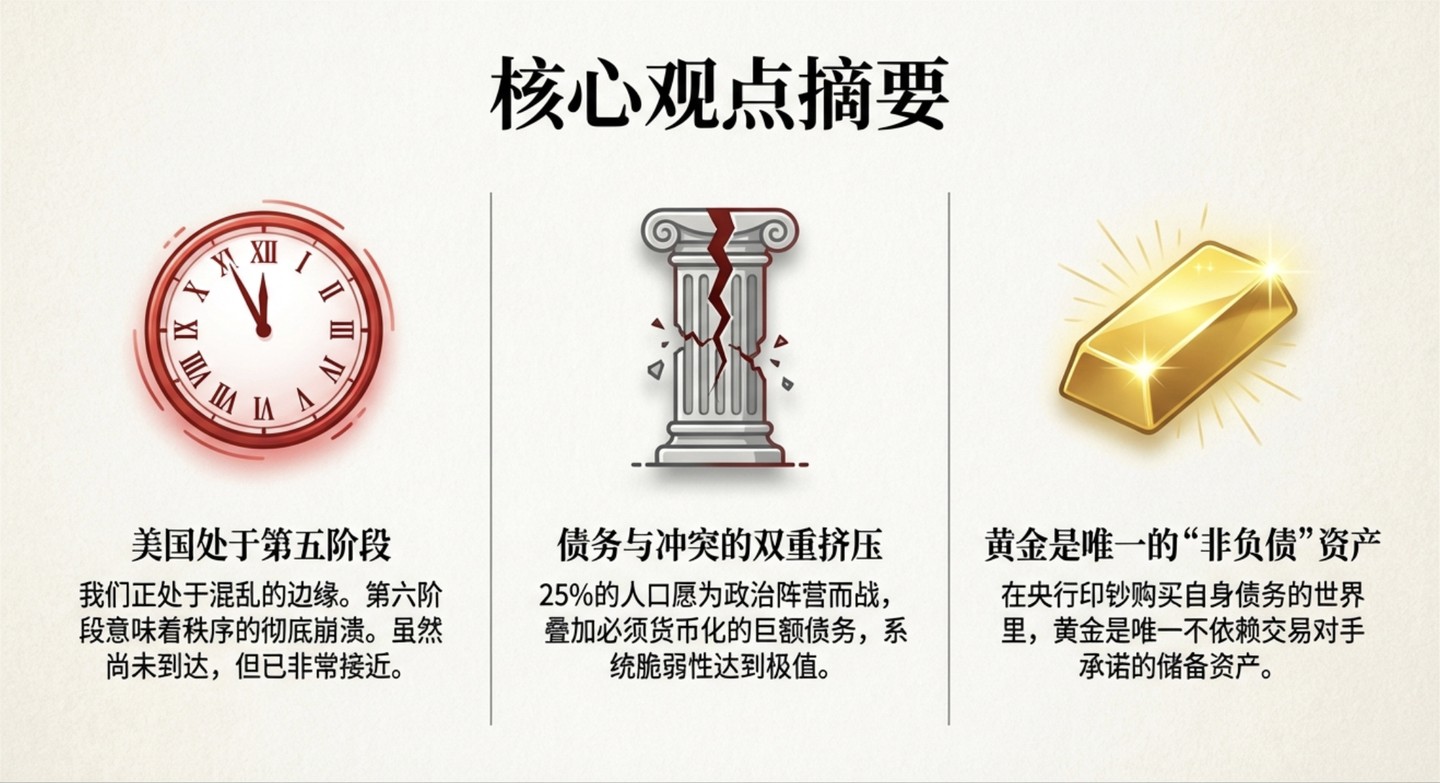
Ray Dalio, the founder of the world's largest hedge fund Bridgewater, warned that the United States is in the "fifth stage" of the great cycle of empire rise and fall, which is the eve of order collapse and conflict outbreak.
He bluntly stated that under the current debt and political turmoil, gold is the only asset that is "not someone else's liability." He also suggested ordinary people consider survival strategies such as saving, allocating gold, and choosing where to live.
On February 10, Ray Dalio, the founder of Bridgewater, gave an in-depth interview to Tucker Carlson in Dubai, UAE. Based on his decades of macro investment experience and historical cycle research, Dalio elaborated on the historical position of the United States, the evolution logic of the debt crisis, and the response strategies for investors.
Dalio pointed out that the world is influenced by five major forces: monetary/credit cycles, domestic political order, geopolitical order, natural forces, and technological changes. He believes that the United States is currently in the fifth stage of his defined "six-stage cycle"—a period of extreme polarization and debt imbalance, on the edge but not yet fully collapsed.
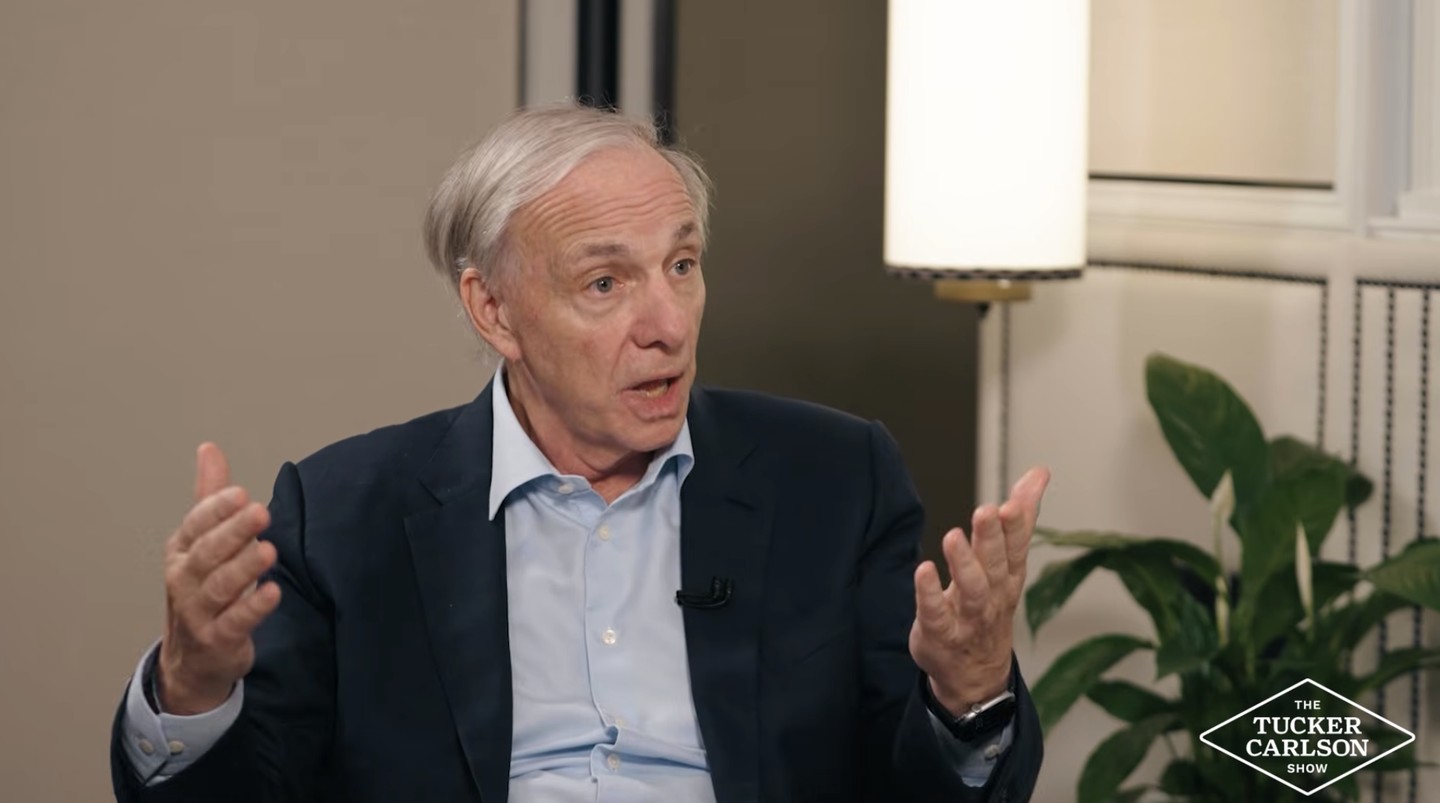
In the "Fifth Stage": Just One Step Away from Order Collapse
The market is highly concerned about whether the current macro environment in the United States is sustainable. In this regard, Dalio gave a pessimistic outlook. He divides the national rise and fall cycle into six stages, and the United States is currently in the fifth stage.
Dalio stated in the interview:
"We are in what I call the fifth stage, which means we are on the edge but have not yet crossed over the edge... The sixth stage is when these orders collapse. We are not there yet, but we are very close and moving in that direction."
The typical characteristics of this stage are huge wealth gaps and differences in values leading to domestic political polarization, the rise of populism, and the disappearance of willingness to compromise. Dalio cited polling data to highlight the severity of the risks:
" About 25% of the population says they would fight violently for their camp. That is a quite significant proportion."
He warned that when people are no longer willing to abide by the system's rules and choose to "win at all costs," democratic regimes will face the risk of transforming into authoritarianism.
Debt Trap and Currency Devaluation: History is Rhyming
When discussing what the "currency collapse" of the sixth stage looks like, Dalio pointed the core contradiction towards the supply and demand relationship of reserve currency debt:
"From a monetary perspective, that is... the demand for reserve currency is insufficient to meet the supply. You generate a large supply, but the demand is lacking. All else being equal, long-term interest rates will rise..." He further described a chain that the market is more familiar with: Insufficient demand pushes up long-term interest rates → Central banks attempt to suppress rates and shorten bond issuance periods → Central banks buy bonds and expand their balance sheets → Currency depreciates relative to gold and other non-sovereign currencies.
When Carlson pressed the question of whether "central banks printing more money to buy their own debt" is absurd, Dalio's response was:
"The government is in a bind because it has a deficit, and unless it raises taxes, cuts spending, or takes other measures, the deficit will persist. But that is detrimental to the economy and politically unfeasible... Or you print money to cover the gap."
He also recalled the historical memory of the dollar's decoupling from gold in 1971, believing that the "machine" has operated in a similar manner repeatedly over the past few decades, leading to stagflation-like side effects:
"Since we left the gold standard in 1971 and entered a fiat currency system, we have been doing this... I found that the government did exactly the same thing in March 1933... Then the country experienced stagflation in the 1970s."
Asset Allocation Strategy: Gold Should Account for 5%-15% of the Portfolio
In terms of asset allocation, which is of utmost concern to investors, Dalio once again emphasized gold as a "currency" rather than merely a speculative commodity. He pointed out that during periods of excessive debt and currency depreciation, wealth and money are two distinct concepts, and liquidity is crucial in times of crisis.
Dalio provided clear allocation advice during the interview:
"If I have no opinion on gold, how much gold should I have in my portfolio? ... For individuals, it depends on their portfolio composition, it could be 5% to 15% of the portfolio."
He explained the underlying logic of being bullish on gold with impactful words:
"Apart from gold, there is no currency you want as a reserve currency in the world. It is merely a default choice because it is debt, while gold is not... As they say, it is the only asset you own that is not someone else's liability, meaning you do not have to rely on others to obtain it (to fulfill payment commitments)."
He believes that investors often view the world through the "lens" of the dollar, seeing rising gold prices; but if viewed through the "lens" of gold, what is seen is the depreciation of fiat currencies.
How Ordinary People Can Cope with Turmoil: Diversification and Choosing Stable Places to Live
In the face of potential turmoil (whether or not civil war or severe social conflict occurs), Dalio offered some practical advice for ordinary people and investors:
-
Financial Discipline: Earn more than you spend, try to save.
-
Investment Diversification: Including consideration of currency attributes (allocating gold).
-
Choosing Where to Live: Dalio observed that capital and population are migrating from high-tax, high-conflict areas to stable and vibrant places. "Domestically, it's Texas and Florida... Globally, people are moving to stable and opportunity-rich places."
Dalio concluded by stating that while the U.S. is in the fifth stage, this is not an inevitable fate, but it requires strong leadership and high political wisdom to address the debt issue and bridge social divides, which is a "huge challenge" in the current environment Abstract:
Ray Dalio, founder of Bridgewater Associates, issued a warning in a recent interview, stating that the United States has entered the "fifth stage" of the great cycle of imperial rise and fall, characterized by extreme political polarization and debt imbalance, just one step away from the "sixth stage" of order collapse. He emphasized that the U.S. faces severe debt supply and demand issues, and that central bank money printing to address deficits will lead to currency devaluation. For investors, Dalio explicitly recommends allocating 5%-15% of their portfolios to gold, calling gold the "only asset that is not someone else's liability." He urged investors to pay attention to the distinction between "wealth" and "money," and to hedge against potential social unrest and geopolitical risks through asset diversification and choosing stable places to live.
Full Translation of Dalio's Interview:
Tucker Carlson
Thank you very much, Dalio. We spoke here last year, and you broadly described what you see as a kind of cycle of civilizations vying for dominance. I think not everyone fully accepts your views on this. You’ve been mocked for, you know, scaring people like Jeremiah and so on.
Tucker Carlson
A year later, you released a long-awaited summary of new thoughts this week, and about 18 people sent it to me. So I think we’ve reached a moment when people are ready to hear your perspective. If you don’t mind, please elaborate on the cyclical nature of nations as you see it, and where our country—the United States—currently stands in that cycle.
Ray Dalio
Happy to. There is indeed a cycle. There are various orders and systems, right? First is the monetary order. How does the economy work? You put in money, create credit. Those who have credit obtain credit and act on it. If they can earn enough money to pay it back, they will borrow. The system works well. They create productivity, create opportunities, form capital markets, and so on.
Ray Dalio
This is the monetary system, and the way it operates in the cycle is: when there is no debt—like in 1945—we start a new monetary order, with no debt, and a system that will gradually build up over time. There is a mechanism in place: when income rises compared to debt repayment expenses, the repayment expenses rise, which squeezes other expenditures, both for individuals and for companies, although the government can print money, but that still squeezes expenditures and becomes a problem. There is also a supply and demand issue. When you have a new monetary system—at that time, the U.S. had a new monetary system, with the dollar as the world reserve currency—then you can sell more debt. So there is supply and demand, right? Therefore, as debt continues to accumulate—one person's debt is another person's asset—people accumulate a lot of debt and assets denominated in dollars, and then when they sell more debt, a supply and demand mechanism arises. Then, when domestic politics and world politics, geopolitical issues intervene, for these reasons, the monetary system faces greater risks. We will discuss this later
Ray Dalio
But the first of these five forces is the mechanism of this process, which is the monetary system. The second is the domestic political order. Every country has an order, a system, and all these orders change and evolve. Of course, this is associated with the economic system. Therefore, when there are huge disparities in wealth and values, and people feel that this system is unfavorable to them, leading to increased polarization, populism emerges, just like in the 1930s, you know, the left and the right. This populism can develop to the point where there are irreconcilable differences between the two sides. In other words, there is a lack of willingness to compromise, a lack of willingness to accept defeat—such as electoral defeat. Instead, there is a willingness to fight and win at all costs for one's side, just like in the 1930s. Democratic regimes can turn into authoritarian regimes because the polarization is too severe, and the willingness of people to follow the will of the democratic system no longer exists. This dynamic has occurred repeatedly throughout history.
Ray Dalio
The third is the geopolitical order, which refers to how countries operate relative to each other and what the system is. After World War II, we created a system, a multilateral system, which in some ways was somewhat naive, but very different from the previous systems. It made decisions based on representation within a rules-based system through multilateralism, having the United Nations, the World Trade Organization, the World Health Organization, the International Court of Justice, and so on. Of course, the problem is that any system must have its enforcement power. If the entire system, that is, the multilateral system, is not aligned with the interests of the most powerful, then, you know, power speaks.
Ray Dalio
So you see this dynamic of order breaking down, right? Therefore, we are breaking the monetary order in a very classic way. We are breaking the political order in a very classic way. We are breaking the geopolitical order. So we must recognize that throughout history, all these orders have changed. There has never been a time when they did not change or collapse under their problems, and in some ways, they are returning to a past state. The fourth is natural behavior: droughts, floods, and... pandemics kill more people than wars, so their enormous impact cannot be ignored. The fifth is the invention of new technologies. In particular, you know, wonderful new technologies emerge that are not only important for prosperity but also for war. You know, whoever wins the technological war also wins the economic and geopolitical war, right? So there is this dynamic. This dynamic is manifested when emerging powers challenge existing powers, with no courts to appeal to and no resolution path. There is a test of these forces. We are currently in a power-type dynamic. When you understand how this dynamic operates over time and delve into its specific symptoms—in other words, in the book I wrote about five years ago, "Principles for Dealing with the Changing World Order," I divided this cycle into five parts (actually six parts). Then, like a disease, you can see the symptoms of each part, see its progression, and see the choices that exist at those stages. Therefore, when you are at different stages, the leadership is also at different stages. I just want to try to help people see this, whether in that book or in our conversation today I'm just a pragmatic investor, right? I've been investing for 60 years. I've always been a macro investor. So I have to bet on what the future will look like. I make financial bets on this, and now I've reached a stage in my life where I want to pass this on. So... I hope we can calmly discuss or examine how this machine operates to create this dynamic? That's it.
Tucker Carlson
Absolutely right. You're not making a judgment. You're just acknowledging the facts, right? What has happened, and therefore what might happen. Because, looking back... I don't want to let the second factor you mentioned—the political factor—just pass by. You referred back to the challenging 1930s, where you said four democratic countries became ungovernable due to partisan strife and reverted to authoritarian regimes. They couldn't reconcile, so they turned authoritarian. Do you think this is a universally applicable rule?
Ray Dalio
You can look at it through the lens of Rome. It's about who is in control, right? Yes, you know, Caesar was in the Senate, standing right there in the Senate. Plato wrote about this. I think around 350 BC, he wrote about this cycle in "The Republic." In other words, democratic countries and their challenges, like voting, etc. But then there are wealth gaps and income disparities, and then who has the money, and then they are unwilling to vote. Then power... shifts. Yes.
Tucker Carlson
So partisan strife turns into a deadlock, becomes irreconcilable, and chaotic. Then, this inevitably evolves into authoritarianism.
Ray Dalio
Right? When... when I am no longer willing to accept the rules of this system because everyone thinks it is manipulated. Well. Is the Supreme Court like that? Is it manipulated because one party has more appointed judges, thus becoming unfair? I remember a time when the Supreme Court was just the Supreme Court, and we lived in an era where we said the system was fair. The legal system was like that too, when you went to court and were convicted, well, the legal system was fair, etc. Then you believed in that system, despite its flaws, etc. When that is no longer the case, when the causes people support become more important to them than the system itself, the system becomes dangerous.
Tucker Carlson
Right? Yes, of course, by definition it is. You know, all of this relates to where we are now. So tribalism, whether political or ethnic, but when people split into different tribes, they have no common ground, no hope for reconciliation or compromise, then you are about to usher in a new system.
Ray Dalio
You see, this is very interesting. It's like watching a movie repeatedly because you see how they stereotype each other, right? Stereotypes about this type of person, stereotypes about that type, whether it's racial, economic, or something else. "Oh, they are that kind of person, I am this kind of person." Now it has become a struggle between stereotypes, right.
Tucker Carlson
This stereotype is dehumanizing, right? So it makes it easier to fight.
Ray Dalio
There’s no empathy. Of course, there’s...
Tucker Carlson
The other side is not seen as human. That’s serious...
Ray Dalio
A struggle, right? And then you have to pick a side, huh? I mean, you have to choose one of three things: pick a side and fight for it, or keep a low profile and hope not to get caught up, or flee. Historically, that’s how it is. But we’re quite confident.
Tucker Carlson
So did you actually join the civil war? Were you trying to find a safe place domestically, or did you just split?
Ray Dalio
In other words, you stay silent because you don’t want to get involved in the fight. You might get hurt, right? A lot of people are feeling scared right now, right? Some people you can imagine writing to us, they never thought they would feel scared, right? They don’t want to speak out or do anything. So you keep a low profile. You either join the fight, pick a side and fight for it; historically, that’s a fact. Or you pick a side and fight for it, or you keep a low profile, or in some cases, flee. You know, people leave. They do so through immigration... think about the circumstances under which immigration mainly happens, right? Some bad things happen there, and then they move to places where those things don’t happen. We’re in the UAE now. Well, a lot of people come to the UAE, in a sense they are fleeing. So there’s that dynamic. So you can see many symptoms. For example, some things, you know, when it gets violent, when... too many people are killed, you start crossing lines, you know, like possibly in Iran, okay, have we crossed the line? And then yes, and there, you know, there are these symptoms, and there are financial aspects, you know, how to pay and so on.
Tucker Carlson
Really. I just... but back to the political side, the last question is: is there a time when this situation can be resolved? When people don’t want to compromise at all, or even live in the same place, can this system remain intact? Have you seen any examples where people would say, "Wait, let’s get into power-sharing before things get violent or a king emerges"?
Ray Dalio
In some places, sometimes during dynasties and so on, there have been, but it’s not common. What happens is that it requires a strong enough person who can handle the issues to reverse or fix it. For example, we have a debt problem, and we have all these other issues, and that person can unite people. But it almost requires what Plato called a "benevolent dictator." Yes, like that. It’s in his cycle. In other words, it requires someone who can stop the fighting and is wise enough to impose the necessary discipline. For example, financial discipline. How do we handle debt? And all the supply and demand issues, can we raise taxes? Can we cut spending? What are we going to do to achieve budget balance? Or not budget balance, say a deficit of 3% of GDP, which might sustain a range of situations. What is that financial discipline? What kind of cooperation can allow us not to harm each other? Because we are at a juncture, for example, as we approach the next midterm elections, you know, the Republican Party has a high likelihood of losing the House of Representatives, and possibly the Senate as well. Well. Now, when you imagine the situation afterward and the potential conflicts that may arise, how will those conflicts operate? Will it be rule of law, or will it be win at all costs? When that win-at-all-costs situation arises, does that mean there are rules? Are the rules being followed? You know, it's that kind of dynamic. So, these things will replay. Achieving that state is not easy because you have to deal with, you know, how do we stop fighting each other, and how do we do the right thing to become strong? That's a huge challenge. So...
Tucker Carlson
Given the five factors you outlined, where is the United States, and even the entire West (including Europe), in the very familiar cycle of "rise and fall" that you described?
Ray Dalio
In my book, I show 18 indicators that measure health, covering various aspects such as education, military, reserve currency, etc., which indicate strength. Well. What is the level of strength? The United States is the strongest power, but it has been in relative decline and is experiencing these conflicts.
Ray Dalio
If you look at the book "Principles for Dealing with the Changing World Order," you will see some charts that quantify this. So I don't want to just announce it verbally. I just want to say that if you look at education, test scores, and other statistics, you will see the existence of rising powers, declining powers, and significant wealth and value differences. We are in what I call the fifth stage, which means we are on the edge but have not yet crossed over. In other words, we have not... oh, there is still the capability... this is before a period of large-scale disorder, at which point a collapse of the monetary system may occur. You know, what is money? We should take time to talk about that. What is money? Can money effectively store wealth? If it can't, what will happen? So we are in the fifth stage of what I call the six-stage cycle. The sixth stage is when these orders collapse. We are not there yet, but we are very close and moving in that direction.
Tucker Carlson
What does collapse look like? What does the sixth stage look like?
Ray Dalio
From a monetary perspective, that is... the demand for reserve currency is insufficient to meet the supply. This means you see a supply and demand issue. You generate a large supply, but the demand is lacking. All else being equal, long-term interest rates will rise, while central banks try to suppress the rise in long-term rates by lowering short-term rates and operating by shortening the maturity of debt sales, well, it's that dynamic. Then, relative to non-fiat currencies, such as gold, the debts and currencies priced in that currency will depreciate. In other words, you see central banks and countries holding gold as an alternative reserve currency, partly due to that supply and demand situation, and partly because they are concerned about potential payment issues. Payment issues, like what Japan experienced before World War II, when Japan had economic problems. The U.S. imposed sanctions and essentially did not pay Japan's debts—that was a creditor/debtor issue—they did not make those payments, very similar to the situation with Russia You know, they basically control it because they have the ability to control government bonds and so on. Therefore, the willingness to hold that kind of currency decreases, and more turns towards non-fiat currency, which I think is gold. That is to say, right?
Tucker Carlson
Other countries see risks in holding dollars for many reasons, but one of them is: if the U.S. government doesn't like you at the time, they can seize your dollars. That's how it is. So it's not worth it. Right. And…
Ray Dalio
This is the risk faced by debtors and creditors. You might feel insecure about holding government bonds for two reasons: you might be sanctioned, or there are supply and demand issues. So you start to see movements in that direction. Of course, in this case, the government also wants to control its own supply and demand. So they might establish foreign exchange controls, they might do something similar. But they also feel vulnerable. If the U.S. cannot sell enough bonds to others, if demand is insufficient, then the U.S. will also feel vulnerable because interest rates will have to rise to balance supply and demand, with supply being too much relative to demand.
Tucker Carlson
To make bonds more attractive to buyers.
Ray Dalio
Yes. And, but at the same time, also to cut credit demand. In other words, if prices (interest rates) rise, then people will reduce borrowing and so on. This will mechanically slow down the economy, leading to that result. Then what happens is that the central bank intervenes, prints money, and buys debt, which will devalue the currency. This is the mechanism of the debt part, which is linked to the political and geopolitical part. That answer... I can.
Tucker Carlson
You assess for yourself: if foreign countries do not want to buy your debt, and your central bank decides we want to print more money and use it to buy our own debt (which is exactly what we are doing), shouldn't the people doing this stop and think? "Wait, this sounds like a windmill. What are we doing? It sounds too crazy."
Ray Dalio
They are in a bind because they have deficits, and unless they raise taxes and cut spending or take other measures, the deficit will exist. But that is detrimental to the economy and politically unfeasible.
Ray Dalio
Yes. Well. Or you print money to make up the difference. Therefore, since the collapse of the monetary system in 1971—when there was too much demand for gold, and we had a system linked to gold—because on August 15, 1971, I remember very clearly, I had just graduated from college and was working at the New York Stock Exchange before going to graduate school. But Richard Nixon went on television on the evening of August 15 (Sunday) and said, we will no longer allow that kind of paper currency to be exchanged for gold, you will not get your gold. The next morning I walked into the trading floor of the stock exchange, and I thought, this is a major crisis. What they essentially did was print money, and then we experienced stagflation in the 1970s. But I was very surprised, I found that I had never experienced anything like this, so I started studying history. I found that they did exactly the same thing in March 1933 Franklin D. Roosevelt did exactly the same thing in March 1933.
Tucker Carlson
Right after he took office, right?
Ray Dalio
Yes, for the same reason, well, because your choices are to let a lot of defaults and debt issues happen, or to resort to printing money. Right? That's how it works, that's how the machine operates. So, ultimately, since we left the gold standard in 1971 and entered the fiat currency system, we've been doing it this way. You know, the Federal Reserve also... you know, that's how it is.
Tucker Carlson
So, and it works to some extent.
Ray Dalio
For 55 years, but it shows signs... well, it acts like...
Tucker Carlson
It acts like what? A hangover remedy? Yes, I'm familiar with that. Well. Yes, indeed. It...
Ray Dalio
What you do is provide more money and credit. What happens is, to get out of the predicament, because that makes it easier to repay debt, you create... yes, just like in 2008 or 2020. You give money. Well. You provide credit, you provide funding, you facilitate all that, but that also causes debt to rise again, right? Until you reach the critical point of debt squeeze spending, and supply-demand issues arise. That's why these big debt cycles exist. You know.
Tucker Carlson
So I think that even for those who are not interested in monetary policy or macroeconomics, they will feel that at some point this approach will no longer be effective. It will just collapse.
Ray Dalio
It has been happening, and... so...
Tucker Carlson
What does that look like specifically? People have been talking about a debt crisis.
Ray Dalio
Well, I... that's why my recently published book—about less than a year ago—is called "How Countries Go Broke" (originally should be "Principles: Life and Work," this may refer to another book or a slip of the tongue). Yes, the big cycle. What I wanted to do was just show 35 cases. That just shows the mechanics of how it works.
Ray Dalio
Well. But it's that kind of spending squeeze and supply-demand dynamic, and then you start to see, as I said, long-term interest rates rising while short-term rates fall because central banks are keeping short-term rates low, and then they shorten the debt maturities, and then the central banks buy that debt. Then the central banks now hold all this government debt, and then the central banks start to incur losses because they hold government bonds and... then interest rates rise. So they have to create money and credit to keep interest rates from rising, they incur more and more losses, and that dynamic cannot stop the changes in capital flows.
Ray Dalio
That's why you... and in all traditional cases, you will see a shift towards hard currency—towards gold— right? As we see, you see that dynamic of shifting towards gold, and then it starts to take on a life of its own So this is very much like... think about what happened from '71 to the entire 70s that led to more stagflation. Then at some point, the inflation problem or currency devaluation problem became so severe that the central bank had to tighten monetary policy, right? And so on. Just like during the Volcker era, 1979, 80, 81, 82, right? So the pendulum swings back and forth. Think of it this way: to maintain balance, to have a successful economy and a successful capital market, since one person's debt is another person's asset, you have to keep interest rates neither too high—so as not to crush debtors—nor too low—so as not to disadvantage creditors, right? So you see these cycles: when we have zero interest rates and negative real interest rates, what you see is massive creation of credit and money and borrowing, and so on. Then you have that cycle. That's what that cycle looks like.
Ray Dalio
If you have losses... and in this case, classically, there will also be a weakening of central bank control... or I should say a strengthening of central government control over the central bank. In other words, when these things happen, there can't be a divergence between them. Well. So the central government will have greater control over this. You are writing...
Tucker Carlson
News?
Ray Dalio
No, I just watched that movie.
Tucker Carlson
This...
Ray Dalio
Is exactly what is happening.
Tucker Carlson
I know, but that's what I'm saying. Because it will inevitably happen in that dynamic nature when you imagine... the struggle between the central bank and the central government during a crisis and so on. So there is this control because there is currency...
Tucker Carlson
It has to be there.
Ray Dalio
Right? If you are the President of the United States or the leader of that country, and you are in this currency crisis, what happens? It's like any struggle. You don't want internal strife. You want to gain control, so there is a struggle for control. So we live in a world today where there is a struggle for control, right? Who has the power and the struggle for control.
Tucker Carlson
So again, at what point will we know that this system has collapsed? This experiment started after World War II in 1945, and now it has come to an end, and we need something new?
Ray Dalio
It can only be determined in hindsight. If you... I mean, if you really look closely, you say, when did they know a collapse was happening? Or when did they know, for example, that the French Revolution had broken out? Was there a day they said it was...
Tucker Carlson
The day the Bastille was stormed.
Ray Dalio
Right? It was that day. And they said... they didn't know before that. No, they didn't know.
Tucker Carlson
Like some prison being stormed or something. They
Ray Dalio
I don't know. Yes, that's right. Well, it's not as clear-cut as they announced, or as clear and obvious, right? You gradually slide into those things; there's never a clear moment. But...
Tucker Carlson
I asked you privately last year, and I will never forget it. I've always been a gold buyer, but I actually don't understand it. I just instinctively feel it makes sense. But I've always felt a bit embarrassed. So I asked you, is it crazy to take some money and buy gold? You said it's not crazy at all. I remember feeling validated at the time, but also wondering why more people aren't saying this? It almost feels like there's a conspiracy in the financial world.
Ray Dalio
It's not just about gold; it's true for everything. I think people are accustomed to it. For them, what is credible is their experience and the norms of their time. So many people see what's happening...
Ray Dalio
I hear people say they're shocked by... but the only reason they're shocked is that they're used to the previous situation, right? If you travel back in time, before 1971, etc., you see history, you see the universality of currency and gold, and how the whole system has operated time and again over time, you would understand that dynamic is happening. But people misunderstand. They think of it as a speculative metal. Right. They don't realize it's actually a form of currency. Okay? Central banks... it's the second-largest currency (holding asset).
Ray Dalio
So when you... it's almost like when you look at the world through that currency (gold), you can see the cost of things through that lens. Absolutely correct. And people instead look through the lens of the dollar, and they see gold going up. Okay.
Tucker Carlson
But, so you...
Ray Dalio
Can... if you can look at the world through the lens of gold, okay, and then see currency devaluation, okay? So what I want to say is that because of their experience, it seems unbelievable. It's like, you know, the tooth fairy or Santa Claus. You know, you believe in those things, etc. And then you realize through cycles... that's why surprises happen, that's why it seems unbelievable. But if you read history, it's almost, you know, logical.
Tucker Carlson
So you seem not at all surprised by anything that has happened or is happening. What things in the near future would not surprise you? For example, starting with gold. What is the spot price of gold per ounce five years from now that wouldn't surprise you?
Ray Dalio
I don't want to... you know, that's the kind of clickbait speculation, I... um, let me put it this way. Yes, I think people are too focused on whether the spot price will go up or down, etc. What they aren't doing is thinking: if I have no opinion on gold, how much gold should I have in my portfolio? In other words, if you do a portfolio construction exercise, right, you say what is an effective diversified portfolio? What assets should I hold? How much of each? Because gold is a very effective diversification tool and a protector in this situation. During very bad times, when other parts of your portfolio are performing poorly, gold performs well, such as in the 1970s or 1930s, which are good examples; during those periods, it was a diversification tool. Well, so for an individual or a central bank, the optimal holding may differ. Hmm, but for an individual, depending on their portfolio composition, it might be 5% to 15% of the portfolio.
Ray Dalio
So what I would say is, if you approach this issue that way and think about what I should hold, you should have that amount we discussed earlier—I think it was a year ago, etc. Depending on your portfolio situation, you should have some amount within that range. Because it is an effective diversification tool, and it is a currency, well, when traditional currencies perform poorly, this currency performs well. When traditional currencies that bring you interest... then the situation is the opposite. So yes, that’s what I want to convey to people, you know, well, do you have a little bit? What is the amount you feel comfortable with, you know, but have a little. So...
Tucker Carlson
If you were managing the United States or a country like the United States, at its current position, amidst these changes—some are inevitable, some may not be—what would you need to do to protect your country? Specifically, what steps would you take to help your country?
Ray Dalio
I would deal with a... for example, a budget deficit of no more than 3%. I would try to build financial... I would try to minimize or eliminate, but minimize the dynamic risks I mentioned. So...
Tucker Carlson
You would allow the budget deficit... yes.
Ray Dalio
But, and I would... I would tell every... I would tell legislators, I would go to Washington, you know, the leaders of both parties. I would say, it’s like being on a ship, and everyone on the ship is heading towards the rocks. And everyone knows that if you have a deficit of 6% or 7% of GDP, you will encounter supply and demand issues.
Ray Dalio
I have had these conversations, and broadly this is the consensus. I don’t care if you’re left or right, but don’t hit the rocks. What I would do is set a target of 3% and commit, in other words, say I will bring it down to that level. If I can’t reach an agreement on how to achieve it, I would proportionally do three things: I would proportionally raise taxes, cut spending... in other words, if you raise taxes by 4% and cut spending by 4%, that would reduce... because it improves the supply and demand situation, it would also lower interest rates. At the same time, it conveys the message that the problem is being addressed. You would also lower... debt interest? These two things would start to bring it closer to about a 3% budget deficit, etc. But doing this is politically impossible
Ray Dalio
So I have these conversations, and the answer is, you know, like "Ray, you don't understand the political world. If I were there, I would at least have to make one or two commitments. These commitments, maybe both, are: I will not raise your taxes, I will not cut your benefits." Well, you know, taxes, you know, benefits. So there is a major trend here, trying to get out of the predicament through growth. In other words, again, you know, through fiscal and monetary stimulus, hoping that this can generate, perhaps with the help of new technologies, etc., enough income growth, etc., to move the deficit towards that 3%. But that seems unlikely to happen to me.
Tucker Carlson
Why? Is technology unlikely to become so beneficial and profitable that...
Ray Dalio
I think technology... it's not that artificial intelligence and technological miracles aren't a great miracle. Okay? I mean, very beneficial. I, I, I have studied great miracles, the invention of electricity. I mean, wow, think about how we would be without electricity. But if you... in short, you can describe what the 1920s would be like, the 1920s and... etc. The ability to translate that kind of technology into enough productivity miracles...
Ray Dalio
I think, within the timeframe we are dealing with, the likelihood is low. So that's a problem. Debt, and that dynamic, is still a problem. And of course... there's also the dynamic of how that prosperity and productivity are shared. In other words, there is... it has created a huge wealth gap.
Ray Dalio
Now you see this... we will talk about wealth. I want to go back and talk about wealth. But you see some groups' wealth increasing significantly, you know, wow, trillionaires. Well, yes, that kind of thing. And then... 60% of Americans read below a sixth-grade level. So, you look at that sixth-grade level, okay, now how are you going to deal with... you still have to deal with the nature of that dynamic. So the question is, how much productivity translates into income? How does the government get revenue to deal with its debt? So that debt holders get effective real returns without problems? How to achieve this in a politically acceptable way? There are many things that make this very difficult. I want to say something about wealth and wealth taxes that I think is worth understanding. Wealth and money are very different. I just want to emphasize that. Okay. Wealth is easy to create because it is almost accounting-based. I mean, I can initiate a round of financing, and individuals can raise $50 million at a $1 billion valuation, and they will call that... that person is a billionaire, and the wealth has increased by $1 billion. Okay. Strictly speaking, you need to complete those transactions, and wealth is not worth much unless it is converted into money. In other words, you have all that wealth, but you can't spend...
Tucker Carlson
You can't use it to pay for dinner, right, Ray?
Ray Dalio
You have to sell some to get money to pay. So when wealth grows significantly relative to money, you face a risk situation. Okay, now, another thing about wealth... I
Tucker Carlson
talked about the risk situation.
Ray Dalio
Because when... bubbles burst, right? When there's a movement of "I need to get money." Now, this is usually because I need money to pay off debts, you know, right? In other words, assume... usually people borrow money to purchase wealth. Well, so now there’s a lot of borrowing, not only to buy stocks, but companies are also buying back their own stocks to create wealth. When you need to get money, just like in all stock market bubbles, there’s a lot of borrowing to purchase wealth. When the moment comes that you need money, they have to sell some wealth to get cash. Then this creates a dynamic.
Ray Dalio
Well, you don’t tax wealth, okay? So because you don’t tax wealth, there’s this political issue of wealth. Dear, would you tax wealth? What would happen in California? What would happen elsewhere if you tax wealth? If you tax wealth, then imagine what would happen. You have to sell wealth to pay taxes, okay? So there’s a dynamic that needs to be understood, and...
Tucker Carlson
This would lower its value, right?
Ray Dalio
That’s the reason for popping the bubble.
Tucker Carlson
The bubble, right?
Ray Dalio
So this, the wealth issue is a political issue. The wealth gap issue is a political issue, and it’s a market issue, an important issue that needs to be understood. So...
Tucker Carlson
Given the way our wealth is distributed among 350 million people, do you see the emergence of a wealth tax as inevitable? Isn’t it predictable?
Ray Dalio
It seems like such an obvious headline, a seemingly logical thing, right? In other words, everyone would say, wait a minute, all these people have all the wealth, and they’re not paying any taxes on that wealth, while all this is going on, okay? We need to go find the rich places, right? So it looks that way, without fully understanding these things and how to do it in... oh, a well-managed way. But anyway, it’s imminent.
Tucker Carlson
Indeed, and what will happen. I mean, I think there’s a referendum in California.
Ray Dalio
So... um, I think what’s happening is that we see in many different ways around the world, people... people in California are moving away. And it’s not just happening, but it’s the fear of what might happen, right? So, you know, you see that dynamic. I just, you know, it’s like I’m a mechanic. Of course.
Tucker Carlson
I get it. You’re not making a judgment. You’re just describing what’s happening. But because that’s happening, people are migrating, not just domestically but abroad, do you have any guesses or observations about where people are moving to? Clearly, domestically it’s Texas, Florida, and Wyoming. But where are people moving in the world?
Ray Dalio
Generally speaking, they migrate to stable and opportunity-rich places where there is not much conflict. You know, they want to go to those places and... have... they go to those places with lower taxes but also vibrant. You know, Vegas, Texas, and Florida, as you mentioned, and here in the Middle East, or, you know, in those vibrant places where things are happening. So you can see that pattern of migration. Then the problem that arises is that those other places will experience hollowing out because when they leave, the tax base... generally speaking, you know, the top 10% pay about 80% or 76% of the taxes. So when you lose, say, half of them, you lose a significant amount of tax revenue, and then it becomes, you know, a dynamic. So...
Tucker Carlson
Given all the factors you described, can you see a country like ours continuing to practice a democratic representative system?
Ray Dalio
I, I, you know, I just... I hope so. I do. I'm not... I just don't know. I think, I think deep down, most Americans really want that. Yes, and so on. But at the same time, there are irreconcilable differences. I think there was a recent poll that said about 25% of the population said they would fight violently for their side. I mean, that's a significant proportion. Yes. And it only takes a relatively small number of people. So I think we can't take that for granted. In other words, there are many things we can't take for granted, and I think we should cherish those things. We should place those things above everything else, but you can't take them for granted.
Tucker Carlson
When you hear people casually talk about civil war — they really are doing that — what is your reaction?
Ray Dalio
I have a principle. If you are worried, you don't have to worry. If you are not worried, you need to worry. Because if you are worried, then you are more likely to prevent the thing you are worried about from happening. So I think it's a good thing to worry more about these things, you know? Yes. In other words, well, now we wouldn't take it for granted. We are worried about these things. So what are we going to do?
Tucker Carlson
I see people not worrying and somewhat blindly throwing out this talk, just like their attitude when discussing certain foreign policy actions: "Go in, you know, take these guys out, get these guys in, it'll be fine." I hear a lot of that attitude about a civil war in America too. "Well, we have to fight one eventually." You've studied civil wars in history. What are they like?
Ray Dalio
Civil wars and international wars are so horrific that every one of, you know, the bravest people, those who sound the horn and throw themselves into it, etc., ultimately come out with deep regrets. I mean, we can see... we see the news, you can see those, but just imagine how horrific war is. So I think it's a cycle, you know, um, your confidence and courage tend to increase the further you are from the last war, you know Yes.
Tucker Carlson
What’s the difference? You mentioned before that there is a distinction between money and wealth, and that wealth is not necessarily easily convertible into money in our society. Where is the money? Who has the money? Is it the same group of people who have wealth?
Ray Dalio
No. Many people have a lot of wealth but not much money. They own illiquid assets. Yes. Well, then, money is... something you can trade? Currency, short-term deposits, things you can identify and quickly convert into cash. You know, that’s money. Yes. And central banks really control the money. Then you can look at who owns those things... increasingly, like you can look at M0, M1, you can see money market accounts, you can see those very liquid, you know, safe money, treasury bills, that kind of stuff. So, you know, but ultimately it’s the central banks because they control supply and demand. So...
Tucker Carlson
I mean, during times of volatility, it seems like central banks control the money supply circulating in people's hands.
Ray Dalio
Well, it faces trade-offs, right? The trade-off is like... for example...
Tucker Carlson
During the COVID-19 pandemic, right?
Ray Dalio
Or like in 1971 when there was too much claim on money and so on. The trade-off there is that people... need money. They might need money to pay off debts, or they might need money for various reasons. So they are tempted to create money. So you see the coordination between fiscal policy and monetary policy. So you see two waves of large budget deficits and strong support from the central bank. The first was during the Trump administration when the pandemic started, and then during the Biden administration when they came into office. Because he wanted more universal basic income, in both cases, the government issued a lot of checks, and that was also a popular thing to do. Fiscal discipline is not something the public likes. Issuing those checks, but where does the money come from? Then the central bank accommodates by providing government bonds, printing money, and then buying those bonds. So, you know, when they are in it, you know, tightening policies are not easy to implement. Right.
Tucker Carlson
So my last question is, given that you describe the U.S. as being in a process that is only... in the fifth stage.
Ray Dalio
But that doesn’t mean it’s inevitable. It...
Tucker Carlson
Of course, but there are only six stages in the process you describe. So it’s close to the end. It is...
Ray Dalio
It’s time to worry.
Tucker Carlson
So you go to Washington, trying to persuade policymakers, congress members, government officials: this is what you need to do. You describe the response you get as, "Hey, you don’t understand politics. We can’t do that." So, you know, obviously not much progress has been made, and the reasons are clear.
Ray Dalio
What advice do you have for those watching, who are not policymakers or just Americans, about what they can do to prepare for whatever might happen next?
Ray Dalio
Well, you know, there are some basic principles. You know. Um... earn more than you spend. Try to save. Diversify your portfolio. Include thoughts about currency. Those, those are crucial. Think about this country, think about opportunities, where are the opportunities? People move from one place to another, following the flow of vitality. Most importantly, nurture your children well. You know, so they can receive a good education, be productive, and be cultured, so they can be efficient. And as I said, a country only needs to do three things, and the same goes for individuals. You know, nurture children well, ensure they receive a good education, be able to earn income and handle affairs. Go to those well-functioning places where there is stability and productivity, where there are opportunities. Avoid civil wars and international wars.
Tucker Carlson
These seem very obvious.
Ray Dalio
If you do these things well. Um, I mean, really, almost everything else will fall into place. Really.
Tucker Carlson
Ray Dalio, thank you very much for your insights.
Ray Dalio
Always a pleasure.
Tucker Carlson
Thank you
