


The next round of Doubao is coming, and the AI battle for the Spring Festival is becoming increasingly lively

Doubao goes straight to the Spring Festival Gala, Qianwen offers 3 billion in free orders, and Yuanbao gives out 1 billion in red envelopes. The AI battle during the Spring Festival is intense! This battle not only overloaded servers and boosted tea beverage stocks but also led to a blockade in the WeChat ecosystem. Goldman Sachs predicts that by 2026, China's tech giants will spend over 60 billion dollars on AI. Behind the cash burn, a life-and-death struggle for the "AI super entrance" has fully commenced
This Spring Festival, the atmosphere of the AI battle is even more intense than firecrackers.
On February 10th, Doubao, a large model under ByteDance, officially announced that it would distribute over 100,000 tech gifts and cash red envelopes of up to 8,888 yuan during the CCTV Spring Festival Gala on New Year's Eve. Following Tencent's 1 billion red envelopes and Alibaba's 3 billion free orders, Doubao has officially joined this grand Spring Festival marketing battle.
Doubao: Aiming for the Biggest Stage of the Spring Festival Gala
Unlike other AI applications that choose social viral marketing strategies, Doubao is targeting the top traffic entry of the CCTV Spring Festival Gala this time.
The lineup of prizes is quite luxurious: cutting-edge tech products such as Yushu robots, Songling power robots, magical atomic robotic dogs, Tuo bamboo 3D printers, and DJI drones, as well as smart consumer products like Xiaomi smartwatches and Supor rice cookers, and even the usage rights for two electric cars, the SAIC Audi E5 Sportback and the Mercedes-Benz CLA.

What’s more noteworthy is that Doubao officially emphasizes that all tech gifts are integrated with the Doubao large model. For example, the Yushu robot utilizes the large language model, voice synthesis model, and visual understanding capabilities from the Doubao model family, allowing it to exhibit more human-like tones and intonations, as well as smooth voice interactions.
Currently, the "Doubao New Year" event has been launched on the Doubao App. As a consumer-grade AI application with over 100 million daily active users in China, Doubao's collaboration with the Spring Festival Gala will undoubtedly further expand its user base.
Qianwen: 3 Billion Free Orders Trigger "Server Earthquake"
If Doubao's approach is steady and methodical, then Qianwen's strategy is "simple and straightforward."
On February 6th at noon, after Alibaba's AI application Qianwen launched the "3 Billion Free Orders for the Spring Festival" event, it quickly topped the free app charts on the Apple App Store, surpassing Doubao from ByteDance and Tencent's Yuanbao.
The activity mechanism is highly enticing: users who update the app receive a 25 yuan no-threshold free order card, which can be used for purchasing milk tea, New Year goods, or takeout on Taobao Flash Sale. For every new user invited, both parties receive a 25 yuan free order card, with a maximum of 21 cards per person.
The effect was immediate, but it also brought unexpected "sweet troubles."
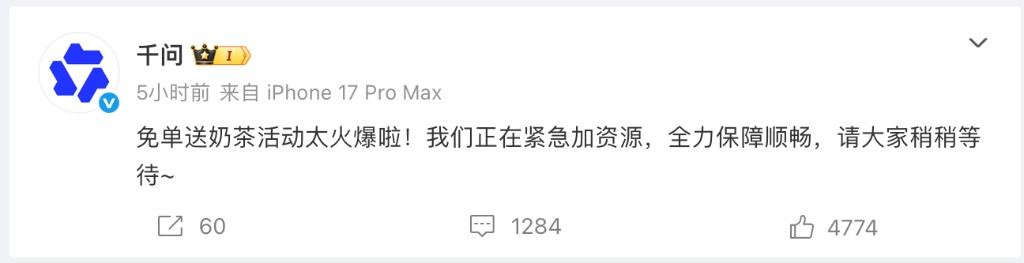
Within less than 3 hours of the event going live, over 1 million orders for milk tea were sent out, but the influx of millions of users directly crashed the servers, and the event page temporarily displayed "The event is too popular, please try again later." The Qianwen team urgently responded on social media, stating that they were increasing resources to ensure smooth service.
This marketing storm also generated interesting chain reactions: most Hong Kong-listed beverage stocks rose that day, with Gu Ming rising over 5% to set a new high since its listing, Cha Bai Dao rising over 4%, and Hu Shang Ayi and Mi Xue Group following suit with increases However, the capital market remains rationally calm. Despite the enthusiastic response to activities, Alibaba's stock price still fell by 3% on that day. Investors are cautious about the business model of acquiring users through high subsidies for AI applications, with the market focusing more on long-term profitability rather than short-term spikes in downloads.
WeChat Takes Action: Ecological Lockdown Intensifies Competitive Barriers
Just as various AI applications are engaged in a heated red envelope battle, WeChat, the largest social traffic pool, has erected a "firewall."
Qianwen has become the third AI application to be blocked by WeChat's Spring Festival marketing activities. WeChat indicates that its link "contains content that induces or misleads downloads/redirections," requiring users to switch to a third-party browser for access. Some users have found that when sharing activities from the Qianwen APP to WeChat friends, it has automatically changed to a copy command format.
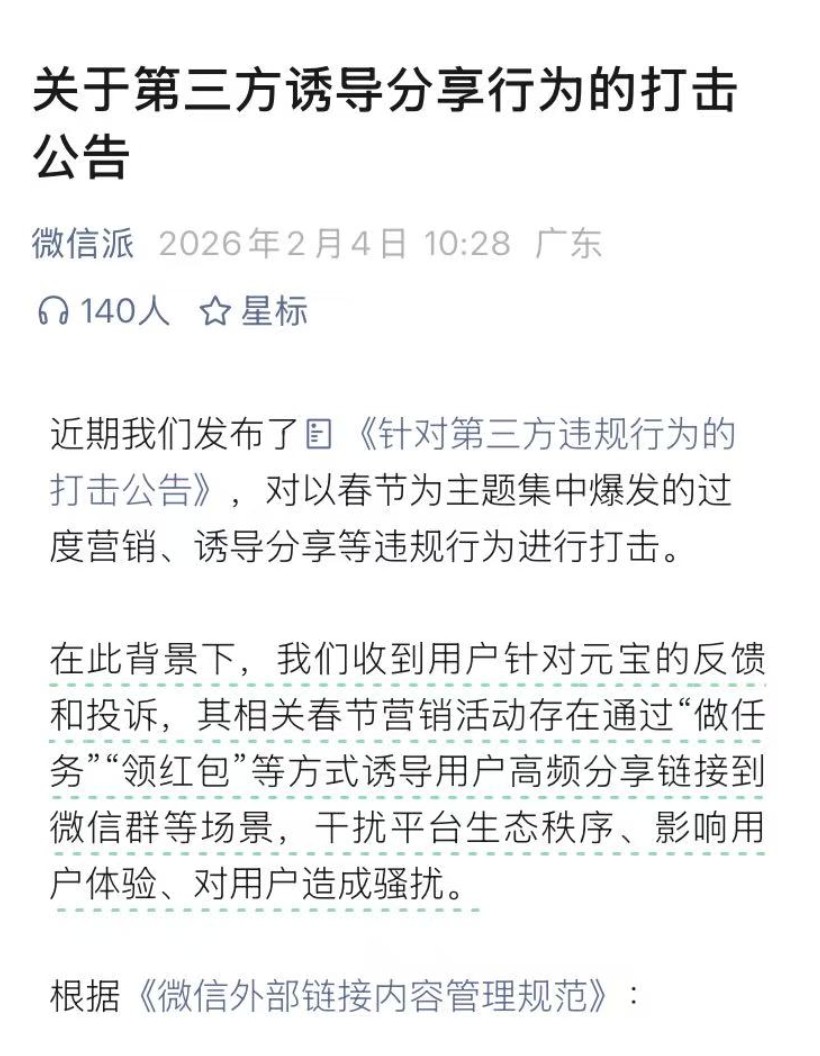
Previously, on February 4, WeChat's official account "WeChat 派" had already announced that the Yuanbao Spring Festival marketing activities were inducing users to frequently share links through "task completion" and "red envelope collection," disrupting the ecological order of the platform, and restricting its non-compliant links. WeChat's public relations director stated, "User experience comes first, and we treat everyone equally."
On February 5, the red envelope sharing link for Baidu's Wenxin Assistant was also blocked by WeChat, and Baidu has adjusted it to a "command red envelope" format.
WeChat's unified blocking action demonstrates its zero-tolerance attitude towards third-party applications utilizing social relationship chains for viral marketing, but this also gives Tencent's own Yuanbao a unique advantage in competition.
The Year of Strategic Turnaround Has Arrived
Behind this seemingly lively red envelope battle lies a deeper strategic turnaround faced by China's internet giants.
Goldman Sachs pointed out in its latest research report that 2026 will be a "dual mainline year" for China's internet giants to ramp up AI investments and defend their core market positions. The breakthrough impacts of ByteDance in AI, e-commerce, and local services are forcing giants like Alibaba and Tencent to initiate a comprehensive strategic shift.
Data shows that as the leading profit generator in China's internet sector, expected to reach $50 billion in profits by 2025, ByteDance's multiple breakthroughs have directly rewritten the industry's competitive rules. The Doubao APP has over 100 million daily active users, with a daily token consumption of 50 trillion, ranking third globally; Douyin's e-commerce GMV has grown by over 30% year-on-year and is expected to surpass Pinduoduo in 2026.
In the face of ByteDance's offensive, a strategic turnaround among the giants is imperative. Goldman Sachs predicts that in 2026, the combined AI capital expenditure of ByteDance, Alibaba, and Tencent will exceed $60 billion (approximately 410 billion RMB), focusing on the layout of To-C AI super entry points and full-stack technology.
Goldman Sachs emphasizes that in 2026, China's internet investment will bid farewell to the "broad-based rally logic" and shift towards an alpha era of "selective stocks," focusing on three major themes: profit growth, changes in AI and globalization narratives, and shareholder returns This Spring Festival's AI red envelope battle is just the opening drumbeat of a long-term campaign. The red envelope addresses the entry point, but the real test lies in the product itself. Who will ultimately emerge victorious in the competition for the AI super entrance? We shall wait and see
