


AI frenzy erases cyclical memory: When Sandisk rose 12 times, who still remembers the past crash?

The Financial Times of the UK analyzes that the demand for AI has driven an unprecedented rise in the storage chip sector, with Sandisk's stock price soaring 1200% in the past six months. However, the industry's strong cyclicality remains unchanged, and the current market has shown structural risks similar to those in 2022: suppliers are over-purchasing in a bid to secure orders from cloud vendors, while hyperscale companies are overestimating demand, leading to repeated orders and capacity expansion. Historical data shows that storage stocks often experience rapid corrections after sharp increases, and although this cycle benefits from technological differences such as HBM, cyclical patterns are still at play
According to an analysis by the Financial Times, despite the unprecedented surge in the storage chip sector driven by artificial intelligence demand, the strong cyclical nature of the industry has not disappeared. Over the past six months, SanDisk's stock price has soared by 1200%, while Western Digital, Seagate, Micron, and SK Hynix have seen increases of 180% to 280%, making them the best-performing stocks in the S&P 500 index. This wave of growth has raised market concerns: investors may be repeating the mistakes of the 2022 cycle reversal.
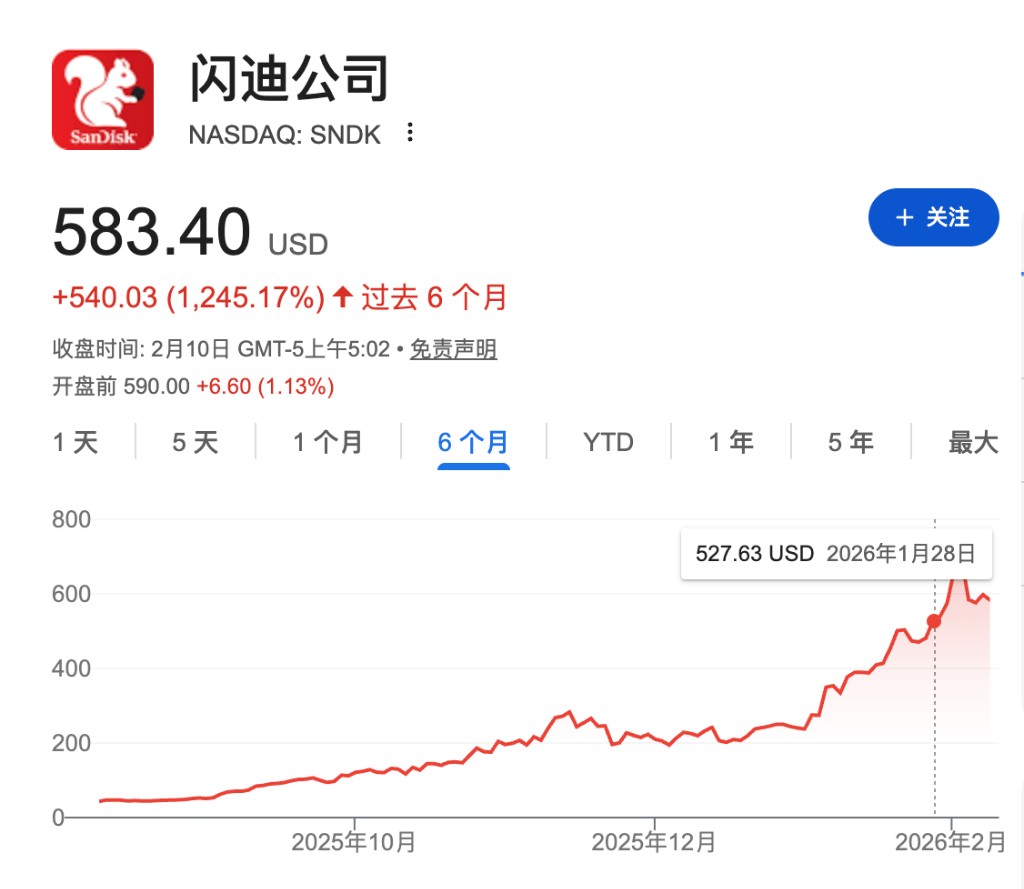
The report suggests that the storage demand generated by AI applications is the core driving force behind this market trend. With memory prices continuing to rise, SanDisk has shifted from a cash-consuming state in 2024 to generating nearly $1 billion in free cash flow last quarter. However, the storage industry is characterized by strong cyclicality, with rapid demand fluctuations and lagging capacity adjustments, often leading to severe price volatility.
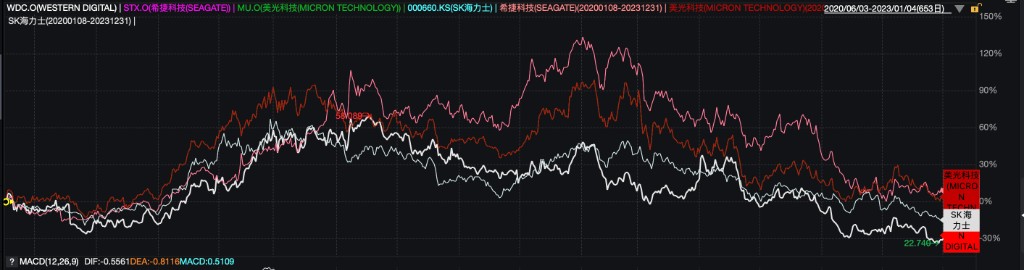
The article cites industry insiders warning that “investors have short memories.” Historical data shows that from mid-2020 to early 2022, the stock prices of Western Digital, Seagate, Micron, and SK Hynix all rose over 100%, only to give back all gains within the following nine months; similar dramatic fluctuations occurred in 2014 and 2018. The current market's optimism is causing people to overlook the lessons of cyclical repetition in the industry.
Large-scale Procurement and Capacity Expansion May Lead to a New Round of Surplus
Industry analysis points out that the current memory market is showing structural risks similar to those of the 2022 cycle. To secure partnerships with large cloud computing companies, suppliers often procure memory in advance before receiving confirmed orders to demonstrate their supply capabilities. However, not all suppliers ultimately secure corresponding contracts, leading to a total order volume far exceeding actual demand.
At the same time, large-scale manufacturers themselves often overestimate future demand. Once they adjust their order sizes, the existing surplus supply will quickly turn into a severe market oversupply. The report cites industry sources stating that order volumes have doubled or even tripled, with capacity expanding in tandem. Recently, Samsung announced plans to significantly increase DRAM capacity, further exacerbating potential pressure on the supply side.
Is This Cycle Different?
Although the inherent cyclical risks of the storage industry remain, market analysis suggests that the current AI-driven expansion period may last longer than previous ones. Jonathan Goldberg, an analyst at Digits to Dollars Advisory, stated:
"Looking back at history, over the past five years, the market will eventually correct. The amplitude of this cycle is larger, so prices may continue to rise. Many semiconductor investors who entered the industry five years ago will say this time is different. But the fact is, the cycle has not changed."
On the other hand, the technological advancements in High Bandwidth Memory (HBM) are seen as a key variable that could reshape the industry landscape. This specialized high-performance DRAM is currently dominated by Samsung, SK Hynix, and Micron. Creative Strategies analyst Ben Bajarin pointed out:
"This cycle is largely driven by HBM, which has a higher degree of differentiation and will not become a homogeneous product in the short term... I believe memory revenue has bottomed out and is rebounding."
The current market is at a juncture where technological iteration and cyclical patterns intertwine, and the supply-demand dynamics of HBM will become one of the core factors influencing the length and shape of this cycle
