


Rising from the ruins of Kindle, Onyx still faces tough battles in going overseas

WenStone Information Technology Co., Ltd. submitted a prospectus to the Hong Kong Stock Exchange, planning to seize the market with its open system e-ink products after Kindle exits the Chinese market. The revenue for 2024 is expected to reach 1.018 billion yuan, a year-on-year increase of 26.62%. Despite gaining a certain market share, WenStone still faces challenges in hardware manufacturing and competitive pressure. The revenue growth rate in the first three quarters of 2025 has slowed down, and WenStone is expanding into overseas markets, focusing on the performance of its open system in the U.S. market
More than three years after Kindle announced its exit from the Chinese market, a "survivor" from Guangzhou is proving to the capital market that the e-ink screen business is not only alive but can also become a company poised for an IPO.
Recently, Guangzhou Wenshi Information Technology Co., Ltd. (hereinafter referred to as "Wenshi") submitted its prospectus to the Hong Kong Stock Exchange.
The business logic of Wenshi can be described as "anti-Kindle."
Unlike Amazon's closed system model that attempts to "sell low-priced hardware + recover costs through book sales," Wenshi's e-ink screen products focus on an open system, allowing users to freely download various apps such as WeChat Reading from the app store.
This strategy has enabled Wenshi to quickly fill the vacuum left by Amazon's withdrawal.
In 2024, Wenshi's revenue reached 1.018 billion yuan, a year-on-year increase of 26.62%, capturing a significant share of the downstream e-ink screen market.
However, behind the impressive data, there are also concerns.
On the ruins left by Kindle's exit, while Wenshi has gained users, it must also face the challenges of the "hard business" of hardware manufacturing: the "ocean of products" strategy from competitors and constraints from upstream giants.
To keep up with the new product launch speed of companies like Zhangyue, Wenshi released 13 new products in 2024 and 9 in 2025, matching the pace of mainstream domestic smartphone manufacturers.
Even so, in the first three quarters of 2025, Wenshi's revenue growth rate was still only about 10% year-on-year, lagging behind the growth rate for the entire year of 2024.
Now, Wenshi is expanding into overseas markets, aiming to compete head-to-head in Kindle's home market of the United States. Whether the open system approach can succeed in overseas markets is under scrutiny. 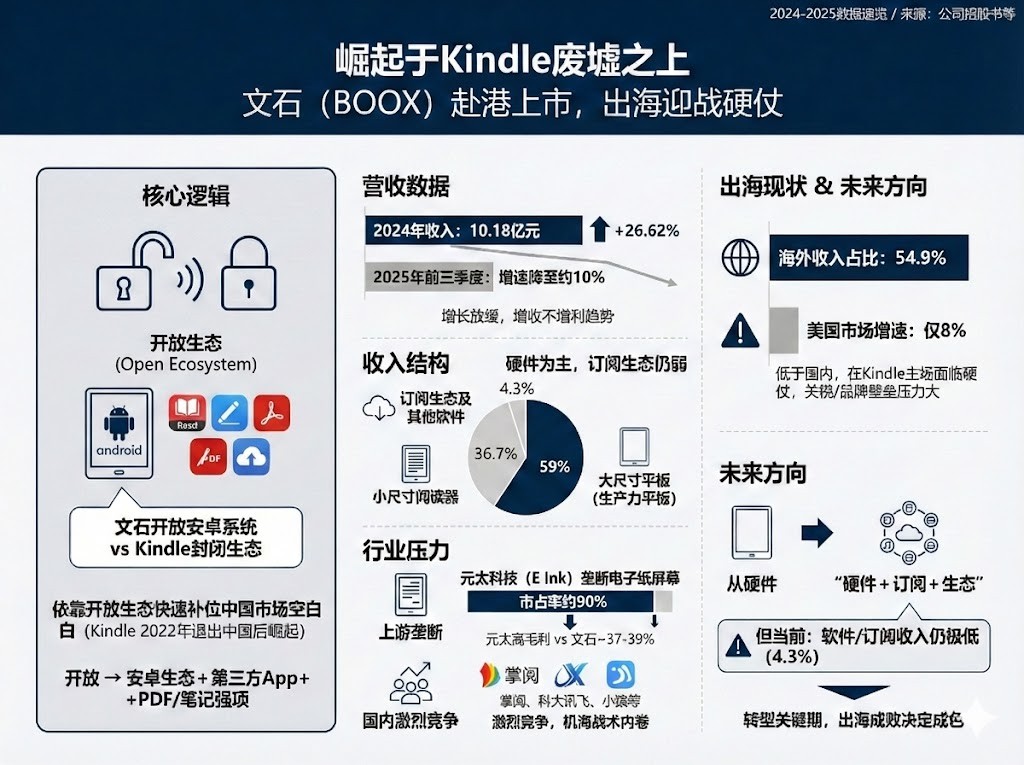
Dual Pressure from Giants and Competitors
The story of Amazon's Kindle e-ink reader retreating from the Chinese market is still fresh in memory, primarily due to the "razor-and-blades" business model encountering severe "adaptation issues" in China.
At that time, Amazon's logic was: hardware could be sold at a loss, relying on a closed system to bind users to the Kindle store and generate revenue through frequent purchases of e-books.
However, this model was clearly unsustainable in China.
On one hand, the pricing strategy for e-books in China is chaotic, piracy is rampant, and users have a very low willingness to pay; on the other hand, the strong rise of free or subscription-based apps like WeChat Reading means that Amazon's closed system cannot integrate third-party apps.
The closed ecosystem that Kindle prides itself on has instead become a shackle, providing an opportunity for Chinese manufacturers represented by Wenshi to rise.
Wenshi focuses on an open Android ecosystem, allowing the installation of third-party apps like WeChat Reading and supporting various file formats, providing users with a more personalized reading experience This "non-bundled content, only tools" approach has allowed Wenshih to quickly capture part of the market share after Kindle exited China, with revenue reaching 1.018 billion yuan in 2024, a year-on-year increase of over 25%.
Breaking down the products, Wenshih's main revenue sources come from e-readers (small size) and tablets (large size), with the two generating 293 million yuan and 472 million yuan respectively in the first three quarters of 2025, accounting for 36.7% and 59% of total revenue.
However, capturing the market share left by Kindle does not mean Wenshih can rest easy.
In the downstream market, besides Wenshih, Chinese manufacturers such as Zhangyue, iFLYTEK, and Hanvon are all eyeing this market.
Although Wenshih cites data from Frost & Sullivan claiming it is the largest knowledge-focused productivity tool brand in China based on 2024 retail revenue, if we look at other third-party data, Wenshih's "first" position is not stable.
According to data monitored by third-party agency Luotu Technology, in terms of sales volume, iFLYTEK accounts for over 80% of the overall offline market, while Xiaoyuan ranks first in online channels.
All parties are engaged in a "sea of machines" battle. In 2025, the Chinese market released a total of 83 tablet products equipped with electronic paper screens, with Zhangyue releasing 13 models at once, while Wenshih, unwilling to be outdone, also released 10 models.
On the upstream side, there are constraints from raw materials.
As the core component of electronic readers, about 90% of the global supply of electronic paper displays is concentrated in E Ink Holdings.
Wenshih also admits to primarily sourcing electronic paper displays from E Ink Holdings, with the procurement amount from E Ink Holdings accounting for 28.1% and 27.4% of total procurement in the first three quarters of 2024 and 2025, respectively.
Under such a monopolistic position, E Ink Holdings "earns" most of the profits in the industry.
In 2024, E Ink Holdings' gross profit margin and net profit margin reached 49.64% and 27.28%, respectively, exceeding Wenshih by 12.73 percentage points and 15.37 percentage points.
Between the upstream monopolized by giants and the downstream where many are vying for dominance, Wenshih's path to breakthrough faces challenges.
Is Going Global the Solution?
Relying solely on "selling hardware" is clearly not imaginative enough in the capital market.
Wenshih has outlined its growth strategy in its prospectus, stating that it is promoting a transition from a "hardware-led" model to a more diversified structure that includes "hardware + subscription + ecosystem."
In terms of subscription services, Wenshih has developed its own note-taking application StarNote, offering various value-added services such as handwriting correction;
Regarding the ecosystem, Wenshih plans to gradually open up the operating system interface to attract developers to create applications specifically designed for eye-friendly reading and focused writing environments, solidifying its position as an open platform operator.
Currently, this portion still accounts for a relatively low share, with accessories, external electronic ink displays, and StarNote application contributing only 35 million yuan in revenue in the first three quarters of 2025, accounting for 4.3% Whether this part of the business revenue can achieve a qualitative leap along with the increase in installation volume remains uncertain. Especially under the operating philosophy commonly adopted by domestic internet platforms of "the wool comes from the dog, and the pig pays the bill," users generally have low willingness to pay for applications like notes.
However, Wenshi's advantage lies in the fact that it has already captured a certain market share in overseas markets where users have a higher willingness to pay.
In the first three quarters of 2025, the European, American, and Asian (excluding China) markets contributed revenues of 170 million yuan, 149 million yuan, and 117 million yuan, respectively, accounting for a total of 54.9%.
To deepen its presence in overseas markets, Wenshi has also launched limited edition products for the overseas market, such as Note Air5 C and BOOX Go 7, primarily catering to users' office needs.
However, earning US dollars is not easy. In the first three quarters of 2025, the revenue growth rate in the US market for Wenshi was 8% year-on-year, lagging behind the domestic market by more than 4 percentage points.
Overall, Wenshi wants to convey to the market that it is not just a hardware company, but also a consumer electronics manufacturer like Apple that can win market share through software ecosystems and globalization.
However, with a year-on-year revenue growth rate of only 10.31% in the first three quarters of 2025, lagging behind the full-year growth rate of over 10 percentage points in 2024, it remains to be seen whether Wenshi's path of "hardware + subscription + ecosystem" can be successful.
Risk Warning and Disclaimer
The market has risks, and investment should be cautious. This article does not constitute personal investment advice and does not take into account the specific investment goals, financial situation, or needs of individual users. Users should consider whether any opinions, views, or conclusions in this article align with their specific circumstances. Investing based on this is at one's own risk
