


Myrmikan founder: The valuation of gold mining stocks is still low, and the long-term gold price is bullish at $12,000

Renowned precious metals mining stock fund manager Daniel Oliver believes that gold is in the early stages of a large-scale bull market. Historically, the market has forced central banks to maintain gold reserves between one-third and one-half of their balance sheets, which implies that gold prices should be between $8,395 and $12,595 per ounce. Due to the actual value of long-term U.S. Treasuries being lower than the market price manipulated by the Federal Reserve, panic may temporarily drive the gold reserve ratio up to 100%
Daniel Oliver, the founder of the hedge fund Myrmikan Capital focused on micro gold and silver mining companies, believes that the gold market is in the early stages of a massive bull market, with long-term gold prices potentially rising to $12,000. He points out that mining stocks remain undervalued even after strong rallies, and the holding ratio of gold among professional investors and domestic institutions is still very low.
In a recent client report, Oliver stated that the Federal Reserve will fall into a monetary printing trap, unable to simultaneously cut interest rates and reduce its balance sheet. He expects that Kevin Warsh, the next Federal Reserve chairman nominated by Trump, will be forced to turn to quantitative easing, despite Warsh's previous criticisms of the Fed's bond holdings.
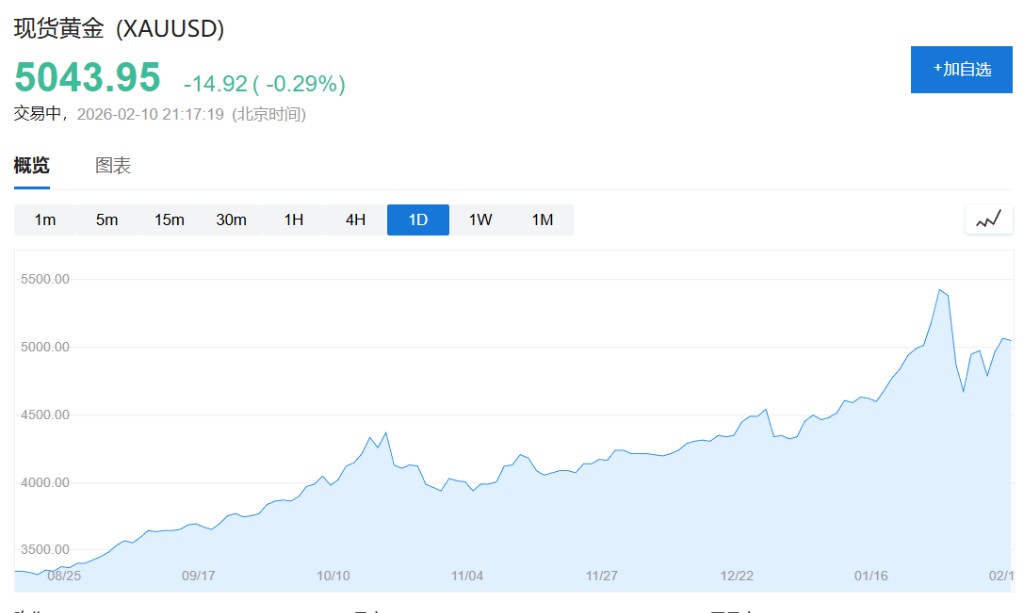
This viewpoint comes as gold prices hovered around the $5,000 mark on Tuesday. Gold prices broke through, fell below, and then broke through this level multiple times on Monday, with the upward momentum largely reflecting the market's wavering confidence in the dollar and U.S. assets.
Oliver's analysis focuses on the fragility of the U.S. debt structure and its long-term impact on gold prices. He believes that private equity is at the center of the impending dollar collapse, which will raise financing costs and drive away foreign capital.
The Federal Reserve Faces a Monetary Policy Dilemma
Oliver points out that since the 2008 financial crisis, the Federal Reserve, under Bernanke's leadership, began massive bond purchases to raise bond prices, lower interest rates, and inject large reserves into the banking system. Subsequently, the Fed started paying interest on bank reserves to maintain the lower limit of interest rates.
Currently, the interest rate paid by the Fed is far higher than the yield on the bonds it holds. According to Oliver, since 2022, the Federal Reserve has accumulated an operating loss of $245 billion. "The entire mechanism requires accelerated money printing and deeper losses for the central bank, which issues the national currency," he stated.
Warsh will face $10 trillion in Treasury bonds maturing within the next 12 months, and the government will be forced to extend these debts. Oliver expects that although Warsh has expressed dissatisfaction with the bonds on the Fed's balance sheet, he will ultimately have to turn to quantitative easing.
Three Stages of the Gold Bull Market
Oliver divides the gold bull market into three stages. The first stage began in 2022 when the U.S. froze Russia's dollar assets, attracting mature gold investors. He believes that international capital flows have caused U.S. financial institutions to "bear a crazy scale of debt."
The second stage has yet to begin, which will reflect the market's realization that the Fed is unable to save private equity or control interest rates unless it buys the entire bond market.
The third stage will see a death spiral for government bonds: "The higher the interest rates, the larger the interest payments, the worse the deficits, the more Treasury supply, the higher the interest rates," he said. Oliver believes that the ultimate outcome will either be a government default or an order for the central bank to purchase all Treasury bonds, destroying the dollar He cited economic theory stating: "There is no way to avoid the collapse that ultimately comes from credit expansion. The only choice is whether the crisis arrives earlier as a result of a voluntary abandonment of further credit expansion, or later as a complete disaster of the relevant monetary system."
Regarding the reasonable price of gold, Oliver explained that historically, the market has forced central banks to maintain gold reserves between one-third and one-half of their balance sheets, which means the gold price should be between $8,395 and $12,595 per ounce. Due to the actual value of long-term U.S. Treasury bonds being lower than the market price manipulated by the Federal Reserve, panic could temporarily push the gold reserve ratio up to 100%.
Investment Opportunities in Mining Stocks
Oliver emphasized that even after a strong rise, mining companies are still undervalued. He pointed out that despite the surge in mining stocks, the inflow of funds into gold mining exchange-traded funds remains insufficient. The number of shares outstanding for the VanEck Junior Gold Miners ETF has decreased by one-third between 2024 and 2026. "This lack of interest indicates that we are in the early stages of a bull market," he said.
The proportion of gold held by professional investors and domestic institutions remains very low. Oliver stated: "Mining companies will continue to benefit from rising gold prices, but the real explosion will begin when the market starts to reprice valuation multiples. As capital floods into the sector in a panic, large miners will perform well. Junior miners should perform even better as their projects become hard to ignore."
He noted that since the establishment of Myrmikan, junior miners have begun to refuse financing deals for the first time, indicating that the fundamentals of the industry are improving
