


Federal Reserve: U.S. consumer debt default rate soars to the highest level in nearly a decade

The report released by the New York Federal Reserve shows that in the fourth quarter of last year, the proportion of overdue household debt among American residents rose to 4.8%, the highest level since 2017, primarily driven by an increase in default rates among low-income groups and young borrowers. The rise in defaults is mainly driven by overdue mortgage loans
The latest Household Debt and Credit Quarterly Report released by the New York Federal Reserve shows that the issue of consumer debt defaults in the United States is significantly worsening.
The Household Debt and Credit Quarterly Report released by the New York Federal Reserve on Tuesday indicates that the proportion of overdue household debt among U.S. residents rose to 4.8% in the fourth quarter of last year, the highest level since 2017.
Data shows that the total household debt in the fourth quarter increased by $191 billion to a record high of $18.78 trillion. The default rate rose by 0.3 percentage points quarter-over-quarter, primarily driven by an increase in defaults among low-income and young borrowers.
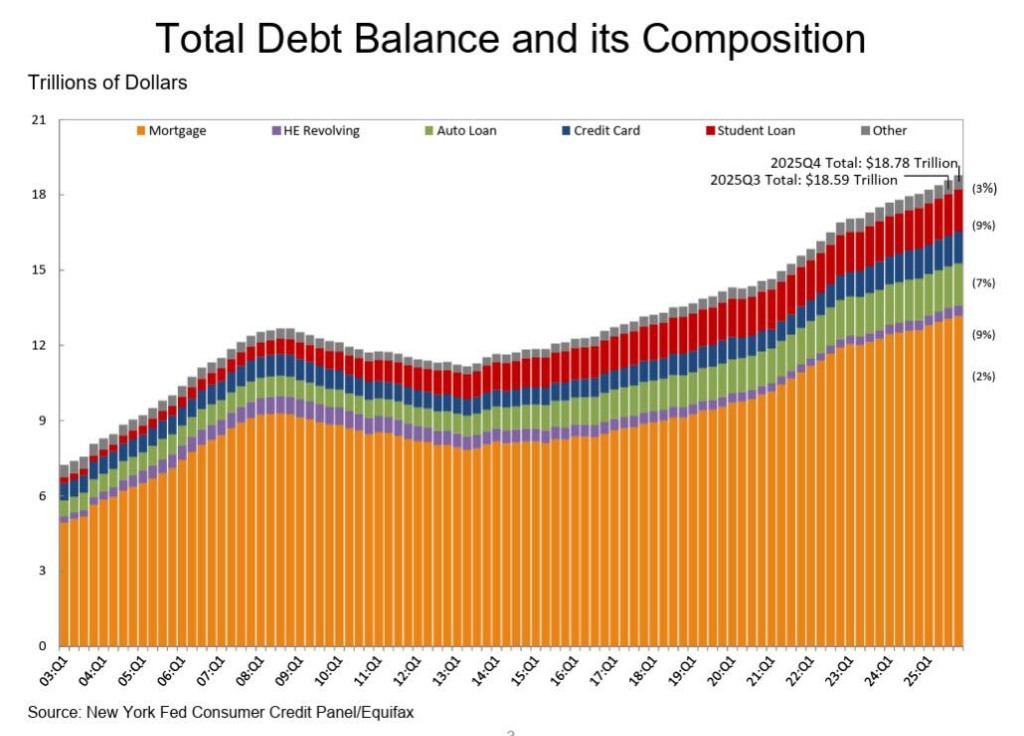 (Total U.S. debt balance and its composition)
The situation in the student loan sector is particularly severe, with 16.3% of student loan debt in default in the fourth quarter, marking the largest increase since records began in 2004.
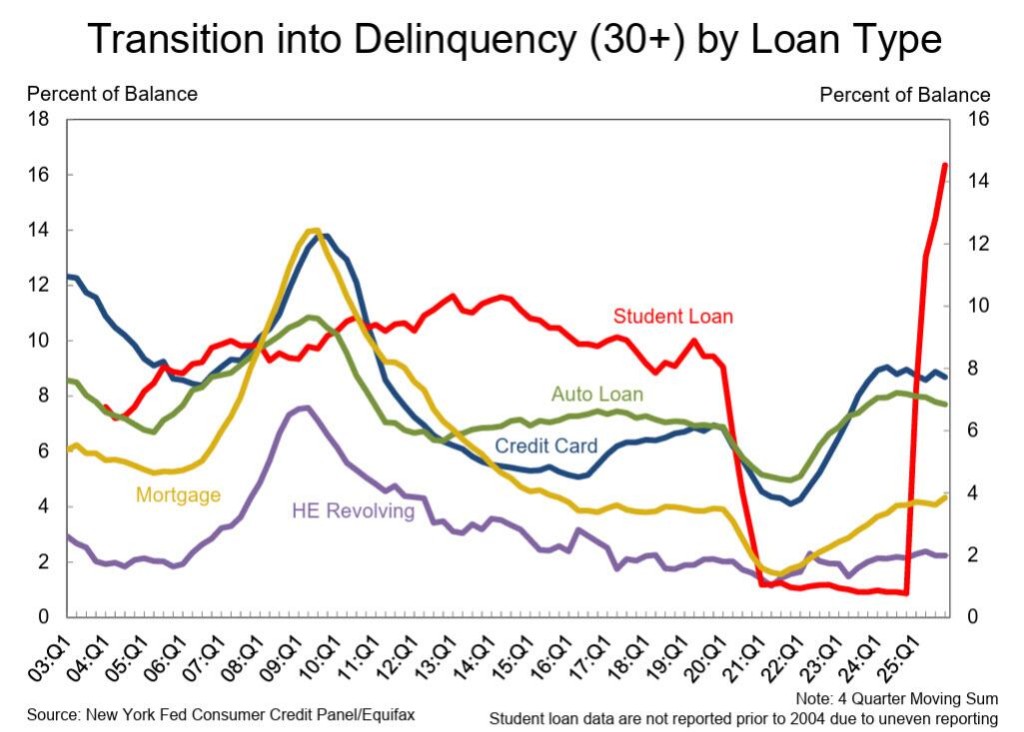 (30-day overdue situation by loan type, red line: student loans)
Wilbert van der Klaauw, an economic research advisor at the New York Federal Reserve, stated that although the mortgage default rate is close to historically normal levels, the deterioration is mainly concentrated in low-income areas and regions with falling home prices. The unemployment rate for young workers aged 16 to 24 reached 10.4% in December last year, close to the levels seen during the peak impact of the pandemic in 2021.
The Surge of Student Loan Defaults
The default situation in the student loan sector is the most severe. With the Biden administration's repayment pause ending over the past year, a wave of defaults has fully erupted.
In the fourth quarter, 16.3% of student loan debt was in default, marking the largest increase since data collection began in 2004. The serious default rate (substantial default) also soared, with borrowers aged 50 and above becoming the main force behind defaults.
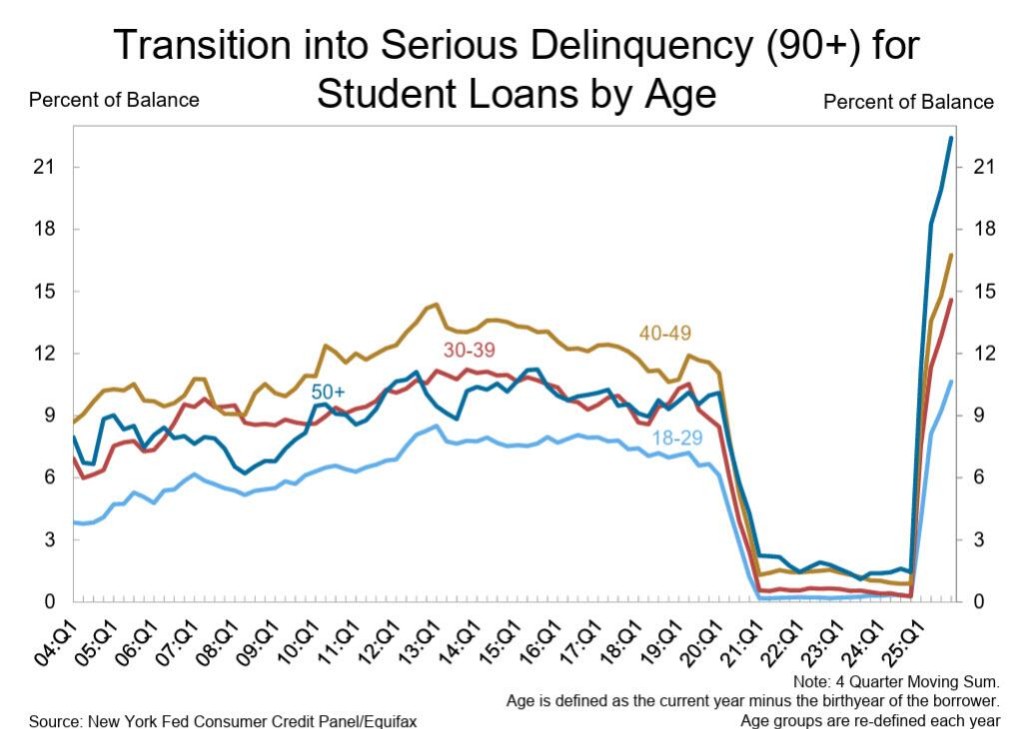 (Student loans by age group)
This phenomenon reflects the rapid emergence of long-accumulated student debt burdens following the removal of repayment protections. This trend aligns with persistently high unemployment rates among certain demographics, highlighting the K-shaped recovery characteristics of the U.S. economy.
As of December last year, the unemployment rate for young workers aged 16 to 24 was 10.4%, close to the levels seen during the most severe period of the pandemic in 2021, primarily impacted by the effects of artificial intelligence technology.
Researchers at the New York Federal Reserve found that mortgage default rates are particularly pronounced in low-income postal code areas, and have also significantly increased in regions with falling home prices. Although the overall default rate is close to pre-pandemic average levels, the distribution is extremely uneven
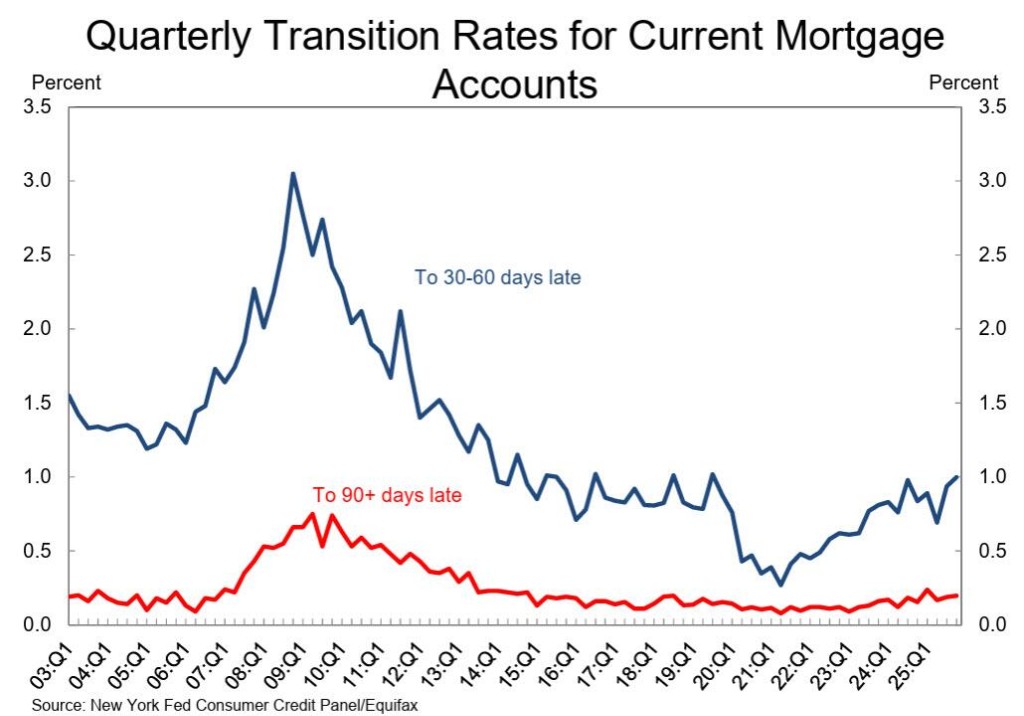 (Red line: Mortgage delinquencies over 90 days vs Blue line: Delinquencies from 30 to 60 days)
Debt Levels Reach New Highs, Credit Expansion Continues
U.S. household debt continued to expand in the fourth quarter of 2025, accumulating a total increase of $4.6 trillion since the outbreak of the pandemic at the end of 2019.
Mortgage balances increased by $98 billion to $13.17 trillion. Home Equity Lines of Credit (HELOC) balances rose by $12 billion, marking the 15th consecutive quarter of growth, currently reaching $433 billion, which is $116 billion higher than the low point in the first quarter of 2022.
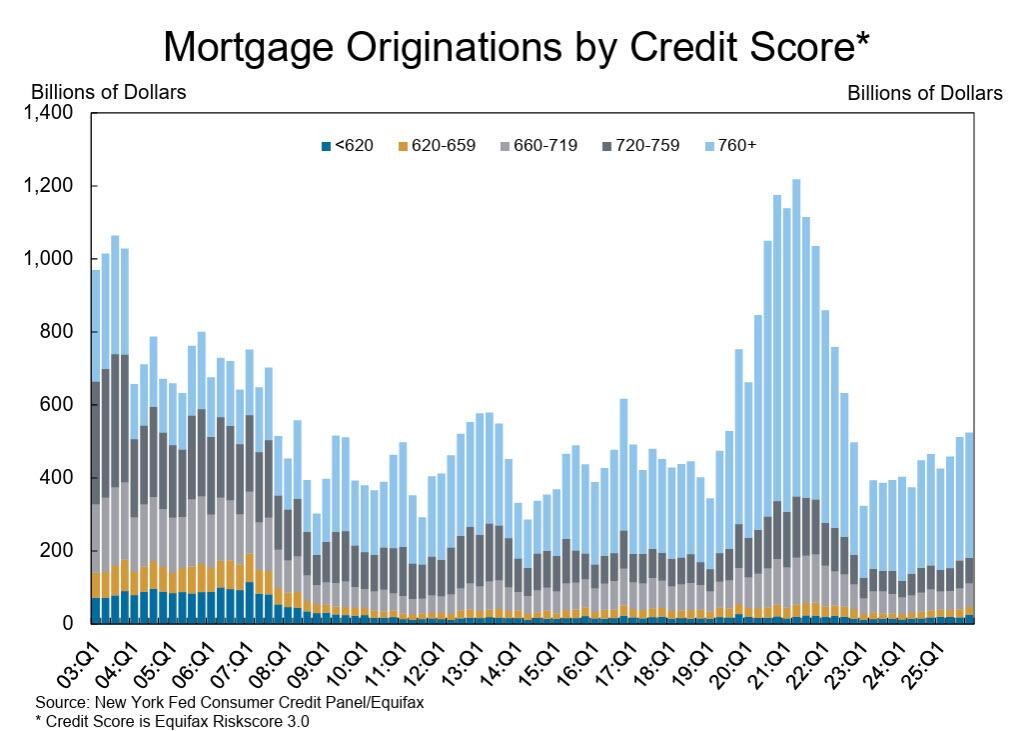 (Mortgage issuance by credit score)
Credit card balances increased by $44 billion in the fourth quarter, totaling $1.28 trillion, a year-on-year growth of 5.5%. Student loan balances rose by $11 billion to $1.66 trillion, while auto loan balances slightly increased by $12 billion to $1.66 trillion.
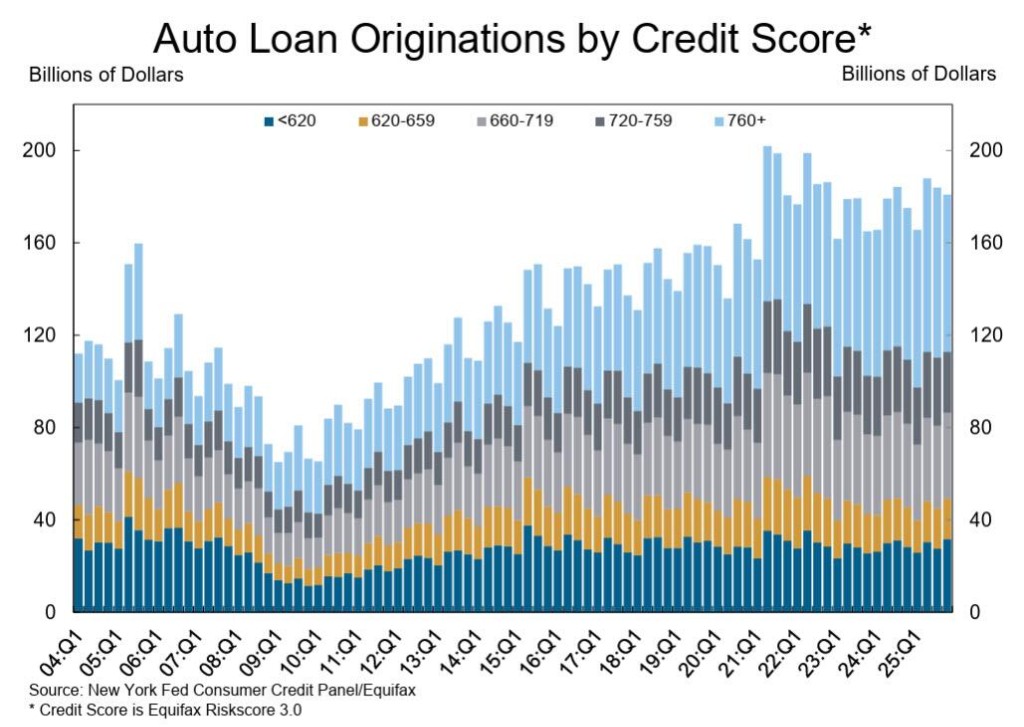 (Auto loan issuance by credit score)
New loan issuance remains robust. Mortgage issuance reached $524 billion, up from $512 billion in the third quarter, the highest level since 2022. Auto loans and leases added $181 billion, slightly lower than the $184 billion in the third quarter. Total credit card limits increased by $95 billion, a growth of 1.6%.
