


Soaring 50%, short sellers refuse to back down! Is POP MART facing an epic "short squeeze" storm?

POP MART's Hong Kong stock has recently surged by 50%, but data from S3 Partners shows that short sellers have not retreated; the short interest as a percentage of free-floating shares has skyrocketed from 2% to 16%, with a short squeeze risk score reaching a perfect 100. Analysts say this is a rare case of "extremely crowded one-sided betting." Despite the company's efforts to boost confidence through buybacks, short sellers continue to bet on expectations of a slowdown in the company's overseas growth, and the market is facing intense short squeeze risk dynamics
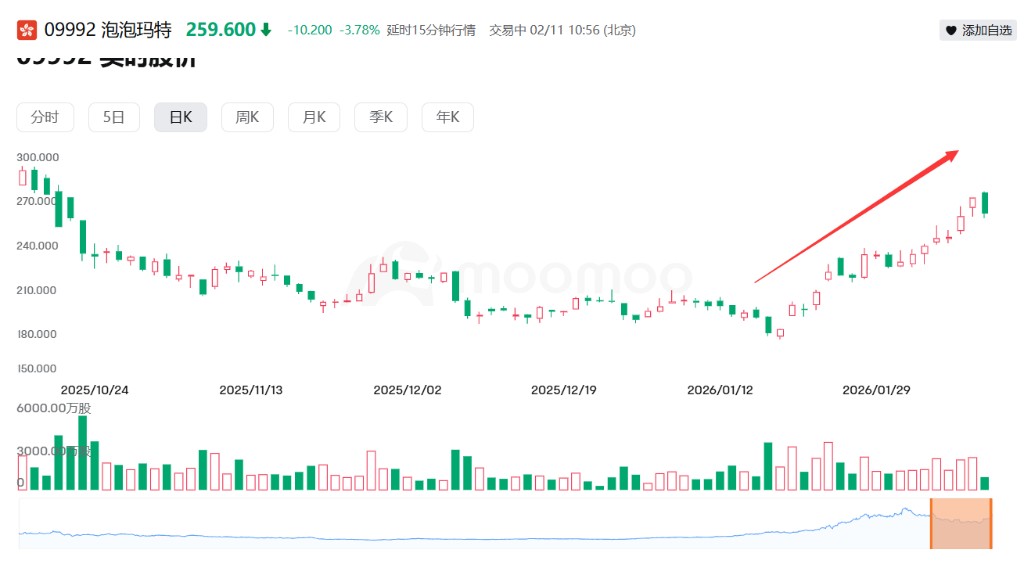
Despite the stock price soaring 50% in less than a month, the short-selling forces against POP MART have not retreated; instead, they are building an extremely dangerous standoff situation.
According to the latest data from S3 Partners, POP MART's shares listed in Hong Kong have recently experienced a significant rise, but this has not deterred short sellers, and there has been no obvious wave of short covering so far.
On the contrary, based on S3 Partners' recent short squeeze risk scoring system calculated by market capitalization returns, POP MART's short squeeze risk score has reached the highest level of 100 points. This typically means that if the stock price continues to rise, short sellers will face immense pressure to cover their positions, potentially triggering a chain reaction of skyrocketing stock prices.
However, the data reveals a counterintuitive phenomenon. Leon Gross, the research director at S3 Partners, pointed out: “Despite the high score, technically, this stock has not yet experienced a short squeeze, as there has been no significant net covering; in fact, from the borrowing data, we have seen almost none.”
This standoff has led to an extreme market structure. Real-time data shows that POP MART's short positions are still steadily increasing, with the proportion of shorts to freely traded shares sharply rising from 2% to 16%. Meanwhile, long position data and hedge fund positions have also seen a slight increase.
Leon Gross commented on this:
“The current short position is far larger than institutional long positions, which is uncommon. This is simply an extremely crowded one-sided bet that has yet to retreat.”
This structure means that if the long forces gain any strength or the company releases positive news, this 16% short position will have nowhere to go and may be forced into a panic buy to cover.
On Wednesday, the stock fell by as much as 5%, and earlier this week it was at a technically overbought level, indicating that under the intense crossfire between bulls and bears, the stock price volatility is increasing.
The Logic of Short Sellers: Betting on Overseas Growth "Cooling Off"
Behind this bull-bear showdown is a significant divergence in the market regarding POP MART's future growth trajectory. Although the company's management is actively maintaining the stock price through buybacks and other means, the short sellers remain skeptical about the company's performance in key overseas markets.
Tracing back to the end of January this year, this divergence between bulls and bears had already begun to emerge.
At that time, after experiencing the strongest rebound in five months, POP MART's stock price saw short interest rise to its highest level since July 2023. Bernstein's analyst for Asian consumer stocks, Melinda Hu, pointed out at the time that the main logic for shorts lies in the cooling trend in key overseas markets.
Melinda Hu stated: “There is still significant short interest from the U.S. market, as sales trends there continued to slow down in January.” For short sellers, the rise in stock prices is not driven by fundamentals, but rather a good opportunity to increase short positions. Melinda Hu analyzes that, "Since this week's stock rebound is not driven by fundamental factors, I suspect they (short sellers) may take this opportunity to increase their positions."
Even at the end of January, POP MART's management conducted a share buyback worth HKD 347 million (approximately USD 45 million) — the most aggressive market support action in nearly two years — yet it failed to shake the confidence of short sellers. At that time, data showed that the number of shares shorted surged from 44 million to 60 million within a week.
The company's CEO Wang Ning also attempted to boost confidence in an interview with Xinhua News Agency, stating that the intellectual property (IP) business typically goes through many cycles, with ups and downs, but he believes the company's IP will continue to grow.
Is a sharp fluctuation imminent?
However, this tug-of-war between "company defense" and "short seller offense" is escalating.
On one hand, there is the management's demonstration of "ample financial resources" and determination to repurchase, while on the other hand, there are concerns from short sellers about weakening demand for popular toy lines like Labubu.
Now, S3 Partners' "100-point" risk warning has turned red. Whether short sellers are ultimately forced to exit due to margin pressure, triggering a surge, or whether deteriorating fundamentals eventually burst the stock price bubble, the market is at a critical point ready to ignite
