


Humanoid Robot Racing: Chinese Startups Rush to Mass Production, Tesla and Boston Dynamics Won't Start Until 2026

In 2025, the humanoid robot sector will witness a dual explosion of capital and industry, with annual financing exceeding $2.6 billion, surpassing the total of the past seven years. China, with a cluster of 23 startups and over 10,000 units in production scale, will outpace the United States in the race for industrialization, leading the world
In the humanoid robot sector, while capital is rapidly increasing, the pace of industrialization is showing divergence. Chinese startups, with denser entrepreneurial clusters and faster output speeds, have gained an advantage in the competition with the United States.
The flow of funds has provided clear signals. According to data from market research platform Tracxn, humanoid robot startups are expected to receive $2.65 billion in investments by 2025, surpassing the total amount from 2018 to 2024, indicating that investors' judgments on the maturity and commercial attractiveness of this technology have significantly increased.
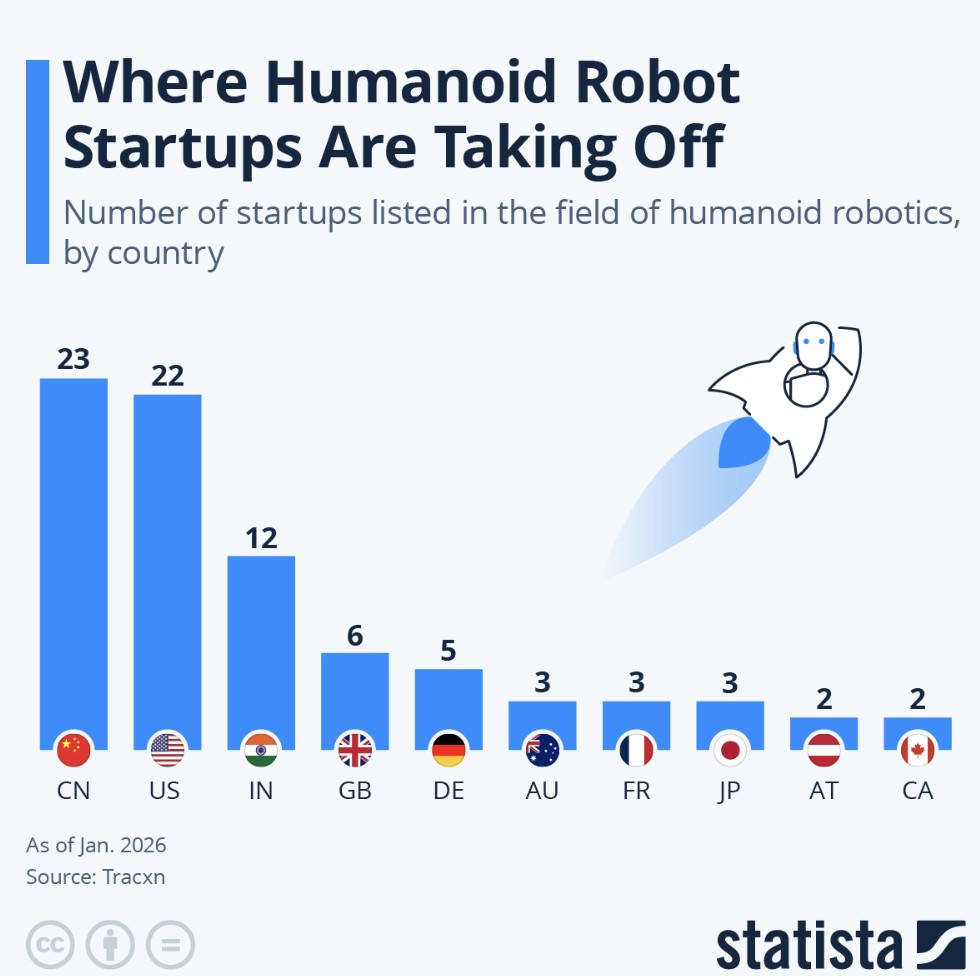
The distribution of startups also shows that two major centers are solidifying. According to a chart released by Statista researcher Tristan Gaudiat, China has 23 startups focused on humanoid robots, slightly higher than the 22 in the United States. China and the U.S. remain the two poles with the highest concentration of humanoid robot startups globally.
A more direct difference comes from the production rhythm. Hangzhou Yushu Technology and Beijing Zhiyuan Robotics each produced over 5,000 humanoid robots in 2025, leading the world in output. In contrast, well-known American companies Boston Dynamics and Tesla plan to ramp up production of their Atlas and Optimus robots in 2026, targeting industrial and consumer application markets.
China and the U.S. dominate the global startup ecosystem, with China slightly leading with 23 companies
Statistics from Statista show that China ranks first with 23 humanoid robot-related startups, followed closely by the U.S. with 22.
Apart from China and the U.S., India ranks at the forefront of the second tier with 12 companies, while among European countries, the UK has 6, Germany has 5, and France has 3.
Australia and Japan each have 3, while Austria and Canada each have 2. Although the distribution is global, the entrepreneurial ecosystem remains concentrated in a few markets.
Investment surge reflects increased technology maturity
2025 marks a watershed year for investment in humanoid robots. The investment scale of $2.65 billion not only sets a new record but, more importantly, exceeds the total investment of the previous seven years, indicating a fundamental shift in the confidence of the capital market regarding the commercialization prospects of this technology.
Behind this investment boom is the acceleration of humanoid robot technology from the laboratory to practical applications. The change in investors' attitudes indicates that the market no longer views humanoid robots as a distant future concept, but rather as a business opportunity that can generate returns in the short term.
China's production pace significantly leads the world
On the output side, Chinese companies have demonstrated stronger delivery speeds. Hangzhou Yushu Technology and Beijing Zhiyuan Robotics both exceeded 5,000 units in output in 2025, leading the world.
Top companies in the U.S. have chosen to focus on scaling up in 2026. Boston Dynamics and Tesla plan to increase the production of humanoid robots, with products being Atlas and Optimus, targeting industrial and consumer applications In the European market, the UK's Engineered Arts and Germany's Neura Robotics are currently key players, but they have not yet demonstrated production scales comparable to those of companies in China and the United States
