


Morgan Stanley "violently" raised the target price for Micron to $450: As long as AI demand remains strong, the impact of Chinese production capacity and overheated capital expenditure are not issues!

Morgan Stanley has significantly raised Micron's target price from $350 to $450, implying an upside of approximately 28.6% compared to the current stock price. Analysts believe that the supply shortage of memory chips has spread to every end market, with pricing power fully in the hands of sellers. Driven by the AI supercycle, traditional cyclical valuation frameworks are no longer applicable, and Micron is at a sweet spot of dual expansion in profitability and valuation multiples
Morgan Stanley believes that the market has greatly underestimated the current shortage of memory chips. Driven by the AI supercycle, traditional cyclical valuation frameworks are no longer applicable, and Micron is at a sweet spot of both profitability and valuation multiple expansion.
According to the Chasing Wind Trading Desk, on February 11, Morgan Stanley's analyst team "violently" raised Micron's target price from $350 directly to $450 in their research report, maintaining an "overweight" rating. The core logic behind this is simple and blunt—as long as the demand for artificial intelligence remains strong, the market's previous concerns about the so-called HBM4 mass production issues, the impact of Chinese memory chip production capacity, and overheated capital expenditures are all irrelevant noise.
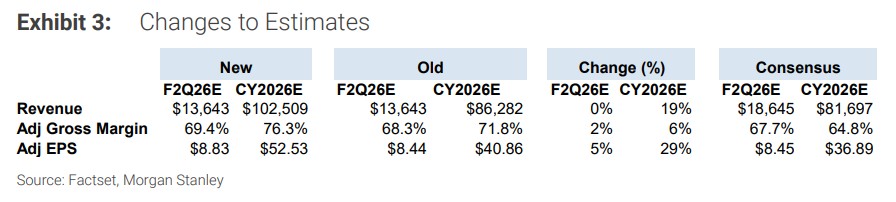
For investors, this report from Morgan Stanley reveals a reality overlooked by the market: the supply shortage of memory chips has spread to every end market, with pricing power completely in the hands of sellers. Morgan Stanley predicts that Micron's earnings per share (EPS) will soar to over $52 in the calendar year 2026 (CY26). Driven by the AI supercycle, traditional cyclical valuation frameworks are no longer applicable, and Micron is at a sweet spot of both profitability and valuation multiple expansion.
Widespread Shortage Ignites Pricing Power, Profit Forecasts Significantly Upgraded
The market has clearly underestimated the current tension in the memory chip market.
According to Morgan Stanley's research, both DRAM and NAND pricing is continuously rising in the first and second quarters of 2026. Although Micron's official guidance for the second fiscal quarter suggests a 37% quarter-over-quarter revenue growth, this implies an average selling price (ASP) increase of about 30% quarter-over-quarter.
This is merely a conservative baseline, as competitor data is even more astonishing: SanDisk's recent guidance shows its NAND ASP skyrocketing by 60% quarter-over-quarter, while teams covering Samsung and SK Hynix model predictions indicate that Q1 conventional DRAM prices will rise by 48% and 55%, respectively.
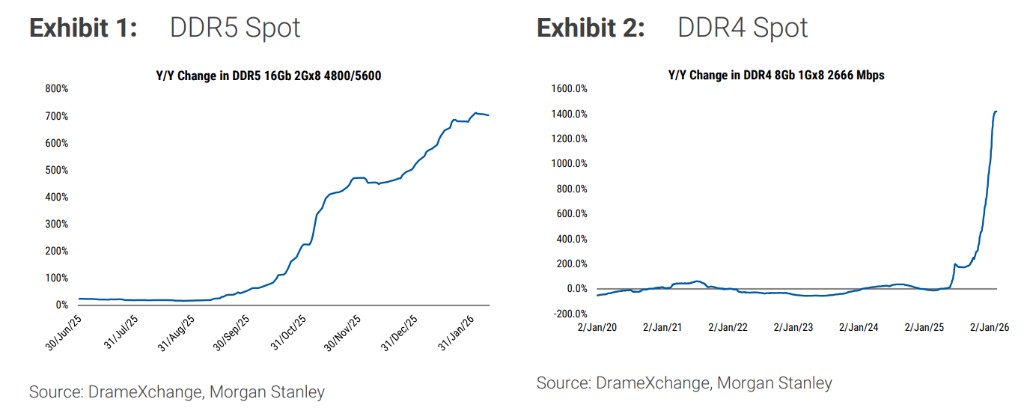
This price surge directly translates into astonishing profitability. Morgan Stanley clearly states that Micron's profitability is moving to a higher level, with EPS expected to reach $52.53 in the calendar year 2026.
Even if Micron chooses not to update specific numerical guidance in its financial report, as long as it confirms that market conditions are better than expected, any stock price pullback due to a lack of specific guidance should be viewed as an excellent buying opportunity. The current consensus expectation is that Micron's earnings will peak at around $12 later in 2027; Morgan Stanley considers this prediction extremely conservative, as Micron's earnings level may continue to exceed consensus models over the next year and a half.
Restructuring Valuation Logic: AI Premium and Cross-Cycle Profitability
The biggest divergence among investors currently lies in valuation multiples Morgan Stanley believes that it is wrong to evaluate Micron based on traditional cyclical thinking. Currently, the price corresponds to a price-to-earnings ratio of only 8 times the profit forecast of $48, while the current gross margin is already 10 to 15 percentage points higher than the peak of the last cycle. If viewed as a cyclical stock, this valuation is not only reasonable but can even be said to be extremely cheap, as it is closer to 5 times peak profitability rather than 10 times during the peak of the 2021 cycle.
Morgan Stanley has readjusted its valuation model, raising the estimated "cross-cycle earnings per share" from the previous $14 to $18. Although this figure is significantly higher than the historical average, it is still less than half of the expected earnings for the next 12 months.
Based on the unique tailwind effect brought by AI and the opportunities in HBM (High Bandwidth Memory), Morgan Stanley maintains a price-to-earnings ratio of 25 times for Micron. The cross-cycle EPS of $18 multiplied by a valuation of 25 times directly leads to a new target price of $450. Additionally, Micron's cash generation capability of about $10 billion per quarter means it can generate cash equivalent to 10% of its current enterprise value (EV) within a year, which will greatly improve its balance sheet.
Supply-Demand Gap Cannot Be Bridged: $200 Billion in New Demand
The cornerstone supporting this super cycle is the structural supply-demand imbalance brought about by AI. Currently, manufacturers have very low inventory on their balance sheets, and customers find it difficult to obtain sufficient supply even if they are willing to pay a premium. On the supply side, the output growth of wafer fabs is extremely slow, and Morgan Stanley expects that by the end of 2026, the year-on-year growth rate of wafer production, including ChangXin Memory Technologies (CXMT), SK Hynix M15, and Samsung P4L, will only be 7%.
In contrast, the growth on the demand side is explosive. NVIDIA expects to increase its quarterly revenue by $30 billion from now until the end of 2026, AMD's data center division expects its quarterly revenue to double to $10 billion, and Broadcom's semiconductor business will double to about $25 billion. Including the incremental contributions from Marvell and Intel, the entire storage industry needs to cope with nearly $200 billion in annualized new revenue demand within the next 12 months.
This figure is larger than the entire logic semiconductor market (such as CPUs and GPUs) in 2020, and the high capital intensity of HBM further limits the pace at which DRAM suppliers can catch up. Therefore, selling stocks merely out of concern for supply growth in the second half of 2027 seems premature.
Shattering the "Short" Narrative: Risks of Chinese Capacity and HBM4 Disproved
In response to market concerns about the potential impact of Chinese memory chip companies, Morgan Stanley believes that this concern is exaggerated.
As for the progress of HBM4, although there has been recent noise in the market, Morgan Stanley maintains its judgment. Micron stated as early as its December financial report that it had obtained qualification certification and expects to begin mass production and shipment of HBM4 in the second quarter of 2026 (C2Q26), and this timeline has not changed Even if Micron encounters unforeseen difficulties in ramping up HBM4 production capacity, HBM3e still occupies the mainstream market and has a broad ASIC customer base, which will not negatively impact profitability. The early major production share of HBM4 from NVIDIA has historically belonged to SK Hynix, which is expected and does not constitute a fundamental negative for Micron
