


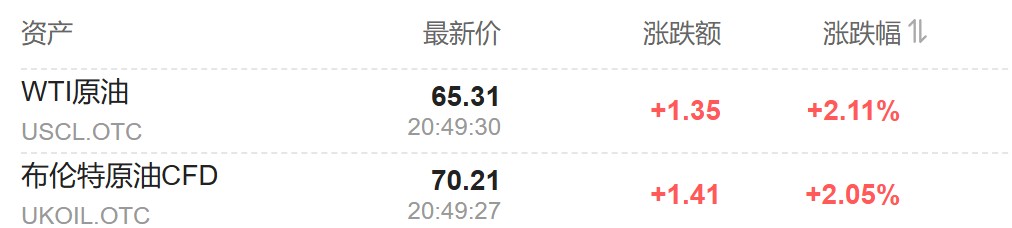
Oil prices rose over 2% during the day, reports: Trump is privately considering withdrawing from the US-Mexico-Canada Agreement

According to media reports, Trump is privately assessing the possibility of withdrawing from the United States-Mexico-Canada Agreement (USMCA), injecting uncertainty into the critical review on July 1. Currently, negotiations are showing bilateral divergence: Mexico is pragmatic, while Canada is tricky. This move may be aimed at forcing concessions from Canada and Mexico in areas such as immigration and drug prohibition. If the agreement collapses, it will rebuild tariff barriers, raise inflation, and impact the midterm election situation. Analysts believe that the threat of withdrawal is more likely a bargaining chip rather than an ultimate goal
According to media reports, U.S. President Trump is reportedly privately assessing the possibility of withdrawing from the United States-Mexico-Canada Agreement (USMCA) by consulting with advisors. This news injects significant uncertainty into the ongoing critical renegotiations between the U.S., Canada, and Mexico, casting a shadow over the agreement that covers approximately $2 trillion in trade and services.
According to CCTV News, on December 3, 2025, President Trump stated that either the USMCA would expire or a new agreement would be reached with Mexico and Canada. Additionally, Trump mentioned that Mexico and Canada have been taking advantage of the U.S., and tariffs have brought wealth to the U.S.
Insiders revealed to the media that Trump has asked his aides why he should not withdraw from the agreement, although he has not yet signaled a direct intention to exit. White House officials responded that Trump is the ultimate decision-maker and is always committed to securing better deals for the American people, and discussions about potential actions are purely speculative until the president makes a formal announcement. Meanwhile, officials from U.S. Trade Representative Jamieson Greer's office stated that merely approving the terms from 2019 does not align with national interests, and the government intends to keep all options open to address established issues.
The current negotiation situation is showing signs of divergence. In an interview, Jamieson Greer pointed out that negotiations will be conducted bilaterally, describing Mexico as currently "quite pragmatic," while dialogue with Canada is "more challenging." This indicates that as the mandatory review deadline of July 1 approaches, trade relations among the three countries are becoming increasingly complex.
Any move to withdraw from the agreement would shake the foundations of one of the world's largest trade relationships, and even the threat of withdrawal is enough to unsettle investors and leaders around the globe. If the agreement collapses, it would not only lead to the re-establishment of tariff barriers and exacerbate inflationary pressures but could also reverse three decades of efforts to integrate supply chains in North America, resulting in economic ripple effects on the upcoming midterm elections, posing a greater challenge for the Republican Party. Following this news, oil prices rose over 2% during the day.
Approaching Review Deadline and Bilateral Negotiations
The USMCA is facing a mandatory review scheduled for July 1, a process that was originally seen as routine but has now evolved into a contentious negotiation. If the three countries agree to renew, the agreement will remain in effect for another 16 years; if no consensus is reached, a ten-year annual review mechanism will be triggered until it expires in 2036. Any country can notify its intention to withdraw six months in advance.
Officials from Jamieson Greer's office stated that if a solution incorporating the opinions of industry stakeholders can be reached, Greer would recommend renewing the agreement. Potential areas of concern include strengthening the rules of origin for key industrial products, deepening cooperation on critical minerals, enhancing worker protections, and anti-dumping measures Trump has asked Ottawa and Mexico City to make more concessions beyond trade, pressuring them to address unrelated issues including immigration, drug trafficking, and national defense. Trump has publicly stated that he hopes to see Canada and Mexico do well, but has also bluntly remarked, "The problem is we don't need their products," suggesting a preference for negotiating through bilateral agreements.
Canada Faces a "More Challenging" Situation
Recently, Trump has intensified pressure on Canada and Mexico, particularly targeting Canada. According to Xinhua News Agency, he has threatened to impose a 100% tariff on Canadian goods; if Canada does not approve certain Gulfstream jets, he will raise tariffs on Canadian aircraft to 50%. Additionally, he has refused to open a new bridge connecting Ontario and Michigan.
Canadian Prime Minister Mark Carney stated that he had a "positive" call with Trump on Tuesday, discussing the bridge threat and the USMCA review issue. However, relations between the two countries remain tense. Carney spoke last month at the World Economic Forum in Davos, calling for middle powers to establish new connections to resist economic coercion from superpowers, and referred to the old rules-based international order as "fiction," which angered Trump. Furthermore, Trump's comments about NATO troops not being on the front lines in Afghanistan have also caused dissatisfaction among Canadians, with some even boycotting American products as a result.
In contrast, U.S. trade representatives believe that Mexico has been more pragmatic in negotiations, although Trump has also vowed to impose tariffs on Mexican products that are shipped to Cuba.
Tariff Risks and Inflation Concerns
If the U.S. withdraws from the USMCA, it could immediately trigger economic pain, subjecting more Mexican and Canadian export products to higher U.S. tariffs. Currently, most goods traded under the agreement are exempt from Trump's global tariffs, with specific exceptions like automobiles. According to 2024 trade data, Mexico and Canada are the two largest trading partners of the U.S. and the largest buyers of U.S. goods.
U.S. business groups and lawmakers are almost certain to oppose a withdrawal from the agreement. The prospect of higher tariffs will exacerbate inflation and affordability issues, which is a sensitive topic ahead of the midterm elections in November. If a withdrawal triggers retaliation from Canada and Mexico, it could hinder Trump's campaign promise to promote U.S. exports.
Trump's Negotiation Strategy and Attitude
Trump often seeks the opinions of his key aides on various issues. While these inquiries may reflect his thoughts, they do not necessarily indicate final actions. It remains unclear whether Trump will publicly threaten to withdraw or formally issue a warning. Analysts believe that if he takes this step, it may be more about using it as leverage to achieve a more favorable deal rather than genuinely intending for the U.S. to exit the agreement.
Although Trump was a negotiator of the agreement, his views on North American trade relations have changed. According to media reports, during a visit to a Ford Motor Company plant near Detroit, he referred to the agreement as "irrelevant," although he did not explicitly state that he would withdraw. This unpredictability has become a significant characteristic of Trump's second term, making it difficult for global leaders to gauge his intentions. Despite threatening to impose tariffs on North American steel and aluminum, he has also shown a willingness to retain most of the USMCA's provisions, particularly the tariff exemption mechanism following warnings from the automotive industry.
