


Elon Musk's Valentine's Day "self-castration"! For personal gain, or for the benefit of all humanity?

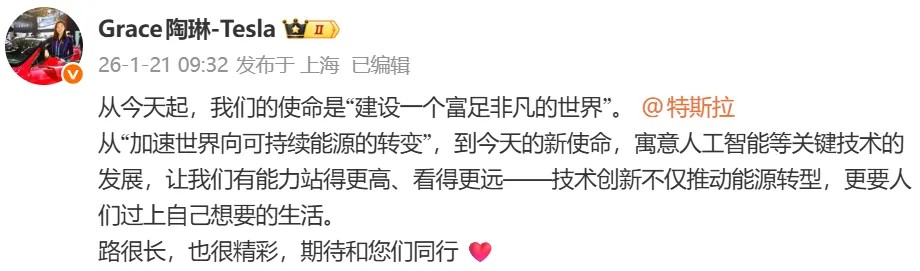
Elon Musk announced that Tesla will stop selling FSD on Valentine's Day, switching to a membership model at $199/month, with a one-time payment of $8,000 required for permanent usage rights before that date. The design of Tesla's AI5 chip is nearing completion, with a 5-fold increase in computing power, aiming to reduce costs and power consumption, supporting future autonomous taxis and robots. Tesla also plans to build a new chip factory to meet demand and has updated its brand mission to "build an extraordinary and abundant world."
Recently, Tesla's big news has been coming one after another.
First, Musk announced that on February 14, FSD would be discontinued in North America and Canada, and thereafter, it would only be available through a monthly subscription model at $199 (approximately RMB 1,400).
The transfer rights for the lifetime version of FSD, which allows "transfer to people, not cars," will officially end on March 31.
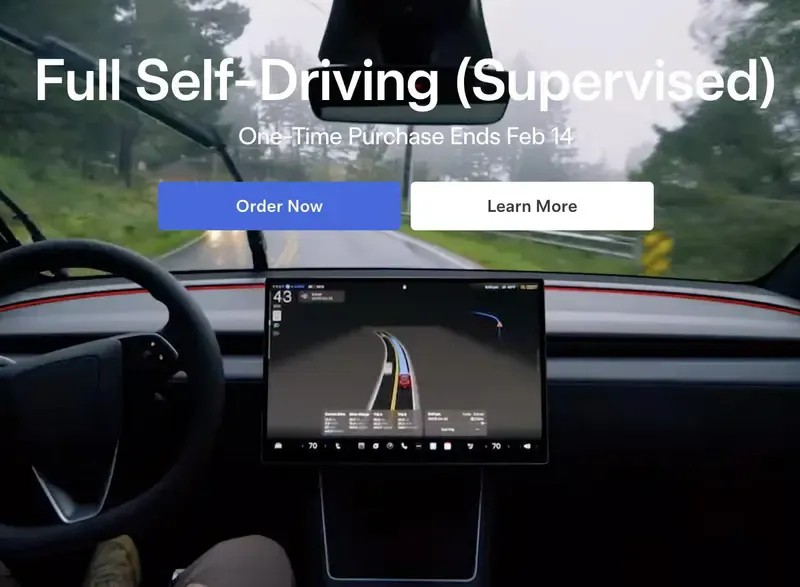
This means that to obtain permanent usage rights for FSD, one must pay $8,000 before Valentine's Day. If nothing unexpected happens, this will be the last opportunity to get in.
Following that, on January 19, Musk announced that Tesla's latest AI5 chip design is nearing completion, with the goal of completing the design cycle in 9 months (the industry typically requires 1-3 years). Meanwhile, the development of the next-generation AI6 chip has already begun.
Compared to the previous generation HW 4.0, the AI5's computing power has increased by about 5 times (2000-2500 TOPS), which will not only enhance the FSD experience and achieve a qualitative leap but will also be used for CyberCab autonomous taxis, Optimus humanoid robots, and Neuralink brain-machine interfaces, making it a "one chip for four uses."
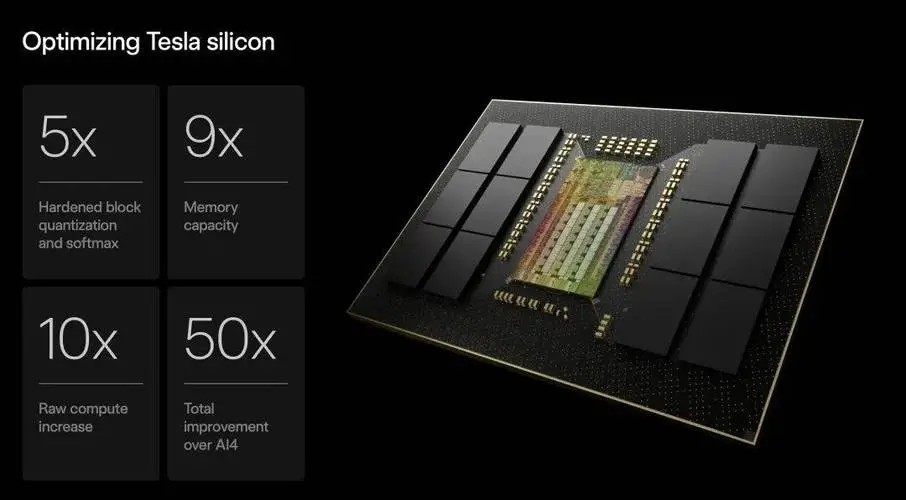
More importantly, the design orientation of AI5 is not extreme high computing power, but rather cost and power consumption.
In Musk's view, only by reducing the cost and power consumption per unit of computing power can they quickly scale up and create an unprecedented "robot army" consisting of 90 million Tesla cars and hundreds of billions of robots.
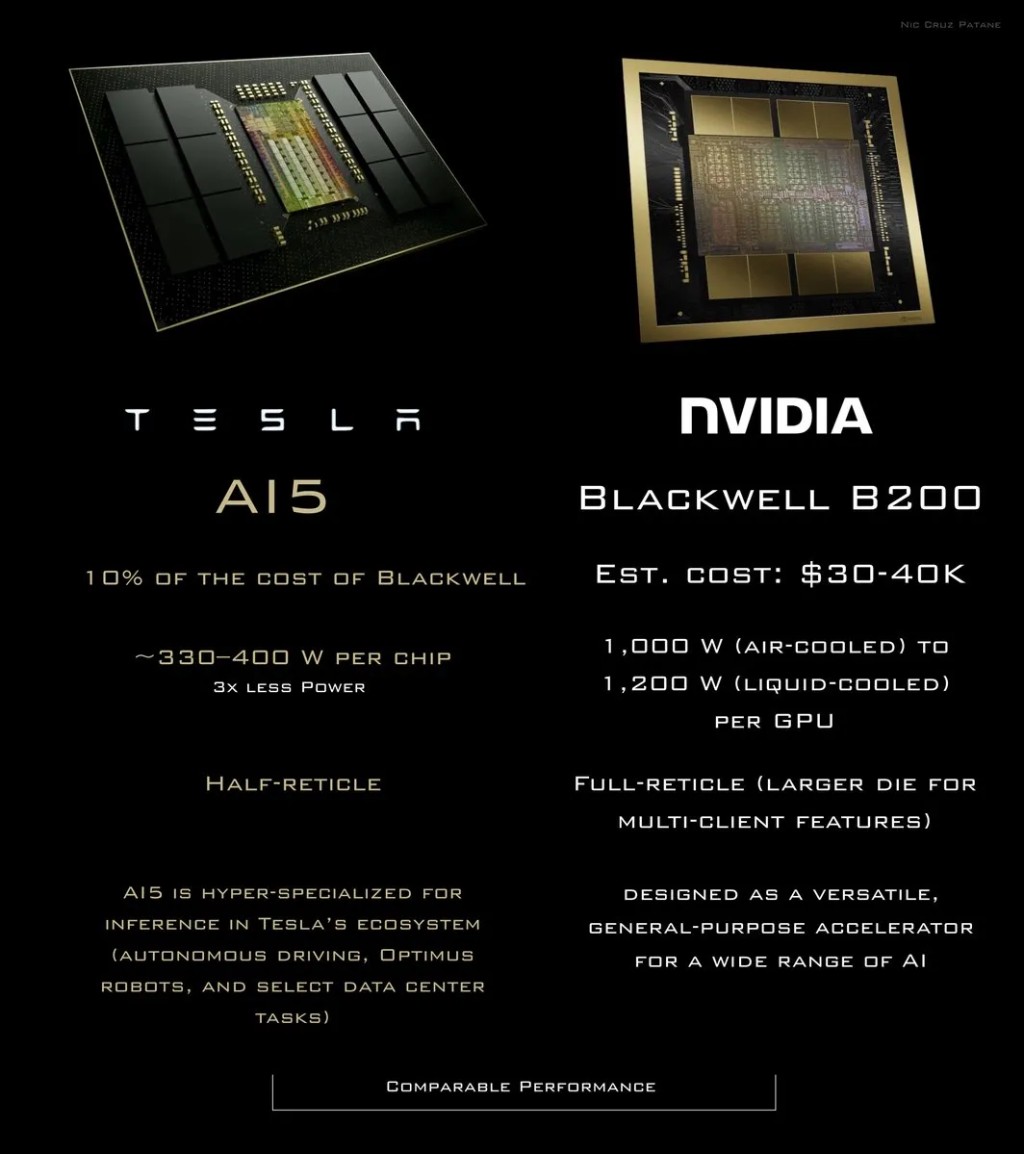
To achieve this, Tesla not only needs to find three major manufacturers—TSMC, Samsung, and Intel—to do the foundry work but also needs to build a TeraFab chip factory with a monthly production capacity of 1 million wafers (tera means trillion) to meet the massive chip demand.
The construction period for the factory must also be compressed from the original 5 years to one or two years to support Tesla's first-mover advantage in the AI field.
As for what big plans Musk really has in mind...
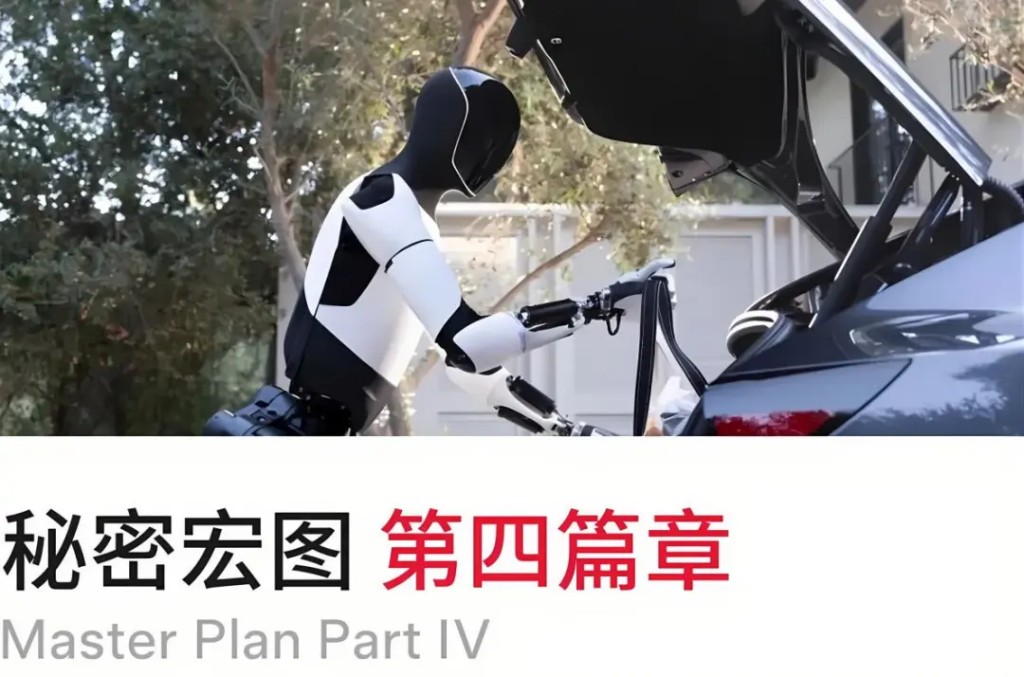 On January 21, Tesla updated its brand mission on its official website, changing from "Accelerating the world's transition to sustainable energy" to "Building a prosperous and extraordinary world."
Tesla Vice President Tao Lin also stated on Weibo that Tesla's next goal is to fully embrace AI, rapidly developing productivity through Tesla's cars and robots, allowing everyone to live the life they desire.
The first step of the secret grand plan's fourth chapter begins with FSD!
Is the intention not in the wine?
A simple calculation reveals that FSD has actually increased in price, and quite significantly.
Originally, as long as the car was not sold, FSD could be used until the vehicle was scrapped. Even if the car was sold, one could either recover the rights and transfer them to the next Tesla or sell it along with the car, getting some money back.
However, if it changes from a one-time purchase to a monthly payment, it can only be used for a maximum of 5 years, which is far less than the time many people take to change cars.

As soon as the news was released, American netizens were the first to explode with reactions.
Some believe this is Tesla's usual price increase tactic to force orders, with the only difference being "pay first" or "pay later." As long as you want to use FSD, you can't escape this price hike;
Others think Musk has become arrogant, trying to "cut leeks" before the FSD technology is fully mature, and that switching to monthly payments will only make it harder to sell;
There are also those who have uncovered that Musk is pushing for the FSD monthly membership system for his own benefit—
Last November, Tesla's shareholder meeting approved a new CEO performance reward.

For Musk to receive a trillion-dollar compensation, he needs to increase Tesla's market value nearly sixfold within 10 years, raise annual profits from $17 billion to $400 billion, and meet a series of stringent conditions.
One of these is that the number of active FSD users must exceed 10 million for three consecutive months.
To put this in perspective, national-level apps like QQ Music have a total of only about 15 million super members.
Based on this figure, just the monthly $199 "FSD membership fee" could bring Tesla $2 billion in profit, enough to buy 600,000 Tesla Model 3s in a year!
However, the ideal is beautiful, but reality is harsh.
Since last year, Tesla's financial reports have publicly disclosed FSD user data for the first time. By 2025, FSD users are expected to grow by 38% year-on-year, and monthly payment users by over 100%, but the total number of paying users is only about 1.1 million, with a penetration rate of less than 12%
This means that to boost FSD sales in a short period, simply selling cars hard is not enough; more Tesla owners need to start using FSD.
Thus, Tesla has rolled out the textbook-level business strategy we mentioned at the beginning.
The first step is to cut benefits.
Recently, the Model 3/Y in North America and Canada no longer comes standard with EAP (removing lane centering and retaining only adaptive cruise control), and its assisted driving capabilities are even inferior to many older gasoline vehicles:

The second step is to offer a 30-90 day FSD trial period, "try before you buy."
Considering the average one-way commuting distance in the U.S. is 24km, the experience with or without FSD can be vastly different. Even if it doesn't convert to orders immediately, it's still effective marketing—"You will eventually use FSD; you can't escape it."
The third step is to pressure users during the hesitation period.
On the surface, the choice to buy or not, to buy outright or pay monthly, seems to be in the user's hands. However, heavy users who need FSD daily have no choice but to buy outright.
The fourth step is to offer monthly payments.
For new car owners, while they can't buy outright, the monthly payment threshold is much lower. Skipping two meals allows them to experience the fun of having the car drive itself for a month, and they can manually turn it off when not in use. If they use it for 10 years, it may not even be more expensive than buying outright.

For Tesla, this "one fish, three eats" strategy not only squeezes money from existing users but also broadens the user base, turning a one-time sale into a continuous cash flow, which is a stroke of genius.
The only question is whether the FSD experience is worth the price and how many people will be willing to pay for it.
Is the early bird the one that knows the spring water is warm?
On January 21 this year, the American insurance company Lemonade announced that as long as Tesla owners activate FSD, their car insurance premiums can be directly halved. As FSD technology matures, premiums will further decrease.

Lemonade co-founder and CEO Shay Wininger stated: "FSD can observe the environment in 360°, never gets tired, and has millisecond-level reaction speed, with accident rates significantly lower than human drivers." This third-party endorsement is indeed highly valuable. After all, premiums are the lifeblood of insurance companies, and collecting over $1,000 less per vehicle each year will inevitably require a significantly reduced accident rate to support it.

As early as 2024, the updated V12 version of FSD, utilizing end-to-end algorithms, began to exhibit the qualities of an experienced driver.
In complex scenarios such as ghosting, multi-vehicle intersections, roadblocks, and detours, it can provide quick and precise handling solutions just like a real person, with operations that are unprecedentedly smooth.

In simple terms, assisted driving can be divided into three parts: perception, decision-making, and execution, corresponding to the eyes, brain, and limbs of human driving.
The smoothness of FSD is due to Tesla's end-to-end algorithms, which significantly reduce the latency between perception and decision-making, and between decision-making and execution through "anticipation."
This is akin to a novice driver changing lanes, who takes several seconds to signal, check the rearview mirror, and confirm a safe distance before turning the steering wheel; whereas FSD, like an experienced driver, performs the entire set of actions seamlessly.
In terms of data, Tesla can output 36 execution actions per second, while many cars can only output around 10.

In 2025, the V14 version of FSD saw significant advancements.
A driver set off from Los Angeles, activating FSD to cross the entire United States to South Carolina. The journey covered 4,400 kilometers and took 68 hours, including various usage scenarios such as highways, urban areas, and charging stops, even taking a lap on a racetrack.
The final number of takeovers was 0.

Although this driver specifically avoided border checkpoints that required stopping to achieve 0 takeovers, and the road conditions in the U.S. are not particularly complex, it still demonstrates the lower limit of FSD's capabilities.
However, this year, FSD has hitched a ride on the fast track of xAI.
When told, "I have a game to play soon, and I'm tired and hungry, give me some suggestions and navigate directly," it responds, "I suggest eating easily digestible carbohydrates and proteins, avoiding greasy foods, and it's best to eat one to two hours before the game. There's a Subway nearby; should I navigate there?" Borrowing the evaluation from Jim Fan, head of NVIDIA's robotics business, Tesla has likely passed the physical Turing test.
Behind this, it's not just Tesla's leading algorithms and the hundreds of EFLOPS computing centers for training AI large models, but also the support of massive amounts of data.

As of January this year, the cumulative mileage of FSD has reached one trillion kilometers, with over 400 trillion kilometers in complex urban conditions; the road testing time for Robotaxi has also exceeded 10 million hours.
The data generated daily is equivalent to 500 years of human driving time.
Tesla's unique skill is its efficient use of data through "video training."
It can identify extreme scenarios such as irregular obstacles, pedestrians, and out-of-control vehicles through small models on the vehicle, recording the operational and manual intervention time points of FSD.
These scenarios are reproduced in the virtual world model created by Tesla, allowing FSD to "practice driving" millions of times. By growing and learning from mistakes, it rapidly enhances FSD's ability to respond to emergencies.
Because of this, the actual experience of the American version of FSD can match its own Robotaxi.

Fully Charged FSD, Coming to China?
After understanding the technical principles of FSD, clever friends should have already noticed—
It is precisely the front-end data that creates the biggest difference in FSD between China and the U.S.
Although most of the complex training has been completed in the U.S., adapting to various road conditions and receiving good reviews in countries like Australia and South Korea, China has diverse traffic participants and rapidly changing infrastructure that complicate road conditions significantly.
Recognizing various road signs, familiarizing with road rules, avoiding vulnerable groups, and even negotiating with traffic regulations... To make FSD "transition from usable to user-friendly," it requires not only data but also time.

For Tesla, there is no large-scale fleet in China providing massive data, and vehicle data and environmental data are also difficult to export, meaning it can only use video training models for localized tuning to enhance driving assistance capabilities in extreme scenarios.
Moreover, the scale of computing power at the training center built in China cannot be compared to that of the U.S. headquarters.
Therefore, in the short term, Tesla will not deploy its "killer move" from the U.S., replacing the buyout system with a monthly subscription model; FSD will still maintain its "high price" of 64,000 yuan

But in the long run, the arrival of the full version of FSD in China is likely not far off.
Musk stated in a recent interview that "Europe may use the full version of FSD in February, and China will follow suit."
Tesla Vice President Tao Lin also candidly mentioned at a media communication meeting that "although there has been no formal rollout, FSD has been continuously adapted for the Chinese market, and its capabilities have been growing, and it will debut in the best possible state in the future."
By then, Tesla, this electric catfish, is likely to stir the market again and create new waves.
Final Thoughts
Looking back at the development of driver assistance technology, an interesting phenomenon can be observed.
The upper limit of the previous generation's technological capabilities often becomes the starting point for the next generation's technological capabilities.

Initially, rule-based algorithms attempted to make the driver assistance system understand the logic of how the human world operates and strictly execute it.
If understanding was difficult, various technologies such as BEV "bird's-eye view," Occupancy "2D to 3D," high-precision maps, along with 3D point cloud data from lidar and millimeter-wave radar, were added to help it see the world clearly.

However, rule-based algorithms cannot enumerate all extreme cases and write them into the system. The more complex the algorithm, the higher the computational power required; when encountering unfamiliar scenarios, it may suddenly become confused and freeze.
Thus, end-to-end algorithms and VLM large models emerged.
At this stage, the driver assistance system observes human drivers, mimicking their operations in special situations, while explaining in human language at each moment "what situation was encountered and why this action was taken."
This is somewhat like thousands of experienced drivers teaching the same apprentice hand in hand, followed by reviews, reflections, and corrections, allowing for rapid learning.
However, the downside is that as a "collection of experienced drivers," it inherits the bad habits of human drivers and does not truly understand the underlying physical world and the safety principles of traffic regulations.

Thus, VLA large models and world models emerged, making reinforcement learning the industry-recognized mainstream solution.
From learning how humans drive to exploring how to drive on their own... as long as there is enough data and a wide variety of simulated scenarios, the driver assistance system can continuously find the optimal solution through trial and error But its ceiling is at most "the strongest experienced driver." There is still a long way to go to achieve true autonomous driving.
To reach L4, it requires not only "the capability for autonomous driving," but also more redundant designs, verification of safety and reliability, and passing a series of regulatory assessments.

In the near future, a new generation of technology will certainly emerge, pushing assisted driving further towards autonomous driving.
As for whether Tesla will still be the leader this time?
That will depend on the speed of progress of Chinese brands, whether it is fast enough.
Electric Vehicle Community
Risk Warning and Disclaimer
The market has risks, and investment requires caution. This article does not constitute personal investment advice and does not take into account the specific investment goals, financial conditions, or needs of individual users. Users should consider whether any opinions, views, or conclusions in this article align with their specific circumstances. Investment based on this is at one's own risk
