


The AI computing power competition ignites super orders! Liquid cooling leader Vertiv's quarterly orders surged by 252%, and the 2026 performance guidance exceeded expectations

Vertiv's stock price surged 25% overnight. The Executive Chairman pointed out during the conference call that AI infrastructure is in its early stages, and the company's market position is becoming increasingly strong. Regarding the technical controversy, the CEO stated that CDU liquid cooling is irreplaceable and emphasized Vertiv's core position in complex thermal management systems. In addition, the company announced that it will stop disclosing quarterly order data to avoid short-term fluctuations interfering with long-term value judgments
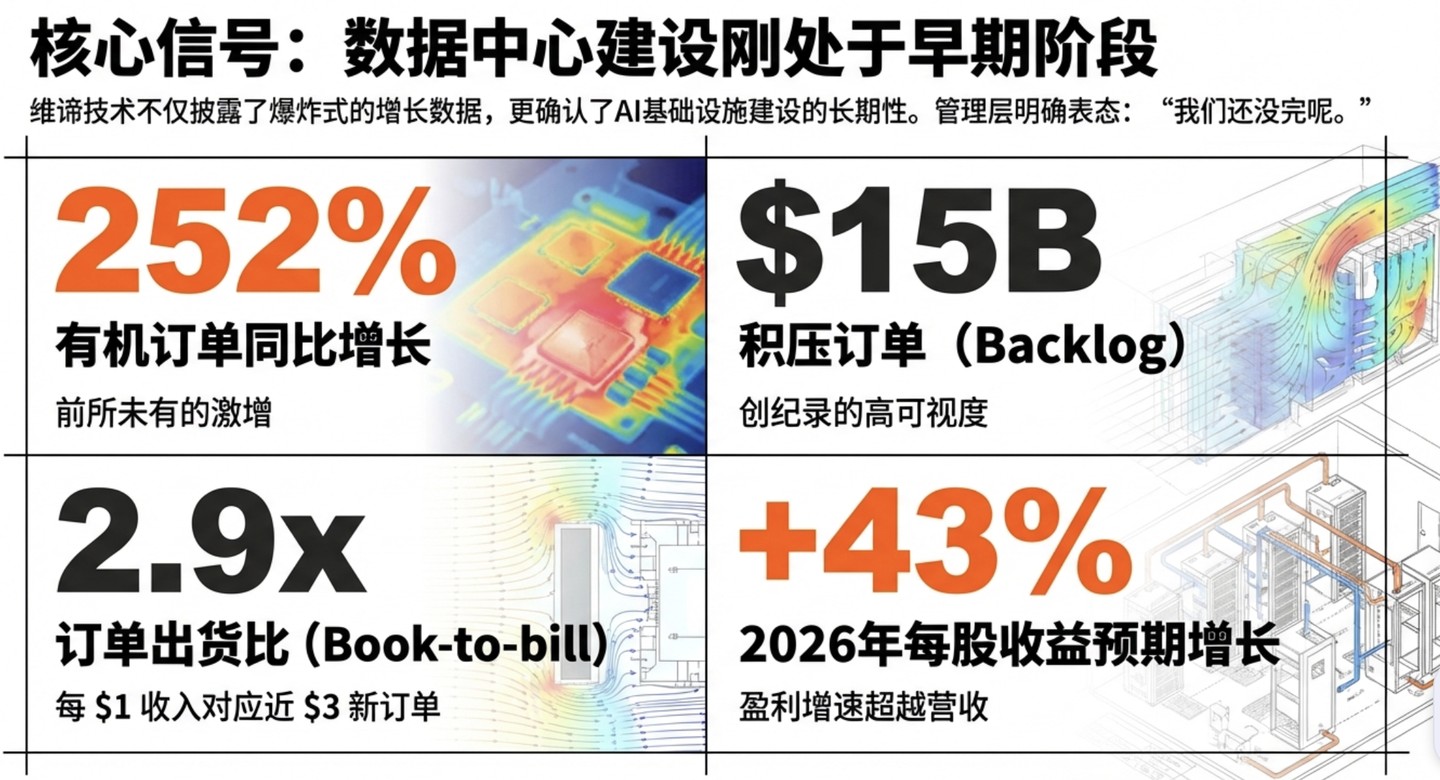
Driven by the AI computing power arms race, the liquid cooling leader Vertiv has delivered a performance report that far exceeds market expectations, with organic orders in a single quarter (excluding orders from acquisitions) skyrocketing by 252%, backlogged orders doubling, and providing an optimistic performance guidance for 2026.
Vertiv has just concluded its fourth quarter and full-year earnings conference call for 2025. The company's management not only disclosed explosive order growth data but also conveyed a clear message to the market through a series of strong and confident statements: the super cycle of data center construction is still in its early stages, and Vertiv's position in the market is becoming increasingly strong.
Driven by strong performance news, Vertiv surged nearly 25% overnight.
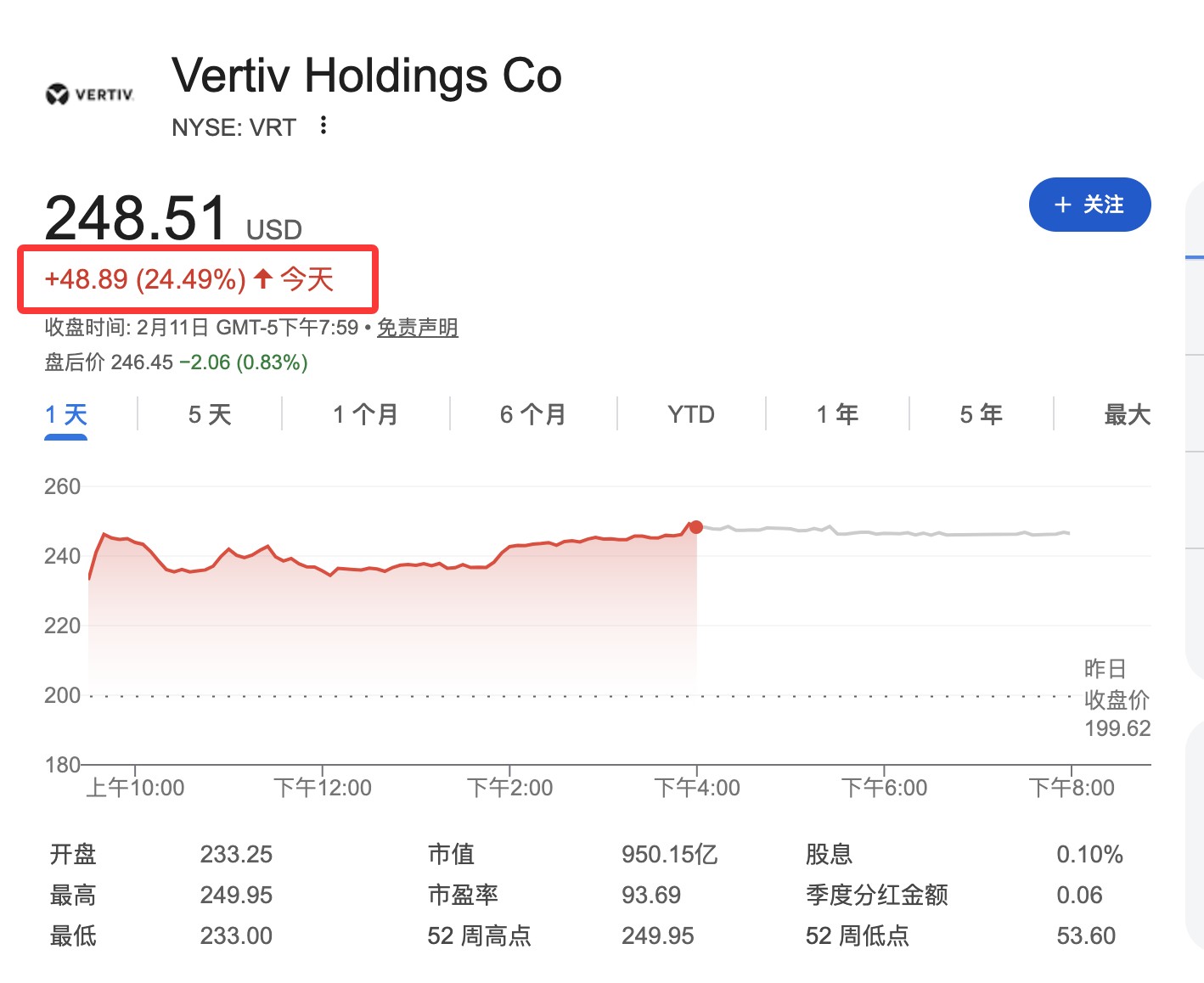
(Vertiv surged 24.56% overnight)
Order Surge: Year-on-Year Increase of 252%, Backlogged Orders Reach $15 Billion
“The momentum is undoubtedly very strong,” Vertiv CEO Gio Albertazzi stated candidly during the call. The most exciting data for investors appeared in the order segment: In the fourth quarter of 2025, Vertiv's organic order volume increased an astonishing 252% year-on-year and 117% quarter-on-quarter.
This data directly drove the company's backlogged orders (Backlog) to $15 billion, more than double that of the same period last year. The book-to-bill ratio reached 2.9 times, meaning that for every $1 of confirmed revenue, there are nearly $3 of new orders.
Vertiv Executive Chairman Dave Cote summarized the company's status in a very aggressive tone at the beginning:
“Vertiv is not choosing between today and tomorrow. We win now, we will win later... Simply put, we are not done yet.”
Regarding the influx of such a large volume of orders, the market is concerned whether it involves "rush orders" or abnormal factors. Gio denied this, emphasizing that it reflects the market's trust in Vertiv's scalable delivery capabilities and pointed out that orders are becoming “increasingly larger”:
“There are no major anomalies here... Orders are becoming increasingly larger. This is actually customers knowing they need our equipment, systems, and solutions, and knowing when and where they need them.”
2026 Guidance: EPS Expected to Increase by Over 40%, Americas Market as the "Main Engine"
Based on the massive backlog of orders in hand, Vertiv has provided an ambitious financial guidance for 2026. **The company expects the adjusted diluted earnings per share (EPS) for 2026 to be $6.02, representing a 43% growth at the midpoint; organic sales growth is expected to reach 28%, approximately $13.5 billion **
From a regional perspective, the Americas market remains the absolute core of growth. Organic growth in the Americas is projected to be 46% in 2025, with guidance assuming that the sales growth rate in the region will still be over 30% in 2026.
More interesting is the outlook for the EMEA (Europe, Middle East, and Africa) market. Although sales in the region fell by 14% in Q4, management has seen strong signals of recovery. Gio used a vivid metaphor to describe the shift in sentiment in the European market:
“We can say that the coiled spring is starting to release. Market sentiment has significantly improved, and pipeline growth is accelerating.”
AI and Liquid Cooling: "The explosion radius is too large," CDU is irreplaceable
During the Q&A session, in response to the recent market debate about whether "Rubin racks may not need coolers" or "using stainless steel coolers to replace CDU (Cooling Distribution Unit)," Gio made a strong rebuttal, defending Vertiv's "moat" in thermal management.
He pointed out that while chip temperature tolerance is improving, heat dissipation still exists, and hybrid cooling (air + liquid) will complicate the thermal chain, which is precisely where Vertiv's advantages lie. Regarding the radical proposal to cool chips directly bypassing the CDU, Gio's response was quite impactful:
“Currently, we have not seen any other ways to directly cool chips outside of the CDU... Simply put, in most cases, this would be too dangerous, and the explosion radius is a bit too large.”
This statement directly addresses market concerns about the disruption of technological routes, implying that in high-value assets like data centers, safety and reliability (provided by the CDU) are far more important than extreme cost reductions.
Capacity Expansion and No Longer Disclosing Quarterly Orders
To respond to this wave of "immense wealth," Vertiv announced an increase in capital expenditures (Capex). CFO Craig Chamberlin stated that the ratio of capital expenditures to sales will rise from historical levels of 2%-3% to 3%-4% by 2026. Gio added:
“We are accelerating capacity expansion... Factories are being expanded, and several new locations are about to go into production.”
It is noteworthy that the company announced a significant change in disclosure: it will no longer report actual orders, order forecasts, or backlog order data in quarterly reports, only disclosing this information in the annual report (10-K).
Gio explained that the "irregularity" of large orders can lead to unnecessary fluctuations:
“These fluctuations do not represent the company's ongoing performance and are not beneficial to our investors.”
Although this decision may reduce transparency in the short term, it also reflects management's intention for the market to focus on long-term delivery capabilities rather than single-quarter order fluctuations.
Full translation of Vertiv's Q4 2025 and annual financial report conference call:
Vertiv Q4 2025 financial report conference call
Conference Operator:
Good morning. I am Nadia, and I will be your conference operator today. Now, welcome everyone to the Vertiv Q4 2025 and full-year earnings call. To prevent background noise, all lines have been muted. Please note that this call is being recorded.
Now, I would like to introduce today's conference host, Vice President of Investor Relations, Ms. Lynne Maxeiner.
Lynne Maxeiner, Global Vice President of Finance and Investor Relations: Okay. Thank you, Nadia. Good morning, and welcome to the Vertiv Q4 2025 and full-year earnings call. Joining me today are Vertiv Executive Chairman Dave Cote, CEO Gio Albertazzi, and CFO Craig Chamberlin. Today's call will last for one hour. During the Q&A session, please be mindful of others in the queue, and each questioner is limited to one question.
If you have follow-up questions, please rejoin the queue. Before we begin, I would like to point out that during this call, we will make forward-looking statements regarding future events, including Vertiv's future financial and operational performance. These forward-looking statements are subject to significant risks and uncertainties that could cause actual results to differ materially from those expressed in the forward-looking statements.
Please refer to the cautionary language in today's earnings press release, and you can find more information about these risks in our annual reports, quarterly reports, and other documents filed with the U.S. Securities and Exchange Commission. Any forward-looking statements made today are based on assumptions we believe to be reasonable as of today. We have no obligation to update these statements due to new information or future events.
In this call, we will also present financial metrics calculated in accordance with U.S. Generally Accepted Accounting Principles (GAAP) and Non-GAAP measures. Our GAAP performance and the reconciliation between GAAP and Non-GAAP measures can be found in our earnings press release and in the investor slides on our website investors.vertiv.com.
Now, I would like to invite Executive Chairman Dave Cote to speak.
Dave Cote, Executive Chairman:
Well, I am very pleased with our performance in the fourth quarter and throughout 2025. We have achieved strong results in key metrics, and we are entering 2026 and beyond with tremendous momentum. What you are seeing now is the return on years of strategic investment and disciplined execution.
Our focus on engineering innovation, capacity expansion, and deep partnerships with customers is directly translating into results. Hugh and his team have done an outstanding job executing our strategy, and I am impressed with how they are addressing opportunities and challenges.
AI-driven infrastructure development is accelerating, with data centers at the center of it all. We are still in the early stages of this long-term growth trend. Vertiv's position in this market is becoming increasingly strong. Our technological leadership, global scale, and our service and operational capabilities are not easily replicable, and we are continuously widening this gap
We have established a good track record. We set ambitious goals and achieve them. Now, what excites me the most is this: Vertiv is not choosing between today and tomorrow. We win now and we will win in the future, which enables us to create value for both now and later. Simply put, we are not done yet.
Now, please welcome Gio, our leader and the architect of this wonderful day.
Giordano Albertazzi, CEO:
Okay. Thank you very much. Thank you, Dave, and welcome everyone. Please turn to slide 3, I am very pleased with how we are closing out 2025, another very strong quarter and a very strong year. In the fourth quarter, organic order volume increased by252% year-over-year and 117% quarter-over-quarter, with all regions and markets performing very strongly. The organic order growth rate over the past 12 months is 81%, and this number would be even higher if we include our recent acquisitions.
Our order-to-shipment ratio is 2.9 times. Our backlog has reached $15 billion, more than double that of the same period last year. Fourth-quarter organic net sales grew by 19%, primarily driven by significant strong performance in the Americas, which saw organic growth of 46%. The Asia-Pacific region declined by 9%, and the Europe, Middle East, and Africa region declined by 14%. The adjusted operating profit margin for the fourth quarter was****23.2%, an increase of 170 basis points compared to the fourth quarter of 2024, with adjusted operating profit of $668 million, a 33% increase year-over-year.
Our adjusted diluted earnings per share for the fourth quarter was $1.36, a 37% increase compared to the fourth quarter of 2024**.** The adjusted free cash flow for the year was approximately $1.9 billion, with an adjusted free cash flow conversion rate of 115%. For 2026, we expect adjusted diluted earnings per share to be $6.02, with organic sales growth of 28% and an adjusted operating profit margin of 22.5%.
Let me elaborate on the situation we see in each region, for which please turn to slide 4. Starting with the Americas. The Americas remain our primary engine of growth. Sales for 2025 are strong and broadly based, covering products and customer segments. The market is accelerating. Even after a large number of orders in the fourth quarter, our pipeline continues to grow. Our guidance assumes a sales growth rate of over 30%.
The Americas are leading the acceleration, and this momentum continues. Next, looking at Europe, the Middle East, and Africa, well, we can say that the coiled spring is starting to release. Market sentiment has significantly improved. Pipeline growth is accelerating. We saw strong orders in the fourth quarter and expect this to continue into 2026. We anticipate a recovery in sales growth in the second half of the year.
Speaking of the Asia-Pacific region, well, that is also accelerating. We expect moderate growth rates in China to continue into 2026, but India and other parts of Asia are accelerating strongly, and we are well-positioned to capture this growth opportunity
Now, please look at slide 5. I want to start with the customer demand on the left side of the slide, where Vertiv's momentum is very significant. Organic orders have grown by 81% over the past 12 months. Orders in the fourth quarter increased by more than 250%, with the order-to-shipment ratio approaching 3 times, showing strong performance, and we indeed saw some large orders this quarter.
These large orders reflect the increasing trust customers have in our scalable delivery capabilities, as well as their improved confidence in their own markets. Our backlog of $15 billion is more than double that of the same period last year, with a quarter-over-quarter growth of 57%, which is very strong. Notably, the structure of our backlog has not changed much compared to a year ago, except that the delivery window has been extended more to 12 to 18 months.
This is highly consistent with the very strong order intake in the fourth quarter. We see strong growth in the pipeline across all regions and all product technologies. This demonstrates the health of demand and the improvement in our market visibility. We are confident in capturing a significant portion of this pipeline. Orders are getting larger. For some time, we have been discussing the irregularity of orders. This irregularity can lead to unnecessary volatility. Market dynamics also make orders very difficult to predict. Consistent with our statements from last year, we have been reflecting on how we disclose our orders. We believe that the best approach at this time is to no longer report actual orders, order forecasts, or backlog in quarterly earnings reports. This seems to only lead to excessive volatility, which does not represent the company's ongoing performance and is not beneficial to our investors. We will continue to provide annual historical disclosures on sales and backlog in the 10-K form. We will provide our market outlook during the quarterly earnings call.
We are very pleased with the strength of the pipeline, our ability to win orders, growth prospects, and our potential to lead the industry. Our order performance was extremely strong last year, and we believe it will further grow in 2026. Pricing remains favorable. Pricing in 2025 exceeds inflation, and we expect the same for 2026. Now looking at the right side of the slide, let's talk about how we manage the current environment and prepare for growth.
We are mitigating material inflation pressures through pricing mechanisms and focused collaboration with suppliers. In terms of capital expenditures, we will increase from a historical level of 2% to 3% to 3% to 4% of sales by 2026. We continue to take a very disciplined and forward-looking approach to support our growth trajectory. Our suppliers are an extension of our operations, and we are working closely to ensure they can scale with us. This combination puts us in a very favorable position to capture future growth while protecting our margins—you can see this in our guidance.
Now let’s move to slide 6. You know we are passionate about driving rapid technological evolution. This is where Vertiv's advantages truly come into play. Our traditional expertise in gray space has been seamlessly enhanced and intertwined with our expertise in white space infrastructure For each rack with hundreds of kilowatts of load, the mechanical, electrical infrastructure, and IT stack are so closely interconnected that they need to be viewed as a system. Here are two integrated prefabricated solutions that fully align with this vision.
Let's start with OneCore, an end-to-end complete data center solution that greatly simplifies and accelerates the customer journey, significantly shortening time to market. Vertiv OneCore can scale to gigawatt levels with building blocks of 12.5 megawatts. OneCore is a complete, integrated data center infrastructure. It is designed and scaled by industry leaders to serve the industry with speed, simplicity, and repeatability. It is engineered and scaled by industry leaders with a complete product portfolio.
Our collaboration with Hut 8 proves this point. Now let's continue to introduce Vertiv SmartRun, an integrated and prefabricated white space infrastructure solution that greatly accelerates the fit-out and readiness of data halls. Similarly, it brings simplicity and time to market for our customers. SmartRun is flexible and scalable, capable of supporting multiple generations of silicon.
It is being deployed at scale among several large clients, and our collaboration with Compass Data Centers perfectly showcases these capabilities. Vertiv SmartRun can be used independently or as part of OneCore. We continue to actively define the market with solutions like OneCore and SmartRun.
Now please look at slide 7. Our service portfolio is a key competitive advantage and a strong source of recurring revenue. Our lifecycle service orders grew by over 25% year-on-year.
I am very pleased to see this. But you can imagine, I am not satisfied with just that. The increasing complexity of the market and technological challenges present opportunities to showcase our unique service capabilities and deepen customer relationships. Our service business is designed to provide customer value at every stage of the infrastructure journey. The acquisition of PurgeRite aligns perfectly with Vertiv's service paradigm. It significantly enhances our end-to-end fluid management capabilities, including primary and secondary fluid networks. These are critical systems in chilled water systems and liquid-cooled artificial intelligence data centers. Fluid management is one of the most technically demanding and financially impactful aspects of operating modern data centers and AI factories.
With PurgeRite, Vertiv now offers one of the most comprehensive fluid management capabilities in the industry, covering the entire process from initial design to commissioning and through decades of operational life for data centers. We optimize flow at startup and maintain balanced ultra-cleanliness and fluid performance throughout the lifecycle of the site. As environmental conditions change, each rack receives precisely the cooling it needs, achieving the highest levels of reliability and resilience. For customers, this means less thermal throttling, higher compute throughput, improved efficiency, and significantly reduced downtime risk for hardware valued in the millions of dollars
We expect PurgeRite's expertise to expand globally through our existing service network, creating a differentiated capability to meet the growing and critical customer demands. With that said, Craig, it's over to you. But first, I am pleased to introduce our new Chief Financial Officer, Craig Chamberlin, to the earnings call audience. Craig, it feels a bit strange to call you new. I am very satisfied with how quickly we have delved into the business, and we have collaborated very well; it feels like we have worked together for much more than just about three months, and I am very excited. So now, it’s really, really over to you.
Craig Chamberlin, Chief Financial Officer:
Thank you, Gio. First, I want to say that I am very excited to be the new Chief Financial Officer of Vertiv. In my over twenty years of career in the industrial sector, I have worked with many excellent companies. However, what is happening here at Vertiv stands out to me.
Our strong market position, exceptional technology quality, and the high caliber of this team make me very excited about the future direction. Vertiv's ability to establish competitive advantages, customer relationships, and operational capabilities is the result of disciplined execution and strategic vision. I am honored to join at this turning point and look forward to working with all of you to continue creating value for our shareholders. Now, let’s review our financial performance. Turning to slide 8, we can look back at our strong fourth-quarter performance, starting with adjusted diluted earnings per share of $1.36, a year-over-year increase of 37%, which is $0.10 higher than our previous guidance. The main driver was strong operational performance, particularly in the Americas, where we saw excellent sales growth. Organic net sales grew by 19%, with the Americas continuing to maintain strong momentum, growing by 46%, but partially offset by a 9% decline in the Asia-Pacific region and a 14% decline in Europe, the Middle East, and Africa.
Our adjusted operating profit was $668 million, a 33% increase from the previous quarter and $29 million higher than prior guidance. The adjusted operating profit margin was 23.2%, an increase of 170 basis points from last year. The margin expansion was driven by strong operational leverage from sales growth, productivity improvements, and favorable price-cost execution. At the same time, we saw the year-over-year incremental profit margin continue to maintain a positive trend, reaching 31% this quarter.
Concluding the discussion of the fourth quarter, let’s talk about cash. We achieved $910 million in adjusted free cash flow, a 151% increase from the fourth quarter of last year, thanks to higher operating profits and working capital efficiency, although partially offset by higher cash taxes.
The larger orders this quarter brought corresponding larger prepayments, which benefited our cash flow in the fourth quarter. At the end of this quarter, our net leverage ratio was 0.5 times, providing us with significant strategic flexibility. Turning to slide 9, let’s take a look at the performance of each segment, which further highlights some dynamics that Gio mentioned earlier. In the Americas, the team once again delivered strong results Sales increased by 50%, with organic growth of 46%. This growth is attributed to a broad strength in products and customer base, strong end-market demand, and our delivery capabilities.
Adjusted operating profit was $568 million, an increase of 77%, with a margin expansion of 450 basis points. These results are the outcome of strong operational leverage, positive price-cost differentials, and ongoing productivity improvements.
Looking to the right, sales in the Asia-Pacific region decreased by 10%, with organic decline of 9%. However, other regions in Asia remain strong. Adjusted operating profit was $49 million, with an adjusted operating margin of 9.9%, down 270 basis points from last year, primarily due to the pressure of volume deleveraging.
In the Europe, Middle East, and Africa region, sales decreased by 8%, with an organic decline of 14%, due to continued market weakness. However, as Gio emphasized, we see signs of recovery from the strong order performance in the fourth quarter. We still expect sales growth to resume in the Europe, Middle East, and Africa region in the second half of 2026. Fourth-quarter adjusted operating profit was $111 million, with an adjusted operating margin of 22.1%. This is a decline from last year's 26.6%, which is expected given the 14% organic sales decline. Margin pressure reflects lower operational leverage, and we expect this margin trend to continue into the first quarter.
Turning to slide 10. Here we highlight the full-year performance for 2025, where the team delivered outstanding results once again. We saw improvements across all key financial metrics. Adjusted diluted earnings per share were $4.20, an increase of 47%, exceeding guidance by $0.10. Net sales were $10.2 billion, achieving 26% organic growth, exceeding guidance by $30 million. We saw strong growth in the Americas at 41%, with Asia-Pacific growing 18%, partially offset by a 2% decline in Europe, the Middle East, and Africa.
Adjusted operating profit was $2.1 billion, an increase of 35%, exceeding guidance by $30 million. Operating margin expanded by 100 basis points to 20.4%. The full-year margin expansion was primarily driven by productivity and positive price-cost differentials. To conclude the margin discussion, I want to emphasize that while we are achieving margin expansion, we are also investing in growth and managing inflationary pressures.
Adjusted free cash flow was another strong performance. We generated approximately $1.9 billion in adjusted free cash flow, an increase of 66%, primarily due to higher operating profit and positive working capital, including increased prepayments this quarter due to a large volume of order deliveries. Our cash performance gives us the flexibility to invest in growth, pursue strategic acquisitions, and return capital to shareholders. These results demonstrate our exceptional execution and industry leadership.
Now let’s turn to page 11 for a detailed overview of our guidance for the full year 2026. We believe this outlook highlights our confidence in market growth and our ability to continue delivering exceptional performance. We expect adjusted diluted earnings per share of $6.02, with the midpoint representing a 43% increase. This improvement continues to show strong profit growth compared to last year. Turning to the net sales guidance, we expect a midpoint of $13.5 billion, representing 28% organic growth, with sales growth driven by continued strength in the Americas (growing nearly 40%), approximately 25% growth in the Asia-Pacific region, and flat to low single-digit declines in Europe, the Middle East, and Africa.
Regarding Europe, the Middle East, and Africa, as we mentioned before, we expect this market to re-accelerate in the second half of 2026. Subsequently, we expect adjusted operating profit to be $3.04 billion, with a midpoint margin of 22.5%, which implies an expansion of 210 basis points.
The expected margin expansion will primarily be driven by continued operating leverage and positive price-cost differentials, while we also expect to continue investing in capacity and technological advancements. Finally, for the full year, we expect adjusted free cash flow to be $2.2 billion, a 17% increase, reflecting anticipated strong profit growth and improvements in working capital, but offset by higher taxes and increased capital expenditures supporting growth. As you can see from the metrics on the page, we are confident in delivering strong performance again in 2026.
Turning to slide 12, let's take a look at the outlook for the first quarter of 2026 to conclude. For the first quarter of 2026, we expect adjusted diluted earnings per share to be $0.98, representing a 53% growth at the midpoint. In terms of net sales, we expect to achieve $2.6 billion, or a midpoint organic growth of 22%. This guidance anticipates nearly 40% growth in the Americas, approximately 20% growth in Asia-Pacific, and is expected to be offset by a decline of about 25% in Europe, the Middle East, and Africa.
We expect adjusted operating profit to be $495 million, with a midpoint growth of 47% and a margin of 19%, which corresponds to an expansion of 250 basis points at the midpoint. Regarding tariffs, it is worth mentioning that we expect to essentially offset the adverse margin impact from tariffs by the end of the first quarter this year, based on exit rates.
As you can see from these metrics, we expect a strong start to 2026. Now, I will hand the microphone back to Gio.
Giordano Albertazzi, CEO:
Okay, thank you, Craig. Let's summarize. To do this, we turn to slide 13. Again, the fourth quarter and the full year of 2025 exceeded guidance across all metrics. Orders and backlogs are very strong, reflected in an impressive order-to-shipment ratio of about 3 times. The momentum is undoubtedly very strong. Our position as an industry thought leader continues to strengthen, highlighted by our product technology offerings, system-wide approach, and service advantages. All of this has been reinforced by our acquisitions, with PurgeRite being a great example. Our guidance for 2026 shows improvements across all key metrics. I have never been more excited about Vertiv's future. We are leading the industry in orders. We are scaling up, and we are in a very favorable position to expand our market leadership and drive the industry forward
I am very much looking forward to seeing as many of you as possible at the investor meeting in May. With that said, Nadia, I’ll hand it back to you, and we’ll start the Q&A session.
Q&A Session
Conference Operator:
Thank you. We will now begin the Q&A session. (Operator instructions). The first question comes from Steve Tusa at JP Morgan. Please go ahead.
Steve Tusa, Analyst:
Hi, good morning.
Giordano Albertazzi, CEO:
Good morning, Steve.
Craig Chamberlin, CFO:
Good morning.
Steve Tusa, Analyst:
Yes, your ERP system must be quite busy this quarter; you might need to build a few more data centers to handle it. Regarding the dollar value of orders, you previously mentioned $3 million to $3.5 million per megawatt. Clearly, a lot of megawatt capacity is coming online and being ordered. However, is there an upward growth in this unit value that supports these orders? Or should we still view it as the correct framework for the total potential market in dollars per megawatt?
Giordano Albertazzi, CEO:
Yes. I would say that for now, you can use it as a framework. Clearly, we have also mentioned on other occasions that with the evolution of technology, the complexity of technology, and the technological trajectory, if viewed from the perspective of the total potential market per megawatt, it is absolutely favorable, and this is more certain. So it’s a bit early to say this at this stage. We like what we see. I think it’s best that in three months we come together, and of course, this will be an important topic.
Steve Tusa, Analyst:
Then a quick follow-up on the capital expenditure numbers. How should we think about the incremental capital expenditure of an additional $100 million? From what we’ve seen, whether it’s Eaton or some of your other peers, the sales growth multiple from this capital expenditure is quite high; for example, how much output multiple can $100 million mean? Is there a multiple, like 15 times or 20 times, that can be used to think about how this additional $100 million could support future revenue run rates? I just want to understand how you can achieve this, and what conditions are needed to execute this backlog of orders?
Giordano Albertazzi, CEO:
Let me try to answer that, Craig, if you want to add anything. But I would say that the best way to look at it is to see the percentage of capital expenditure as a percentage of sales moving from 2% to 3% to 3% to 4%, let’s say 3% to 5%. You can certainly relate this to our growth and trajectory. Yes, back to how we achieve this.
As I mentioned a few minutes ago, it’s about being incremental, about being ahead. But again, capital expenditure expansion and capacity expansion are not achieved through big leaps, at least not the way we do it. We like many meaningful steps, but I think the correlation between growth and the percentage of capital expenditure is an interesting and important element
Steve Tusa, Analyst:
Great. Thank you, everyone.
Giordano Albertazzi, CEO: Thank you.
Conference Operator:
The next question comes from Scott Davis of Melius Research. Scott, please go ahead.
Scott Davis, Analyst:
Hey, good morning, everyone.
Giordano Albertazzi, CEO:
Good morning.
Craig Chamberlin, CFO:
Good morning, Scott.
Scott Davis, Analyst:
Good morning, welcome Craig. Congratulations on an incredible year. Everyone, I'm just a bit curious, I'm trying to paint a picture of these huge orders that have come in for the fourth quarter, I know this is also at the core of Steve's question. But is there anything— you mentioned irregularities, but were there any particularly large projects or unusual things this quarter? Were there any incentives that prompted people to place orders before the end of 2025, like pricing or otherwise, or to get ahead in the queue? I just want to understand these numbers, which are absolutely huge.
Giordano Albertazzi, CEO:
Well, from a normal business process perspective, whether there are any unusual aspects like pricing or otherwise, the answer is quite simple, no. I would say this certainly reflects the market demand we are seeing. Of course, as I mentioned, it reflects the trust in our proven scalability, combined with our excellent technology. But the fact is, yes, there are indeed quite a number of large orders, but equally, quite a number.
We should not view this as a dramatic anomaly. This is what is happening in the market, orders are becoming larger and larger. So this is actually customers knowing they need our equipment, our systems, our solutions, and they know when and where they need them. So there are no big anomalies here, but orders can be irregular, sometimes they cluster in one quarter, a bit more in one quarter, less in another quarter, and so on. So the ordering is irregular.
This is what we have been saying for a long time, and this is also why we made the decision regarding order guidance and actual disclosures. But no, there is nothing unnatural.
Craig Chamberlin, CFO:
So I think this continues (multiple speakers).
Giordano Albertazzi, CEO:
Sorry, please continue, Craig.
Craig Chamberlin, CFO:
No, it indicates that it continues to validate what we talked about before, which is system-level thinking, and I think system-level thinking is starting to play out on a larger scale, Scott, which is making these orders larger than in the past
Scott Davis, Analyst:
That makes sense. Good luck to you all. Thank you for your explanation. I will stop here.
Giordano Albertazzi, CEO:
Thank you, Scott.
Conference Operator:
The next question comes from Amit Daryanani of Evercore. Amit, please go ahead.
Amit Daryanani, Analyst:
Thank you very much, and congratulations as well; the orders here are very impressive. If I look at the number of orders and backorders you have, you are clearly prepared for very strong performance, and I think not just in 2026, but even in 2027 and beyond. So I would like to know, Gio, if you could roughly outline what you believe are the key operational steps and critical bottlenecks that need to be addressed to convert this backlog into revenue and earnings per share in the future?
Perhaps it would help us understand what your focus areas are and what needs to run smoothly to convert these orders into sales and earnings per share for 2026 and 2027? Thank you.
Giordano Albertazzi, CEO:
Yes, okay. Thank you, thank you, Amit. We are indeed working hard and have been working hard. So this is not new. We have been working hard and will continue to do so. We are accelerating capacity expansion. Capacity expansion is always achieved in two ways. One is capital expenditure, the so-called capacity expansion, generally speaking, not just this, but also productivity improvements, but the other is really getting more output from existing capacity. So the dual approach we have talked about multiple times is still being implemented.
But now, we are—factories are expanding. We have several new locations about to come online, and we are working very, very actively with our supply chain. So we are indeed focused and diligently executing this backlog.
I think we are in good shape. We have been diligently and progressively but rapidly increasing capacity over the past few years and are re-accelerating based on our capital expenditure and revenue numbers.
Craig Chamberlin, CFO:
Amit, I think you can look at the fourth quarter; the acceleration in capital expenditure is reflected in the financial numbers, and you will also see the acceleration in capital expenditure in the guidance, which corroborates what we are doing.
Most of this is ongoing, meaning we are already in the process of expansion, and we understand what needs to be done to achieve the sales guidance we have announced.
Amit Daryanani, Analyst:
Got it. Thank you.
Conference Operator:
The next question comes from Jeff Sprague of Vertical Research. Jeff, please go ahead
Jeff Sprague, Analyst:
Hey, thank you. Good morning. Congratulations on your remarkable achievements. Perhaps I can briefly talk about Europe and Asia. First, regarding Europe, has the on-the-ground situation really changed, such as issues with permitting bottlenecks? Clearly, you mentioned that orders have improved, but the year started slowly.
Giordano Albertazzi, CEO:
Yes. Okay, thank you. Thank you, Jeff. Let's start with Europe, the Middle East, and Africa. I'll first talk about the entire Europe, Middle East, and Africa region. I think this is certainly a combination of accelerated investment, basically that's it. So it's not like someone waved a magic wand and made things like permitting in Europe easier; that would be too simplistic. But I think the need for more focus and awareness on infrastructure is now evident.
And those long-standing pipelines, remember, I've been emphasizing this. They have been and are expanding, and the sales cycles of various elements in the pipeline are accelerating. And we have some regions where progress is particularly smooth. Take Northern Europe as an example; it's not the only one, but it's an example where this is happening.
You may have heard me mention once or twice that given everything happening in North America, some decision-makers are still focused on North America, although they are still focused on North America now. But I think there is an awareness that action needs to be taken outside of North America.
That's what I think, or at least what we observe as the reality. So there is quite an optimistic outlook there. So you kind of see a positive expectation in the market that I haven't seen in a long time.
Jeff Sprague, Analyst:
Great. Thank you.
Conference Operator:
The next question comes from Chris Snyder of Morgan Stanley. Chris, please go ahead.
Chris Snyder, Analyst:
Thank you. Gio, you talked about the deep relationships the company has with leaders in the data center industry. So I guess my question is, how much visibility do these relationships provide Vertiv regarding the future workflows or architectures of these data centers? Because I have to imagine you need to develop solutions ahead of when customers are ready.
So I'm also interested in how far in advance the company starts its R&D or engineering processes to bring these future solutions to market. Thank you.
Giordano Albertazzi, CEO:
Of course. Thank you, Chris. I think there are several dimensions to this. We have always emphasized the strength of our relationships with customers and other ecosystem participants. It's very important. Very important because, as you said, our technology needs to be ahead of the cutting-edge chips—far ahead in terms of implementation.
But to achieve this, of course, working with NVIDIA or other chip technology providers requires looking two to three years ahead, sometimes at a higher level, like more R&D, but in our collaboration approach, we need to be two to three years ahead. So our roadmap will certainly extend, but one aspect that I am very proud of, which is very important to us, especially crucial for our customers' success, is the real technological partnerships we have with many customers, looking one, two, sometimes three years ahead, and then saying, "Hey, Given everything happening in the technology sector, considering your business model and customers, what technology is most suitable for your strategy?
This is not about being told, but about co-designing the architecture, allowing them to understand the possibilities from a technical perspective. I believe we play a unique and powerful role in this regard within the industry. So the results are very good.
Chris Snyder, Analyst:
It certainly seems that way. Thank you.
Giordano Albertazzi, CEO:
Thank you.
Conference Operator:
The next question comes from Nigel Coe of Wolfe Research. Nigel, please go ahead.
Nigel Coe, Analyst:
Thank you. Good morning, everyone. So I think we haven't seen too much impact from the digital space yet. That's good news. So I want to go back to the backlog question.
Giordano Albertazzi, CEO:
Understood. Sorry, I can't hear you clearly. The line is a bit choppy.
Nigel Coe, Analyst:
Okay.
Giordano Albertazzi, CEO:
Please continue, Nigel.
Nigel Coe, Analyst:
Yes, sorry. Can you hear me now?
Giordano Albertazzi, CEO:
Yes.
Nigel Coe, Analyst:
Yes, great. So I want to return to the backlog. I think, Craig, you mentioned more system-level orders. Clearly, you've been emphasizing the SmartRun product. Perhaps you could talk about where you see this success and what your wallet share is in data centers? Also, Gio, could you discuss the aging of the backlog? It seems the guidance suggests about a 15-month backlog conversion period. But typically, you are at 9 months. So maybe you could talk about whether we are seeing longer order durations in the backlog? Thank you.
Giordano Albertazzi, CEO:
Okay, I'll start with the aging so we can address that. We've mentioned several times that the delivery cycles requested by our customers are around 12 to 18 months, especially when we talk about larger orders, which are not precise sizes but always within a range. I would say that 12 to 18 months is a good approximation for the delivery time requested for large orders.
Typically, if it is indeed a large order, not just a single batch. That said, if you think about the structure of our order intake this year—sorry, last year 2025, we were very, very strong in the second half relative to the overall strong year, but especially strong in the second half, particularly in the last quarter—then you will see that 12 to 18 months will push some things into 2027, while we are very satisfied with our coverage for 2026
So again, as I mentioned in my previous comments, the structure of the backlog orders is not significantly different. It is merely a result of the timing of orders we receive when we take orders. Therefore, there is not much difference in the way the market inquires, demands, or expects us to deliver. Regarding systemic issues, we have clearly seen an acceleration.
When we talk about OneCore or SmartRun, we are discussing systems and solutions that are beginning to be widely adopted. This certainly helps with the dynamics of our backlog order reception. But when we talk about systems, we are not just talking about integration. For us, a system encompasses the entire power drive chain, the entire thermal management chain, and of course, when we deliver prefabricated solutions or integrated solutions, we need to consider all the components that are truly designed to work in synergy.
But again, if we go back to your previous question, my answer is that it is about sitting down with customers, having a complete product portfolio, having a good and deep understanding of system-level and data center-level technologies, and being able to communicate with our customers at the system level.
Nigel Coe, Analyst:
Okay. Thank you, Gio.
Giordano Albertazzi, CEO:
Thank you.
Conference Operator:
The next question comes from Andrew Obin of Bank of America. Andrew, please go ahead.
Andrew Obin, Analyst:
Yes, good morning.
Giordano Albertazzi, CEO:
Good morning.
Craig Chamberlin, CFO:
Good morning.
Andrew Obin, Analyst:
Gio, Craig, Lynne, thank you. My question is about services. It seems that the feedback we are getting is that one of Vertiv's major differentiating advantages is not just delivering products, but also being able to provide maintenance services on-site and offer various additional value-added services around that. Last quarter, you shared with us the increase in service personnel. Can you update us on how staffing is going in the context of rapidly growing backlog orders, and possibly give a preview of the direction of the service organization? I believe you will discuss this at the Analyst Day, but please give us a preview of what is happening there. Thank you.
Giordano Albertazzi, CEO:
Okay, thank you, Andrew. This is one of my favorite topics. I have many topics I like, but this is definitely one of my favorites. I agree, this is a significant differentiating advantage. As you can see, this is a huge differentiating advantage that we continue to invest in. So our perspective is definitely not static. We talked about the number of personnel. I think we are now very, very quickly approaching 5,000 on-site personnel, really thinking from the perspective of our on-site capabilities, and its trajectory is very similar to our delivery capabilities
Of course, it depends on the installed base, but the installed base is growing. Our services are growing. Certainly, commissioning and launching are very important events in the data center lifecycle, and we ensure that we have sufficient capacity locally to serve our customers while also developing our technology, not only in—PurgeRite is a great example for me, but also in all the digitization of our injection service business.
Craig Chamberlin, Chief Financial Officer:
I mean, I want to add one thing—I'm as excited about our service portfolio as Gio is, which comes from relying on services to survive and grow in heavy industry. I think this is the superpower we will continue to build, especially when you start to look at what we can do with the existing installed base.
Andrew Obin, Analyst:
Thank you very much.
Giordano Albertazzi, Chief Executive Officer:
Thank you.
Conference Operator:
The next question comes from Nicole DeBlase of Deutsche Bank. Nicole, please go ahead.
Nicole DeBlase, Analyst:
Yes, thank you for the question. Good morning, everyone, and congratulations on an outstanding quarter. Let's start with the backlog. I think there has been very good growth in the backlog both sequentially and year-over-year in the fourth quarter. Gio, as you look ahead to the next 12 months, based on what you see in the pipeline, do you expect the backlog to grow year-over-year again in 2026?
And then a small follow-up question on capital expenditures. Given the rapid growth in the industry, will we be in that 3% to 4% range of capital expenditures to sales for the foreseeable future? Thank you.
Giordano Albertazzi, Chief Executive Officer:
Well, I won't completely guide our orders; I wish I could provide a lot of details if I could. But if we go back to what we've shared, if you consider our directional guidance, we believe our orders will grow. You may have already calculated our orders for 2025, and now we have our sales. So, the answer might be simple. We believe we will continue to directionally increase the backlog. So that is indeed the case.
Craig Chamberlin, Chief Financial Officer:
Nicole, regarding your question, yes. About capital expenditures, I think, again, we always want to consider normalizing around 2% to 3%, as we are cautiously increasing, as Gio mentioned earlier. So we think this year might be slightly above normal levels. But on a normalized basis, we always want to stay around 2% to 3%. So I think that's our current answer. We won't set specific numbers for 2027 until we see the market situation from the order perspective. But this year's guidance is to continue to keep an eye on this as we move forward
Giordano Albertazzi, CEO:
Once again, we very much hope to see you at the investor day, and of course, this will be an opportunity to elaborate further on this and the long-term trajectory of the business.
Nicole DeBlase, Analyst:
I won't miss it. Thank you, everyone. That's all from me.
Giordano Albertazzi, CEO:
Thank you.
Conference Operator:
The next question comes from Julian Mitchell of Barclays. Julian, please go ahead.
Julian Mitchell, Analyst:
Hi, good morning. I just wanted to take a look at the composition of orders and backlog from a cash perspective. Because I think it's interesting that you have a significant operating capital cash inflow in 2025, and I believe we've heard from some other companies that high growth is a reason for poor cash flow conversion rates.
But for you, it's quite the opposite, largely due to the inflow of deferred revenue in the fourth quarter. So related to this, I want to understand whether the types of orders you received in the fourth quarter generated a disproportionate inflow of deferred revenue? Additionally, when we look at slide 11, you guide that operating capital and similar items will use a small amount of cash in 2026, but if orders are growing, wouldn't it be more likely to see another inflow of deferred revenue to help operating capital become a source of cash in 2026?
Craig Chamberlin, CFO:
Yes. Well, Julian, let me clarify the slide first, and then we can dive a bit deeper. But the slide states a year-over-year decline of $80 million. I believe this is a year-over-year decline, but it will still be an improvement in operating capital. It should be a result of operating capital, possibly positive, so it's just a smaller positive impact compared to the same period last year.
Julian Mitchell, Analyst:
Got it. Thank you. Are these deferred revenue balances inflated due to specific large orders, or should we think of them as proportional to the total orders you received? Just trying to understand this, because traditionally in the medium and low voltage electrical equipment space, you wouldn't have these large advance payments.
Craig Chamberlin, CFO:
Yes. I would say it depends on the type and mix of orders. Again, I think we do always strive for some upfront payments and progress payments. But the mix can have a bit of an impact on this, which may be a factor driving the increase in the fourth quarter relative to the third quarter, but I wouldn't say this is significantly different from what we've seen historically.
Julian Mitchell, Analyst:
Great. Thank you.
Giordano Albertazzi, CEO:
Thank you.
Conference Operator:
The next question comes from Mark Delaney of Goldman Sachs. Mark, please go ahead.
Mark Delaney, Analyst:
Yes, good morning, thank you very much for taking my question, and congratulations on your strong performance and very strong orders. I would like to understand Vertiv's view on how its cooling product portfolio and business opportunities will evolve.
I ask this question because after the Consumer Electronics Show, there has been some discussion suggesting that the Rubin rack may not require coolers; instead, after last fall's Supercomputing Conference, a competitor proposed replacing cooling distribution units with stainless steel coolers. So there are some changes here. I would love to hear your thoughts on how Vertiv's business opportunities will evolve and what this might mean for your megawatt content and market share. Thank you.
Giordano Albertazzi, CEO:
Let's start from the bottom—thank you, Mark. Let's start from the bottom, and I will return to what we said. We believe in technological evolution, which is certainly at the core of our statement and is beneficial from a content perspective. This is no exception. Clearly, there is an opportunity for some graphics processors to operate at higher temperatures than historically.
But this is basically true for many of NVIDIA's newer chips. Clearly, it does help, and that is a benefit. Let’s all remember that this does not eliminate heat dissipation. Heat dissipation will continue to exist and will continue to exist. Don't forget that some loads can be cooled at higher temperatures. Certain loads within some data centers require lower temperatures.
So if there is any difference, despite the overall efficiency of the system improving, we are increasingly considering hybrid cooling and thermal chain infrastructure. Now, clearly, there is the ability to reduce the number of coolers, but not the net number of heat dissipation technologies. This depends on specific climate conditions, the type of load, and the resilience of the data center designed for various non-graphics processor or different graphics processor loads.
When we look at this area, we are very encouraged by the products we see, and now that they have become catalog products, it is very, very important for us, what we call the series coolers. This is a cooler truly optimized for operation at high temperatures, but at the same time has the ability to provide flexibility for lower temperatures that coexist in the system.
So this is a solution that maximizes free cooling, and of course, it is very, very central to the future of the industry. So in summary, we see the design still being hybrid. If there is any difference, it makes the thermal chain more complex, and this complexity is something we like, as a company with a complete product portfolio, we are certainly in a perfect position to support our customers. Back to what we said, making the right choices for customers. Currently, we have not seen direct cooling of chips in ways other than through cooling distribution units. Simply put, because in most cases, this will be niche applications, possibly, but in most cases, it will be too risky, the blast radius is a bit too large, and so on. So we are very confident that cooling distribution units in various forms and shapes are a long-term component of the thermal chain.
Mark Delaney, Analyst:
Thank you, Gio. I appreciate it.
Giordano Albertazzi, CEO: Of course.
Conference Operator:
The next question comes from Andy Kaplowitz of Citigroup. Andy, please go ahead.
Andy Kaplowitz, Analyst:
Good morning, everyone.
Giordano Albertazzi, CEO:
Good morning.
Craig Chamberlin, CFO:
Good morning.
Andy Kaplowitz, Analyst:
Gio, Craig, good morning. If I look at the incremental profit margin core planned in your model, I think you have planned close to 30% for the first quarter and 2026, which is about the low end of your long-term range, but I think the scale of these contracts may work in your favor as they should maximize your ability to leverage sales.
So, considering the potential operational leverage, is it possible to generate a higher incremental profit margin, or do we need to be more conservative regarding the supply chain? Or/and do you need a higher level of growth investment to fund all the revenue growth?
Craig Chamberlin, CFO:
Yes, I would first say you are absolutely correct. There are indeed higher levels of investment. We still guide to the low end of what we have previously said, which is 30% to 35%. I think as we get through this year, as the investments we are making come into play, we can continue to see those numbers rise in our long-term guidance, and we will reiterate our outlook for the future on Investor Day.
But I think you are very accurate in what you said. Some of the investments we are making, and the acceleration of those investments, have put some pressure on us as we push for those incremental profit margins.
Giordano Albertazzi, CEO:
Yes, I would say the long-term trajectory has absolutely not changed. So we feel good about that.
Andy Kaplowitz, Analyst:
Okay. Thank you, everyone.
Giordano Albertazzi, CEO:
Thank you.
Conference Operator:
The next question comes from Michael Elias of TD Cowen. Michael, please go ahead.
Michael Elias, Analyst:
Great. Thank you for having me, and congratulations on the order quarter. It's great to see you gaining market share there. Gio, I have a question for you. I believe you have a similar feeling after coming out of the PTC exhibition, that demand is very strong. Looking ahead, could you give us an update on the utilization rate of existing production capacity?
Perhaps as part of this, could you introduce the evolution you have seen in the delivery cycles of products such as switchgear, given the strong demand, how have they changed over the past three months? Thank you.
Giordano Albertazzi, CEO:
Hey, Mike, thank you. Yes, of course, the demand is there and very healthy, as I mentioned, we are pleased to seize this opportunity. Again, capacity utilization, obviously, we are quite satisfied. Overall, I have always said that we have some buffer in our factory capacity load, and that remains the case. We are utilizing this buffer space, sometimes to accelerate our growth when necessary. But again, we like to plan our capacity with a buffer of 20% to 25%. The same approach to long-term capacity applies here as well.
This is how we decide on capacity increments, reflected in our capital expenditure numbers. Regarding delivery cycles, yes, certain product lines have indeed seen a slight extension. But again, overall, the delivery cycles in most products are roughly as such in the customer end markets.
So again, quite satisfied. Very pleased with our progress in this regard. We like growth. We like capacity utilization.
Michael Elias, Analyst:
Great. Thank you. Looking forward to seeing what happens next.
Giordano Albertazzi, CEO:
Okay. I think we have time for one more question.
Conference Operator:
The last question comes from Amit Mehrotra of UBS. Amit, please go ahead.
Amit Mehrotra, Analyst:
Thank you. Perhaps just to add and clarify here. So I wanted to ask about the pipeline because clearly the pipeline brings in orders. I can imagine if your orders doubled from the third quarter to the fourth quarter, your pipeline should be depleted. But from the way you talk about the pipeline, it seems that is not the case.
So please talk about that. And then the last one, just to clarify. Please remind us, from the perspective of deposit or delivery certainty visibility, what conditions need to be met for an order to enter your backlog? If you could remind us of that, that would be great.
Giordano Albertazzi, CEO:
Okay. So the pipeline has not been depleted. If anything is different, despite the very strong order intake last quarter, we still see the pipeline growing quarter over quarter. So again, very satisfied with that. It’s not just the market, but also our visibility into the market. So I want to reiterate, it has not been depleted.
Regarding what makes an opportunity a backlog order, that is a binding purchase order. All backlog orders at Vertiv are binding purchase orders. In most cases, there are often prepayments, but that is the nature of a purchase order, a legally binding purchase order
Amit Mehrotra, Analyst:
Understood. Alright. Thank you. I really appreciate it.
Giordano Albertazzi, CEO:
Thank you.
Conference Operator:
Thank you. Our Q&A session has now concluded. I would like to hand the conference back to Gio Albertazzi for closing remarks.
Giordano Albertazzi, CEO:
Alright, thank you very much. I appreciate everyone’s questions and thank you for taking the time today. Of course, I am very pleased with the results we delivered in 2025 and very satisfied with our positioning as we enter 2026. I am certainly very proud of the work done by the entire Vertiv team. I am super grateful for the collaboration with our customers and partners. We are pleased with our progress.
You now know me. We are certainly never satisfied. I am certainly never satisfied. We continue and will continue to invest ahead of the curve, maintain our technological leadership, and execute with speed and precision. I am more confident in Vertiv's trajectory today than ever before, and it is very encouraging. I want to thank everyone and wish you all the best for the rest of your day.
Conference Operator:
Thank you. The conference has now concluded. Thank you for participating in today’s presentation. You may now disconnect
