


AI strikes the "hard-hit area," Indian IT stocks have collapsed, is India's export engine about to stall?

Affected by the impact of AI automation tools such as Anthropic, Indian IT stocks plummeted over 4% to a four-month low on Thursday, with industry leader Tata Consultancy Services experiencing a significant decline. Concerns over business replacement triggered by AI, combined with weakened expectations for interest rate cuts in the U.S., led to a substantial evaporation of the industry's market value. Despite favorable policies and attempts at corporate transformation, the traditional labor-intensive model is facing fundamental challenges, causing market confidence to fall into crisis
Indian software exporters are facing a market confidence crisis triggered by artificial intelligence. On Thursday, Indian IT stocks plummeted over 4% to a four-month low, as ongoing concerns about AI disruption combined with strong U.S. employment data weakened expectations for interest rate cuts, putting this pillar industry that has supported the Indian economy for 30 years under valuation reassessment.
The Nifty IT index fell to a four-month low in early trading on Thursday, with industry leaders Tata Consultancy Services (TCS), Infosys, and HCLTech seeing stock prices drop by 4% to 5%. Last week, the sector had already evaporated $22.5 billion in market value, with the Nifty IT index experiencing a weekly decline of 7%, marking the largest drop in over four months.
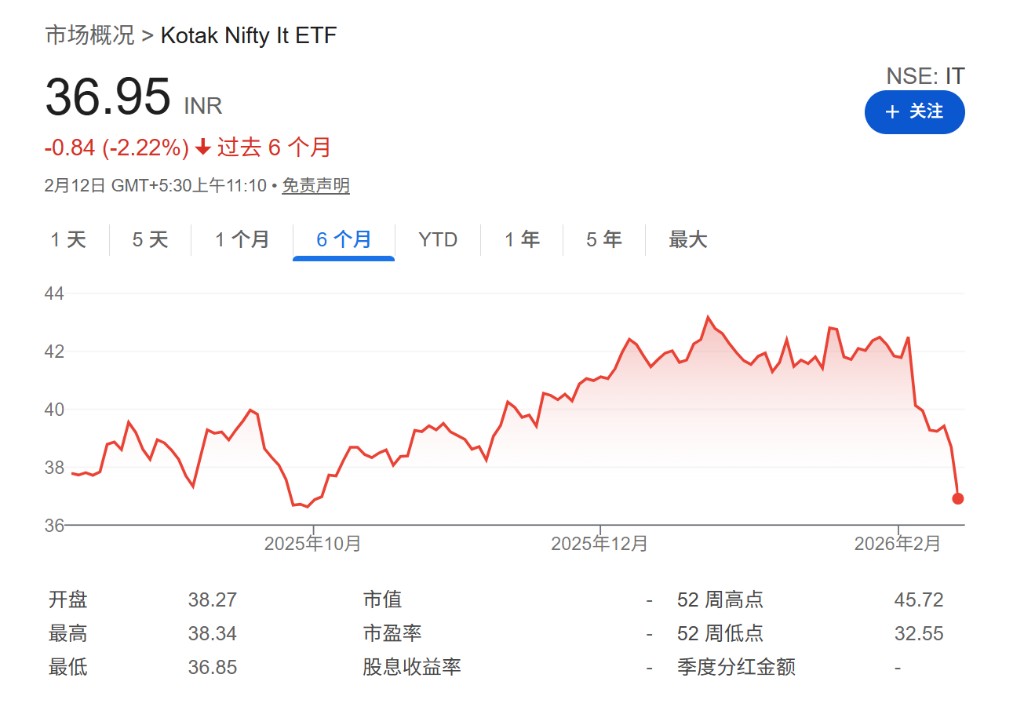
This sell-off was triggered by the launch of Claude Cowork, an intelligent agent plugin by Anthropic. This tool aims to automate tasks in areas such as law, sales, marketing, and data analysis, directly impacting the core business areas of the Indian IT services industry. This panic is synchronized with global tech stocks: the S&P 500 Software and Services Index evaporated about $800 billion before rebounding, marking the worst relative performance against the broader market in 25 years.
For an industry valued at $283 billion and built on a labor-intensive outsourcing model, AI brings not only short-term volatility. Although India has just reached a trade agreement with the U.S. and the EU, which is expected to support cross-border service exports, favorable policies are hard to withstand against technological shocks—AI automation threatens to compress project cycles and reduce billable hours, directly undermining the foundation of this export engine.
AI Tools Ignite Market Panic
Anthropic's Claude Cowork agent plugin became the catalyst for market sentiment. This tool can automatically perform tasks across legal, sales, marketing, and data analysis fields, precisely covering the types of outsourcing business that Indian IT service providers handle extensively.
Investment research firm Jefferies warned that "more pain lies ahead for the Indian IT industry." The firm pointed out that products from Anthropic and Palantir demonstrate how AI can erode application service revenues, which account for 40% to 70% of these companies' revenues. "Companies are facing growth pressures, and the market consensus on growth expectations has not fully reflected this, leading to downside risks in valuations," Jefferies stated.
Brokerage Motilal Oswal provided a more specific forecast: over the next four years, AI-driven disruption could eliminate 9% to 12% of the industry's revenue. This estimate highlights the scale of the challenge— even a relatively conservative loss percentage signifies a significant adjustment to the business model for IT service providers that rely on stable growth.
Labor-Intensive Model Faces Technological Shock
The Indian IT industry has been the flagship sector of the country's exports since the 1990s, with its success built on a simple logic: **providing a large number of highly skilled labor at relatively low costs to undertake software development and maintenance work for companies in developed countries. However, AI automation is challenging the core value proposition of this model **
"The market is concerned that AI tools may replace the currently outsourced IT services. The true impact remains to be seen," said VK Vijayakumar, Chief Investment Strategist at Geojit Investments.
The sensitivity of the timing lies in the fact that the Indian IT industry should have benefited from geopolitical tailwinds. Trade agreements reached with the United States and the European Union are expected to support cross-border service exports, solidifying India's position as a trusted technology partner. However, these policy dividends are hardly able to withstand technological shocks—while trade agreements may expand the volume of outsourced work, AI automation is compressing project timelines and reducing billable hours, directly hitting the labor-intensive model that has supported India's IT boom for decades.
Data from Société Générale shows that in the global software stock sell-off, the S&P 500 Software and Services Index has experienced its worst performance relative to the broader market in 25 years, and the panic in the Indian market is part of this global re-evaluation.
Diverging Views: Panic or Warning
Not everyone believes this is a survival crisis. Some analysts think the market reaction is ahead of the fundamentals.
Piyush Pandey from Centrum Broking described the sell-off as a "knee-jerk reaction." "AI tools have been in development, and this is just how the industry is evolving now. But currently, they are not expected to substantially disrupt the industry," he said.
JP Morgan stated, "It is illogical to extrapolate the rollout of some tools to the expectation that enterprises will replace every layer of critical enterprise software." Kotak Institutional Equities described the decline as "a lot of panic over a small fluctuation."
This view is echoed at the top of the AI value chain. Jensen Huang, CEO of NVIDIA, dismissed concerns that AI would replace software, calling it "the most illogical thing in the world." "If you are a human or a robot... would you use tools or reinvent tools? The answer is clearly to use tools," he said.
However, some remain cautious. "There will definitely be other tools in development... We do not expect the glorious era of the IT industry to return anytime soon," said Arun Malhotra from CapGrow Capital.
IT Giants Accelerate Transformation
Indian IT giants are not sitting idly by. TCS, Infosys, and Wipro are actively adjusting their strategies to turn AI from a threat into an opportunity.
Infosys is establishing new AI-led partnerships, TCS is embedding AI more deeply into its services, and Wipro stated that AI now supports many of its global pursuits.
But the key question is: can they adapt quickly enough? AI is rewriting the outsourcing rules, shifting from headcount and hourly billing to outcome and value delivery. This not only requires technological upgrades but also a fundamental transformation of business models.
For an industry built on cost arbitrage and scale advantages, the transition to value creation and intelligent services is both a necessity for survival and fraught with uncertainty. The market is clearly reserved about whether this transformation can be successfully completed, and the answer may take years to reveal
