


The "Boiling Point" Moment of the Liquid Cooling Era: Insights into the New Revolution in Liquid Cooling from Vertiv's Financial Report

Vertiv's Q4 2025 financial report shows that performance significantly exceeded expectations, with orders increasing by 252% year-on-year, and backlog orders reaching $15 billion. The revenue guidance for 2026 is $13.5 billion, far exceeding analysts' expectations. Liquid cooling technology has become a necessity in the industry, marking the transition from the "air cooling era" to the "liquid cooling era." The industry will reach a critical moment of large-scale production in 2026, with market space rapidly expanding
Order growth year-on-year, with a backlog of $15 billion (over six times last year's total revenue), and a revenue guidance of $13.5 billion for 2026 (far exceeding analyst expectations) — Vertiv's data clearly indicates that liquid cooling has transitioned from an "optional solution" to a "necessary standard," moving from "technology validation" to an "order explosion period." The year 2026 marks a watershed moment for the liquid cooling industry as it shifts from "pilot" to "mass production," with a trillion-level market space rapidly opening up, necessitating a systematic enhancement of strategic awareness in this sector.
I. What happened? Vertiv's performance significantly exceeded expectations
Vertiv announced its Q4 2025 financial report, with performance and guidance surpassing expectations, driving the stock price up by 24%. This signals a definitive industry shift as global computing infrastructure fully transitions from the "air cooling era" to the "liquid cooling era." Orders increased by 252% year-on-year, with a backlog of $15 billion (over six times last year's total revenue), and a revenue guidance of $13.5 billion for 2026 (far exceeding the analyst expectation of $11.7 billion). The year 2026 will be a turning point for the liquid cooling industry as it moves from "pilot" to "mass production," with a trillion-level market space rapidly opening up.
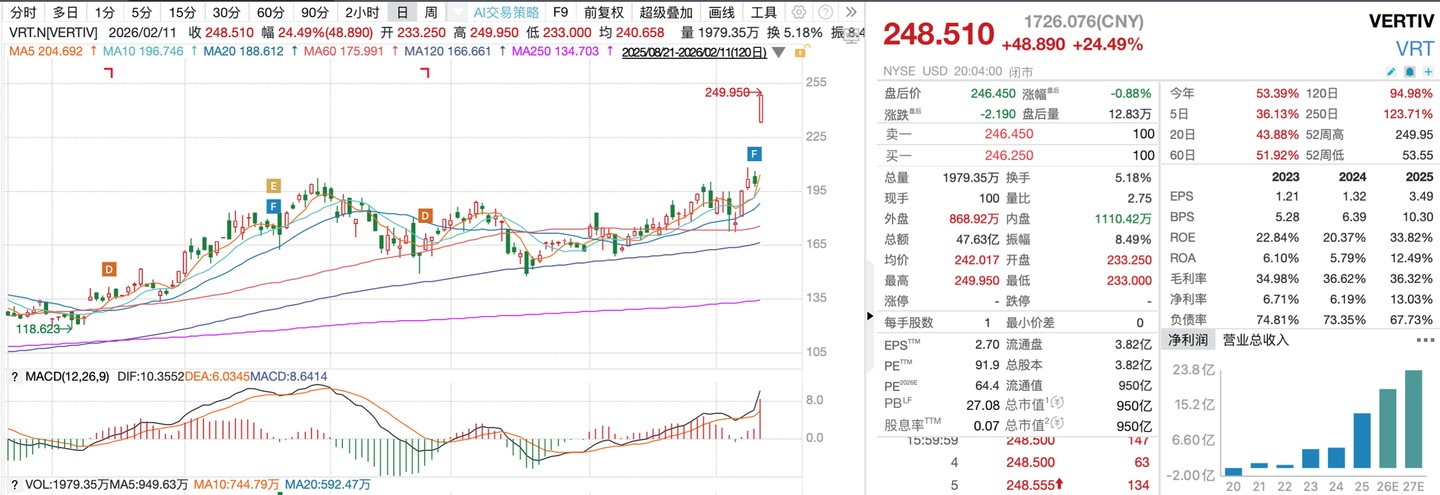 Source: WIND
① Core financial data: Not just a "beat," but a "structural re-rate"
All key financial indicators for Vertiv show nonlinear growth characteristics:
(1) Profitability and revenue: Comprehensive outperformance
Q4 adjusted EPS was $1.36, a year-on-year increase of 37%, significantly higher than Wall Street's expectation of $1.29;
Q4 revenue was $2.9 billion, a year-on-year increase of 23%, with organic growth of 19%, and the Americas region recorded an astonishing growth rate of 46%;
(2) Orders and backlog: A true "trigger point" signal
Q4 orders increased by 252% year-on-year and 117% quarter-on-quarter;
The book-to-bill ratio reached 2.9 times, meaning for every $1 in sales completed, nearly $3 in new orders were received;
The ending backlog reached $15 billion, doubling compared to the same period last year, equivalent to 1.5 times the company's total revenue for 2025 and 1.1 times the revenue guidance for 2026.
(3) Profitability and cash flow: Solid growth quality
Q4 adjusted operating profit margin was 23.2%, an increase of 170 basis points year-on-year;
The adjusted free cash flow for the year was approximately $1.9 billion;
The net leverage ratio was only 0.5 times, indicating an extremely healthy balance sheet.
(4) 2026 guidance: Significantly higher than market consensus
The full-year revenue guidance is $13.5 billion (range of $13.25-13.75 billion), corresponding to an organic growth of 28%, far exceeding Wall Street's expectation of $11.7 billion;
The full-year adjusted EPS guidance is $6.02 (range of $5.97-6.07), a year-on-year increase of 43%, far exceeding the expected $4.85; 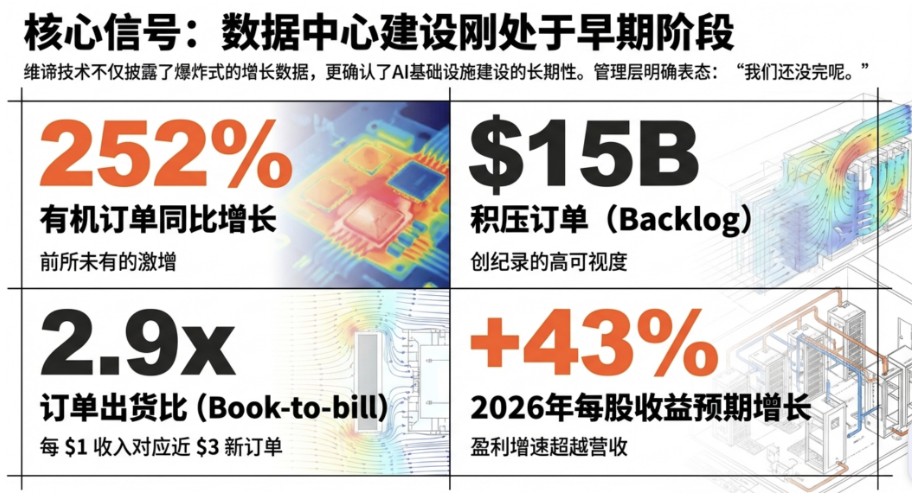
② The inherent nature of the industry implied by the financial report: three "unexpected" signals
Signal One: Non-linear growth in orders reflects a shift in customer purchasing behavior from "pilot" to "panic buying."
The 252% order growth rate is far from explainable by "linear extrapolation." This indicates that a group of large internet clients has completed the final validation of liquid cooling solutions and has entered the stage of large-scale procurement. CEO Giordano Albertazzi clearly stated in the conference call: "We see strong growth in project reserves (pipeline) across all regions and all technology product lines, with order sizes increasing." This is not merely a cyclical restocking but a structural wave of capital expenditure driven by generational technology replacement.
Signal Two: $15 billion in hand orders lock in growth visibility for the next 18-24 months
The order delivery cycle for Vertiv has extended from the past 6-9 months to 12-18 months. This is not a decline in supply chain efficiency, but rather demand far exceeding short-term delivery capabilities. This means the company's performance certainty has risen to the top level of the AI hardware supply chain.
Signal Three: 46% organic growth in the Americas, EMEA "the spring is uncoiling"
The rapid growth in the Americas is the most direct evidence of AI computing power investment being transmitted to infrastructure. More critically, orders in the EMEA region have significantly warmed up, with management describing the European market's activation as "the coiled spring is uncoiling." This suggests that liquid cooling demand is spreading from North America to the global market, and the breadth and sustainability of industry prosperity are expected to exceed expectations.
After the financial report was released, Vertiv's stock price hit an all-time high. Please note that this is not a simple pricing of a single quarter's performance, but a systematic reassessment by the market of the growth expectations for the entire liquid cooling industry. The strategic significance is worth noting, similar to the previous December VIP article "Micron Financial Report Interpretation."
II. Why is it important? Liquid cooling becomes a core new variable
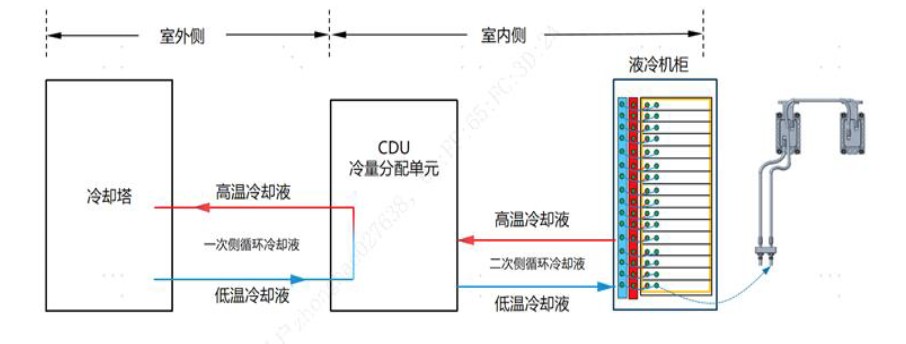
Why is liquid cooling a major trend? The underlying logic is that chip power consumption has broken through the physical limits of air cooling, making liquid cooling the "only solution."
Currently, the thermal design power (TDP) of AI acceleration chips has generally reached 700-1000W, with NVIDIA's B200 platform power exceeding 1000W, and the next-generation Rubin architecture is expected to rise further. The cooling capacity limit of air cooling is about 800W per chip; beyond this threshold, traditional cooling solutions will face:
- Noise and reliability issues caused by excessively high fan speeds;
- A sharp decline in airflow organization efficiency;
- The PUE (Power Usage Effectiveness) of data centers is deteriorating and cannot meet regulatory requirements.
Therefore, liquid cooling is not a "better choice," but rather the "only viable path." Major global cloud service providers have clearly designated liquid cooling as the default standard in their next-generation architectures. This is a critically important qualitative judgment:
-
2024: Liquid cooling remains a "technical option," with some customers piloting it;
-
2025-2026: Liquid cooling will be included in bidding requirements, becoming a "threshold requirement";
-
2027 and beyond: Air cooling will be basically eliminated in newly built high-end computing clusters.
 TrendForce predicts that the penetration rate of liquid cooling in global AI data centers will rapidly increase from 14% in 2024 to 47% in 2026. A threefold increase in penetration rate over three years represents an extremely steep S-curve in the history of hardware technology substitution. According to estimates, the global AI server liquid cooling market size is expected to reach $21.8 billion by 2027. The demand for cold plate liquid cooling corresponding to NVIDIA GPUs alone will reach $6.9 billion and $17.3 billion in 2025 and 2026, respectively; if including ASIC chips from AMD, Amazon, etc., the total scale will increase by $500 million and $1.2 billion.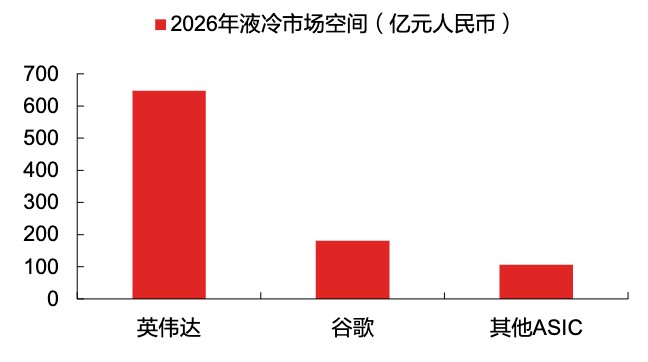
What does $21.8 billion represent?
-
Approximately 15%-20% of the global server market size;
-
8-10 times the global liquid cooling market size in 2023;
-
CAGR (2024-2027) exceeding 80%.
In 2026, looking at the industry's current landscape from three dimensions of liquid cooling—
(1) Supply side: Capacity bottlenecks begin to emerge, capital expenditures enter an upward cycle
Vertiv has raised its capital expenditure as a percentage of revenue for 2026 from 2-3% to 3-4%, mainly for new factory construction and capacity expansion. Domestic manufacturers such as Infinera and Yimikang are also entering the capacity ramp-up stage. Early equipment investment indicates that the prosperity of the industry chain is sustainable.
(2) Demand side: NVIDIA's Rubin platform becomes the "strongest catalyst"
The computing trays and network switch racks of the Rubin architecture adopt a fanless design, relying entirely on liquid cooling for heat dissipation. This means that Rubin will become a milestone product for liquid cooling penetration rates to exceed 90%. It is expected that Rubin will begin small-scale shipments in 2026 and ramp up in 2027, highly coinciding with the timeline of the liquid cooling industry's $21.8 billion long-term market space.
(3) Price side: Profitability continues to improve Vertiv Q4 operating profit margin is 23.2%, up +170bp year-on-year. This indicates that liquid cooling products have good pricing power due to high technical barriers. With the release of scale effects, leading manufacturers still have room for margin improvement.
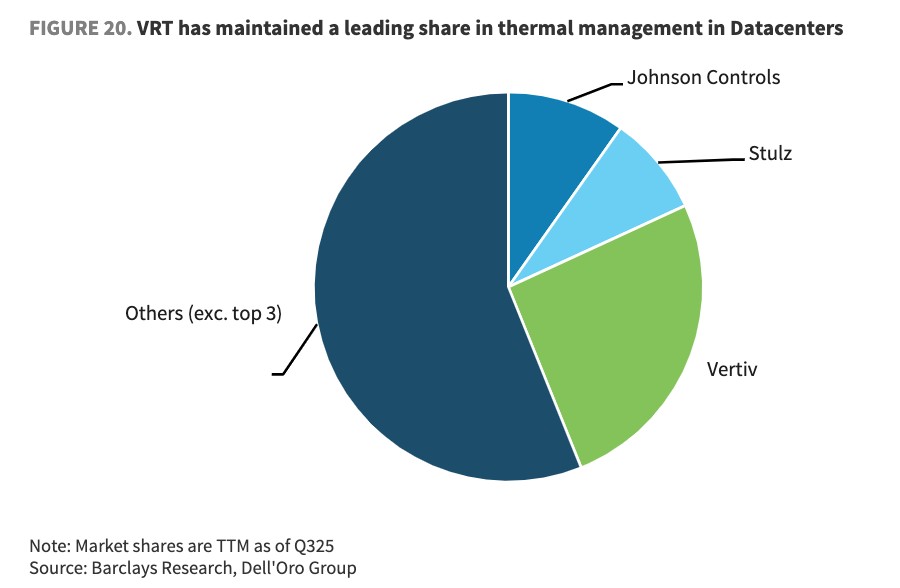
III. What to focus on next? Technical routes and industrial value distribution
The liquid cooling technology route presents a clear layered pattern:
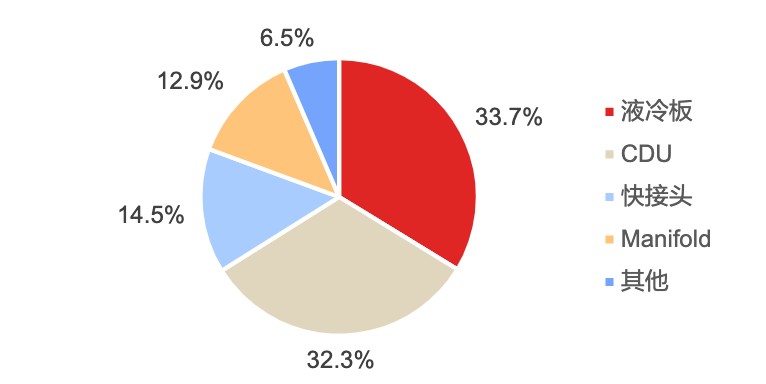
(1) Cold plate liquid cooling (DTC, Direct-to-Chip) — currently the absolute mainstream (90%+ share)
-
Advantages: Minimal changes to server components, smooth transition from air cooling, mature industrial chain, controllable costs;
-
Current status: Vertiv and Taiwanese manufacturers (Shuanghong, Qihong) dominate, with domestic companies like Invec and Sugon already having full-chain solution reserves;
-
Outlook: The next 3 years will still be the main shipping force.
(2) Immersion liquid cooling — the ultimate solution for ultra-high heat density
-
Advantages: Highest cooling efficiency, PUE can be as low as below 1.1, completely eliminating fan power consumption;
-
Bottlenecks: High cost of cooling liquid, difficulty in equipment modification, maintenance ecosystem not yet mature;
-
Judgment: 2026-2027 is the "eve of explosion" for immersion liquid cooling, expected to occupy 10%-20% share in leading supercomputing clusters and newly built large data centers after 2028.
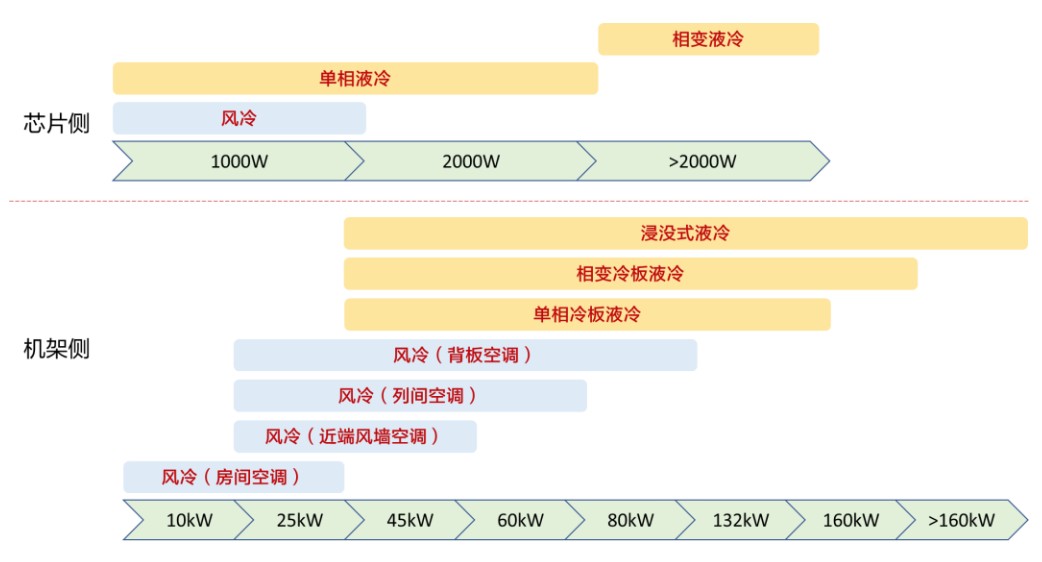
(3) Microchannel/two-phase liquid cooling — cutting-edge supplementary technology
-
Still in the transition phase from laboratory to industrialization, with TSMC, NVIDIA, and Microsoft all having layouts;
-
Mainly aimed at internal chip or package-level cooling, enhancing the performance of cold plate solutions rather than replacing them.
The global liquid cooling market is dominated by Taiwanese manufacturers, with extremely high trust barriers. Since liquid cooling systems directly contact GPUs/CPUs priced at tens of thousands of dollars, chip-level reliability certification (RVL) is the core access threshold. NVIDIA controls access rights through its official recommended supplier list (RVL), while leading Taiwanese companies (Shuanghong, Qihong, Delta) have formed a significant ecological closed loop due to decades of cooperation with NVIDIA and AMD.
The domestic market is breaking through through two parallel paths.
-
Path one: OEM for Taiwanese leaders, indirectly going overseas. Typical examples include some suppliers of cold plates, pipelines, and quick connectors, leveraging manufacturing advantages and cost control to enter the global supply chain.
-
Path two: Direct participation in chip giants' R&D to obtain RVL certification codes. A few technologically leading companies upgrade from "hardware OEM" to "standard-setting participants" by jointly developing next-generation cooling reference designs with NVIDIA and others Domestic liquid cooling companies are facing a dual window of opportunity with "global supply chain penetration" + "accelerated domestic substitution."
We have distilled the value distribution of the liquid cooling industry chain into a "three-tier pyramid":

Key focus on sub-segments——
① System integration and temperature control solution providers——value anchor, priority allocation
The core logic is to master customer interfaces and provide overall solutions, with the potential to upgrade to RVL certified suppliers. Companies with a full chain of liquid cooling solution reserves are scarce and can enjoy valuation premiums.
② Core component manufacturers (cooling sources, castings, quick connectors)——deterministic spillover demand
The core logic is that during the global liquid cooling capacity bottleneck, overseas leaders will outsource some manufacturing processes, and domestic companies with precision manufacturing capabilities will directly benefit.
③ Cooling media (fluorinated liquids/silicone-based liquids)——long cycle, high elasticity, main battlefield for domestic substitution
The core logic is that the biggest bottleneck for large-scale applications of immersion liquid cooling is the cost of cooling liquids and supply security. The domestic fluorosilicone industry chain is complete, and after 3M's exit, there is a huge supply gap in the market, with strong demands for self-control. The current penetration rate is extremely low, and once the technology matures, the market space will grow exponentially.
Future catalytic time nodes——
① Q2-Q3 2026: Release of Rubin platform technical details
The NVIDIA GTC conference will be an important catalyst, and the final plan for the Rubin thermal architecture will determine the specific weight of liquid cooling technology paths for the next two years.
② Second half of 2026: Domestic CSP liquid cooling bidding season
The construction plans for intelligent computing centers by Alibaba Cloud, Tencent Cloud, ByteDance, etc., for 2027 will be released successively. Whether domestic manufacturers can gain market share in large-scale bidding will be the core standard for assessing competitiveness.
In summary, the Q4 financial report from Vertiv is a formal confirmation signal for the transition of the liquid cooling industry from "thematic investment" to "prosperity investment." A 252% order growth, $15 billion in hand orders, and a 43% EPS growth guidance collectively outline a steep growth curve with strong visibility. This is worth noting.
Risk warning and disclaimer
The market has risks, and investment should be cautious. This article does not constitute personal investment advice and does not take into account the specific investment goals, financial conditions, or needs of individual users. Users should consider whether any opinions, views, or conclusions in this article align with their specific circumstances. Investment based on this is at one's own risk
