


Google DeepMind CEO: This year will start clinical trials for AI anti-cancer drugs, with robotic breakthroughs expected in the next 18 months

DeepMind CEO revealed that its AI drug development company has 17 projects in progress, with the first clinical trial for an anti-cancer drug expected to start in early 2026; Gemini 3 has crossed a capability watershed, predicting that robotic technology will experience a breakthrough moment in the next 18 months; smart glasses will become the killer hardware for AI; AI will completely reshape the healthcare and energy industries, and humanity is standing at the entrance of a "new renaissance" and a "golden age of discovery."
Google DeepMind leader Demis Hassabis painted the ultimate picture of AI at the Davos Forum: not only aiming to send AI-designed drugs into clinical trials by 2026, but also predicting that humanity will enter a "golden age of discovery" in the next 10 to 15 years.
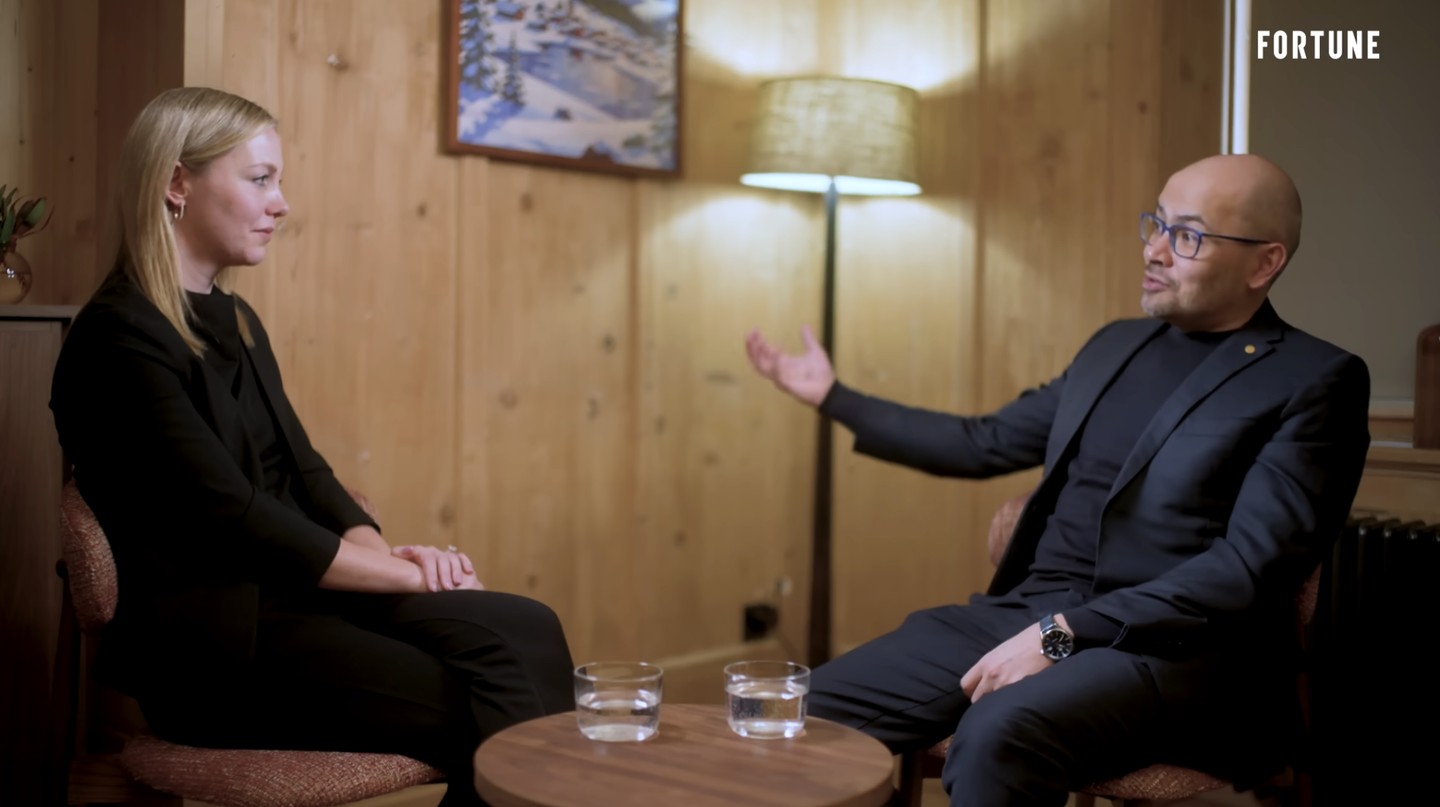
During the World Economic Forum held in Davos, Switzerland, Google DeepMind CEO Demis Hassabis was interviewed by Fortune magazine.
In this in-depth conversation about the future of artificial intelligence, Hassabis not only disclosed the latest progress of Google's large model Gemini but also emphasized the disruptive potential of AI in the biopharmaceutical field, as well as the timing of the explosion of agents and robotics technology.
Aiming to "Solve All Diseases": 2026 May Be a Turning Point
As the creator of AlphaFold (protein structure prediction model), Hassabis is attempting to translate this technology into actual drug therapies through his startup Isomorphic Labs.
He revealed a key timeline during the interview: 2026. Hassabis stated:
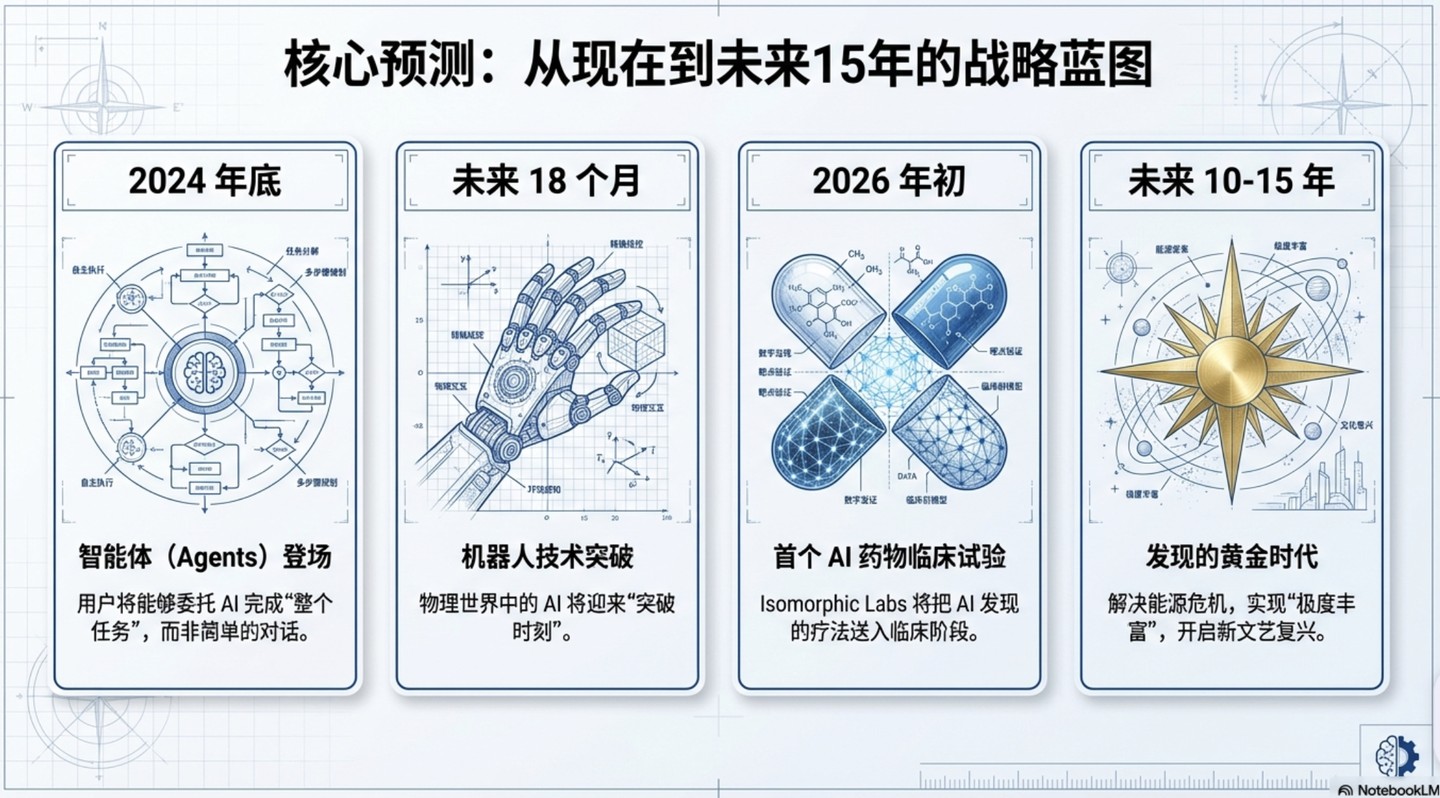
"We hope that by early 2026, the first drug will enter the clinical trial phase."
Isomorphic Labs is currently researching multiple fields, including cancer, cardiovascular diseases, and immunology, and has established partnerships with Eli Lilly and other top global pharmaceutical giants. Currently, the company has 17 drug projects underway and plans to eventually expand to hundreds.
Hassabis pointed out that traditional drug development takes an average of 10 years, costs billions of dollars, and has a success rate of only 10%. His goal is to use AI to complete most of the search and design work at the "silicon-based" level, using the laboratory (Wet Lab) only as a verification step, thereby increasing efficiency "hundreds of thousands of times."
Hassabis does not hide his ambitions, stating that the company's mission is:
"To solve intelligent problems, and then use it to solve all other problems."
Gemini 3 Has Crossed the "Watershed Moment"
When discussing AI integration within Google, Hassabis likened Google DeepMind to Google's "Engine Room," powering products like Search, YouTube, and Chrome.
Regarding the progress of large models that the market is concerned about, Hassabis confirmed that Gemini 3 has crossed the "watershed moment." He stated:
"For our Gemini 3, we have crossed a watershed moment... it is now very capable, and I will definitely use it in my daily life to help me with research, summarization, and coding."
He emphasized that Google is regaining various qualities of its "golden age"—taking risks, rapid releases, and innovation. In the interview, he revealed that to respond to competition, Google has rebuilt its infrastructure to quickly project the capabilities of the latest models onto the product side.
The Next Killer Application: Smart Glasses and Robotics
Regarding investors' concerns about the commercialization of AI and its future forms, Hassabis provided specific predictions. He believes that AI agents and more autonomous systems will truly begin to emerge by the end of this year, allowing users to delegate entire tasks to them.
Notably, Hassabis reiterated the potential of "smart glasses." He believes that AI technology is the key puzzle piece that makes smart glasses truly feasible. Hassabis stated:
"I think there could be killer applications on smart glasses."
He envisioned a concept of a "universal assistant" that would span all devices, including phones, computers, and glasses, understanding the user's contextual environment and providing services.
Additionally, he is also optimistic about the prospects of robotics technology. He predicted:
"In the next 18 months or so, I think we will also see breakthrough moments in robotics technology."
Outlook: A New Renaissance and Golden Age
At the end of the interview, Hassabis made an imaginative outlook on the world in the next 10 to 15 years. He believes that if developed properly, humanity will usher in a new "discovery golden age" and a "new renaissance."
"I believe human health will be fundamentally transformed... personalized medicine will become a reality."
Hassabis stated, adding that AI will also be used to address the energy crisis (such as nuclear fusion, solar energy, battery technology), ultimately bringing humanity into a "highly abundant" world, enabling humans to "explore the galaxy."
Regarding this rapid transformation, Hassabis summarized:
"It feels like there have been huge changes happening almost every year over the past decade. I don't think this year will be any different."
Full translation of Hassabis's interview:
Demis Hassabis
In 10 to 15 years, we will usher in a new discovery golden age. That’s why I look forward to a new renaissance.
Allison Shontell
We are at the peak of the AI revolution, but looking back to January 2014, we might consider it one of the most critical moments in business history. In that month, Demis Hassabis sold his AI company DeepMind to Google. He turned down a higher offer from Meta and Mark Zuckerberg, and this acquisition scared Elon Musk so much that he decided to co-found a competing company with Sam Altman, now known as OpenAI. Fast forward to today, Demis is still that person. He is in charge of all of Google's AI initiatives, including Gemini, which is rapidly eating into OpenAI's user base In his spare time, Demis won the Nobel Prize and runs a startup called Isomorphic, hoping to use AI to solve all diseases. I sat down with Demis at the World Economic Forum in Davos to learn about his views on the future.
Allison Shontell
Demis, we are now in Davos. Thank you for taking the time for this interview. So…
Demis Hassabis
It's great to be here.
Allison Shontell
You achieved great things in 2025, and it sounds like you're preparing for 2026. But before we talk about those two things, I want to take a step back to help people understand you better.
Allison Shontell
One of the things you enjoy is chess. That's right. You are a chess master. That's right. You also enjoy astronomy. That's right. I'm curious how these two things led you to the field of AI or shaped the way you think about it.
Demis Hassabis
AI. I've been interested in astronomy, cosmology, and physics since I was young because I've always been fascinated by big questions. So, you know, the actual happenings in the universe, consciousness, the nature of consciousness, all those types of things. So if you're interested in big questions, you'll be drawn to physics.
Demis Hassabis
Then for me, with chess, I also love games, love strategy, and ultimately trained my brain by taking chess very seriously as a child. And that made me think about thinking and how the brain works. But then I combined all of this. It brought me to AI and computers, which is a way to understand our own thoughts and is a perfect tool for science and understanding the universe.
Allison Shontell
Hassabis has a degree in computer science and a PhD in cognitive neuroscience. He co-founded DeepMind in 2010 with an ambitious goal—to solve intelligence. Under Hassabis's leadership, the DeepMind team made significant progress in its AI models. Just four years later, Google acquired the research startup for hundreds of millions of dollars. You initially founded DeepMind. You co-founded it a few years ago, around 2014, and sold it to Google for about $500 million. At that time, it was a hot deal. I know Meta wanted it too. In my view, I think when we look back at that moment, we will see it as one of the most transformative moments in business history. We laid the foundation for Google to build an amazing AI machine and truly bring it into the future. How do you feel when you look back at that moment? How did you make that decision? Did you know at the time it would be such an important moment?
Demis Hassabis
We, we really did. Those of us who were involved in the science. So it's interesting. We founded DeepMind in 2010, which was 15 years ago. At that time, no one was talking about AI, but we knew our mission was to solve intelligence and then use it to solve all other problems So we want to be the first company to establish artificial intelligence. The main content we want to apply is to solve scientific problems. So when Google emerged in 2014, it was actually driven by Larry Page, who was the CEO at the time. We know that in some ways, we underestimated it a bit. But on the other hand, what is important to me is not money, but the ability, the mission, and the ability to accelerate our progress towards artificial intelligence and the scientific problems we are trying to solve. I feel that collaborating with Google will accelerate this process, mainly because they obviously have tremendous computing power. We see today how important this is for developing intelligence. So at that time, I did mention to Larry and the then head of search that he was pushing this deal, otherwise they didn't seem to be inclined to do so. This may now become Google's most important acquisition ever, which says something because they have a good history of acquiring important items, like YouTube and Android.
Allison Chantel
Now, if you go back to the origins of OpenAI, Elon and Sam came together because they were concerned that Google might monopolize the AI field by acquiring DeepMind. Yes, this also created a huge competitor at that time.
Demis Hassabis
Yes, I think all these butterfly effects would happen. I think part of the reason is also the success of something like AlphaGo, which was the first program to become the world champion in Go, using the learning systems we are familiar with today, you know, reinforcement learning and deep learning are at its core. I think this was also an important watershed moment in 2016. In fact, this year marks the 10th anniversary of this breakthrough. I think it really sounded the starting gun for the modern AI era, including things like OpenAI. I know the founders of that competition and wanted to be involved.
Allison Chantel
Following Google's acquisition of DeepMind, the company's achievements in AI have repeatedly made headlines. In 2015, the company's AI model AlphaGo became the first computer to defeat a champion Go player. Later, it defeated top players in chess, strategists, and StarCraft II, a popular real-time strategy computer game.
Allison Chantel
In 2020, Google's DeepMind AlphaFold also solved the protein folding problem. For decades, scientists have struggled to predict how protein sequences fold into their final structures. The model completed this process with astonishing accuracy. Since then, the team has expanded this process to predict 200 million structures, all of which are now available in an online database. Hassabis received the Nobel Prize in Chemistry and a knighthood in 2024, partly due to this achievement.
Allison Chantel
Under Google's Alphabet, you have been able to have many moonshot projects, ventures, and attempts at things that do not yield immediate returns. But yes, in terms of breakthroughs. Yes. One of them you received a Nobel Prize for. So I wonder, congratulations to you Incredible. I wonder if you could tell me more about AlphaFold and why it is so important in how we tackle future diseases.
Demis Hassabis
Yes, I think one of the benefits of being part of Google and Alphabet is having the resources and time to really tackle these deep scientific questions. And AlphaFold, I believe, is the best example of this. Essentially, it solves a fundamental problem in biology that has lasted for 50 years: can we determine the 3D structure of a protein solely from its amino acid sequence, which is basically derived from its gene sequence? This is very important because proteins can essentially do anything in your body, from muscle to neuron firing, everything depends on proteins. If you know the 3D structure of a protein, what it looks like in your body, then you partially know its function and what it supports. Obviously, this is important for diseases as well, because proteins can go wrong. They can fold incorrectly. Like in Alzheimer's disease, this can lead to illness. So it is very important for drug discovery and fundamental biology.
Demis Hassabis
And AlphaFold is a solution to a question posed by another Nobel Prize winner, Christian Anfinsen, 50 years ago, who believed it should be possible to directly transform a one-dimensional amino acid sequence into this 3D structure. So how does it curl up into a ball? AlphaFold is a solution. So efficient, not only accurate, we have folded all 200 million proteins known to science. Then we placed it in a huge database at the European Molecular Biology Laboratory, freely available for everyone in the world to use. So now there are 3 million researchers worldwide using AlphaFold every day.
Alyson Shontell
It has become, I believe you are using part of it, for Isomorphic, which is your startup. I want to stay on the side. Yes, you are doing two huge jobs here at the same time. Of course, you raised hundreds of millions at Google as a supporter.
Alyson Shontell
For Isomorphic, can you explain the mission there? You have some lofty goals, as you said, they don’t. To solve all diseases. Yes. You have to cure. Yes. You said solve. Yes. Also tell me how difficult it is to get drugs into trials, because that has historically been very difficult.
Demis Hassabis
Difficult. This has always been the idea behind AlphaFold. Obviously, if we can understand the structure of proteins, we can conduct a lot of fundamental scientific research, including designing new proteins with new functions. So you can reverse engineer AlphaFold, like, okay, I want this specific shape.
Demis Hassabis
How do I get the gene sequence? But for drug discovery, understanding the structure of proteins is just a small part of the whole process. It typically takes an average of 10 years from understanding the disease target to having a drug fully ready to go to market Therefore, this requires a significant amount of time and cost, billions of dollars, and ten years or even longer. Most drugs, you know, will fail in this process. The success rate is only about 10%. So this is very inefficient because biology is very complex.
Demis Hassabis
So the first thing I have always dreamed of doing, you know, I want to apply AI to human health and improve human health. The more important use of AI and AlphaFold is to prove that this is possible.
Demis Hassabis
Then with Isomorphic, we split it out after completing AlphaFold, so about 3 or 4 years ago we developed additional breakthroughs around AlphaFold. Therefore, you can consider more in the chemical space. So if you know the structure of a protein now, you need to know where the chemical compounds you are designing drugs for will bind to the protein and what they will do. Therefore, you need to build other AI systems that can predict all of this.
Demis Hassabis
This is what we have been doing with Isomorphic. Progress is going very well. We have a great partnership with Eli Lilly, which is one of the world's top pharmaceutical giants, and we already have 17 drug projects underway, and we plan to eventually reach hundreds. I think this is the way to achieve real transformation. The advancement of human health is basically about searching and hypothesis searching in silicon. This is hundreds of thousands of times more efficient than searching in wet labs. You will use the wet lab part only for validation steps. Of course, in the end, you have to test in trials, human trials, and all those types of things to ensure everything is safe. But you can do all the searching and designing in silicon, or almost all of it. That is the plan. And.
Allison Chantel
You mentioned that 2026 will be an important milestone. Yes, I think this is true for both Google and Isomorphic. Do you expect that early in 2026, this will be the moment when your first drug enters clinical trials for cancer treatment?
Demis Hassabis
Yes. So we are actually researching multiple areas including cancer, cardiovascular, immunology, etc., and ultimately, we hope to expand to all therapeutic areas. We are building a universal drug discovery engine platform. You can imagine that we are already in the preclinical trial stage for some cancer drugs. Then, you know, hopefully by the end of the year, if these are successful, clinical trials will begin.
Allison Chantel
How do you manage yourself, your time, and your team? Because you are completing a very daunting task, whether it is the successful and well-received launch of Gemini 3 or pushing drugs into the trial phase. These sound like completely different things. That's right, managing different teams. You can't be in two places at once. Of course. How do you do it? How do you run two companies at the same time?
Demis Hassabis You know, one of my skills is bringing together world-class interdisciplinary teams. I love managing these teams. I enjoy combining these management teams. I have incredible teams. You know, both are from Google, DeepMind, Anna, and Isomorphic. If we take Isomorphic as an example, we have integrated top biologists and chemists, as well as leading machine learning and engineering experts. I believe that when you have this kind of interdisciplinary community group, a lot of magical things happen. Then, if we consider Google DeepMind, we are trying to merge the best of the startup world, just like what we were initially doing at DeepMind, and then at scale, you know, on a multinational scale, and then have all the advantages of these amazing product surfaces that we can deploy immediately, you know, technologies like Gemini 3, 2, and get great feedback from users right away. And, you know, help billions of users in their daily lives. So this is actually very exciting and inspiring. In terms of how I manage my time, you know, I don't sleep much, just a few hours. Yes, if, you know, sleeping a few more hours is not good for the brain. Yes, I do try not to get sick, but I have unusual sleeping habits. I manage a bit during the day, trying to schedule as many meetings in the office as possible, with almost no time for breaks. Then I go home, spend a little time having dinner with my family, and then I start working for the next day around 10 PM, thinking and doing some more creative work and research until about 4 AM. You know, I've been doing this for about ten years, and it works well.
Allison Shontell
I can't imagine being creative at 4 AM, but if that works best for you, that's fine too.
Demis Hassabis
I, I probably start to feel energized around 1 AM.
Allison Shontell
In 2023, Google faced increasingly fierce competition from other rapidly developing search engines and the launch of ChatGPT. In the same year, under Hassabis's leadership, Google merged its two AI teams—DeepMind and Brain. The goal was clear: to drive the development of the next generation of AI. You are clearly good at motivating teams to do difficult things. I know that in 2023, Google made a decision to put two different AI teams under your management. So, how did you address the management issues and get the teams re-engaged in their work? Because there seems to be a feeling that Google has been a bit complacent in AI, and I'm curious if you think that's true and how you woke them up.
Demis Hassabis
Yes, we had two world-class teams in the original DeepMind and Google Brain. In fact, I think as a whole, we often don't get enough credit because I believe about 90% of the modern AI industry is built on the technologies or discoveries from one of these two teams, from Transformers to AlphaGo and Deep Reinforcement Learning. So, when we still have deep people and the broadest research teams, we have incredible talent, I think much better than anywhere else in the world
Demis Hassabis
But there are two groups that are becoming increasingly complex, especially considering the computational effort required for this scaling error. That's why we have to bring these two groups together so that we can gather all the talent working on one project, you know, in Gemini. But even for someone like Google, there isn't enough computing power to have two cutting-edge projects under one roof. So we need to combine all the reasons together.
Demis Hassabis
You know, I am a very collaborative person. I am very open to different ways of working and have always been striving to improve, just like my watch. What I follow is a Japanese word I like, kaizen, which is an effort of continuous self-improvement. That's what I've been trying to do. I am always in learning mode. Maybe that's why I love building learning machines, because I love learning. No matter how specialized you are, you can learn something by bringing two teams together and trying to combine the strengths of both cultures, which is great, and I think we are reaping the rewards of that now.
Demis Hassabis
Now Google DeepMind is actually us, and the way we think is like Google's engine room. So we are pushing forward, like connecting to the nuclear power plant of this amazing company called Google. I think one thing we are doing, and something I am very proud of, is fostering a culture of rapid delivery and online presence, rediscovering the golden age of Google, which I think was 10 or 15 years ago, taking risks, calculating risks, and iterating and innovating quickly. I think all of this is going very smoothly now, while being thoughtful and scientifically rigorous about the content we release into the world, whether it's engineering or science. I hope you know that we are achieving the right balance.
Allison Chantal
You mentioned going back to Google's golden age to the extent that the founders, at least Sergey, seem to be back. What is it like working with him on AI?
Demis Hassabis
Google? It's great. Larry and Sergey are two different people. Larry is more strategic. So I want to dive into the details, get involved in programming, you know, things like Gemini, and it's amazing to see them getting involved.
Allison Chantal
Is he working on the code, or do you prefer him to be more like a sergeant, right?
Demis Hassabis
No, more like he chooses the work he wants to do. But it's great to see him pushing things in a specific direction in the office. If the founders are deeply involved, things become easier. And I still play a role like a co-founder, just like one or two of the founders of Google DeepMind, right?
Demis Hassabis
In terms of what we have to do and the strategic choices we make. This is what I think I've learned to do well over the past 10 or 15 years when you have some ambitious goals, like solving all diseases or building AGI What are some intermediate goals that are also very ambitious, but serve as a roadmap, and which are the right choices? I think we have done quite well in most Alpha projects, such as AlphaGo, AlphaZero, and so on. Now Gemini. I believe it is crucial for any very ambitious science and engineering project to break it down into manageable steps so that you can see you are heading in the right direction. I think we are very clear about the technology we are building. It has been an incredible few years for us, and I think we are getting into the zone. I believe others and the outside world are starting to feel this, including factors like Wall Street and stock prices.
Allison Chantel
- Any doubts about whether Google faces an innovator's dilemma in AI in the search field have been answered after the first quarter. Its stock price soared, partly due to its progress in AI development, including the launch of Google's popular image generation model Nano Banana and Gemini 3. By the end of the year, Alphabet's stock price had risen by about 65%, marking its best performance since 2009 and making it the best-performing stock among the "Seven Giants." It certainly looks like there is some kind of KPI assessment driving this forward. This is a unifying moment because, I mean, the launch of Gemini 3 has caused a stir among many concerns, even leading OpenAI to go into red alert, claiming this has been happening all along. I just want to say, well, of course. Then there’s this huge, milestone deal with Apple, which I think is significant for the entire industry. So I’m curious about what’s happening behind the scenes. How do you set these KPIs for the team? And how do you plan to maintain this momentum in 2026?
Demis Hassabis
Well, look, I think for me, it always starts with research, like having the best models and obviously the foundational research in this case. I’ve always believed that you need to reflect this in your products as soon as possible, and then you have to do the marketing allocation correctly. But if your models are not state-of-the-art, then none of this matters.
Demis Hassabis
So that’s what we first focused on with the Gemini model, as well as our other models, like Nano Banana, our image model, which went viral. That was a big part of our success last year. Our video models, our world models. So it’s not just large language models. We have VR for all of these.
Demis Hassabis
Then there’s the thing about internal organization, almost rebuilding the infrastructure in a Google-like way so that you can very quickly reflect the power of the latest models into lighthouse products, including Search, YouTube, and Chrome, all these amazing surfaces we have, of course, as Gemini applications. This is new for everyone in the industry. I think, you know, rebuilding things around this takes a bit of time Very well, you know, to emphasize again, Google's deep exploration of the engine room's ideas provides engines for other parts of the organization. I think it took me a year and eighteen months to get it right.
Demis Hassabis
But I think we are now seeing the results. By the way, I think there is still more to go, and we can have faster speeds. I think another thing is instilling this culture of intensity, speed, and focus, really concentrating on the important things and minimizing distractions.
Demis Hassabis
Then, perhaps the last thing I want to say is that I think there is a lot to be said, especially in today's very noisy world, about consistently making good decisions, making good rational decisions, and minimizing drama over time. Then, I think over time, this situation will become very remarkable. You know, I think we are building a lot of momentum now, and I hope you will see more of it this year.
Alison Chantel
As we mentioned earlier, the decision to address the deep-seated issues at Google is a milestone moment, a transformative moment for the business. If you succeed now, I think this could be the biggest transformation in business. What impact does this have on you to ensure that you, as a leader, drive this direction for the benefit of society, the workforce, and Google? Because this is the innovator's dilemma, yes, this is the king of search, a huge advertising-based business model, if you succeed. Yes, I don't know.
Demis Hassabis
Of course. Well, look, I mean, this is a classic innovation dilemma. I think we have handled it well so far. Search is more successful than ever. But there is another aspect, if we don't disrupt ourselves, others will. So we, you know, you better stay ahead and do it on your terms. So I think that's what we have discovered.
Demis Hassabis
In terms of responsibility, I feel, you know, I've always had this feeling, not just because of their Google, but even before that deep well, even in my academic career, because. If we, you know, Shane and I, especially our chief scientist, you know, when we started to think deeply, we, it seemed like a fantasy, but we really believe that creating artificial intelligence is possible. We understand, I think more and more people now understand how transformative this will be for the world. Of course, the help for science and human health and energy and so on is also amazing. But there are also risks. This is a dual-use technology. You know, harmful actors, you know, bad actors can use it for harmful purposes. Ultimately, as AGI becomes AI, but the technology becomes more autonomous, more real, as we move towards AGI, the technological risks come along with it.
Demis Hassabis
So I am very concerned about all these things. Of course, you know, we have to ensure that the engines and the economic engines are also working properly. Therefore, we have enough funding to support our research, fund things like AlphaFold, and provide it to the world for free You know, it's not easy. Creating something like frontier research requires a lot of money to create something like AlphaFold. But we've done a lot of these things, and I want to do more of these things for the world, but that also requires us to succeed commercially. So I think, you know, there's a balance there, but responsibility, I think part of it is, I feel like we can do this at Google too, we have a platform to show how to deploy AI responsibly and benefit society as a whole.
Demis Hassabis
You know, all of us at the frontier allow for the production of AI, and we can choose what to do with AI. We will use it for things like medicine, alleviation, management, and helping the poor, or we will use it for exploitative things. I think we will strive to be a model for all the good things that AI can bring. That doesn't mean we won't make any mistakes. We will do so because this is such an emerging and complex technology, but we will be as thoughtful as possible, and we will also conduct scientific research on it as much as we can. The scientific rigor we bring to our work, I think, will be important here. I mean, this is ultimately a scientific endeavor. Then, you know, I hope we. You know, we like to strive for reliability, safety, and security that will be reflected in our products. And then I think the market will reward that because if you consider the businesses that use these technologies, as they become more complex, they will want some assurance about what you are doing with the AI systems you introduce, so I think this could be a good aspect of AI becoming very commercialized, which is that there will be commercial incentives to remain strong, reliable, and safe, and all the things you want, actually preparing for AGI to enter the world.
Alison Chantel
So looking ahead to the next year, what do you think the trends in AI development will be? What achievements will we make?
Demis Hassabis
Well, I think this year, I mean, I say this every year, um, not, you know, every year is critical for AI. It feels like at least for those of us working at DeepMind, you know, like almost every year something happens. I think this year is no exception. It's very intense, but you also let us occasionally look up at the strategic picture. I think, at least for our Gemini3, we have crossed a watershed moment. Hopefully, those of you who have used it can fill in this gap; it is very capable now, and I will definitely use it in my daily life to help me with research, summarization, and coding. So I think these systems are now ready to potentially build agents. We talk about, the whole industry is talking about agents and more autonomous systems and delegating entire tasks to them. But I think maybe by the end of this year, we will really start to see that. I am very much looking forward to helping you enter the real world
Demis Hassabis
Perhaps in terms of glasses. We have a big project on smart glasses. I think AI technology can make it truly feasible. I believe there could be killer applications for smart glasses. You know, I think this is part of bringing it into the world. Additionally, in robotics, I still believe there is more research to be done in robotics, but I think in the next 18 months or so, we will also see breakthrough moments in robotics. So, we are working very hard to push all these areas, and of course, improve Gemini.
Alison Chantel
That's it. Those are the glasses, right? No, they are.
Demis Hassabis
No.
Alison Chantel
If they were, I would buy them. They like, yes, yes. I want to ask you about the product form, you know, computers were not built for AI, and all the things AI can do. What do you think that product form is? Sounds like glasses. I think.
Demis Hassabis
Last year was just one of the solutions. I have a side thought; we internally discussed the concept of a universal assistant. What we mean is an assistant that is very helpful in daily life, recommending things to you, enriching your life, handling administrative tasks, all those types of things. But it spans across all surfaces. So it exists on your computer, browser, phone. Then I think there will also be new devices, like glasses, that will be the same assistant, capable of understanding the context of your different conversations, in your car or office. If you want, you know, all these can be integrated together, I think it can help you, you know, improve your life in all these different aspects.
Alison Chantel
Life. So maybe next Christmas, next holiday, we can all wear Google Glasses. That's the idea. You're always too early. I feel like before their time.
Demis Hassabis
Look, I think, you know, like many things we did at Google, we might be, you know, pioneering all these spaces. In hindsight, maybe glasses were a bit too early, whether it was the technology or the technology to make them not too bulky, but I also think it lacked a killer application. I think an AI digital system could be that.
Alison Chantel
Yeah, that’s amazing. Well, I have one last question I want to ask you. I want to ask you to boldly predict, looking ahead, how AI will change the world. I know you’ve said that one year now is equivalent to ten years in the past. That's right, it really is. Yes. But when you look to the future, do you think it will be a world of abundance where AI can solve all our problems? What does it look like?
Demis Hassabis
I think if done right, in 10 to 15 years, we will enter an incredible new golden age. Discovery. That’s why I hope for a new renaissance; I believe human health will be fundamentally transformed It won't, medicine won't be like today. I believe personalized medicine, for example, will become a reality. I think it will solve many significant problems using these AI technologies, such as science and new materials, and perhaps help with fusion, solar energy, or optimal batteries, some way to solve the energy crisis. Then I think we will enter an extremely abundant world where we can use these energies to travel to the stars and explore the galaxy. That is what I believe our destiny is.
Alison Chantel
That's great. Well, thank you. I hope that's what you're building. And thank you for all the effort you've put into this. That's wonderful.
Demis Hassabis
It was great chatting with you.
Alison Chantel
Likewise
