


AI scares the US stock market, Asian stock markets "benefit from disaster," with chip stocks being the biggest beneficiaries

The panic caused by AI's disruption across various industries has triggered a global capital migration! Wall Street funds are accelerating their withdrawal from U.S. stock-related assets and flowing towards Asian AI hardware manufacturers. The MSCI Asia Pacific Index has surged over 12% this year, surpassing the S&P 500 (-0.2%) and the Nasdaq 100 (-2%). Chip giants like Samsung and Taiwan Semiconductor, which have pricing power, are being heavily bought by foreign capital, making the Asian AI hardware supply chain a major winner in this wave of AI
Concerns in the U.S. market about AI potentially disrupting industries, are pushing global funds from potential victims on Wall Street towards winners in Asian AI infrastructure, with chip manufacturing stocks becoming the most direct beneficiaries.
According to Bloomberg, the MSCI Asia-Pacific Index has risen over 12% since 2026, while the S&P 500 has fallen 0.2% this year, and the Nasdaq 100 has dropped about 2%. In the past 10 trading days, the Nasdaq 100 has fallen 4.6%, with a market value evaporating by about $1.5 trillion, led by sectors like software that are considered vulnerable to the impact of new AI tools.
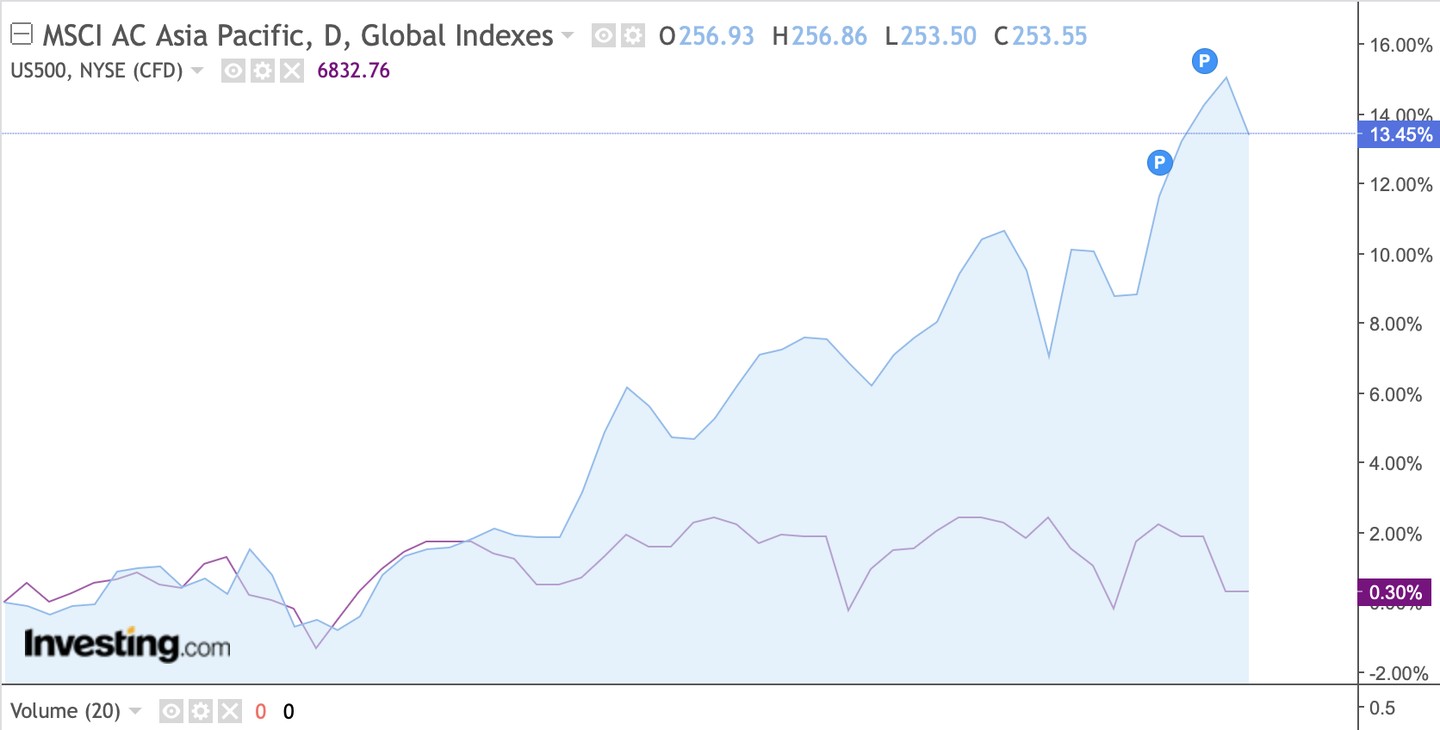
The flow of funds is also quickly reflecting this divergence. On Thursday, Samsung saw the "largest scale" of overseas net buying, with its stock price rising 6.4%, continuing to rise on Friday; global investors recorded the third-largest weekly net buying of Taiwanese stocks. Japanese memory chip manufacturer Kioxia Holdings saw its stock price surge 15% on Friday.
The core of the market's bet is that global funds are shifting from "money-burning" AI pioneers to hardware and upstream supply chains with pricing power, and Asia occupies a key position in advanced chip manufacturing, foundry, and assembly.
Micron's latest statement about tightening supply of memory chips, along with Nvidia's comments on sustainable spending, further solidified this allocation logic. According to Bloomberg, multiple institutional sources indicated that as the market begins to price in the "ChatGPT moment of AI agents," infrastructure demand may be realized in Asian assets sooner.
Funds withdrawing from "AI disruption trades," U.S. stocks under pressure while Asia benefits simultaneously
The trigger for the current volatility in U.S. stocks is investors' concerns that AI models may threaten the business models of certain software, legal, and real estate service providers, leading to sell-offs in related stocks. Bloomberg noted that this "AI Scare Trade" has also affected U.S. real estate service stocks and insurance brokerage sectors.
In contrast, the technology exposure in the Asian market is more concentrated in upstream segments. Richard Tang, head of research at Baosheng Group in Hong Kong, stated: "The main concern in the U.S. is the spending issues of mega-corporations. Most of Asia's tech exposure is in upstream. Regardless of who ultimately wins, the upstream will still derive income from downstream participants."
Rising prices of memory chips have reinforced positive signals on the hardware side, benefiting regional leaders like Samsung. TSMC, as the world's leading contract chip manufacturer, also provides support for the Taiwanese stock market due to its "irreplaceability."
Micron Technology's latest comments on tight supply of memory chips, along with Nvidia's statements on sustainable spending, have been interpreted by the market as still supportive of hardware cycles and capital expenditure expectations.
Foreign capital increases in South Korea, Taiwan, and Japan, amplifying the driving effect of chip stocks on index weights
Against the backdrop of incremental capital inflows, the high weight of major Asian chip stocks in local indices has amplified their pull on market performance.
According to Bloomberg data, TSMC's weight in the Taiwan Weighted Index Taiex is approaching 45%, three times that of ten years ago; the structure of the Korean Kospi is also nearing a "dual oligopoly," with Samsung and SK Hynix combined weight approaching 40%.
On the funding side, Samsung recorded the largest net overseas buying on Thursday, driving a significant surge in its stock price, while the Taiwanese market saw the third-largest net buying by global investors in a single week. Kioxia raised its earnings expectations driven by AI demand, leading to a substantial rise in its stock price, further reinforcing the market pricing of "upstream first realization."
Not fully immune, software stocks still under pressure, but market consensus leans towards "continuing to outperform"
Bloomberg points out that Asian software companies will still be pressured by sentiment transmission, such as Hong Kong-listed Kingdee Software and Indian IT service company Infosys Ltd., which fell recently alongside similar U.S. assets during the sell-off. However, their market share in the region is limited.
Stephanie Aliaga, a global market strategist at JP Morgan, stated in an interview with Bloomberg Television that some "shocks" from the U.S. are actually good news for Asia, especially when considering "what infrastructure is truly needed to harness agentic AI," as the market begins to price in the "ChatGPT moment for AI agents."
Elfreda Jonker, a client portfolio manager at Alphinity Investment Management, told Bloomberg that she is currently more willing to invest in chip manufacturers, with TSMC being one of her key holdings, stating, "All roads to AI lead to TSMC."
Bloomberg reports that supported by different company divisions, cheaper valuations, and stronger profit growth, Asian stock markets are expected to continue to perform excellently.
