


A major asset rotation is happening! Bank of America Hartnett: U.S. policies give rise to "everything is possible, except for the dollar" trades!

Bank of America strategist Hartnett stated that global capital is accelerating its escape from dollar assets, and a structural major rotation has already begun. U.S. stocks and tech giants are no longer the only safe havens, as funds are flowing into emerging markets, commodities, and international stock markets. He summarized the current trading as "buy anything except the dollar," and believes this is a pre-pricing of the "new world order." Deteriorating fiscal conditions and uncontrolled debt have become the core support for shorting the dollar, and a weak dollar may become the norm
Bank of America strategist Michael Hartnett issued a new warning: As the Trump administration implements a combination of "overheating" economic policies alongside tariff impacts, global capital is fleeing dollar assets at an unprecedented pace, initiating a structural rotation across asset classes.
According to the Wind Trading Desk, the report states that since the beginning of 2026, $104 billion has flowed into developed market funds such as those in Europe and Japan, while only $25 billion has flowed into U.S. funds during the same period. The staggering 4-fold difference reflects that the "American exceptionalism" is being replaced by "global rebalancing."
Hartnett believes that investment logic is undergoing a fundamental reconstruction. U.S. stocks, especially tech giants, are no longer the only safe haven, as capital begins to flow into emerging markets, commodities, and international equities. This trend is not a short-term tactical adjustment but rather a pre-pricing of the "new world order."
In terms of allocation, the report advises investors to reduce exposure to large-cap growth stocks in the U.S. and increase holdings in physical assets (gold, oil), emerging market stocks, and U.S. small-cap value stocks to cope with the diminishing relative attractiveness of dollar assets.
The Twilight of Dollar Hegemony and the "New World Order"
Since the Trump administration introduced historic tariff policies in April, although some measures were later withdrawn, market confidence has suffered an irreversible blow. Hartnett summarizes the current trading logic as "buy anything except the dollar" (ABD trade), which is driven by structural repricing induced by the "let the economy overheat" policy.
Data supports this judgment. The dollar index has cumulatively fallen by 10% since the end of 2024. U.S. stocks have significantly lagged: while the S&P 500 index rose 15% during the same period, the MSCI global (excluding the U.S.) index surged 39%, highlighting the disparity.
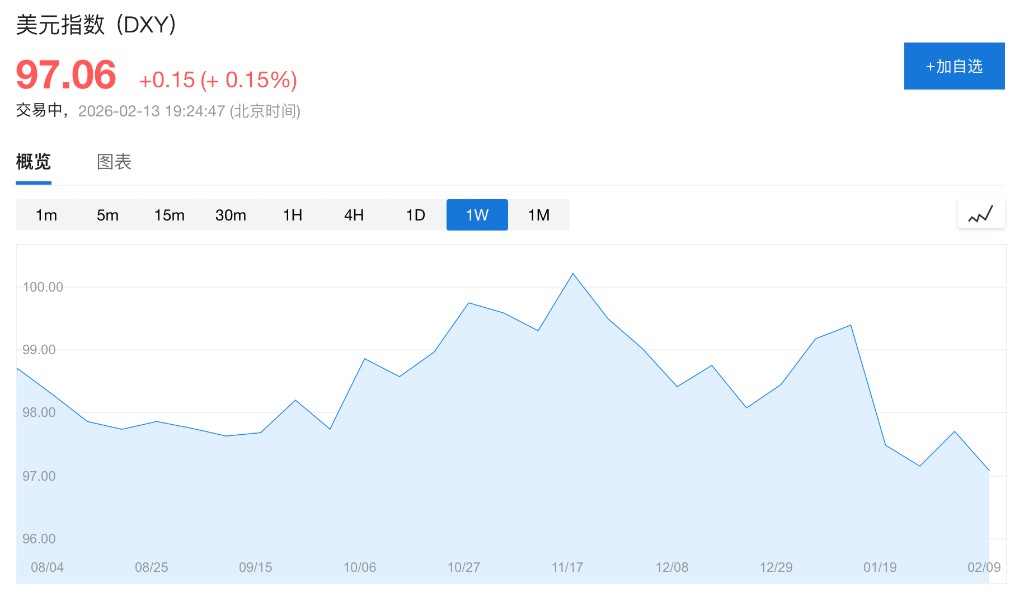
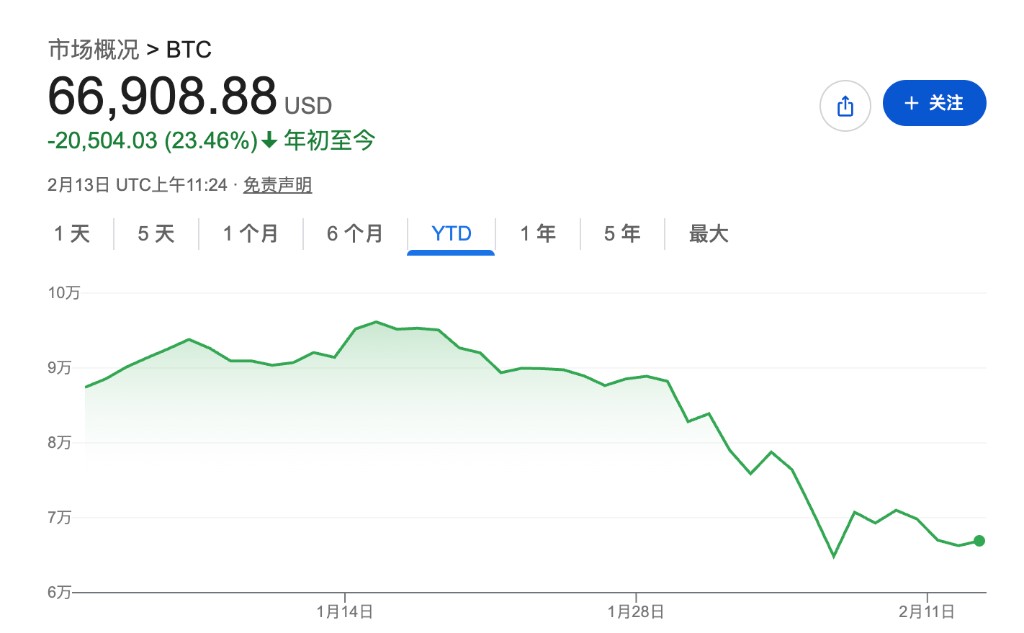
The asset performance from the beginning of the year further reveals the rotation pattern. Gold is up 13.4%, oil is up 9.5%, leading the pack; meanwhile, U.S. stocks are down 0.2%, the dollar is down 1.4%, and Bitcoin has plummeted 24%, becoming the clear loser in this round of rotation. Hartnett emphasizes that this is not a cyclical short-term fluctuation but the beginning of the "new world order," as global capital accelerates its migration from dollar assets to physical assets, emerging markets, and international equities.
Capital Flow: Voting with Feet, Fleeing Wall Street
The flow of capital is writing the clearest footnote to Hartnett's "global rebalancing" viewpoint. Since the beginning of 2026, developed market equity funds in Europe, Japan, and others have attracted a cumulative inflow of $104 billion, while U.S. funds have only recorded $25 billion, with the former's scale exceeding the latter's by more than four times, confirming the trend of capital accelerating outflow from dollar assets Highlights in niche markets are emerging. The South Korean stock market recorded the strongest four-week capital inflow since 2002, totaling $14.3 billion; the infrastructure sector also achieved its best fundraising record since 2007. Although there is still capital inflow into technology stocks, Hartnett warns that the risk of a rotation from "AI panic to AI poverty" is accumulating, with triggering signals possibly coming from large-scale cloud providers announcing cuts in capital expenditures.
Another key signal comes from Bank of America’s private clients. In the first week of February, the amount withdrawn from cash and U.S. Treasury bonds reached the highest level in the past 14 years, while they shifted towards municipal bonds, investment-grade bonds, and Japanese stock ETFs, indicating that domestic funds are also following the "de-dollarization" allocation logic.
Historical Echoes: A Once-in-Fifty-Years "Great Rotation"
Bank of America strategist Michael Hartnett outlines a clear pattern by reviewing the market history of the past 50 years: significant political and geopolitical events always trigger changes in asset leadership. Standing at the juncture of 2026, he believes a new round of rotation has already begun.
Looking back at history, each institutional turning point has reshaped capital flows. The collapse of the Bretton Woods system in 1971 saw physical assets rise to prominence, with gold soaring; in 1980, Volcker's interest rate hikes initiated a 40-year bull market in bonds; the fall of the Berlin Wall in 1989 propelled the rise of U.S. stocks through globalization; China's accession to the WTO in 2001 ushered in prosperity for emerging markets and commodities; the QE era in 2009 marked the golden age for U.S. growth and technology stocks; and the pandemic and fiscal expansion in 2020 pushed the "seven giants" and Bitcoin to bubble peaks.
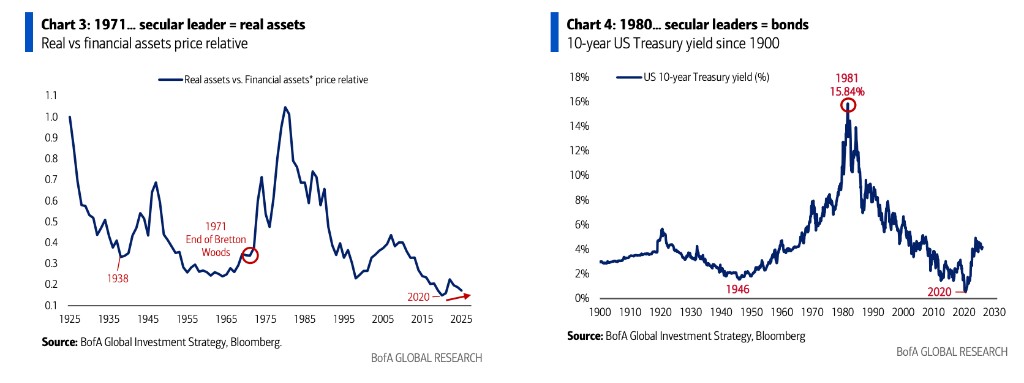
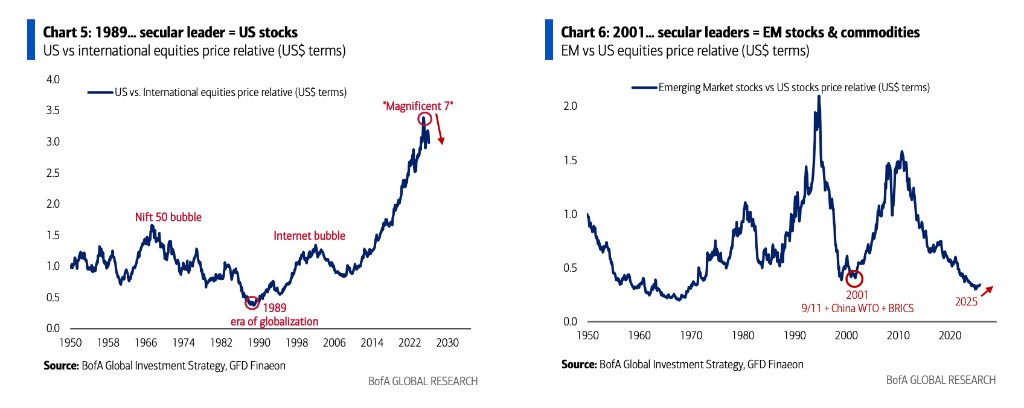
Now, Hartnett proposes the core judgment for the next decade: emerging markets and small-cap stocks will take over.
The logical chain clearly points in two directions. First, from Wall Street to Main Street, populism is replacing elitism, and isolationism is replacing globalization; this structural shift will benefit small-cap value stocks rather than large-cap growth stocks. Second, from the U.S. to emerging markets, the end of "American exceptionalism" is driving capital flows to the undervalued Asia-Pacific region.
Debt Black Hole and Inflation Hedge
The continuous deterioration of the U.S. fiscal situation is becoming the core pillar of the "short dollar" trade. Data shows that U.S. national debt is skyrocketing at an uncontrollable rate of $1 trillion every 100 days. According to the Congressional Budget Office (CBO) forecast, annual interest expenses in the U.S. are expected to surge from $1 trillion to $2.1 trillion over the next decade.
Bank of America strategist Michael Hartnett points out that the increasingly heavy interest burden may ultimately force the U.S. government to implement yield curve control (YCC), which means a weak dollar will become the norm in policy In this context, Hartnett reiterates that long-term government bonds are the most certain risk hedging tool for 2026. The core logic is that the U.S. government will not allow the yield on 30-year Treasury bonds to break through the psychological barrier of 5%, as long bonds possess both safe-haven attributes and the dual advantage of policy support.
Market Sentiment Indicator: Sell Signal Remains On
Despite capital rapidly flowing out of the U.S., market sentiment remains in an extremely euphoric state. The latest reading of the Bank of America Bull & Bear Indicator is 9.4, slightly down from the previous value of 9.6, but still significantly above the sell threshold of 8, sending a clear contrarian warning signal.
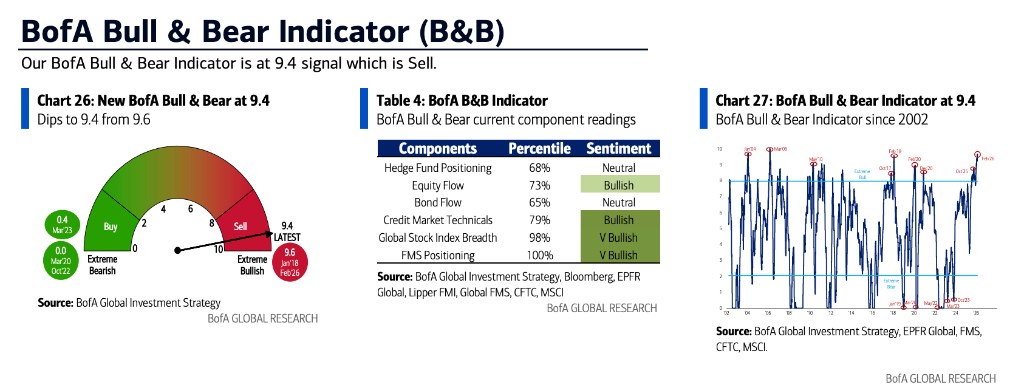
The report points out that the removal of this sell signal requires meeting three conditions: a significant rise in cash levels, large-scale short covering in bonds, and technology stock positions falling to neutral territory. The current market has clearly not reached any of these thresholds.
Bank of America strategist Michael Hartnett summarizes that the trading script for 2026 has been clearly written, with the main characters being inflation hedges, physical assets, emerging markets, and non-U.S. currencies. For those still clinging to U.S. tech giants and dollar cash, it is time to reassess the clock on asset allocation
