


Is Tencent being wrongfully killed?

Bernstein believes that Tencent's stock price decline is mainly due to the dual impact of lagging AI model development progress and concerns about AI disruption in the gaming industry. Currently, Tencent is trading at 14-15 times the expected price-to-earnings ratio for 2027, close to the low levels faced by the industry during the gaming approval stagnation and pandemic lockdowns of 2022-2023. Although Tencent does need to catch up in chatbot development, the company continues to generate robust AI investment returns through its advertising and gaming businesses, and the current valuation reflects overly pessimistic expectations
A debate on "Who is the AI winner" is causing fundamentally solid companies to face mispricing.
As investors shift their focus from steady profit growth to cutting-edge model development and chatbot competition, Tencent's valuation has fallen to near recent lows. So far this year, Tencent's Hong Kong stock has dropped 10%, and is down 21% from last year's peak.
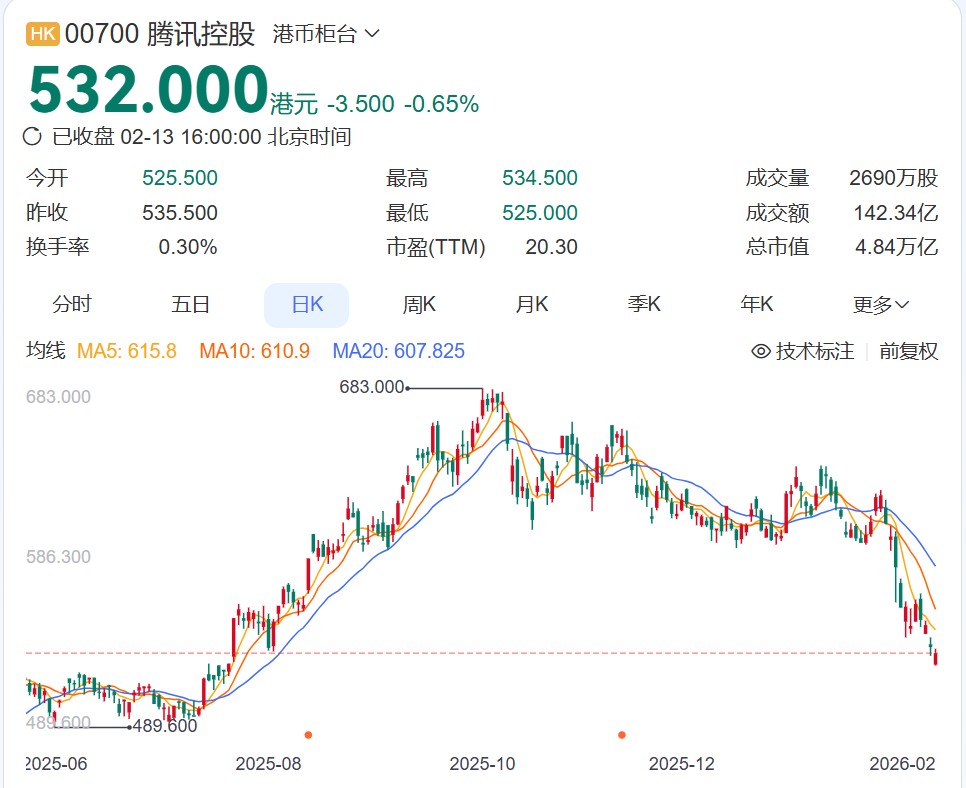
According to the Chasing Wind Trading Desk, Bernstein's latest research shows that Tencent's stock price decline is primarily due to the dual impact of lagging AI model development progress and concerns over AI disruption in the gaming industry. Currently, Tencent is trading at 14-15 times the expected price-to-earnings ratio for 2027, close to the low levels faced by the industry during the gaming approval stagnation and pandemic lockdowns of 2022-2023. Analyst Robin Zhu pointed out that while Tencent does need to catch up in chatbot development, the company continues to generate solid AI investment returns through its advertising and gaming businesses, and the current valuation reflects overly pessimistic expectations.
Meanwhile, Alibaba has gained market favor due to its progress in AI models. Alibaba has maintained a leading position in the domestic AI competition with the launch of its Qwen agency service and the release of the Qwen3-Max-Thinking model. Alibaba Cloud's revenue has grown by 30-40%, along with a top-ten global AI model and a leading domestic GPU development project, providing the company with long-term AI optionality. However, analysts also question when investors will demand more evidence that agency AI can drive growth in e-commerce GMV share and CMR growth.
The Red Packet War Fails to Resolve Chatbot Dilemma
On the eve of the Spring Festival, Tencent, Alibaba, ByteDance, and Baidu all launched red packet sharing activities in unison, attempting to boost user growth for AI chatbots. Behind this marketing battle lies a key issue: on the consumer side, AI model capability is only part of the equation.
Unlike the promotion of mobile payments through red packets in 2015, the logic of using cash incentives to encourage users to use AI chatbots seems more indirect this time. A decade ago, the cash accumulated in users' WeChat wallets directly catalyzed the popularity of online payments and laid the foundation for subsequent transaction ecosystem growth. The closed loop of "giving users money and letting them spend it within the same application" still makes sense in e-commerce scenarios—such as shopping with Tongyi Qianwen. However, how red packet funds can drive users to conduct information searches or seek AI companionship is not immediately clear.
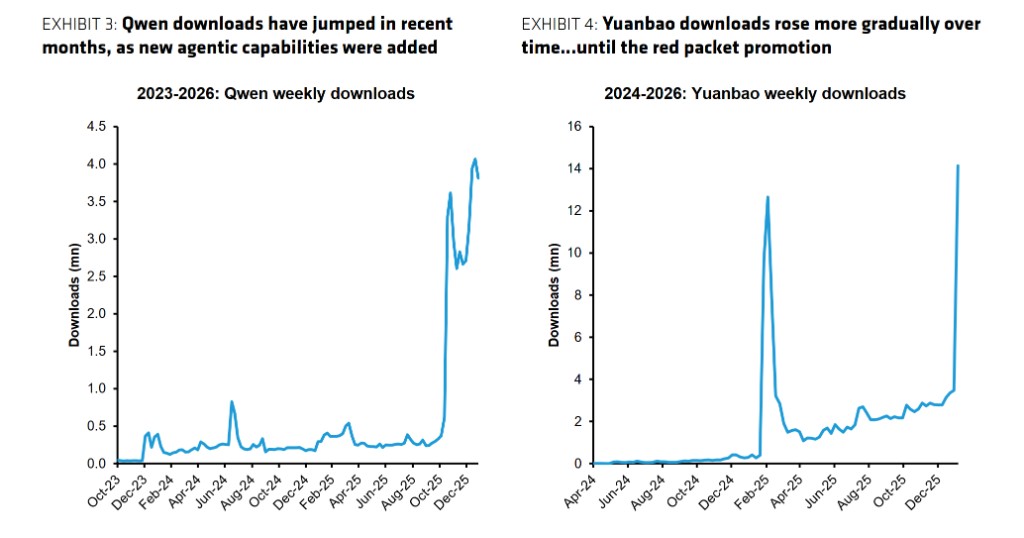
QuestMobile data provides some early clues. Alibaba's milk tea subsidies drove the daily active users of Qianwen to soar to 73.5 million on February 7, but the next day it fell back to 68 million. Tencent's Yuanbao application saw its daily active users nearly double to 18.3 million on February 7, then drop to 16.7 million on February 8. This pattern of sharp rises and falls raises questions about new user retention rates.
The deeper issue lies in user engagement. Although the red packet activities significantly boosted downloads and daily active users, overall progress in engagement, measured by daily active conversations and usage duration, has been limited As of the end of January, the high-frequency users of Tongyi Qianwen (over 10 uses per day) were about 500,000, and Yuanbao was about 2 million—compared to major traffic entrances like WeChat, Douyin, and Xiaohongshu, these numbers are still insignificant. Reprogramming human user behavior takes a long time.
Tencent: Undervalued Profitability
Market concerns about Tencent's AI progress are not unfounded. The company's Hongyuan Turbo S model ranked seventh in LMarena when released in February, and the company was noticeably absent from the public chatbot rankings. The recent Yuanbao party event performed poorly, seemingly reflecting the status of dual-track AI development both inside and outside WeChat—as a messaging infrastructure for 1.4 billion users, WeChat indeed faces a higher quality threshold before launching new features.
However, this narrative pressure has been fully reflected in the valuation. Based on Bernstein's forecasts, Tencent is currently trading at 14-15 times the expected price-to-earnings ratio for 2027, at the low end of the company's historical range, close to the bottom level when the industry faced more severe top-level resistance in 2022-2023.
More importantly, Tencent's operational business continues to run steadily. In the fourth quarter, Sensor Tower data showed that total mobile game revenue declined by about 2% year-on-year, but considering the growth of "Delta Force," overall game growth, including PC games, should remain robust. The advertising business also performed strongly, with video account revenue surpassing 10 billion yuan in the fourth quarter, a year-on-year increase of about 40%.
Bernstein's sensitivity analysis shows that even assuming a significant increase in operating expenses over the next two years to support AI investments, Tencent's earnings per share could still reach 33-35 yuan in 2027. On this basis, the current stock price corresponds to a price-to-earnings ratio of less than 15 times. In contrast, when Google, Amazon, and Meta took turns sitting in the "AI laggards" position, the market ultimately returned to fundamentals. Robin Zhu noted that after a period of valuation adjustment, Tencent's stock price psychological model is somewhat similar to that of the U.S. internet sector.
The key question is how long investors are willing to wait. Management hinted that Hongyuan 2.0 is the first model released after the reorganization of the AI development team, and the speed of model iteration should accelerate thereafter. However, before that, the market may continue to focus on the "seeing is believing" story of chatbot development.
Alibaba's AI Gamble
Alibaba's strategy has become clearer in recent weeks. On January 15, Qianwen launched an agency service, allowing users to conduct e-commerce transactions, order food, and book travel through the app. The subsequently released Qwen3-Max-Thinking model scored about 40 points on the Artificial Analysis intelligence index, keeping pace with Minimax, Z.ai, etc., maintaining the company's leading position domestically.
The company announced a 3 billion yuan subsidy plan to drive user acquisition and incentivize the use of new features. If everything goes as planned, the incremental traffic from Qianwen and the takeaway business should help boost visits to platforms like Taobao, thereby supporting CMR growth But the cost cannot be ignored. Alibaba's group capital expenditure in the second quarter of fiscal year 2026 was RMB 31.5 billion, while operating cash flow was only RMB 10.1 billion. Bernstein expects the latter to improve in the third quarter and subsequent quarters as spending related to competition in food delivery eases. However, if investors' tolerance for cash consumption under the guise of AI capital expenditure decreases, it may limit the strategic freedom of Alibaba's management.
From a valuation perspective, Alibaba's stock price has been higher than Tencent's in recent months, which Bernstein believes reflects investors' adoption of the SOTP valuation method for Alibaba Cloud. The analysts' mental framework remains "e-commerce business worth $100 per share, plus AI optionality." The core e-commerce business generates about $2.0-2.5 in quarterly NOPAT per share, providing some support for the stock price.
As for how to value Alibaba Cloud and broader AI efforts, there can be multiple angles of debate—but in a world where Minimax and Z.ai have market capitalizations of $20 billion, and Baidu's semiconductor spin-off is receiving similar attention, having (1) a top ten global cutting-edge model, (2) Alibaba Cloud with 30-40% revenue growth, and (3) one of the best GPU development projects in China, this combination clearly holds value
