


Strong employment data hits interest rate cut expectations, U.S. stock funds experience net outflows for the first time in three weeks

Strong employment data weakened interest rate cut expectations, combined with concerns over AI disruption, leading to the first net outflow of funds from U.S. stock funds in three weeks (USD 1.42 billion). There was significant differentiation in fund flows: large-cap stocks saw outflows of USD 12.34 billion, while small-cap stocks attracted USD 2.01 billion. In a risk-averse environment, bond funds experienced inflows for six consecutive weeks, while money market funds faced redemptions
A strong employment report weakened expectations for interest rate cuts by the Federal Reserve, combined with market concerns over spending by artificial intelligence-related companies, leading to the first weekly net outflow of funds from U.S. stock funds in three weeks.
According to Reuters citing LSEG Lipper data, investors net sold $1.42 billion worth of U.S. stock funds in the week ending February 11. This marks the first weekly net sell-off of U.S. stock funds since January 21, indicating a reversal in market sentiment from the positive trend seen since the beginning of the year.
In addition to pressure from the macro interest rate outlook, potential disruptions in the artificial intelligence sector have also triggered panic among investors. The NASDAQ Composite Index fell 2.03% on Thursday, as the market refocused on the potentially disruptive impacts of AI technology on industries such as software, legal services, and wealth management. This concern accelerated the pace of capital withdrawal from risk assets.
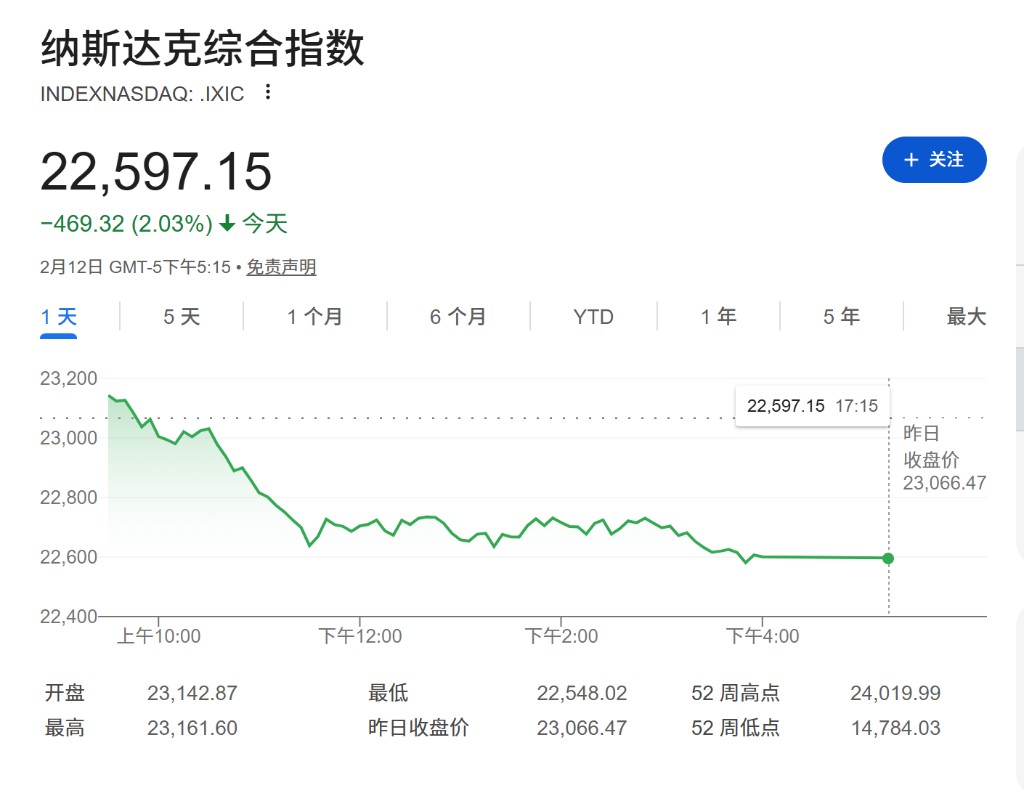
Currently, market attention has shifted to the January inflation data set to be released on Friday, with investors eagerly awaiting this key indicator for the latest clues on the interest rate outlook. Against this backdrop, fund flows have shown clear risk-averse and defensive characteristics.
Large-cap stocks bleed, small-cap stocks attract funds against the trend
In terms of the structure of fund outflows, large enterprises are the hardest hit. Data shows that U.S. large-cap stock funds experienced net outflows of up to $12.34 billion during the week, while mid-cap stock funds recorded net outflows of $787 million. This data indicates that investors are taking profits or reducing risk exposure from previously leading large tech stocks and core assets.
In stark contrast, small-cap stock funds broke through the trend, recording net inflows of $2.01 billion. This may reflect that some funds are seeking targets with more attractive valuations or are betting on the resilience of the U.S. domestic economy while hedging against the high volatility risks of large-cap stocks.
Bond market favored, funds see net inflows for six consecutive weeks
While the stock market is under pressure, the fixed income market continues to attract funds. Investors injected $13.37 billion into U.S. bond funds during the week, extending the net buying momentum of this asset class to six consecutive weeks. This shows that in an environment of uncertain interest rate paths, investors' preference for stable yield assets remains strong.
Breaking it down, short- to medium-term investment-grade funds became the main source of capital, with net inflows reaching $4.29 billion. Following closely are short- to medium-term government and treasury funds, which gained $3.09 billion in net inflows, while general domestic taxable fixed income funds also recorded net inflows of $2.7 billion. These flows indicate that the market is locking in the currently high yield levels.
Despite the hot bond market, money market funds, which serve as cash management tools, experienced significant withdrawals. After recording net inflows for two consecutive weeks, investors withdrew $25.83 billion from U.S. money market funds during the week. **This trend may suggest that some funds are reallocating from pure cash positions to interest-bearing assets like bonds, or are being used to meet liquidity demands arising from stock market volatility **
