


After a fourfold surge in stock price, SK Hynix promises to continue expanding AI chip production capacity

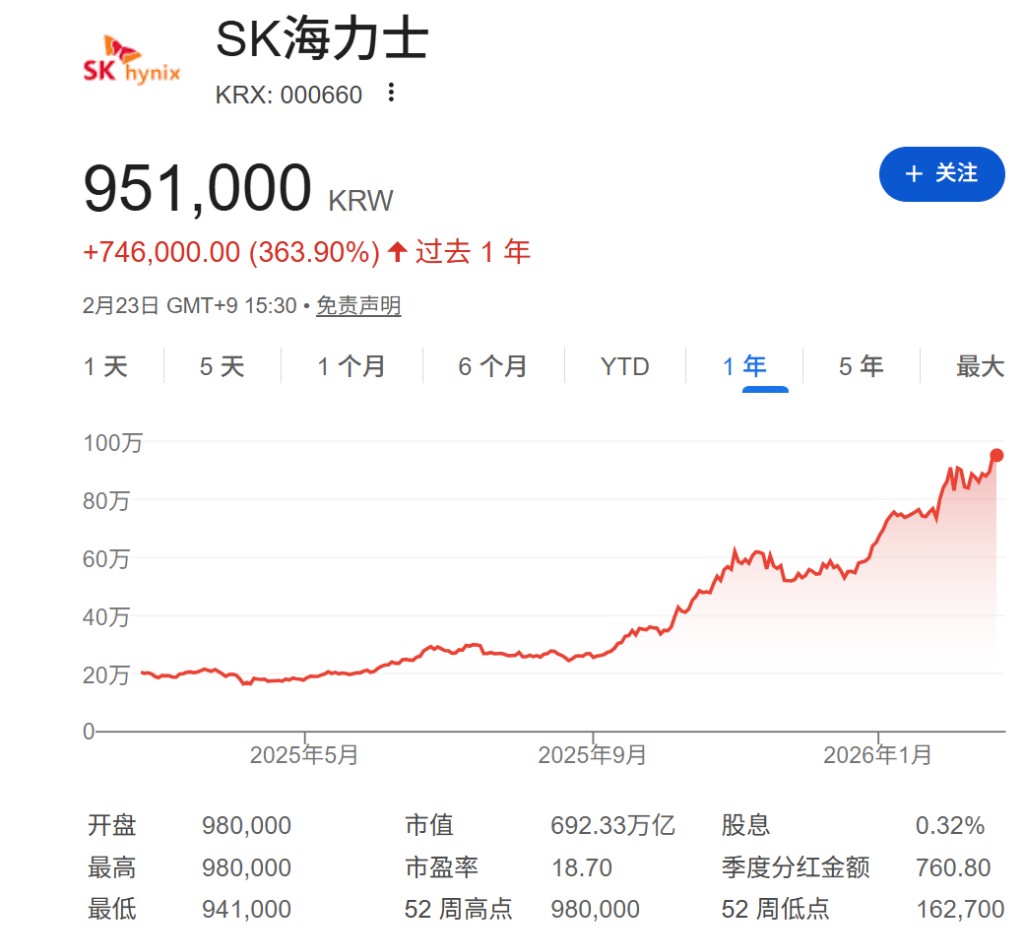
As SK Group Chairman Choi Tae-won promised to significantly expand the production of HBM "monster chips" in response to the supply shortage caused by global AI infrastructure development, the company's stock price has soared more than four times in the past year, setting a record for profits. Benefiting from strong demand from clients such as NVIDIA, SK Hynix's production capacity for 2026 has already been sold out, with profit expectations raised to as high as $100 billion
As SK Hynix's parent company, SK Group Chairman Choi Tae-won pledged to expand AI storage chip production capacity to meet the surge in demand brought about by the global data center construction boom, the company's stock price has soared more than fourfold over the past year, setting profit records.
The head of South Korea's second-largest conglomerate referred to high bandwidth memory (HBM) as a "monster chip" during a conference in Washington on February 20, stating that this product is generating huge profits for SK Hynix. This chip manufacturer has outperformed the global semiconductor industry due to the explosive growth in demand for AI chips.
In January, SK Hynix announced that its capital expenditure for 2026 would significantly increase compared to last year to meet the demand for HBM chips required for AI accelerators designed by companies like NVIDIA. The company's entire storage chip production capacity for 2026 has already been sold out.
This capacity expansion plan highlights how the global AI race is reshaping the semiconductor supply landscape. American tech giants, from Microsoft to Meta, are expected to invest about $650 billion this year in building AI infrastructure, leading to a global shortage of storage chips due to this record spending.
Market Dominance Further Consolidated
Currently, the global storage chip market is dominated by SK Hynix, its South Korean rival Samsung Electronics, and American Micron Technology. In the critical component area of HBM for AI, SK Hynix has established a leading advantage. The company's 2026 production capacity has been fully booked, and Micron's HBM products are experiencing similar situations.
American tech companies are engaged in a large-scale infrastructure race, trying to gain an edge in AI technology development. From Microsoft and Meta to other tech giants, a total investment of about $650 billion is expected this year for AI-related infrastructure construction. This unprecedented scale of investment is directly driving the demand for high-performance storage chips.
The HBM chips produced by SK Hynix are core components of AI accelerators from companies like NVIDIA and AMD, used for training and running artificial intelligence services. As the scale of AI models continues to expand, the demand for such high-performance storage chips is experiencing explosive growth.
Profit Expectations Soar but Risks Remain
Analysts continue to raise profit expectations for SK Hynix. According to Choi Tae-won, analysts' average forecast for the company's operating profit in 2026 has risen from about $50 billion at the end of last year to $70 billion in January this year, with some institutions even raising expectations to over $100 billion.
However, Choi Tae-won also issued a warning. "This sounds like good news," he said, "but it could also turn into a $100 billion loss." The chairman warned that rapid technological iterations could lead to dramatic changes in the competitive landscape, and there remains a possibility of losses in the future.
This cautious statement reflects the cyclical nature of the semiconductor industry and the uncertainties brought about by technological changes. Despite strong current demand, industry history shows that imbalances in supply and demand and generational technology transitions can quickly alter market dynamics
Energy Infrastructure Becomes a New Bottleneck
Cui Taiyuan also pointed out the increasingly severe infrastructure challenges. He stated that SK Group is exploring the construction of power plants next to AI data centers, as failing to meet energy demands could lead to "catastrophic" consequences.
This statement highlights the new constraints faced by the AI chip industry. As AI models and data centers continue to scale up, power supply is becoming another critical bottleneck following chip production capacity. For chip manufacturers planning large-scale expansions, ensuring a stable energy supply has become a strategic priority.
Although Cui Taiyuan did not specify the scale of SK Hynix's capacity expansion, the company has clearly stated that it will significantly increase capital expenditures. This commitment indicates that despite technological and market risks, SK Hynix remains confident in the long-term demand prospects for AI chips
