


China's LPR in February remains unchanged for the ninth consecutive month: the LPR for over 5 years is 3.5%, and the 1-year LPR is 3%

China's LPR remained unchanged in February. Regarding this year's monetary policy, the central bank recently stated that the use of tools such as reserve requirement ratio cuts and interest rate reductions should be "flexible and efficient." "Flexible" indicates that monetary policy tools will be used appropriately based on changes in the internal and external environment and the needs of economic development; "efficient" means that when using tools like reserve requirement ratio cuts and interest rate reductions, more consideration should be given to the effectiveness and targeting of the policies, aiming to both support economic growth and strengthen the prevention of risks such as fund idling and local debt
China's loan market quotation rate (LPR) for February was released on February 24, with both the 1-year and 5-year LPR remaining unchanged.
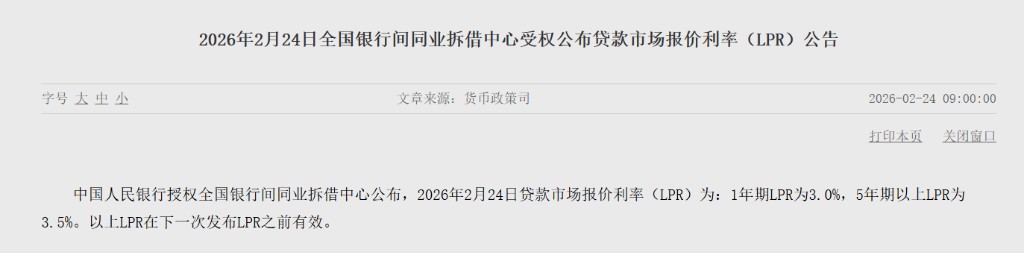
The People's Bank of China authorized the National Interbank Funding Center to announce that the 1-year loan market quotation rate (LPR) for February is 3%, the same as the previous value of 3%. The 5-year loan market quotation rate (LPR) for February is 3.5%, unchanged from the previous value of 3.5%.
The last adjustment of the LPR was in May 2025, when both the 1-year and 5-year LPR were lowered by 10 basis points. The LPR is the main reference benchmark for loan interest rate pricing and is released regularly every month.
China's loan interest rates continue to remain low. Data shows that the weighted average interest rate for newly issued corporate loans and newly issued personal housing loans in December 2025 is around 3.1%, having decreased by 2.5 and 2.6 percentage points, respectively, since the second half of 2018.
Regarding this year's monetary policy, the central bank recently emphasized the need for "flexible and efficient" use of tools such as reserve requirement ratio cuts and interest rate reductions.
In the monetary policy implementation report for the fourth quarter of 2025, the central bank proposed to continue implementing a moderately loose monetary policy. It aims to promote stable economic growth and a reasonable rebound in prices as important considerations for monetary policy, and to grasp the strength, rhythm, and timing of policy implementation based on domestic and international economic and financial conditions and the operation of financial markets. It will flexibly and efficiently use various policy tools such as reserve requirement ratio cuts and interest rate reductions to maintain ample liquidity and relatively loose social financing conditions, guiding reasonable growth in the total financial volume and balanced credit distribution, ensuring that the growth of social financing scale and money supply aligns with economic growth and overall price level expectations.
"Flexibility" indicates that monetary policy tools will be used timely based on changes in internal and external environments and economic development needs; "efficiency" indicates that when using tools such as reserve requirement ratio cuts and interest rate reductions, more consideration should be given to the effectiveness and targeting of policies, supporting economic growth while strengthening the prevention of risks such as fund circularity and local debt.
Wen Bin, chief economist of China Minsheng Bank, pointed out that regarding reserve requirement ratio cuts, at the press conference held by the State Council Information Office on January 15, 2026, it was mentioned that the average statutory deposit reserve ratio of financial institutions is currently 6.3%, indicating that there is still room for reserve requirement ratio cuts. Looking ahead, to support concentrated fiscal efforts, stabilize bank liabilities, and deeply release long-term liquidity in the context of continuously increasing MLF and reverse repurchase balances, there is a certain necessity for reserve requirement ratio cuts to alleviate the ongoing pressure on the central bank. However, currently, the central bank is comprehensively using tools such as 7-day and 14-day reverse repos, outright reverse repos, MLF, and government bond transactions, combining short, medium, and long-term measures to better meet market liquidity needs and maintain stable interest rates, thus the probability of reserve requirement ratio cuts in the short term is low. Regarding interest rate reductions, the current internal and external constraints on stabilizing the exchange rate and interest rate spreads have eased, and there will be a large-scale repricing of long-term deposits maturing in 2026, along with reductions in various relending rates, which also creates some space for interest rate cuts. However, considering that structural interest rate cuts have already been implemented in January and the stock market continues to perform well, the necessity for short-term interest rate cuts is also low
