


"Equal Tariffs" One Year Anniversary, In the End, Did Americans Bear All the Burden?

CITIC Construction Investment pointed out that 92% of the costs of Trump's tariff policy in 2025 (up to 100% in Japan) are borne by American importers and are accelerating to be passed on to consumers. By the end of the year, this has cumulatively pushed up the year-on-year PCE by about 0.72 percentage points—after deducting tariffs, the actual core inflation is only 2.18%. This means that inflation stickiness is severely underestimated, and the Federal Reserve's interest rate cut expectations may be overly optimistic
The market has long held a fantasy: high tariffs will force foreign exporters to bleed prices, thereby protecting the U.S. domestic economy. However, China Securities Construction (CSC) points out: In this tariff game, the ones footing the bill are U.S. importers, and ultimately, U.S. consumers.
On February 25, China Securities Construction (CSC) released a research report indicating that the "pass-through rate" of tariffs in 2025 is as high as 92%. This means that foreign exporters have almost no incentive to lower prices, and for every $100 increase in tariff costs, U.S. importers have to bear $92. More critically, as inventory depletes, this cost pressure is spreading to the Personal Consumption Expenditures (PCE) index at an astonishing rate. By December 2025, tariffs are expected to cumulatively raise the PCE year-on-year by about 0.72 percentage points, pushing the actual PCE up to 2.90% (compared to 2.18% without tariffs).
Macroeconomic Impact on Investors:
Inflation stickiness is severely underestimated: The additional inflation of 0.72 percentage points brought by tariffs means that the inflation baseline faced by the Federal Reserve is more stubborn than expected, and the market's pricing of interest rate cuts may be overly optimistic.
Corporate profit margins are under pressure: In high pass-through rate industries (such as toys, furniture, and clothing), U.S. importers have initially borne huge costs. If they cannot fully pass on this additional inflation of over 65% to end consumers, the profit expectations of related retailers and importers will be significantly downgraded.
Seeking safe havens with "domestic alternative capacity": Only in industries with substantial domestic production capacity, such as crop production and basic chemicals, will foreign exporters be forced to lower prices to absorb tariffs. This means that in trade frictions, U.S. domestic defensive sectors with high substitutability have greater certainty.
First Layer of Transmission: Exporters Refuse to Lower Prices, U.S. Importers Absorb 92% of Tariff Costs
The first part of the report hits the core: who ultimately bears the tariff costs? China Securities Construction based on HS10-level import data has constructed a massive panel dataset containing 5.35 million observations (covering 8 countries, 20,868 products, spanning 108 months to December 2025).
The baseline conclusion from the regression model is: β≈−0.08, meaning the pass-through rate is about 92%. For every 1 percentage point increase in tariffs, exporters only reduce prices by an average of 0.08 percentage points. Exporters only absorb 8% of the shock, while the remaining 92% falls entirely on U.S. buyers.
Looking at the data by country, the results are even more striking:
China: The pass-through rate is as high as 94%. For every $100 in tariffs, U.S. importers bear $94, while Chinese exporters only absorb $6.
Japan and ASEAN: The pass-through rates exceed 100% (Japan 1.12, ASEAN 1.19). This means that exporters from these regions not only did not lower prices but instead raised prices taking advantage of the tariff barriers to expand profits.
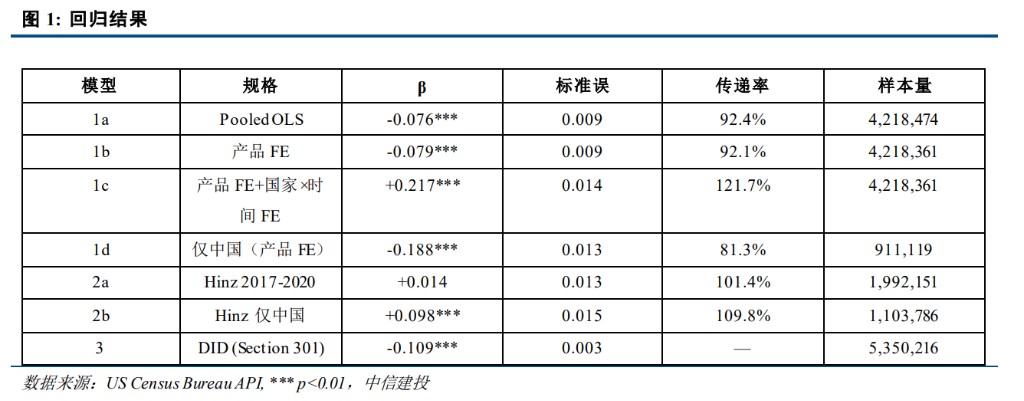
Industry Polarization: Who is Taking Advantage of the Fire, and Who is Cutting Losses to Preserve Value?
The research report further analyzed 44 NAICS industry codes (covering 83% of import volume) and found that the average pass-through rate reached 83%, with a median as high as 97%.
High Pass-Through Rate Industries (U.S. Companies Fully Taking Over): Metalworking Machinery (134%), Toys (105%), Furniture (105%), Clothing (104%), Agricultural Machinery (111%). The report specifically points out that 80% of toys in the U.S. market come from China, and 70% of automotive seats and interiors are manufactured in Mexico. The pass-through rates in these two highly concentrated industries are close to or exceed 100%, as importers simply cannot find alternatives.
Low Pass-Through Rate Industries (Exporters Bleeding and Reducing Prices): Crop Production, Communication Equipment Manufacturing, Basic Chemical Manufacturing, etc. Why are exporters in these industries willing to absorb tariffs? The report reveals the answer: Domestic Capacity. Crops and basic chemicals are industries where U.S. exports exceed imports, with significant domestic alternative production capacity. Foreign exporters face extremely high demand elasticity; if they do not lower prices, they will be completely abandoned by the market.
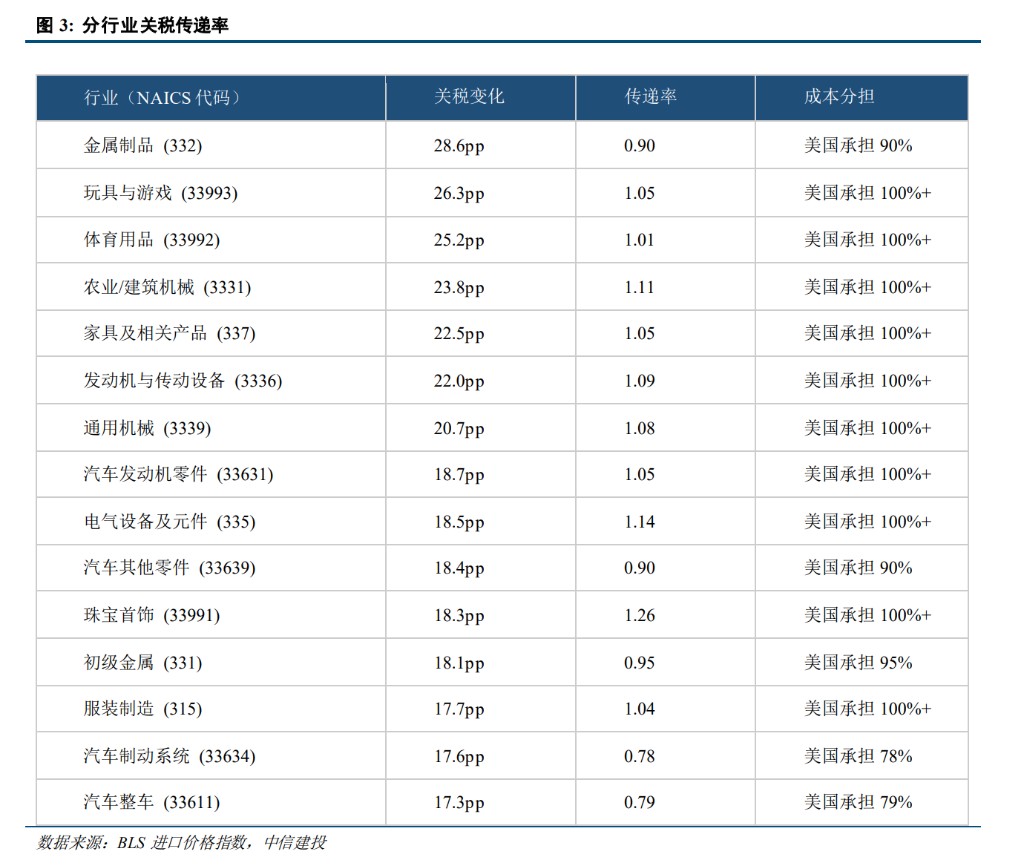
Second Layer Transmission: The Explosion After the Time Lag, Inflation Bills Submitted to U.S. Consumers
Where did the costs borne by importers ultimately go? The report tracked the penetration of tariffs on PCE (Personal Consumption Expenditures) inflation through a five-step transmission model.
The data reveals a dangerous "time lag trap":
The Initial Phase of Boiling a Frog in Warm Water: Within 2-3 months after the tariffs took effect, the impact was almost invisible (the transmission coefficient β was only between 0.02-0.08 and not significant). During this period, U.S. companies were consuming old inventory.
Rapid Rebound After Inventory Depletion: Starting from June-July, as low-cost inventory was depleted, the transmission coefficient surged, becoming statistically significant at the 1% level for the first time in July, soaring to 0.55 in September, and ultimately reaching 0.65 in December.
The Final Form of the Inflation Bill: β=0.65 means that theoretically, of the 1% price increase that tariffs should push up, 0.65% has already been converted into consumers' "excess inflation."
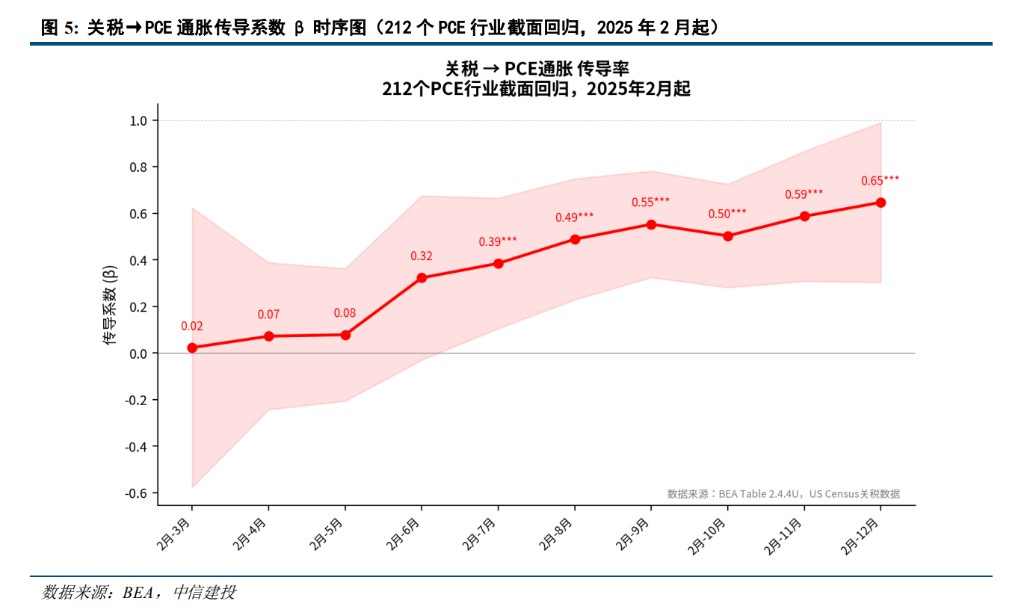
The final macro account shows: By December 2025, tariffs will have cumulatively pushed PCE up by approximately 0.72 percentage points year-on-year. The actual PCE in December was as high as 2.90%. If the tariff-driven effect is forcibly deducted, the real PCE is actually only 2.18% (very close to the Federal Reserve's 2% target). The impact of tariffs on inflation has worsened from a mere +0.06pp in April to +0.72pp by the end of the year
