


Japanese TVs usher in the era of the Chinese home court
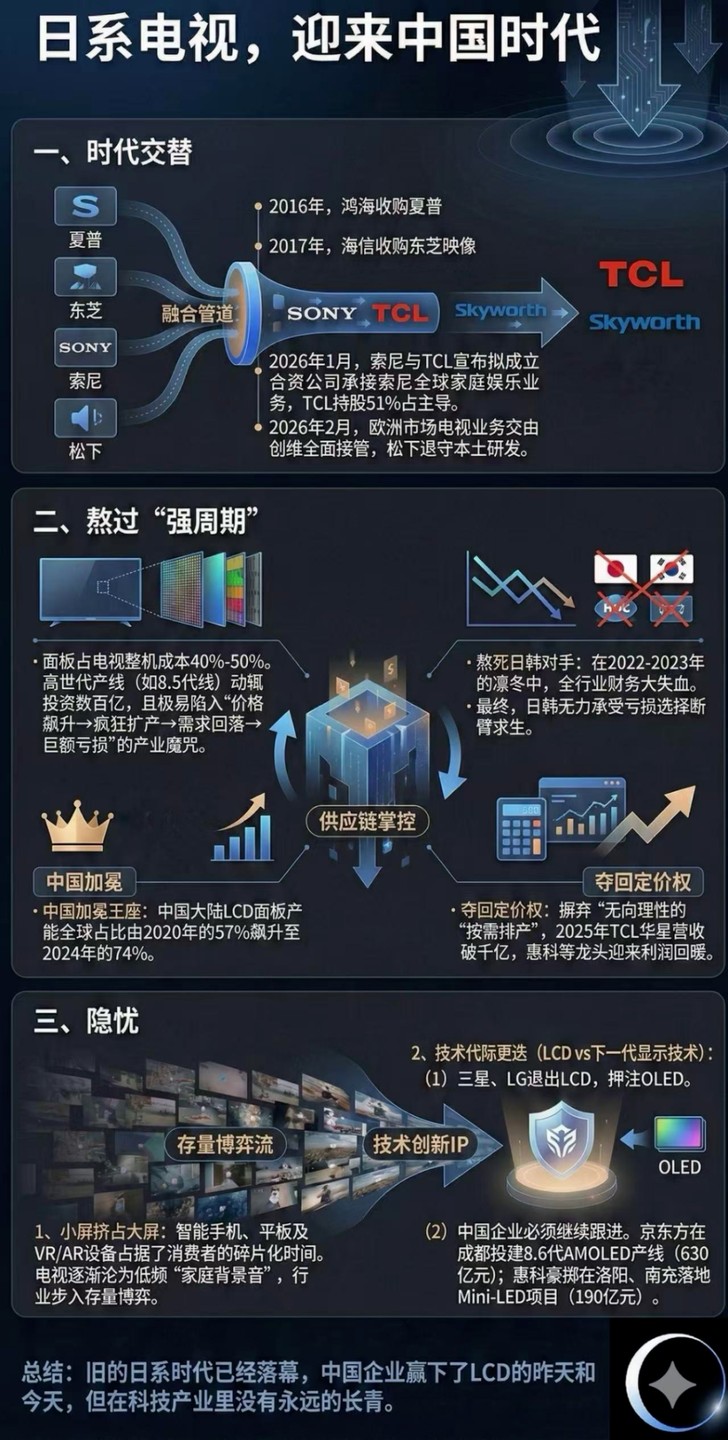
The Japanese television industry is entering an era dominated by China, as Panasonic hands over its television business in the European market to SKYWORTH, marking the inclusion of Japan's four major television giants into industrial collaboration with Chinese manufacturers. This move is a result of the long-term decline of the Japanese television industry, facing challenges from technological upgrades. SKYWORTH will be responsible for Panasonic's production and sales in Europe, while Panasonic will focus on the research and development of high-end models. This collaboration may indicate the possibility of SKYWORTH fully taking over Panasonic's global television business in the future
The global television industry's migration, spanning several decades, is coming to a phased conclusion.
Following Sharp's acquisition by Foxconn, Toshiba's takeover by Hisense, and the alliance between Sony and TCL, Panasonic recently announced that it will hand over its television business in the European market to SKYWORTH for full management.
Thus, the once-dominant Japanese television giants have all been incorporated into the industrial synergy map of Chinese manufacturers.
This is an undeniable fact: the once-revered Japanese television is collectively entering the Chinese era.
Looking back at this long journey to the top is a blood-and-tears history for the entire industry. From reckless expansion leading to a price collapse to the entire industry suffering massive financial losses, Chinese panel manufacturers have finally outlasted the struggling Japanese and Korean firms.
However, challenges have never ceased, and the seemingly impregnable LCD production capacity moat is now facing the impact of next-generation display technologies.
The LCD production capacity moat, built with hundreds of billions in funding, may become a heavy asset burden in the future. In the face of technological changes, can the newly crowned Chinese giants bet correctly this time?
The Final Twilight
What Panasonic is handing over to SKYWORTH is its television business in the European market.
According to the cooperation agreement between the two parties, SKYWORTH will be fully responsible for the production, sales, marketing, and channel expansion of Panasonic televisions in the European market; Panasonic will then focus on domestic and high-end model research and production.
According to a person close to SKYWORTH, Panasonic has a solid market foundation and consumer recognition in Europe and North America, and this cooperation will continue to retain the Panasonic television brand.
This may just be the prelude. An investor who has long observed the panel industry in Beijing believes that it is not ruled out that SKYWORTH will fully take over Panasonic's television business globally in the future.
This is not an isolated case.
Sony also partnered with TCL earlier this year to establish a joint venture, with TCL holding a 51% stake and taking the lead, which will undertake the global operations of Sony's television and home audio businesses.
If we extend the observation period, the successive exits of Panasonic and Sony mark a phased conclusion to a long industrial restructuring.
Turning the clock back to 2015, it was the starting point for the "four Japanese television giants" to slowly sell their television businesses and divest heavy assets.
To date, this massive retreat and consolidation sweeping the global television industry has just crossed a historic milestone of 10 years.
In this wave of consolidation, Sharp was the first to undergo a change of ownership.
In 2015, Hisense invested $23.7 million to acquire Sharp's Americas business and a 5-year brand usage right. This trial asset acquisition marked the beginning of the exit of the Japanese four giants from television competition.
The following year, facing ongoing financial loss pressures, Sharp accepted an investment of about $3.5 billion from Foxconn and relinquished control, officially incorporating its technological accumulation and global channels in the LCD field into the business system of Chinese enterprises This trend of asset restructuring accelerated further in the following years.
In 2017, Hisense invested approximately 12.9 billion yen to acquire 95% of Toshiba's imaging business and obtained a global brand license for 40 years.
If we consider the Toshiba TVs already acquired by Hisense, Sharp which was sold to Hon Hai, along with Panasonic and Sony that are now handing over their TV businesses, the once-dominant "four Japanese TV giants" have all been incorporated into the industrial synergy map of Chinese manufacturers, marking the official entry of Japanese TVs into the Chinese era.
Cycle Baptism
The continuous acquisition of Japanese giant brands by Chinese companies relies not only on "tycoon-style" spending but also on control over the supply chain.
While brand premiums can support higher prices, in the highly standardized scale business of televisions, the fundamental cost that determines survival is the cost of display panels. According to data from TrendForce, display panels account for about 40%-50% of the total cost of a television.
However, to control the panels, it is necessary not only to improve manufacturing efficiency but also to face the brutal backlash of "strong cycles." The investment for a high-generation panel production line starts at hundreds of millions, with a long construction cycle.
Different generations of panel production lines, such as G8.5, G8.6, and G10.5, see an increase in glass substrate size with each generation, but investment costs also rise accordingly.
For example, TCL Huaxing's one G8.5 LCD production line has a total investment of up to 24.5 billion yuan;
With limited financial strength, Huike Co., Ltd. has not laid out G10.5 and G11 generation lines, but to achieve cutting of large-size panels, it has implemented efficient glass substrate masking cutting technology to cut ultra-large panels over 85 inches.
This clearly shows the financial pressure high-generation production lines place on manufacturers.
What pains all players is the frequent misalignment between supply and demand.
When terminal market demand surges and panel prices soar, the temptation of profits drives companies to frantically expand production; however, when the newly added production capacity, after years of construction, is finally released, the demand in the consumer electronics market often peaks and declines.
This industrial curse has repeatedly harvested players in the market like a ghost over the past years.
Chinese manufacturers can be said to have undergone painful cycle baptisms time and again in this process.
Taking the last 10 years as an example, since 2017, global terminal market demand has begun to show signs of fatigue. Although in 2021, catalyzed by sporadic factors, the industry experienced a brief peak of prosperity, this overdrawn demand quickly faced a severe backlash.
Since the second quarter of 2022, the panel market has turned downward, entering a long and harsh winter.
DISCIEN data shows that in 2023, global LCD TV panel shipments were only 234.6 million units, a significant year-on-year decline of 10%.
In a situation where there is no perfect egg under the overturned nest, the entire industry is bearing huge financial losses in this brutal downward cycle:
Industry leader BOE has experienced a significant profit decline for two consecutive years, with net profit attributable to shareholders dropping by 70.91% and 66.22% year-on-year in 2022 and 2023, respectively; Known as the "Panel Three Brothers," Huike Co., Ltd. suffered a loss of over 2 billion yuan in 2022.
It is precisely the painful cyclical game that has accelerated the reshaping of the global landscape.
In the decades-long industrial migration of "Japan's development - Korea's surpassing - Taiwan's rise - mainland China's transfer," the Japanese and Korean giants, unable to bear the bottomless losses, ultimately chose to amputate to survive.
With TCL Huaxing's investment of 10.8 billion yuan to acquire LG's 8.5-generation production line in Guangzhou last year, this is the only remaining large-size LCD capacity from the Korean side. Coupled with the dim shutdown of the last Japanese holdout, Sharp's Sakai factory, the past chaotic situation of competition among China, Japan, and Korea has officially ended.
It can be said that Chinese companies have endured the harsh winter with flesh and blood, completing a significant capacity consolidation in the process.
This decades-long capacity transfer has recently shown a decisive outcome in the data: the global market share of LCD panel capacity from mainland Chinese manufacturers has surged from 57% in 2020 to 74% in 2024.
With over 70% of panel capacity concentrated in mainland China, this not only brings unmatched scale effects but also pricing power over the supply chain.
The disorderly expansion and "production based on sales" model that previously led the entire industry into cyclical massive losses have become history.
Now, mainstream panel manufacturers have begun to implement rational dynamic adjustments, namely "production based on demand."
After experiencing significant fluctuations, the global high-generation production line utilization rate is expected to stabilize around 85% in the future; in terms of new capacity, only three new LCD panel production lines have been added and put into operation globally since 2023, namely TCL's G6 LCD production line, Shentianma's G8.6 LCD production line, and BOE's G6 LCD production line.
This new normal of supply strategy not only smooths out the long-standing cyclical volatility but also provides extremely stable cost expectations for downstream television brands from the ground up.
This can also be seen from the recent performance reports of TCL Huaxing and Huike Co., Ltd. In 2025, TCL Huaxing's operating income is expected to exceed 100 billion yuan, with a net profit of over 8 billion yuan; in the same year, Huike Co., Ltd.'s net profit attributable to the parent company is expected to reach 3.808 billion yuan, a year-on-year increase of over 10%.
Looking ahead at price trends, BOE expects TV panel prices to continue rising in March this year.
The painful cyclical baptism has finally ushered in a glimmer of hope.
Not Without Worries?
With the overall performance turning positive, Chinese panel giants seem to have reached an absolute high point in the industry, but this battle may not be over yet.
The first most intuitive impact comes from the "small screen" challenging the "large screen."
Although Chinese companies have won the global living room, the dilemma is that people are leaving the living room.
With the rapid development of mobile internet, short video platforms, and smart hardware, smartphones, tablets, and even VR/AR devices are encroaching on consumers' fragmented time.
Once an irreplaceable absolute center of home entertainment, televisions are gradually becoming a low-frequency "background sound" device, and the industry faces the challenge of a stock game Compared to changes in consumer habits, a more lethal threat lies in the generational shift of underlying technologies.
The reason Chinese manufacturers were able to clear the field in the LCD sector using "scale effects + cost control" is that LCD technology has entered an extremely mature stage.
However, in the history of the technology industry, no technology can remain evergreen forever.
For example, OLED has physical advantages such as self-emission, being lighter and thinner, flexible bending, and extremely high contrast, and is currently mainly used in smartphones, with relatively slow progress in the large-size television panel sector.
According to data from Qunzhi Consulting, in 2024, the shipment share of OLED in the television display panel sector is only 3%.
In this regard, TCL Group Chairman Li Dongsheng believes that although the industry generally thinks that new display technologies may replace traditional LCD technology in the future, in practical applications, there is currently no other technology that can surpass LCD in large-size screen displays, especially in terms of cost-effectiveness and competitiveness.
However, in reality, all parties are still investing heavily in next-generation display technologies. Notably, the South Korean giants that have chosen to exit the LCD battlefield are not retreating entirely but are betting more funds on next-generation display technologies.
Currently, the global large-size OLED television panel market is mainly occupied by Samsung and LG.
Since 2001, Samsung has started producing OLED, initially achieving production through the transformation and upgrading of old low-generation LCD production lines, and began to successively produce new G5.5 production lines and build G6 and G8.5 production lines after 2011.
In January of this year, Samsung Display CEO Lee Jae-young stated in an interview: "In the IT business sector, our product lineup continues to expand. The company has added 8.6 generation OLED products this year, and sales are expected to grow by 20% to 30% compared to last year."
LG achieved the production of its first G8.5 production line as early as 2014.
This is precisely the biggest concern for the current Chinese panel industry: if the LCD production capacity moat built with hundreds of billions of funds and years of fierce competition faces a "dimensionality reduction attack" from next-generation display technologies, then Chinese manufacturers holding large LCD capacities will face extremely heavy asset burdens and technological gaps.
For this reason, Chinese manufacturers have to continue investing heavily in the construction of OLED and Mini-LED production lines.
BOE's 8.6 generation AMOLED panel production line has already been established in Chengdu, with a total investment of up to 63 billion yuan.
To support the construction of this production line, as the lead bank and agent for the syndicate loan, the China Development Bank has completed the establishment of a 25 billion yuan syndicate loan.
In February and May 2025, Huike Co., Ltd. successively established Mini-LED backlight/direct display module and complete machine projects, as well as a full-color M-LED new display chip base project in Luoyang and Nanchong, with a total investment of 19 billion yuan In this arena representing the foundation of great power manufacturing, there has never been a true endgame, only a starting line that is constantly reset.
The old Japanese era has indeed come to a close, but the new technological competition between China and South Korea is gradually unfolding.
For the newly crowned Chinese panel manufacturers, winning yesterday does not mean they can hold onto tomorrow: to avoid being ruthlessly abandoned by the times in the generational transition, they can only resolutely charge into the next even more brutal cycle of technology.
Risk Warning and Disclaimer
The market carries risks, and investment requires caution. This article does not constitute personal investment advice and does not take into account the specific investment goals, financial situation, or needs of individual users. Users should consider whether any opinions, views, or conclusions in this article align with their specific circumstances. Investing based on this is at one's own risk
