


Why haven't oil prices risen to $100 despite the "actual closure" of the Strait of Hormuz and attacks on Middle Eastern energy facilities?

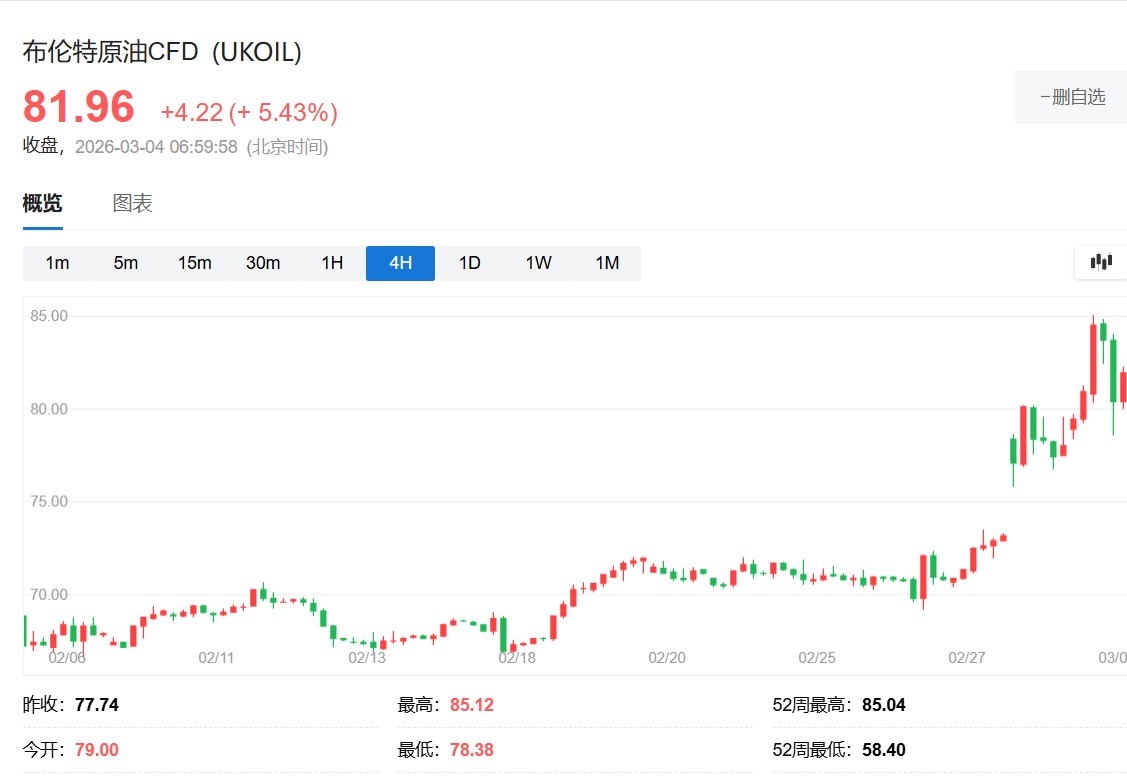
In the Strait of Hormuz, 150 oil tankers are stranded, and a Qatar LNG plant has been attacked, marking a scene that can be described as the "worst-case scenario." However, oil prices have only risen by 30% to $85, with the $100 threshold remaining unbroken. Ample inventories, the U.S. strategic reserves on standby, and traders' crisis restructuring experience have kept the market restrained—yet analysts warn that if the blockade continues for two weeks, breaking the $100 mark may be inevitable
The actual shipping stagnation in the Strait of Hormuz, along with attacks on Qatar's largest liquefied natural gas plant and important Saudi refining facilities, closely aligns with the "worst-case scenario" previously described by energy experts. However, oil prices have failed to break through the symbolic threshold of $100 per barrel.
Since the outbreak of the conflict four days ago, the benchmark Brent crude oil price has risen by about 30%, reaching $85 per barrel on Tuesday, the highest level since July 2024. However, this increase pales in comparison to historical major oil crises, and market panic has been notably suppressed.
According to the Financial Times, over 150 oil tankers are currently stranded around the Strait of Hormuz, with shipowners and insurance companies refusing to allow vessels to pass through the conflict zone, effectively halting about one-fifth of the world's oil and gas supply routes.
Carlos Bellorin, an analyst at energy data firm Welligence, stated, "The market response is cautious and tends to wait and see," but he also pointed out that there are no signs of de-escalation in the current situation, "Iran is escalating, not de-escalating." Analysts generally believe that the key variables affecting oil prices are the duration and intensity of this disruption.
Why the Market Remains Restrained
The increase in oil prices far exceeds the conflict between Israel and Iran last year, which lasted 12 days and had minimal impact on energy infrastructure. However, compared to historical major oil crises, the response remains moderate.
During the Arab oil embargo from 1973 to 1974, oil prices soared by 260%. The Iranian Revolution in 1979 triggered an increase of about 160%, and Iraq's invasion of Kuwait in 1990 pushed oil prices up by approximately 180%.
The relative calm in the current market reflects the dual effects of structural changes and accumulated experience. Developed economies are now far less dependent on oil than in the 1970s. The United States has risen to become the world's largest oil producer, and new supplies from Guyana, Brazil, and Canada continue to enter the market.
At the same time, after experiencing the COVID-19 pandemic and the 2022 Russia-Ukraine conflict, oil and gas traders have accumulated rich experience in rapidly restructuring global energy flows. MST Financial analyst Saul Kavonic noted that the shocks the industry has faced over the past five years are comparable to the total of the previous 25 years, making the market more composed in the face of short-term supply disruptions, "even somewhat complacent."
Moreover, the market is also speculating on the policy intentions of the Trump administration. With the midterm elections approaching in November, the White House has a strong motivation to suppress inflation, and if oil prices continue to rise, the release of the U.S. Strategic Petroleum Reserve could intervene at any time.
Before the outbreak of the conflict, the global oil market was well-supplied, and countries had time to replenish their inventories. According to Vortexa data, China currently has enough crude oil reserves to support 124 days of consumption; while global ground inventories are at historically low levels, they still amount to about 2 billion barrels. Vortexa Chief Economist David Wech stated, "2 billion barrels is still quite substantial in absolute terms, while the daily supply risk from the Middle East is about 16 million barrels." Saudi Arabia and the UAE can also transfer about 9 million barrels of exports daily by bypassing the Strait of Hormuz through pipelines.
What scenarios could push oil prices above $100?
Analysts' baseline forecast is that if the Strait of Hormuz can relatively quickly resume navigation, Brent crude will remain in the range of $80 to $90 per barrel—this is the judgment of Wang Zhuwei, an oil trading researcher at S&P Global Energy. However, if the disruption continues, the situation will significantly worsen.
Kavonic estimates that if the Strait is blocked for two weeks, over 250 million barrels of crude oil will be stranded, and some Gulf countries' storage tanks will reach capacity limits, forcing the shutdown of oil field production, at which point oil prices will exceed $100 per barrel. This scenario is already beginning to take shape: on Tuesday, Iraq shut down part of the operations at the world's largest oil field, Rumaila, citing that storage tanks had reached "critical levels."
Carlos Bellorin believes that Iran may continue to escalate actions before any potential negotiations to accumulate maximum leverage. "If we observe the current trends and the evolution of the situation, it is possible that oil prices could reach the $90 high range this weekend," he said. The real test for the market may just be beginning
