


Breakfast | Three major indices fell, with chip stocks leading the decline in U.S. stocks
The three major indices fell, with chip stocks leading the decline in U.S. stocks, and the semiconductor sector closing down 1.2%; oil prices surged 8% to $82, reaching a new high since July 2024; precious metals retreated, with both gold and silver dropping over 1%
Market Overview
Geopolitical conflicts have pushed up oil prices, raising investor concerns about inflation. The market is awaiting non-farm payroll data. U.S. stocks fell across the board, but the decline narrowed compared to intraday levels.
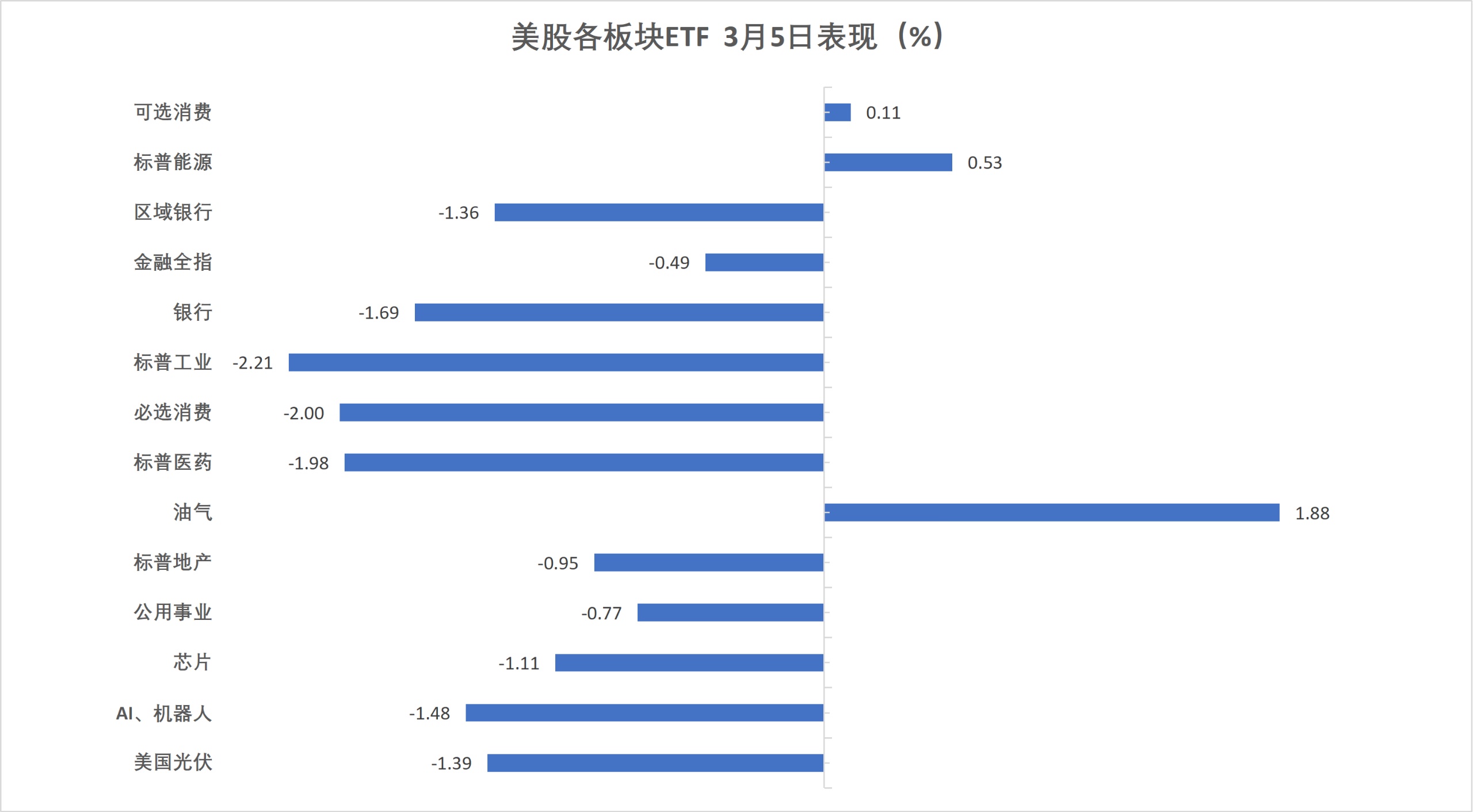
Chip stocks led the decline in U.S. stocks, with the semiconductor sector down 1.2%, having at one point dropped over 3%. Nvidia recovered its losses during the day, ending up 0.16% in a dramatic turnaround. Software stocks continued their recent rebound, with the North American technology software ETF rising 2.27%. Broadcom surged 4.8% after earnings.
WTI crude oil surged 8% at one point, breaking above $82, reaching a new high since July 2024. It retreated slightly at the end of the day due to indications from the Trump administration that it would address oil price issues, but still closed up 3% at $79.
The yield on 10-year U.S. Treasuries rose by 4.2 basis points, marking the fourth consecutive day of increases. The dollar rose by 0.6% at one point.
Bitcoin fell nearly 3% to around $71,000 under the dual pressure of risk aversion and liquidity contraction. Gold fell 1%, and silver dropped 1.58%.
During the Asian session, the three major A-share indices rose collectively, with Micro LED and smart grid stocks experiencing a surge in limit-up trading. Oil prices suddenly plummeted at the end of the day, with the Hang Seng Index dropping over 1% in the afternoon, and Alibaba falling nearly 3%.
Key News
China
Li Qiang delivered the government work report: The economic growth target for 2026 is 4.5%-5%, with a deficit ratio of around 4%.
JD.com's Q4 net revenue increased by 1.5% year-on-year to 352.3 billion yuan, with new business investments leading to a quarterly net loss of 2.7 billion yuan. On the conference call: Investment in delivery services will be lower than last year, and the usage of the Yanshi large model has surged a hundredfold.
Bilibili's Q4 revenue grew by 8% year-on-year, with adjusted net profit increasing by 94%, achieving annual profitability for the first time.
Overseas
Iran dismissed claims of blocking the Strait of Hormuz, preparing to respond to U.S. ground actions and refusing to negotiate with the U.S. Lloyd's: Insurance companies are still quoting for navigation through the Strait of Hormuz, and are communicating with the DFC on trade insurance solutions. France, Italy, and Greece have joined forces to coordinate military deployments to ensure freedom of navigation in the Red Sea. Fuel supply in Asia is under pressure.
The surge in oil prices has impacted interest rate cut expectations, with U.S. Treasury traders warming to the idea that the Federal Reserve may not cut rates this year.
Spot gold briefly fell by $70, with reports that Poland plans to sell gold reserves for national defense financing.
CME Group has lowered gold and silver margins, with gold down from 9% to 7%, and silver from 18% to 14%.
The threat of conflict in the Middle East has prompted South Korea to warn of a "disruption" risk to the chip supply chain.
Reports indicate that Nvidia's GTC conference will introduce new inference chips, which may impact HBM and DRAM demand. Nvidia is undergoing a major capacity adjustment: H200 is making way for the next-generation chip Vera Rubin.
OpenAI released the strongest professional model GPT-5.4, which can automatically operate computers, with plugins supporting AI to excel in Excel and financial analysis.
Market Report
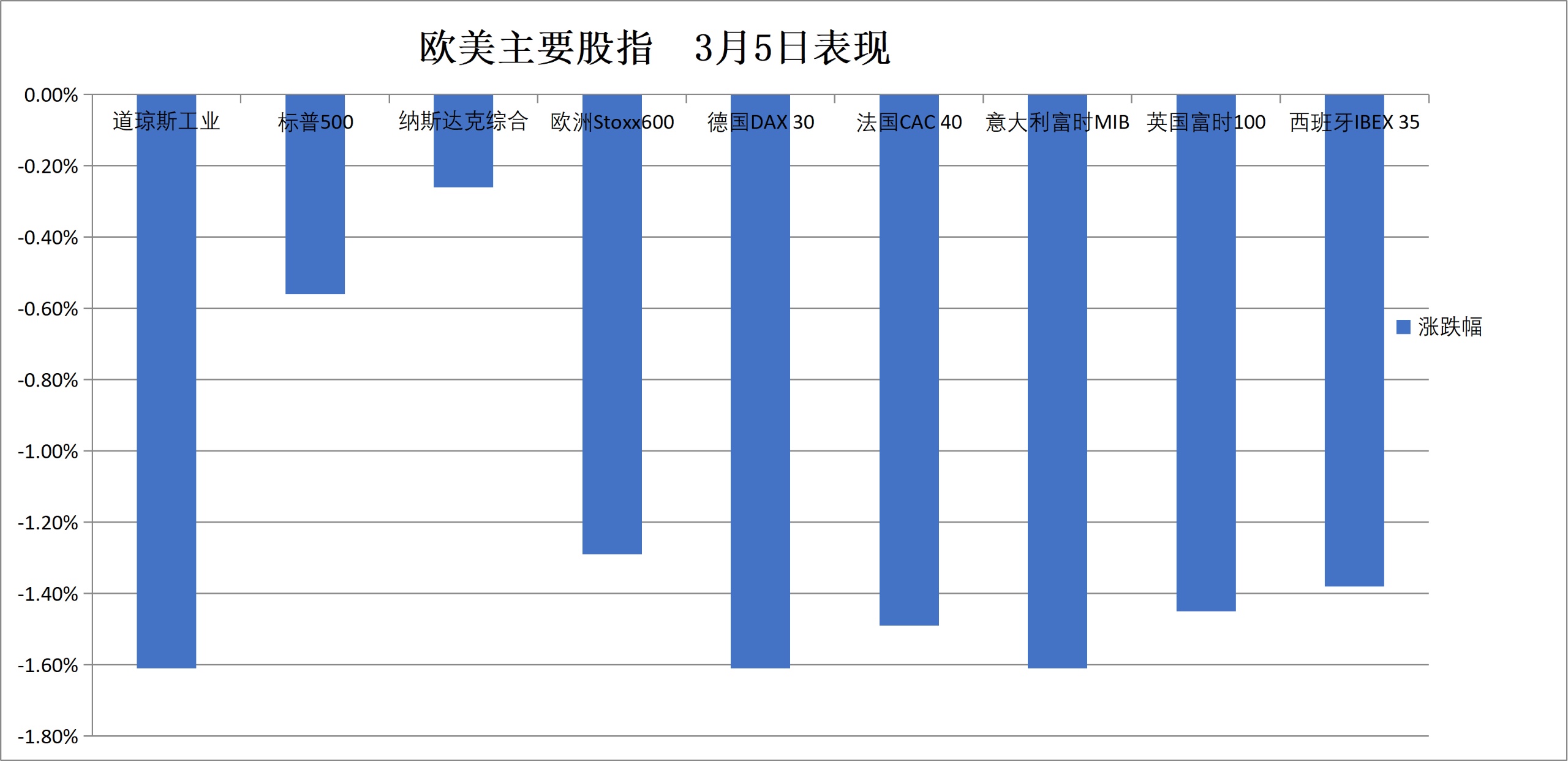
US and European Stock Markets: The S&P 500 fell by 0.57%, closing at 6830.56 points. The Dow Jones fell by 1.61%, closing at 47954.74 points. The Nasdaq fell by 0.26%, closing at 22748.99 points. The European STOXX 600 index closed down 1.29%, at 604.83 points.
A-shares: The Shanghai Composite Index closed at 4108.57 points, up 0.64%. The Shenzhen Component Index closed at 14088.84 points, up 1.23%. The ChiNext Index closed at 3216.94 points, up 1.66%.
Bond Market: The yield on the US 10-year Treasury rose by 3.08 basis points, at 4.127%, with a cumulative increase of nearly 18 basis points over the last four trading days. The yield on the 2-year US Treasury rose by 3.31 basis points, at 3.574%.
Commodities: WTI crude oil surged by 7% during the day, at $81.50 per barrel. Spot gold fell by 1.11%, at $5083. Spot silver fell by 1.37%, at $82.25.
Key News Details
Global Highlights
China
Li Qiang delivered the government work report: The economic growth target for 2026 is 4.5%-5%, with a deficit ratio of around 4%. The government work report proposed the main expected goals for development in 2026: economic growth of 4.5%-5%, striving for better results in actual work; the report mentioned that the deficit ratio is planned to be arranged at around 4% this year; all levels of government should better "manage finances," establishing and improving mechanisms for increasing revenue and reducing expenditure. Focus on stabilizing the real estate market. Implement city-specific policies to control increments, reduce inventory, and optimize supply, exploring multiple channels to revitalize existing commercial housing.
- A simplified version of the government work report. The overall requirements and policy orientation for economic and social development in 2026: Economic growth of 4.5%-5%, over 12 million new urban jobs, consumer price increase of around 2%, and a planned deficit ratio of around 4%. Some work tasks include: developing emerging pillar industries such as integrated circuits, aerospace, biomedicine, and low-altitude economy, implementing city-specific policies to control increments, reduce inventory, and optimize supply, exploring multiple channels to revitalize existing commercial housing.
- The National Research Office interprets the government work report: This year's economic growth target is positive and pragmatic, expanding domestic demand is the first task for two consecutive years. The monetary policy continues to maintain a moderately loose orientation, emphasizing the need to effectively utilize various policy tools such as reserve requirement ratio cuts and interest rate reductions to maintain ample liquidity. This year, the total funds promoted for investment at the central level will exceed 5 trillion yuan. The report has placed expanding domestic demand as the first task for two consecutive years, especially highlighting the "implementation of special actions to boost consumption." This year, a new special fund of 100 billion yuan for fiscal and financial collaboration to promote domestic demand has been established, which is a very new policy this year.
- Government Work Report: Why continue to implement a more proactive macro policy? According to CCTV News, Chen Changsheng, a member of the drafting group of the Government Work Report and deputy director of the State Council Research Office, stated that this year the external environment is highly uncertain, and the domestic supply-demand imbalance continues, resulting in a certain total demand gap. Therefore, it is necessary to strengthen policy adjustments and use the certainty of macro policies to respond to the uncertainty of the situation. From an international comparison, China's current government debt ratio, especially the central government's debt ratio, is still relatively low, and there are still conditions for monetary reserve requirement ratio cuts and interest rate reductions. Additionally, there is still room for innovation in policy combinations. At the same time, this policy orientation is also intended to convey the continuity of macro policy regulation to the whole society.
March 6th Two Sessions Agenda Preview: Review and Discuss the Draft Outline of the 14th Five-Year Plan. On the morning of March 6th, the fourth meeting of the 14th National People's Congress held a plenary meeting for all delegations to review the draft outline of the 14th Five-Year Plan; in the afternoon, each delegation held group meetings to review the government work report and examine the draft outline of the 14th Five-Year Plan.
The draft outline of the 14th Five-Year Plan, summary is here! According to Xinhua News Agency, it emphasizes strengthening original innovation and tackling key core technologies. It insists on combining technology-driven and demand-driven approaches, enhancing strengths and addressing weaknesses, improving the new type of national system, and promoting the output of more iconic original achievements. It promotes comprehensive advancement in digital intelligence technology empowerment. It fully implements the "Artificial Intelligence +" action, strengthens the integration of artificial intelligence with technological innovation, industrial development, cultural construction, social welfare, and social governance, seizing the high ground of artificial intelligence industry applications, and empowering various industries comprehensively.
JD.com's Q4 net revenue increased by 1.5% year-on-year to 352.3 billion yuan, with new business investments leading to a net loss of 2.7 billion yuan in a single quarter. Conference Call: Takeaway investment will be lower than last year, and the usage of the Yanxi large model has surged a hundredfold
- JD's total revenue for the year exceeded 1.3 trillion yuan for the first time, a year-on-year increase of 13%, with growth reaching a new high in recent years. The profitability of its core retail business continues to improve, with an operating profit margin rising to 4.6%. Service revenue, growing at a rate of 23.6%, has become the main engine of growth. In the fourth quarter, revenue reached 352.3 billion yuan, a year-on-year increase of 1.5%, slightly exceeding expectations. However, due to increased investment in new business strategies, the company turned from profit to loss in that quarter, recording a net loss of 2.7 billion yuan. Overall profitability is under significant pressure, with the annual net profit attributable to shareholders halved to 19.6 billion yuan. The operating loss from new businesses for the year reached 46.6 billion yuan, becoming a core factor dragging down overall profitability.
Bilibili's Q4 revenue grew 8% year-on-year, adjusted net profit increased by 94%, achieving annual profitability for the first time. Bilibili's annual revenue reached 30.35 billion yuan, a year-on-year increase of 13%, with advertising revenue reaching 10.06 billion yuan, up 23% year-on-year; the company achieved a net profit attributable to shareholders of 1.19 billion yuan for the year, marking its first annual profit under U.S. Generally Accepted Accounting Principles. In the fourth quarter, revenue was 8.32 billion yuan, a year-on-year increase of 8.0%; net profit attributable to shareholders was 514 million yuan, a year-on-year surge of 478%. In the fourth quarter, DAU reached 113 million, a year-on-year increase of 10%, and monthly paying users hit a record high.
Overseas
Iran refutes claims of blocking the Strait of Hormuz, prepares to respond to U.S. ground actions, refuses to negotiate with the U.S.. Iran claims its drones hit the U.S. aircraft carrier "Lincoln," and its missiles struck a U.S. oil tanker; the Iranian foreign minister stated they are waiting for a U.S. ground invasion, confident in their ability to resist, calling it a huge disaster for the U.S., with no reason for further negotiations; Iran's permanent mission to the United Nations stated that claims of blocking the Strait of Hormuz are baseless and extremely absurd. The Israeli military stated it is entering the next phase of operations, increasing efforts to undermine the foundations and military capabilities of the Iranian regime. The U.S. is reportedly adding resources to support the war for "at least 100 days or even until September." Trump stated he must be involved in determining Iran's supreme leader, with reports indicating he seeks Kurdish assistance for actions in Iran. Italy stated it does not intend to participate in the war, while the UK assists Gulf countries in defending against Iran; Qatar reported being attacked by Iran.
Iran: No blockade of the Strait of Hormuz, but passage rules are controlled by Iran. Iranian officials stated that they are handling vessels passing through the strait according to relevant international rules and established agreements. During wartime, the passage rules for the Strait of Hormuz will be controlled by Iran. Military and commercial vessels belonging to the U.S., Israel, and European countries and their supporters are strictly prohibited from passing through the area, and any detected will be attacked.
Is this the U.S. "ground troops"? Kurdish armed forces begin ground activities within Iran. According to Xinhua News Agency, the "Iranian Kurdish anti-government armed forces" stationed in Iraq have begun to launch "ground offensives" into Iran The U.S. is planning to provide weapons and intelligence support to contain Iranian military power. Analysts warn that Iran's vast territory, complex terrain, and large population, combined with the Kurdish forces' lack of resources and limited trust in the U.S., could lead any ground operation to become a "years-long quagmire." The Kurdish forces have cooperated with the U.S. multiple times but have often been "abandoned."
Lloyd's: Insurance companies are still quoting for navigation through the Strait of Hormuz and are communicating with the DFC on trade insurance plans. The CEO of LMA stated that the market is providing insurance quotes to vessels hoping to pass through and will continue to offer quotes at a future point when shipowners believe it is safe enough for their vessels and crews. Lloyd's also stated that it is actively communicating with the U.S. International Development Finance Corporation (DFC) regarding political risk insurance and guarantee plans for maritime trade in the Persian Gulf.
France, Italy, and Greece join forces to coordinate military deployments and ensure freedom of navigation in the Red Sea. French President Macron spoke with the Italian Prime Minister and the Greek Prime Minister on Thursday morning. The three leaders reached an agreement to coordinate the delivery of military supplies to Cyprus and jointly maintain freedom of navigation in the Red Sea. Currently, the Strait of Hormuz is blocked, and several oil-producing countries are forced to cut production due to full storage tanks, with Saudi Arabia accelerating its shift to export via the Red Sea.
With a surge in oil hoarding and prices, Asian fuel supply is under pressure. The shutdown of the Strait of Hormuz has triggered an energy crisis in Asia. Singapore's marine fuel orders have been reduced; South Korea has issued a level one energy warning and will crack down on price gouging; Japanese refiners are seeking to release international strategic petroleum reserves; and Bangladesh has reduced the delivery of refined oil to gas stations, compressing consumption demand.
Soaring oil prices impact interest rate cut expectations, U.S. Treasury traders are warming to the idea that the Federal Reserve will not cut rates this year. As of Wednesday, traders estimated a 25% probability that the Federal Reserve would maintain the current interest rate range unchanged by December. This percentage is higher than last Friday's 17%, which was the last trading day before the outbreak of the Iran war. Among all possible scenarios, "no rate cuts for the entire year" has become the most probable single outcome. Other scenarios include a 24% probability of a 25 basis point cut once, a 12% probability of two cuts, and even a 16% probability of a rate hike.
Spot gold briefly fell by $70, report: Poland plans to sell gold reserves to finance defense. The Governor of the National Bank of Poland proposed selling part of the gold reserves to raise about $13 billion to support defense spending, causing gold prices to drop by $70 in the short term. This plan has presidential support and aims to replace EU financing projects to strengthen U.S.-Poland defense cooperation. Despite the significant appreciation of gold, the plan faces legal prohibitions and political differences with the Prime Minister, leaving its feasibility highly uncertain. **
CME Group lowers gold and silver margins, gold down from 9% to 7%, silver down from 18% to 14%. CME Group announced that it has lowered the initial margin for its COMEX 100 gold futures from 9% to 7%; at the same time, the initial margin for COMEX 5000 silver futures has been reduced from 18% to 14%. CME Group stated that the new margin standards will take effect after the market closes on March 6, 2026.
Middle East conflict threatens, South Korea warns: chip supply chain faces "disruption" risk! A member of South Korea's ruling party stated that if the geopolitical tensions in the Middle East continue to escalate, it will pose a substantial threat to South Korea's semiconductor industry. He pointed out that rising oil prices will increase domestic electricity costs, thereby weakening the price competitiveness of South Korean chips, while disruptions in the supply of key raw materials and rising logistics costs are also significant risks facing the industry.
Report: NVIDIA GTC conference to launch new inference chip, may impact HBM and DRAM demand. NVIDIA is reported to be developing a new inference chip based on Groq's on-chip SRAM architecture, raising investor concerns that the use of SRAM will reduce demand for main memory, including HBM. However, institutional analysis from KIS pointed out that the market is misreading: SRAM is not a substitute for HBM/DRAM, but a differentiated choice for ultra-low latency scenarios, and the segmentation of memory hierarchy will ultimately expand the total volume of the entire industry.
- NVIDIA capacity adjustment: H200 gives way to next-generation chip Vera Rubin. NVIDIA has partially halted the production of the H200 chip and redirected TSMC's related capacity to the next-generation architecture Vera Rubin. This is a practical compromise in light of the delayed approval of U.S. export regulations.
OpenAI releases the strongest professional model GPT-5.4, automating computer operations, plugin supports AI to excel in Excel and financial analysis. OpenAI has integrated native computer control capabilities into its general model for the first time. GPT-5.4 can directly operate software, browse the web, and control the mouse and keyboard to complete tasks, allowing for deep integration with enterprise applications such as spreadsheets and financial analysis tools; its desktop navigation capability surpasses human benchmark levels, achieving record high scores in web search tests and reaching or exceeding professional levels in occupational knowledge tests; the introduction of a tool search mechanism significantly reduces token consumption. GPT-5.4 is available in two versions, Thinking, which excels in complex reasoning, and Pro, which offers high performance, with a maximum context window of 1 million tokens, priced higher than 5.2; a financial services suite is launched simultaneously
- GPT-5.4 Core Insider Information Exploded! May Have Permanent Memory, Extreme Reasoning Surge. Multiple sources confirm that OpenAI is intensively testing GPT-5.4. Compared to its predecessor, this model may see several significant upgrades: the context window doubled to 1 million tokens, a new extreme reasoning mode to tackle complex problems, and significantly enhanced long-term task execution capabilities. The most explosive rumor is that GPT-5.4 may introduce a permanent memory function, allowing AI to truly possess continuous memory capabilities. If true, this will be a key leap towards the evolution of autonomous intelligent agents.
Research Report Highlights
Hang Seng Technology Index Loses $600 Billion, What Is the Market Afraid Of?. The Hang Seng Technology Index has fallen 28% since its peak last October, with a market value evaporating by nearly $600 billion. Although valuations have dropped below historical averages, the core concern of "burning money for market share, with questionable returns" remains. Major players spent $1.1 billion during the Spring Festival to acquire users, and the upcoming financial reports will be the next critical test.
Power Consumption Drops by 95%, Breaking the Light-Copper Trade-Off Dilemma, Will Micro LED CPO Be the Ultimate Solution? Micro LED CPO, through co-packaging optical and parallel low-speed channel architecture, can reduce unit transmission energy consumption to 1–2 pJ/bit, significantly lowering data center power consumption and increasing interconnect density. With solutions like Microsoft's MOSAIC validating its feasibility, Micro LED optical interconnect is becoming a potential technology route of interest in the capital market, with industry chain opportunities concentrated in areas such as external chips, massive transfer, and advanced packaging.
Domestic Companies
Strong Demand for AI, Foxconn's Revenue Soars 21.6% in the First Two Months of This Year, Setting a Historical High for the Same Period. Foxconn's revenue in February was NT$595.8 billion, setting a new high for the same period, with a year-on-year increase of 8.06%. Cloud network products benefited from strong AI demand, becoming the only segment among the four major product lines to show year-on-year growth, demonstrating resilience during the Spring Festival off-season. Cumulative revenue for the first two months reached NT$1.32 trillion, a year-on-year increase of 21.63%. Despite declines in categories like computer terminals and consumer electronics, the incremental contribution from cloud networks still drove overall revenue growth against the trend. The company expects seasonal performance in the first quarter to exceed the average level of the past five years.
BYD's Wang Chuanfu: Second-Generation Blade Battery Charges in 9 Minutes, 20,000 Fast Charging Stations to Be Built by Year-End. The arrival of the second-generation blade battery means that BYD is officially responding to pressure from competitors with a mass-produced product Lei Jun talks again about the surge in memory prices: mobile business faces great pressure. Since the price increase of the Redmi K90 series smartphones last October, Lei Jun has repeatedly stated that the rise in memory prices has put pressure on the mobile business, with the latest statement made on the morning of March 5. Several industry insiders have indicated that the price increase for new smartphones released after March will be significantly larger, with the minimum increase not less than 1,000 yuan, and the increase for mid-to-high-end flagship models possibly reaching 2,000-3,000 yuan.
Overseas Macro
Report: The Bank of Japan may keep interest rates unchanged in March, with an April rate hike still under consideration. According to informed sources, Bank of Japan officials are still pushing for interest rate normalization, and the assessment of the likelihood of a rate hike at the March meeting is generally low, but this does not mean a shift in the rate hike path. As long as the economic outlook evolves as expected, they will continue to push for rate hikes. Officials have stated that policy decisions will be made at each meeting, and an April rate hike is not impossible.
The cryptocurrency market finally sees a plunge in the Korean stock market. The Korean stock market has plummeted about 20% in the past two days, breaking the speculative frenzy in AI tech stocks and prompting retail funds to quickly rotate into the cryptocurrency market. Currently, trading volume in the crypto market has surged, but the "kimchi premium" indicator shows that current demand is only experiencing a moderate recovery and has not reached extreme speculative levels.
Overseas Companies
Berkshire resumes buybacks, new CEO personally invests $15 million to support, promises to continue increasing holdings for the next 20 years. This is Berkshire's first buyback in a year and a half. Abel stated that the buyback decision was made after assessing intrinsic value and communicated with Chairman Buffett; the buyback does not mean giving up on other capital allocation opportunities such as acquiring companies; he will increase his holdings in Berkshire every year during his tenure as CEO.
OpenAI hires Cooley and Wachtell law firms to prepare for IPO, with the earliest listing possible this year. OpenAI has hired the law firms Cooley and Wachtell to prepare for an IPO, which could be listed as early as the fourth quarter of this year. The company's current valuation is $730 billion, and if listed, it will become one of the largest IPOs in history. Jensen Huang confirmed OpenAI's IPO plans and adjusted investment expectations. Meanwhile, competitor Anthropic is also actively preparing for an IPO.
Broadcom conference call: AI chip revenue will exceed $100 billion by 2027, AI will not disrupt infrastructure software. During the conference call, Broadcom projected that by 2027, revenue from AI chips alone will far exceed $100 billion, with total shipments approaching 10 gigawatts Broadcom believes that infrastructure software such as VCF, serving as a permanent abstraction layer between artificial intelligence software and physical chips (silicon), cannot be replaced or substituted. Relying on deep, long-term cooperation with customers, Broadcom has secured key component production capacity for 2026 to 2028 in advance, becoming one of the first companies in the industry to lock in capacity for 2028.
The U.S. issues its first nuclear power construction permit in a decade, Bill Gates' advanced nuclear reactor approved. TerraPower, backed by Bill Gates, has received the first nuclear power construction permit in nearly a decade, breaking the monopoly of light water reactors with its sodium-cooled fast reactor, and has signed a contract with Meta to build up to eight reactors, exclusively providing carbon-free electricity for AI data centers—the commercialization wave of advanced nuclear power has officially set sail.
Today's News Preview
Economic theme press conference, attended by Pan Gongsheng and Wu Qing.
U.S. February non-farm employment.
U.S. January retail sales.
Eurozone Q4 GDP.
Federal Reserve voting member Harker speaks on the dollar's safe-haven status.
NASA's planned crewed lunar mission in March has been postponed again
