


Qatar: If the war continues for several weeks, Gulf countries will be forced to halt production, and oil prices may soar to $150 in the next three weeks
The global energy choke point is being strangled! Qatar's core LNG hub has been attacked, and the Strait of Hormuz is effectively paralyzed. The Qatari Energy Minister issued the sternest warning: if the conflict continues for several weeks, many countries in the Middle East will be forced to halt production entirely, oil prices could soar to $150, and natural gas may surge fourfold. A superstorm that could "cripple the global economy" is approaching!
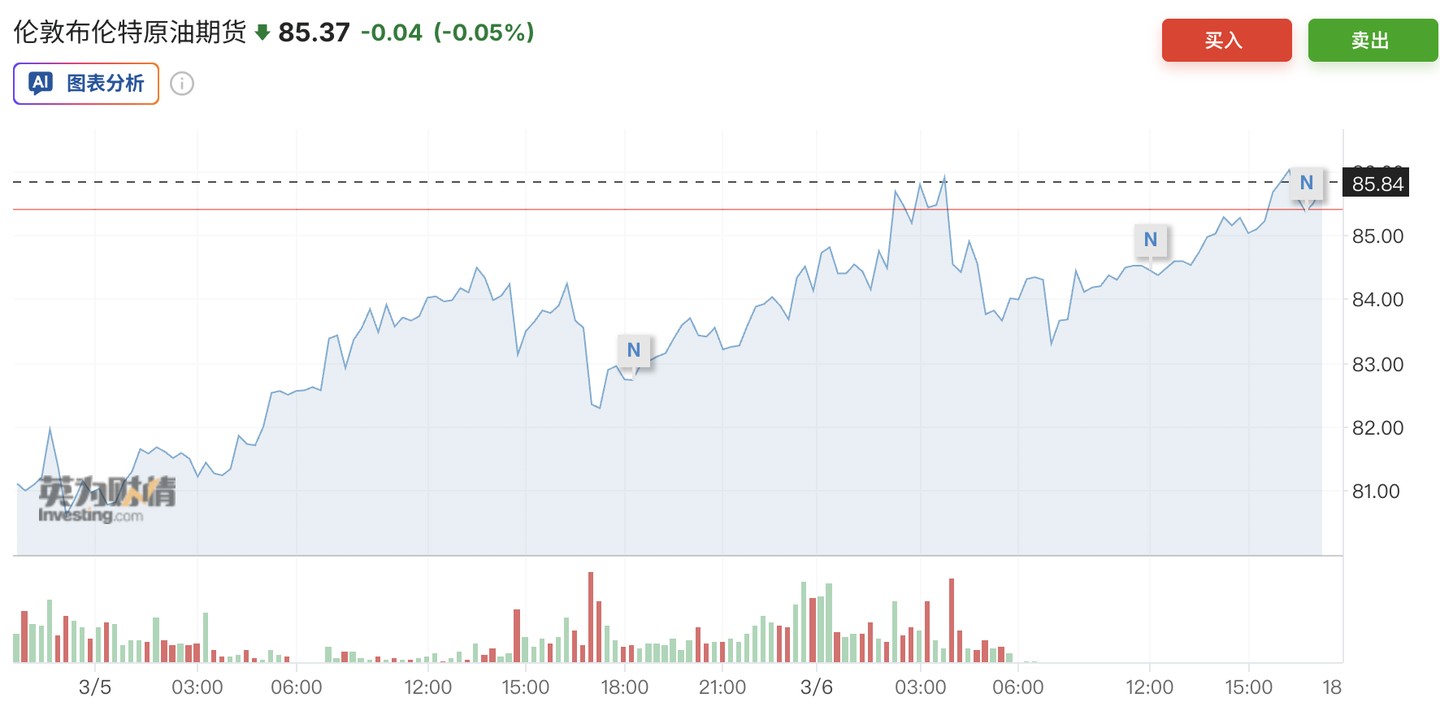
The escalation of conflict in the Middle East is pushing the global energy supply system to a critical point. The Qatari Minister of Energy has issued the most severe warning to date: If the war continues for several weeks, energy-exporting countries in the Gulf region will be forced to halt production entirely, and the global economy will suffer profound impacts. As of the time of writing, WTI crude oil has risen by 1.5% to $82.32 per barrel; Brent crude is up 0.7%.
Qatari Energy Minister Saad al-Kaabi stated in an interview with the Financial Times that even if the conflict stops immediately, it will take "weeks or even months" for Qatar to resume normal liquefied natural gas (LNG) deliveries. He predicts that if the Strait of Hormuz remains closed, international oil prices could soar to $150 per barrel within the next two to three weeks, while natural gas prices could rise to $40 per million British thermal units, nearly four times higher than pre-war levels.
An article previously published by Wall Street Insight mentioned that JP Morgan's calculations show that once the strait is completely blocked, the storage capacity of the seven major oil-producing countries in the Middle East can only support 25 days, after which they will be forced to halt production entirely.
Kaabi warned that this war "will cripple the economies of countries around the world." He expects that as the conflict continues, other Gulf exporting countries that have not yet declared force majeure "will also follow suit in the coming days," at which point Asian buyers will rush to purchase limited spot resources at higher prices, and the European market will also face significant impacts.
Ras Laffan Attacked, Resumption Timeline Still Unclear
On Monday, Iranian drones attacked the Ras Laffan facility in Qatar, forcing QatarEnergy to declare force majeure. This facility is a core hub for Qatar's LNG exports.
Kaabi stated that damage assessment work is still ongoing, and the repair timeline is yet to be determined. "We currently do not know the scale of the damage; the assessment is still in progress. How long the repairs will take is still unclear." He also revealed that while Qatar's offshore production facilities were not damaged, they also face the threat of attacks.
"When our personnel are in danger, when we have been struck in military operations, when we cannot operate normally, and cannot risk our employees, we have no choice but to declare force majeure," Kaabi said.
In addition, Qatar's $30 billion expansion project aimed at increasing the North Field's annual production capacity from 77 million tons to 126 million tons (scheduled for completion in 2027) will also be delayed, and the initial production plan originally set to launch in the third quarter of this year will be postponed. "This will definitely delay all our expansion plans." He said, "If we can resume within a week, the impact may still be manageable; "But if delayed for a month or two, the situation will be completely different."
The Strait of Hormuz is effectively paralyzed
About one-fifth of the world's oil and gas passes through the Strait of Hormuz, but since the United States and Israel launched attacks on Iran last Saturday, shipping in this strategic waterway has nearly come to a halt. Reports indicate that at least 10 vessels have been attacked, insurance rates have skyrocketed, and shipowners are generally hesitant to send vessels and crews through the strait.
Trump stated that the U.S. Navy would provide escort for passing vessels and offer additional insurance coverage for shipping companies. However, Kaabi is not optimistic about this. "Given the current attack situation, sending vessels into the strait... is too dangerous. It's impossible to convince shipowners to take the risk near the Iranian coastline," he said, "Most shipowners will realize that they will become bigger targets because Iran is targeting warships."
The narrowest point of the Strait of Hormuz is only 24 nautical miles and is right next to the Iranian coastline. Kaabi stated, as long as the conflict continues, there is no safe passage for merchant ships in the strait.
Huge logistical challenges remain after resumption of production
Even if the conflict stops and production resumes, restoring normal delivery order will not be easy. Kaabi pointed out that Qatar has 128 LNG carriers, but currently only six or seven are on standby, while the rest are dispersed around the globe.
"Each vessel takes one or two days to load, and at most only six or seven can be loaded at the same time," he explained, which is the fundamental reason why the recovery of deliveries takes a long time.
In terms of market replenishment, Qatar has no other options. Kaabi stated that there is simply not enough spot LNG available for alternative procurement in the market. "If you want to buy 77 million tons to resell to customers, you can't find that large a quantity in the market," he said.
Potential chain economic impacts
Kaabi's warnings extend far beyond the energy market itself. He emphasized that the disruption of trade in the Strait of Hormuz will transmit to multiple supply chains, as the region produces a significant amount of petrochemical products and fertilizer raw materials globally.
"If this war lasts for weeks, global GDP growth will be affected. Everyone's energy prices will rise, some products will face shortages, and factory supply chains will experience chain reactions." he said.
Regarding the European market, although Qatar's exports to Europe are relatively small, Kaabi stated that Europe will still bear significant impacts—as Asian buyers compete for limited spot supplies at higher prices, European buyers will face more intense bidding pressure.
In response to external doubts that this shutdown will damage Qatar's reputation as the most reliable LNG supplier, Kaabi refuted this. "I don't think anyone will blame you for being unreliable because you failed to deliver while being bombed," he said
