Qatar warns Gulf countries to halt production, US stock index futures plunge, oil prices surge, US oil rises 4%, US bonds under pressure, gold and silver rise

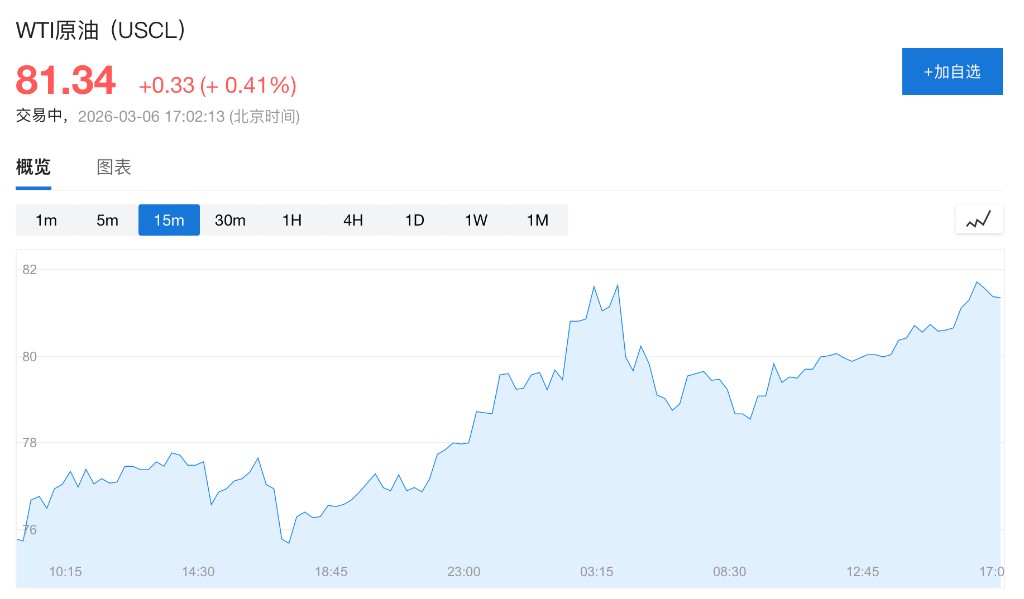
Qatar warns Gulf countries to halt production, causing U.S. stock index futures to plunge and oil prices to surge, with WTI rising by 4%. The situation in Iran escalates, nearly halting shipping in the Strait of Hormuz, raising market concerns about the resurgence of energy supply risks. All three major U.S. stock index futures fell collectively, the U.S. dollar index briefly surged, and WTI crude oil prices increased by more than 2.5%. Precious metal prices rose, with spot silver up 2.5% and gold rising in tandem. After experiencing significant volatility, the market has temporarily stabilized, with investors focusing on the subsequent developments of the Iran conflict
The situation in Iran continues to escalate, with shipping in the Strait of Hormuz nearly coming to a standstill, and energy supply risks reigniting inflation concerns. The market is awaiting tonight's non-farm payroll report.
On March 6, U.S. stock index futures collectively plunged, with Nasdaq futures down 0.42% during the day and S&P 500 futures down 0.36%; the U.S. dollar index briefly surged, rising 0.2% during the day; WTI crude oil briefly rose, increasing over 2.5% during the day to $83.56 per barrel. Precious metals strengthened, with spot silver rising 2.5% and gold rising in tandem.
Crude oil resumes its upward trend, but momentum slows. The latest data shows that maritime traffic in the Strait of Hormuz is nearly completely stagnant, and supply concerns have overshadowed the suppressive effects of U.S. intervention measures. During the early Asian trading session, oil prices briefly fell due to the White House weighing multiple stabilization options. Crude oil prices recorded the largest weekly increase since 2022.
Marco Oviedo, a senior strategist at XP Investimentos, stated:
"What matters now is whether this war will last for a few days, weeks, or longer. The likelihood that the conflict will not last too long remains a basic assumption, and the U.S. will win this war. However, Iran's refusal to concede keeps the situation tense."
Core market trends are as follows:
Nasdaq futures were down 0.42% during the day, and S&P 500 futures were down 0.36%. Previously, Dow Jones futures were up 0.17%, S&P 500 futures were up 0.1%, and Nasdaq 100 futures were up 0.2%.
European stocks opened higher collectively, with the Euro Stoxx 50 index opening up 0.53%, the German DAX index up 0.60%, the UK FTSE 100 index up 0.34%, the French CAC 40 index up 0.43%, and the Italian FTSE MIB index up 0.61%.
The yield on the 10-year U.S. Treasury bond rose by 1 basis point to 4.15%.
Brent crude oil prices rose by 0.6% to $85.93 per barrel.
Spot gold prices rose by 0.3% to $5,100.07 per ounce; spot silver rose by 2.5%.
Bitcoin fell by 0.2% to $70,991.31, and Ethereum fell by 0.1% to $2,078.26.
U.S. stock index futures experienced slight fluctuations, with the market stabilizing after a week of intense volatility. Investors continue to adjust their expectations regarding the duration and impact of the Iran conflict, with energy supply risks and renewed inflation expectations dominating asset pricing logic. In the bond market, U.S. Treasury prices fell, pushing the yield on the 10-year Treasury bond to potentially record the largest weekly increase in nearly a year.
Market focus is shifting to the non-farm payroll report for February, set to be released on Friday, in search of further insights into the Federal Reserve's monetary policy path.
According to Wall Street Journal, Goldman Sachs estimates that new jobs will only increase by 45,000, below market consensus. Major drag factors include approximately 31,000 jobs lost due to new strikes and about 5,000 jobs lost in the construction industry due to severe winter weather; the firm also expects the suppressive effects of the federal government's hiring freeze to continue In addition, when the data is released tomorrow, there will be a simultaneous population control adjustment. Goldman Sachs estimates that due to the continued slowdown in net immigration growth over the past year, the population base is overestimated, and the labor force size and employment numbers may each be adjusted down by about 300,000 to 400,000; however, the impact on the unemployment rate and labor participation rate is expected to be very limited, both less than 2 basis points.

Oil prices recover upward. The latest data shows that maritime traffic in the Strait of Hormuz has nearly come to a complete standstill, supply disruption concerns have reignited, overshadowing the suppressive effects of U.S. intervention measures. During the early Asian trading session, oil prices briefly fell due to the White House weighing multiple options to stabilize oil prices.
The plan for the Treasury Department to directly participate in crude oil futures trading has been temporarily shelved, and possible means to stabilize oil prices include releasing oil reserves and temporarily exempting fuel blending requirements.

Risk Warning and Disclaimer
The market has risks, and investment requires caution. This article does not constitute personal investment advice and does not take into account the specific investment goals, financial conditions, or needs of individual users. Users should consider whether any opinions, views, or conclusions in this article are suitable for their specific circumstances. Investment based on this is at their own risk