Tenways rushes for Hong Kong stock IPO: Holding the "Chinese brand harvesting the European market" narrative, but not as profitable as earning hard money through OEM?

Wallstreetcn
2026.03.06 13:01
portai
I'm PortAI, I can summarize articles.

Star investment institutions collectively bet

In the wave of Chinese manufacturing going overseas in recent years, the two-wheeled mobility sector has witnessed a rare capital frenzy.

The pandemic has changed the way many consumers exercise, and what was once considered a niche market, electric-assisted bicycles (E-bikes), suddenly crossed the category divide overnight, becoming the darling of hot money in the primary market.

Among the many players in this massive wave of bicycle financing overseas, the most notable "star student" is the E-bike brand Tenways, which focuses on the mid-range market in Europe.

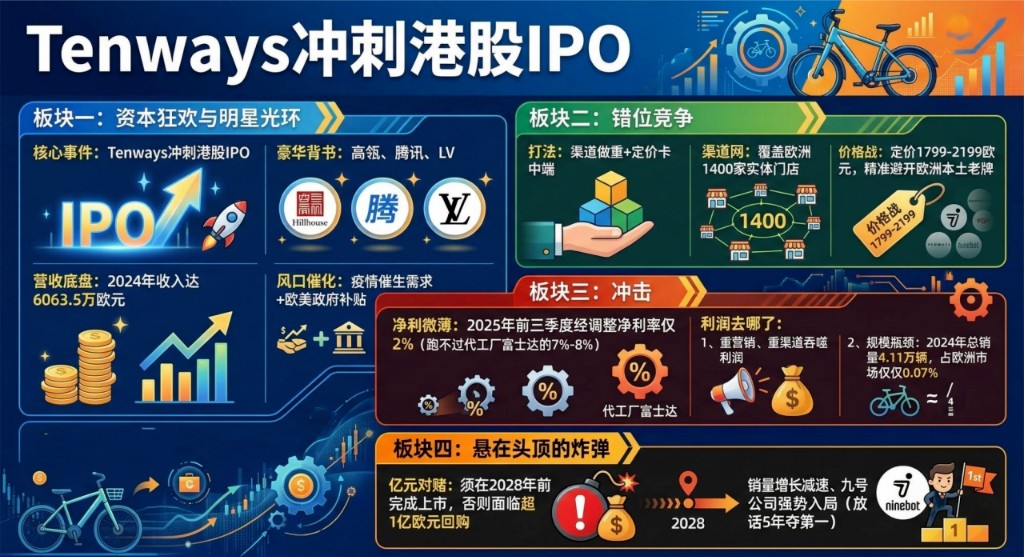
During the brief window of hot money influx from 2021 to 2023, Tenways completed multiple rounds of financing in one go, securing consecutive bets from Hillhouse Capital, Tencent, and LVMH's investment firm, L Catterton.

With the boost from these star investment institutions, Tenways has begun to achieve significant performance, with revenue reaching €60.635 million in 2024, equivalent to RMB 485 million.

With the backing of star institutions and expectations for substantial monetization, Tenways' parent company Radvance Cayman Limited (hereinafter referred to as "Tenways") has initiated a sprint towards the Hong Kong Stock Exchange.

Despite its growing revenue, Tenways faces numerous challenges.

On one hand, if Tenways fails to go public by 2028, the performance guarantee agreements signed with many shareholders may trigger buyback obligations, with this portion of debt exceeding €100 million;

On the other hand, although Tenways' E-bikes are sold at prices exceeding RMB 10,000, it is constrained by scale and marketing, resulting in unimpressive profitability, with an adjusted net profit of only €1.244 million in the first three quarters of 2025.

How to overcome the scale threshold is a brutal challenge that Tenways must face next.

Capital Realization Period

The pandemic in 2020 spurred the development boom of the global electric bicycle industry.

On the demand side, due to the need for safe social distancing, cycling culture in Europe and the United States has fully revived. This not only led to a surge in sales but also shifted the main battlefield of bicycle consumption towards the higher-priced electric-assisted (E-bike) direction.

On the policy side, governments in many European and American countries have taken advantage of the situation, using real monetary subsidies to fuel this trend. Starting in 2020, governments in places like California and Washington in the United States successively introduced subsidy policies for electric-assisted bicycles, including exemptions from a 6.5% sales tax and discounts of up to 50% on purchases; in the same year, the Italian government offered a reimbursement rate of 60% for bicycles, with a maximum subsidy of €500.

Investment institutions, responding to the trend, have placed bets, using real money to push these Chinese E-bike companies onto the fast track of global expansion.

The years 2021-2023 were undoubtedly the roaring years for Chinese E-bikes going overseas. Tenways successively secured over hundreds of millions from Hillhouse, Tencent, and LVMH; Urtopia obtained nearly tens of millions of dollars from Lightspeed China and DCM; Aventon, with the support of GaoRong and Sequoia China, saw its valuation reach as high as $590 million.

Now is the time for a phased assessment. As the first Chinese E-bike company to step into the IPO process during the boom years, Tenways is able to submit its report first, relying on a competitive logic of "heavy channel development and mid-range pricing."

In terms of channel layout, compared to many overseas companies that quickly scale through Amazon, Tenways has taken a relatively "heavier" approach.

For high-priced, experience-heavy E-bikes, offline test rides and maintenance are unavoidable thresholds. To address this, Tenways has covered 1,400 stores across Europe to establish a physical sales network.

Currently, the dealer network, composed of independent stores and retail chains, constitutes the main source of income for Tenways, contributing €38.93 million in the first three quarters of 2025, accounting for about 70%.

In terms of products and pricing, Tenways chooses to go overseas with its own brand, precisely targeting the market gap in the "mid-range upgrade."

Depending on the application scenarios, Tenways' products are divided into urban, hybrid, and cargo electric bicycles, with urban electric bicycles being the main source of income, contributing over 70% of revenue in the first three quarters of 2025.

Currently, the retail price of this main model ranges from €1,799 to €2,199, equivalent to RMB 14,300 to RMB 17,500.

The essence of this pricing strategy is a misalignment battle that avoids the sharp edges of established giants. For example, the E-bikes of the German high-end brand Haibike, which has over 30 years of history, are priced between €6,000 and €10,000, while the Dutch century-old brand Gazelle's E-bikes are also generally priced above €3,000.

Although priced lower than local brands, Tenways, with its own brand going overseas and leveraging China's complete industrial chain, still has a certain gross profit margin. In the first three quarters of 2025, it reached 31.8%.

This figure leaves many OEM companies in the dust.

Taking Tianjin Fushida Bicycle Industrial Co., Ltd. (hereinafter referred to as "Fushida"), which is currently sprinting for an IPO on the Shanghai Stock Exchange, as an example, it mainly provides bicycle manufacturing services for brands like Lightning and Decathlon. In the first half of 2025, its E-bike gross profit margin was only 18.82%, more than 10 percentage points lower than Tenways.

Burdened with Over 100 Million in Bets

On the surface, Tenways' prospectus writes a "brand harvesting premium" overseas success story, but behind the high gross profit, its net profit margin remains relatively limited.

Based on adjusted net profit calculations for the first three quarters of 2025, Tenways' net profit margin during this period was only 2%. In contrast, Fushida, which is still earning hard-earned money from OEM, has managed to maintain a net profit margin of 7%-8% over the past three years.

This is partly because Tenways, as a brand owner, needs to bear more front-end promotion costs, which to some extent erodes profit margins. In the first three quarters of 2025, sales expenses reached €10.61 million, accounting for 19.6% of revenue; On the other hand, the overall sales remain relatively limited, insufficient to form a sufficient scale effect.

In 2024, Tenways' total sales reached 41,100 units, accounting for only 0.07% of the total sales in the European market.

In a rather darkly humorous twist, the core argument Tenways used in its prospectus to validate its "brand influence" is that it ranks second in social media mentions across Europe according to third-party statistics.

This reflects the awkward position of Tenways in the industry.

In fact, compared to contract manufacturers who only need to produce on order and earn processing fees with certainty, personally entering the brand arena means that the profit from each vehicle is squeezed by long distribution lines, expensive customer acquisition costs, and production lines that have not yet reached scale.

Tenways also faces the challenge that industry giants like Ninebot, with substantial financial resources, have finally decided to enter the E-bike competition after a long period of observation.

"In fact, Ninebot has been researching the product direction of E-bikes since 2014, but it wasn't until 11 years later that we truly began to delve into it," said Ninebot founder Gao Lufeng in a media interview last year. "E-bikes were still considered niche products in the early days, and if the company had entered the market then, it wouldn't have made commercial sense. It wasn't until the annual sales of this product reached 10 million units that we believed the timing was right."

To this end, Ninebot plans to launch over 15,000 shared E-bikes in collaboration with operators at the Paris Olympics in 2024, aiming to become the number one in this field within five years.

As competition intensifies, E-bike companies lacking financial strength have already been pushed off the table.

Earlier this year, the well-known North American E-bike brand Rad Power Bikes went through bankruptcy proceedings and was hastily acquired for less than 100 million RMB.

As a company that has only been in operation for five years, Tenways' financial strength is also relatively limited. As of the end of September this year, cash and cash equivalents amounted to 19.71 million euros.

On the fundamental side, Tenways' growth rate is slowing down.

In the first three quarters of 2025, Tenways' E-bike sales growth rate was only 6.3% year-on-year, significantly lower than the over 20% year-on-year increase for the entire year of 2024; prices have also seen a slight decline, with the average selling prices of urban and hybrid E-bikes being 1,144 euros and 1,414 euros, respectively, down 3.21% and 7.82% year-on-year.

The bet is like a sword hanging over its head.

According to the betting agreement signed between Tenways and external shareholders, if it fails to complete its IPO by 2028, it may have to fulfill its buyback obligations. As of the end of September 2025, this redemption liability has reached as high as 118 million euros.

With internal pressures from the betting deadline and deceleration, and external threats from giants and industry reshuffling, for Tenways, sprinting for an IPO at this time can be seen as a race against time. Securing resources from the secondary market and dismantling the 100 million yuan betting bomb before Chinese industry giants fully complete their overseas expansion may be the only opportunity to cope with this brutal elimination race.