


U.S. January retail sales month-on-month -0.2%, the first negative growth since October last year
Affected by winter storms and weak auto sales, U.S. retail sales in January fell by 0.2% month-on-month, marking the first negative value since October last year and the largest monthly decline since May last year. Excluding automobiles, sales remained flat month-on-month, while core "control group" sales increased by 0.3%, indicating that the core of consumption remains resilient. Online sales grew against the trend, and actual consumption showed robust performance. Economists expect that the scale of tax refunds this year is likely to boost consumer spending in the subsequent quarters
Affected by weak sales from automobile dealers and winter weather disturbances, U.S. retail sales in January fell month-on-month, but core indicators show that endogenous momentum still exists, and there remains a divergence in market judgment regarding the consumption outlook.
The U.S. Department of Commerce announced on Friday that, after seasonal adjustment, retail sales in January decreased by 0.2% month-on-month, marking the first negative value recorded since October 2025 and the largest single-month decline since May of last year. The report's release was delayed by several weeks compared to usual due to last year's government shutdown.
Excluding automobile dealers, retail sales were basically flat month-on-month. Year-on-year, retail sales grew by 3.2% in January, accelerating compared to December. More notably, the "control group" sales, which exclude food services, automobile dealers, building materials, and gas stations, increased by 0.3% month-on-month. This indicator directly affects the government's accounting of consumer spending on GDP, showing a relatively stable core in consumer spending.
Continued weakness in consumer spending poses a threat to the U.S. economy, as personal consumption accounts for about two-thirds of GDP. However, economists generally expect that the higher tax refund scale this year is likely to boost consumer spending in the first half of 2026.
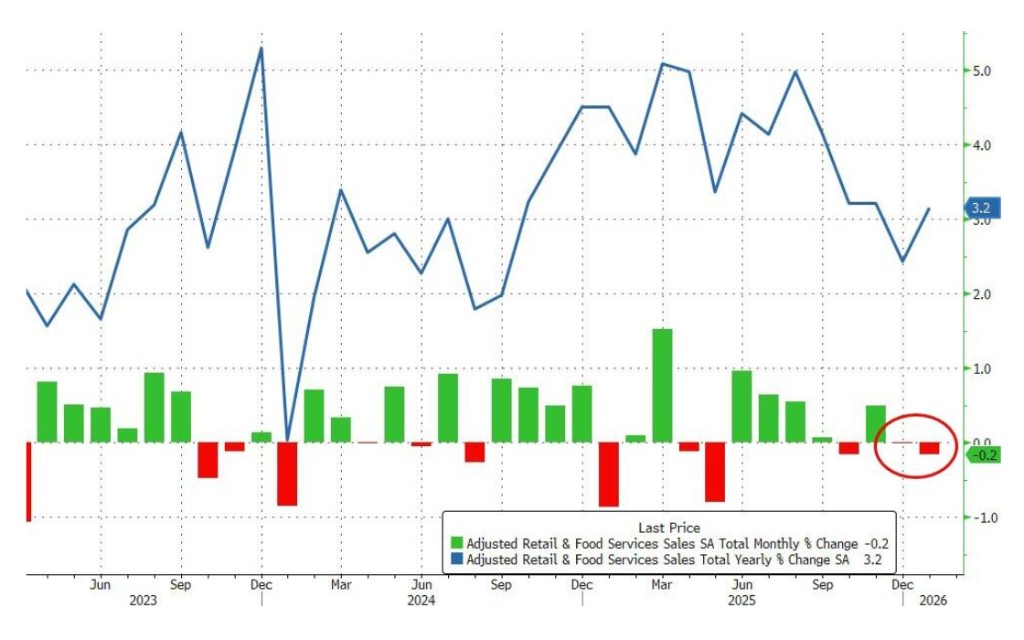 Specific data is as follows:
U.S. retail sales in January decreased by 0.2% month-on-month, expected -0.3%, previous value 0%.
U.S. retail sales in January (excluding automobiles) were flat month-on-month at 0%, in line with expectations and unchanged from the previous value.
U.S. retail sales in January (excluding automobiles and gasoline) increased by 0.3% month-on-month, expected 0.2%, previous value 0%.
Winter Storm and Oil Prices as Main Causes
The year-on-year performance of U.S. retail sales in January was mainly affected by the base effect from the same period last year. Specifically, two major factors significantly dragged down the data for the month:
First, a winter storm swept through the central and eastern United States, bringing widespread snowfall and freezing weather, causing over a million households and commercial users to lose power and triggering the largest wave of cancellations since the COVID-19 pandemic, severely constraining consumers' willingness to travel and spend.
Second, the decline in gasoline prices directly lowered sales at gas stations, becoming an important factor dragging down overall retail data.
Sub-item data shows that sales at restaurants and bars decreased by 0.2% month-on-month, the only sub-item in the retail report that involves the service industry. Dining companies such as Sweetgreen and Chipotle reported that the severe cold and winter storm had a significant impact on sales for the month.
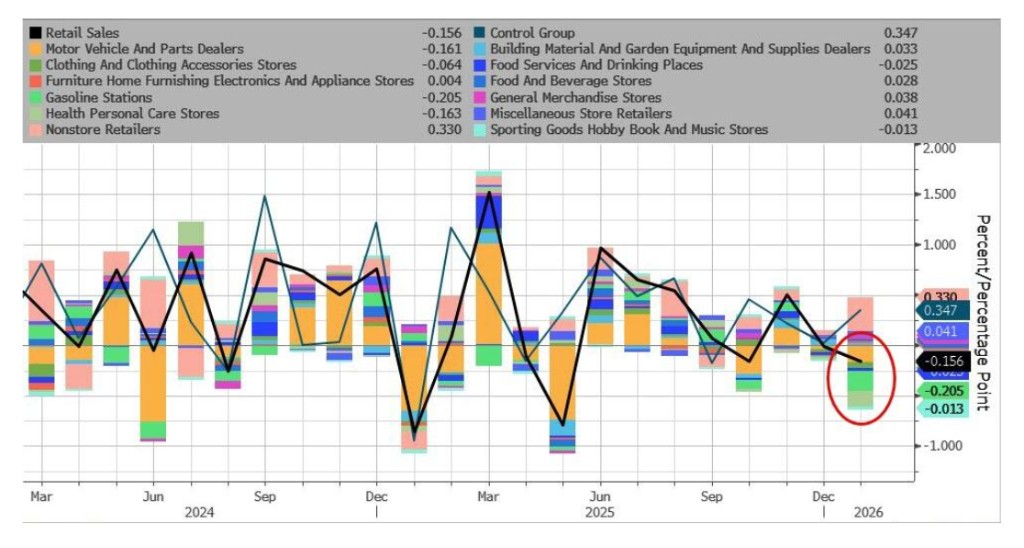
Online Sales Grow Against the Trend
Despite the pressure on overall retail data, non-store sales (i.e., online sales) in January saw a significant month-on-month increase, indicating that consumers shifted their shopping demand to online channels under the influence of adverse weather and other factors, and their willingness to spend did not significantly decline From a broader perspective, the "real" retail sales adjusted for inflation accelerated in January, indicating that the weakness in nominal data is partly disturbed by downward price factors, while actual consumption remains relatively robust. It is worth mentioning that the seasonally adjusted absolute value of retail sales in December 2025 reached a historical high, and the month-on-month decline in January also reflects the normal post-Christmas consumption season adjustment.
Tax Refund Bonuses Expected to Boost Subsequent Consumption
The continued weakness in retail data poses a potential threat to the U.S. economy, as personal consumption expenditures account for about two-thirds of U.S. economic growth. If consumption momentum does not improve, its drag effect on overall GDP cannot be ignored. For example, the latest GDP data for the UAE unexpectedly grew by only 1.4% in the fourth quarter, far below market expectations, partly due to weak consumption.
Economists generally expect that this year's large-scale tax refunds will release consumer support in 2026, providing additional purchasing power for consumers who are currently on the sidelines. Whether the current data weakness is a short-term weather disturbance or will evolve into a downward trend remains to be further validated by subsequent monthly data
