As the ceasefire signal is released, Israel and Palestine mutually attack energy facilities, and the decline in oil prices narrows

Despite Trump's recent hint that the conflict with Iran would "end soon," the situation in the Middle East continues to escalate. On March 10, the Israeli military launched airstrikes on Tehran's nuclear laboratories, while Iran targeted Israel's Haifa oil and gas facilities. The outbreak of hostilities has triggered severe secondary disasters, with the World Health Organization warning of a public health crisis. Due to the blockage of the Strait of Hormuz, the four countries have collectively reduced production by 6.7 million barrels per day
Despite Trump recently signaling that the war is about to end, the situation in the Middle East continues to escalate.
According to CCTV News, on March 10 local time, the Iranian military issued a statement saying that in response to the attack on Iranian oil storage facilities, the Iranian Air Force used attack drones to strike oil and gas refineries and fuel storage facilities located in Haifa, Israel. Previously, the Israel Defense Forces reported detecting a new round of missile attacks from Iran, and air raid sirens sounded in Tel Aviv earlier that day.
Earlier, according to CCTV International News, Israel stated that the Israeli military launched airstrikes on Tehran in the early hours of March 10, targeting local nuclear laboratories.
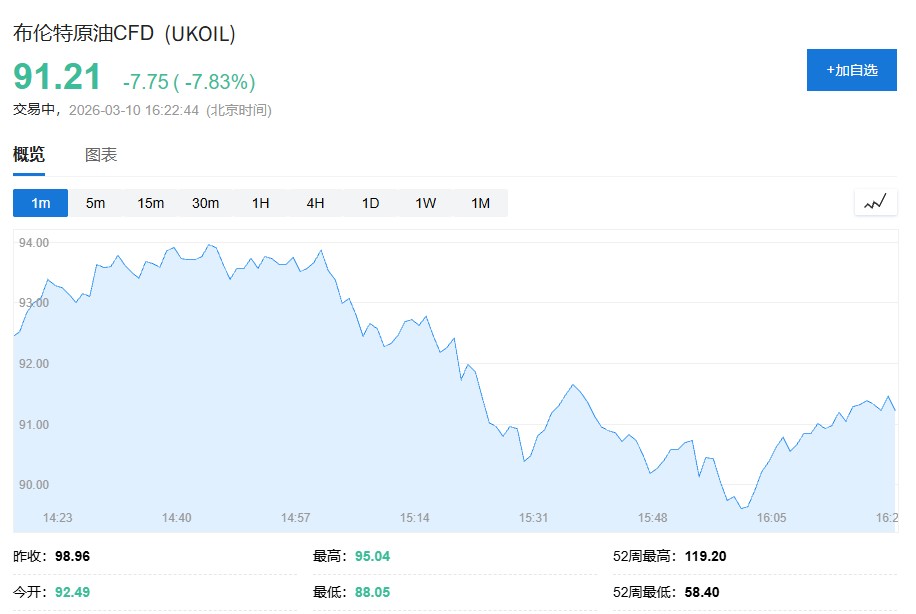
Following the news of mutual attacks on energy facilities between Israel and Iran, oil prices rose briefly, narrowing the day's decline. As of the time of writing, WTI crude oil's decline had narrowed to about 7.5%, trading around $91 per barrel.

Ceasefire signals have emerged, and the market awaits substantial restoration in the Strait
Previously, Trump hinted that the war with Iran is about to end. According to Xinhua News Agency, on the 9th local time, U.S. President Trump stated at a press conference in Miami, Florida, that the war with Iran will "soon" end, but "will not" end this week. Although this statement caused oil prices to retreat, it did not prevent the further spread of the conflict.
As the Strait of Hormuz continues to be obstructed, several oil-producing countries have been forced to cut production. Reports indicate that Saudi Arabia, the United Arab Emirates, Iraq, and Kuwait have collectively reduced oil production by up to 6.7 million barrels per day. Among them, Saudi Arabia has cut production by 2 to 2.5 million barrels per day, Iraq by about 2.9 million barrels per day, and Kuwait and the UAE each by about 500,000 to 800,000 barrels per day. The market is closely monitoring the prospects for the restoration of shipping in the Strait of Hormuz.
The war has triggered "black rain" disasters, and the WHO urgently calls for easing the situation
The secondary disasters caused by the war are becoming apparent. After multiple oil storage facilities in Tehran were attacked by Israeli airstrikes, flames soared and black smoke obscured the sky, with harmful "black rain" containing oil components falling in the area.
World Health Organization Director-General Tedros Adhanom Ghebreyesus warned on social media platform X on the 9th that damage to oil facilities has contaminated food, water sources, and air, posing a serious public health threat to children, the elderly, and those with underlying health conditions. He called on all parties to immediately ease the situation to prevent the war from endangering public health and impacting the healthcare system