Oil prices surged and then retreated! The "Halk Island Bombing" and the "Hormuz Navigation Signal" clash fiercely

Wallstreetcn
2026.03.16 01:16
portai
I'm PortAI, I can summarize articles.

The U.S. military launched a "fierce airstrike" on Iran's largest oil export base—Hark Island, causing disturbances in the market, with Brent crude oil briefly rising to $106, but then retracing its gains and turning lower. Meanwhile, two Indian vessels successfully passed through the Strait of Hormuz, signaling a partial easing, but overall shipping remains significantly restricted. Morgan Stanley estimates that the daily traffic in the strait has dropped to 0-2 vessels, a decrease of about 85%-95% from normal levels

The situation in the Middle East, shipping in the Strait of Hormuz, and military movements are intertwining factors that continue to disrupt the crude oil market.

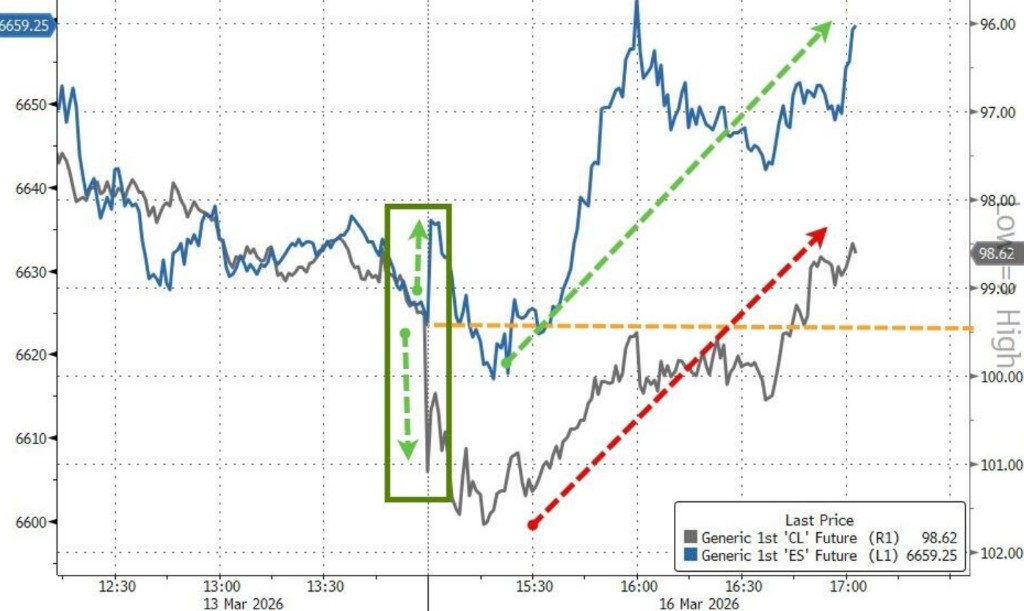
In early trading on Monday, both the oil market and U.S. stock futures rose, with Brent crude briefly surpassing $106 and WTI crude jumping above $101. However, as trading progressed, oil prices subsequently fell back into decline, while U.S. stock futures expanded their gains.

This trend temporarily broke the recent perfect negative correlation between oil and the stock market. Meanwhile, U.S. Treasury futures remained stable, and the dollar slightly weakened.

Current market conditions indicate that traders are weighing two major disruptive factors: on one hand, concerns over the impact of U.S. military strikes on Iran's oil export hub on Khark Island; on the other hand, signs of partial relief in the congestion in the Strait of Hormuz.

Attack on Khark Island: A Key Node in the Global Oil Market

Currently, the market's trading focus remains on the supply disruptions in the Middle East.

According to CCTV News, on the evening of the 13th, U.S. Eastern Time, President Trump posted on social media, stating that U.S. military forces have launched "intense airstrikes" on military targets at Iran's oil export hub on Khark Island.

Khark Island handles 90% of Iran's oil exports, with 9 out of every 10 barrels of Iranian crude oil being loaded there. The island has deep-water ports and large oil storage facilities capable of accommodating very large crude carriers, with a maximum loading capacity of approximately 7 million barrels per day.

The direct military strike by the U.S. on the island has heightened the risks in the global oil supply chain. Market analysis indicates that this event has exacerbated the risks in the global oil supply chain, leading to a significant continuation of the blockade of shipping in the Strait of Hormuz.

Signs of Partial Recovery in Hormuz Shipping

In contrast to the Khark Island incident, there have been some signs of easing in shipping.

CCTV News reporters learned on March 14 that two liquefied petroleum gas carriers flying the Indian flag and belonging to an Indian shipping company have successfully crossed the Strait of Hormuz and are currently en route to India, expected to arrive at relevant Indian ports within a few days.

Additionally, Bloomberg's tanker tracking data shows that several vessels associated with Iran (including a VLCC, a liquefied gas carrier, and several bulk carriers) have also departed the Gulf in the past 24 hours, while a container ship has entered the Persian Gulf.

Indian Foreign Minister S. Jaishankar stated: "I am currently in dialogue with them (Iran), and my discussions have yielded some results. If it works for me, I will naturally continue to adopt this approach."

S. Jaishankar emphasized that reasoning and coordination can lead to better solutions compared to inaction. However, he clarified that this is not a quid pro quo, nor has a comprehensive passage agreement been reached. He made it clear: "Each passage of a vessel is a case-by-case situation." Currently, more than 20 merchant ships flying the Indian flag are still anchored in the strait waiting to pass.

Moreover, the best news may be that there have been no notable shipping incidents in the Gulf region for three consecutive days, with the last attack notification from the UK Maritime Trade Operations (UKMTO) remaining on March 12 CNBC reporter Brian Sullivan provided a direct assessment: "The Strait remains very calm... Will the situation change in the next 24 hours?"

U.S. Military Plans Escort, Morgan Stanley Confirms Shipping Volume Plummets

In response to the blockade of the Strait causing global supply chain disruptions and rising oil and gas prices, the Pentagon is taking action. According to U.S. media reports, Defense Secretary Lloyd Austin has approved the deployment of an amphibious readiness group consisting of several warships and 5,000 Marines. The U.S. Navy's amphibious assault ship USS Tripoli is heading to the Middle East.

U.S. officials revealed that the Pentagon is considering sending additional destroyers to escort tankers attempting to pass through the Strait. However, this is not an immediate positive development. Officials emphasized that even with reinforcements in place, the U.S. military will not immediately initiate escort operations; they must wait until the Iranian threat decreases, a process that could take a month or longer.

However, the shipping situation in the Strait of Hormuz remains severe. Morgan Stanley estimates based on vessel data:

  • Before the conflict: Approximately 25 tankers and LNG ships passed through the Strait of Hormuz daily

  • In the last 11 days: Actual traffic volume was only about 0-2 vessels/day

Morgan Stanley significantly lowered its navigation estimates in the latest daily tracking report. The firm noted that due to disruptions in the Automatic Identification System (AIS) and increased deception incidents, data noise has increased. After re-verification, the average daily traffic volume in the Strait of Hormuz over the past 11 days was only 0-2 vessels, far below the previous estimate of 2-6 vessels.

"Whether the flow has decreased by about 85% or about 95%, the conclusion is the same: transportation through the Strait of Hormuz remains severely restricted, which means the global oil market faces a significant supply shock," Morgan Stanley emphasized in the report.

Goldman Sachs: Risks Facing U.S. Stocks Go Beyond Middle East Situation

In the face of high oil prices and a rebound in U.S. stocks, Goldman Sachs analyst Brian Garrett pointed out that the S&P 500 is currently only about 5% away from its all-time high.

Garrett emphasized two core facts to investors: "First, the de-escalation mechanism in this conflict is not a unilateral decision; second, the risk matrix includes not only the Middle East situation but also macro factors such as credit and employment."

Based on this, Garrett believes that shorting Delta positions is currently the best way to manage long exposure. He clearly stated that the market's upside potential is basically limited to historical highs (around 7,000 points), while the downside risk is unlimited