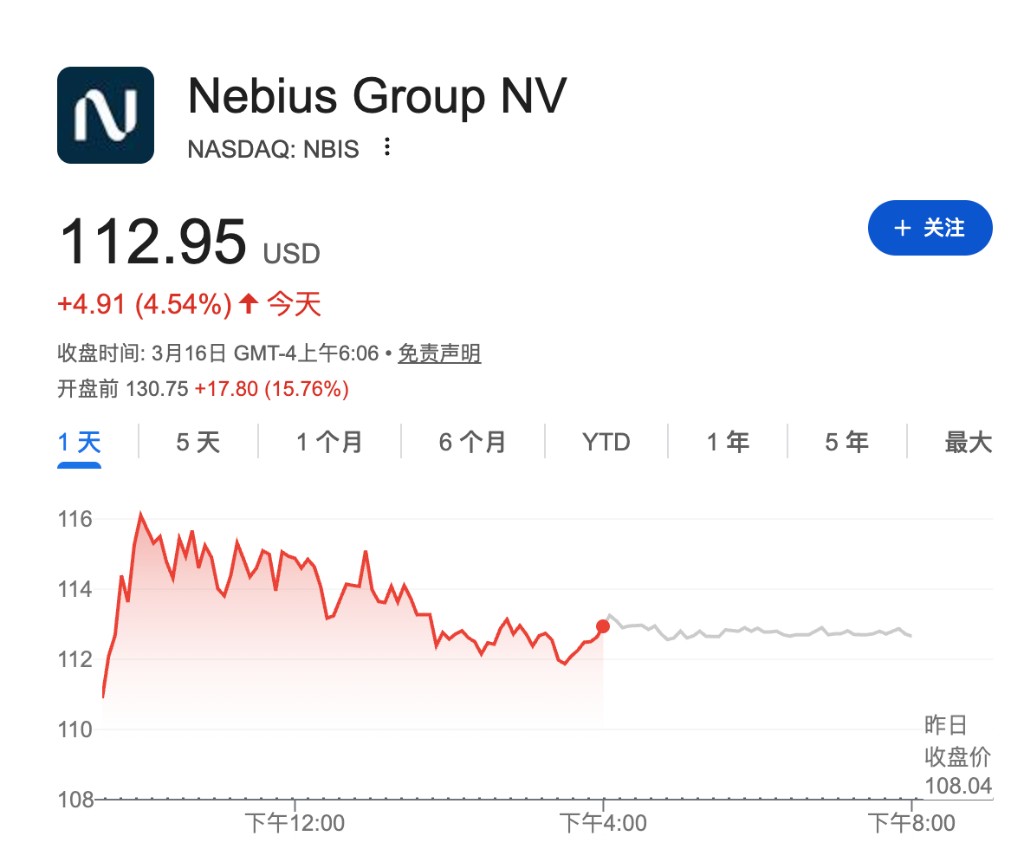
Nebius surged 16% in pre-market trading! Report: Meta will collaborate with it on AI over the next five years, with spending up to $27 billion

Wallstreetcn
2026.03.16 10:35
portai
I'm PortAI, I can summarize articles.

Meta has signed a five-year agreement worth up to $27 billion with AI infrastructure company Nebius. According to the agreement, Nebius will provide Meta with $12 billion in exclusive computing power starting in early 2027, while Meta commits to purchasing up to $15 billion in additional capacity. This marks another significant bet by Meta on Nebius following last year's $3 billion collaboration, highlighting its determination to expand its AI strategy. Boosted by this news, Nebius surged 16% in pre-market trading

Tech giants continue to ramp up their investments in the AI arms race, with Meta planning to collaborate with AI infrastructure company Nebius over the next five years, with a spending scale of up to $27 billion. Boosted by this news, Nebius's stock surged 16% in pre-market trading.

On March 16, Bloomberg reported that Nebius announced on Monday that the agreement consists of two parts: Nebius will provide Meta with exclusive computing capacity worth $12 billion starting in early 2027; Meta also commits to purchasing up to $15 billion of additional capacity that the company builds for third-party clients. This follows a $3 billion collaboration reached between the two parties last year, marking another significant bet by Meta on Nebius.

The agreement is one of the largest single contracts Meta has signed to date, highlighting its determination to expand its AI strategy. The company has prioritized AI as a core focus and is currently facing fierce competition from rivals like OpenAI and Google. Meta stated that a diverse range of partners and technology stacks is a crucial component of its strategy to build "more adaptive and flexible infrastructure."

Major Bets on AI, Capital Expenditures Continue to Rise

Meta founder Mark Zuckerberg announced last year that the company plans to invest $600 billion in U.S. infrastructure projects by 2028. To achieve this goal, Meta is not only relying on profits generated from its advertising business but is also actively seeking external financing to support related projects.

AI has been established as Meta's top strategic priority. In the face of fierce competition from OpenAI and Google, the company has signed multi-billion dollar AI infrastructure cooperation agreements with Nvidia and AMD since the beginning of the year, while also continuing to advance its self-developed chip development. Currently, Meta has launched several AI products, including chatbots integrated into various applications, and is continuously developing cutting-edge large models.

Nebius Rises with the AI Wave, Nvidia's Capital Boosts Valuation

Headquartered in Amsterdam, Nebius spun off from Russian internet giant Yandex in 2024, and is one of the representatives of the "emerging cloud" (neocloud) that has risen during this wave of AI. These companies focus on building data centers specifically for model training and AI service operations, directly competing with traditional cloud service providers like Google and Amazon.

Nvidia is becoming an important driver in this emerging sector. According to Bloomberg, Nvidia announced last week that it would invest $2 billion in Nebius, which led to a 16% increase in the latter's stock price in a single day. This year, Nvidia has been intensively laying out its strategy in the emerging cloud sector: in January, it invested $2 billion in Nebius's competitor CoreWeave, followed by a $30 billion investment in OpenAI, and participated in a $2 billion financing round for the UK-based emerging cloud company Nscale Nvidia's large-scale investment in emerging cloud companies is raising market doubts. Critics point out that Nvidia provides financing to companies that purchase a large number of its chips, creating a closed loop of "investment—procurement—reinvestment," which may fuel industry bubbles.

Structurally, Nvidia injects capital into emerging cloud companies, which then use the funds to purchase Nvidia chips and build data centers, subsequently taking on computing power orders from tech giants. This model supports the valuations of related companies against the backdrop of sustained strong demand for AI computing power, but its sustainability remains a focal point for investors