


Surging oil prices, weakening employment, judicial investigations: This week, Powell faces the "toughest" interest rate meeting
The Federal Reserve's interest rate meeting this week is in a dilemma: Brent crude oil has surpassed $100, pushing up inflation, while February's non-farm payrolls unexpectedly weakened, dragging down employment. The two major goals are at odds, sharply narrowing the policy space. Meanwhile, the ongoing investigation by the Department of Justice may interfere with the leadership transition in May. Powell faces a triple challenge of inflation, employment, and political pressure, with the market expecting him to keep interest rates unchanged while emphasizing a flexible response
Despite the market's general expectation that the Federal Reserve will keep interest rates unchanged this week, the divergence signals from the Middle East situation and employment data are pushing monetary policy into a dilemma.
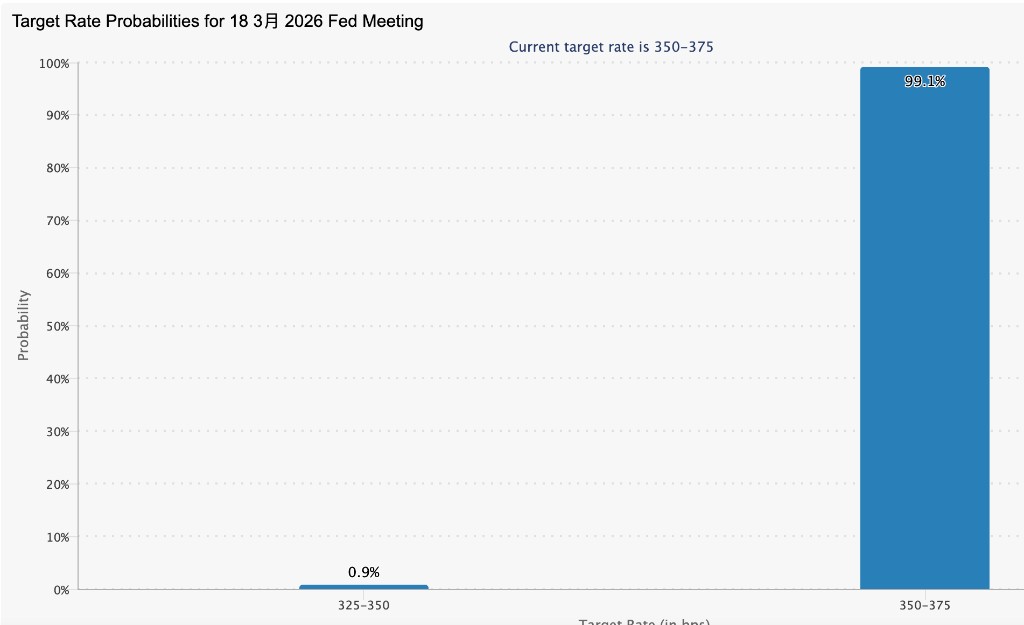
Brent crude oil has surpassed $100 per barrel, and inflationary pressures are resurfacing; February's non-farm employment unexpectedly weakened, casting a shadow over the labor market outlook. The two major targets are sending conflicting signals: high oil prices constrain the downward space for interest rates, while weak employment points to a demand for easing. Powell and the FOMC are facing an increasingly narrow policy window. According to CME FedWatch data, the market expects a 99% probability that the Federal Reserve will maintain interest rates in the 3.5%-3.75% range this week.
Meanwhile, the political turmoil surrounding Federal Reserve Chairman Powell has not yet subsided, with the Department of Justice investigation and the prospects for the chair position hanging in the balance. A federal judge dismissed the Department of Justice's subpoena against the Federal Reserve last week, but prosecutor Jeanine Pirro vowed to continue the appeal, and this legal process may interfere with the Federal Reserve's leadership transition arrangements in May.
Oil Price Shock Disrupts Policy Rhythm
After three consecutive rate cuts by the Federal Reserve by the end of 2025, the policy rate was maintained in the 3.5% to 3.75% range in January this year. At that time, the labor market was stabilizing, and officials generally leaned towards keeping interest rates unchanged for a longer period to continue suppressing inflation, which had been above target for five consecutive years.
However, the outbreak of conflict in the Middle East disrupted the established rhythm. Brent crude oil prices broke through the $100 per barrel mark. Some officials cited "textbook" logic, believing that the impact of energy price shocks on inflation is temporary and does not require a policy response.
However, Aditya Bhave, a senior U.S. economist at Bank of America Securities, pointed out that whether this strategy will work depends on the duration of the conflict, whether public inflation expectations remain stable, and whether the rise in energy prices can be contained from spreading to other areas.
Complicating the situation further is the fact that inflation is not the only hidden danger. If oil prices remain high, consumption, growth, and employment may all come under pressure, and this combination points more towards rate cuts rather than hikes. Data released last Friday showed that consumer spending in January was nearly stagnant, indicating that the U.S. economy had already begun to lose momentum before the outbreak of the conflict.
Internal Divisions, Inflation Judgments Not Unified
Before the outbreak of the conflict in the Middle East, there were already cracks in the Federal Reserve's internal judgment on the inflation path. Governor Christopher Waller believes that after excluding the temporary effects of tariffs, inflation is moving towards the target trajectory; while some officials are concerned that persistently high inflation has eroded the central bank's credibility.
Laura Rosner-Warburton, a senior economist at MacroPolicy Perspectives, pointed out that different positions will determine officials' tolerance for new inflationary pressures. "If you believe inflation is more troublesome and requires a longer time to maintain restrictive policies before the shock arrives, then the new shock means greater risk," she said, "you may thus be unwilling to respond to signals of downturn in growth or employment At the same time, officials such as Waller, Vice Chair for Supervision Bowman, and Governor Milan continue to send signals of interest rate cuts, pointing to signs of weakness in the labor market. It is noteworthy that there have been dissenting votes in the last five Federal Reserve meetings, and this pattern is expected to continue this week.
Former Cleveland Fed President Loretta Mester summarized: “The employment side faces downside risks, the inflation side faces upside risks, and there is a divergence of views within the committee, with the correct answer not being obvious.”
Policy Signal: Wait and See, Avoid Hasty Statements
On Wednesday afternoon at 2 PM local time, the Federal Reserve will release its latest policy statement, followed by a press conference with Chair Powell at 2:30 PM, where officials will simultaneously announce the latest economic forecasts and the dot plot for interest rates.
Wells Fargo senior economist Michael Pugliese expects that the statement and Powell's remarks will acknowledge the rising uncertainty while emphasizing the need to remain flexible in response. “The market hopes to gain more certainty regarding the geopolitical outlook,” he said, the Federal Reserve may adhere to the principle of 'do no harm,' 'not wanting to react hastily and later appear to have made a misjudgment.'
Powell will also face questions regarding the labor market. The unexpectedly weak February non-farm payroll report may prompt him and other officials to adjust their previous assessment that the labor market was stabilizing.
Judicial Turmoil May Affect Leadership Transition
Political uncertainties cannot be overlooked either.
Last week, U.S. District Chief Judge James Boasberg ruled to dismiss the subpoena issued by the Department of Justice to the Federal Reserve regarding the headquarters reconstruction project, citing “lack of supporting evidence,” and noted that there is evidence suggesting the DOJ intended to pressure Powell rather than targeting his interest rate cuts or resignation.
However, U.S. Attorney Jeanine Pirro immediately stated that she would appeal, the legal process may interfere with the nomination confirmation of Kevin Walsh, Trump's nominee for succession. North Carolina Senator Thom Tillis has made it clear that he will not advance Walsh's nomination vote until the DOJ investigation is thoroughly concluded.
Powell's term as Chair of the Federal Reserve Board will expire in May this year, but his term as a governor lasts until 2028, which means he is still eligible to continue serving as Chair of the Federal Open Market Committee.
Court documents reveal that Federal Reserve lawyers disclosed that Powell has made it clear that, to maintain the independence of the central bank, “he cannot resign while a criminal investigation is pending.” Powell himself has not publicly stated whether he will continue to serve
