


Transformer supply is in urgent demand! Global shortage may last until 2029
Citi pointed out that the global supply gap for high-voltage power transformers will last at least until 2029, with a gap reaching 30% of demand by 2025, and the cumulative shortage peak approaching 1,700 GVA. A shortage of skilled workers, bottlenecks in key materials, and exorbitant expansion costs create three hard constraints that slow capacity expansion below expectations; the arms race for computing power in data centers will further shift the demand curve upward
The global power transformer market is entering a long cycle of "supply not keeping up with demand." Citigroup puts it bluntly: it's not a short-term spike in demand, but rather that the capacity for expansion, delivery, and labor cannot keep up with grid upgrades, generation-side expansion, and the additional load from data centers.
According to the Chase Wind Trading Desk, Citigroup research analyst Pierre Lau wrote in a report, "We are optimistic about the global power transformer industry and expect the supply shortage to last at least until 2029." This judgment is backed by a set of "hard constraint" supply-demand calculations: even if leading manufacturers expand production, the gap will continue to accumulate over the next three years.
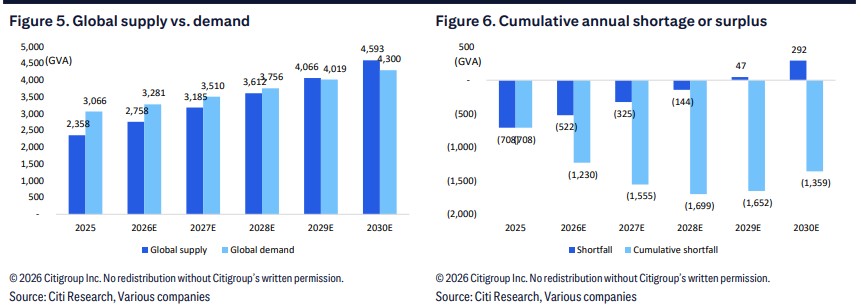
According to Citigroup's estimates for global high-voltage (>100kV) power transformers, the supply-demand gap will be about 30% in 2025, and annual supply will remain below annual demand from 2026 to 2028; the cumulative shortage will rise from 708 GVA in 2025 to a peak of about 1699 GVA in 2028.
The industry outcome is more inclined towards a "price cycle" rather than a "volume cycle": supply shortages mean longer delivery times, rising prices, and orders concentrating on manufacturers with the capacity to fulfill them. Citigroup's stock selection approach is consistent—prioritizing buy ratings for companies with clearer order and expansion paths, while maintaining a neutral stance on companies with similarly strong fundamentals but valuations significantly above the sector average.
The gap is not just one or two years: cumulative shortages peak in 2028
Citigroup breaks down the gap into two levels: annual gaps narrowing year by year, but cumulative gaps continuing to expand before 2028.
2025: Global supply is about 2358.5 GVA, demand is about 3066.0 GVA, with an annual shortage of about 707.5 GVA (approximately a 30% gap relative to demand).
2026-2028: Annual shortages are approximately 522.2/325.2/143.9 GVA, respectively.
Starting in 2029: Annual supply will slightly exceed annual demand (with an annual "surplus" of about 47.2 GVA in 2029), but the cumulative shortage will still not be fully digested by 2030.
This set of calculations also has an easily overlooked detail: the concentration of leading manufacturers is decreasing. Citigroup expects that, based on capacity, the share of the top ten manufacturers will drop from 79.4% in 2025 to 72.6% in 2030. Expansion is happening, but the "effective increment" of supply is dispersed, and the pace of fulfillment is not consistent.
Expansion cannot stop the shortage: capacity and skilled workers are both bottlenecks
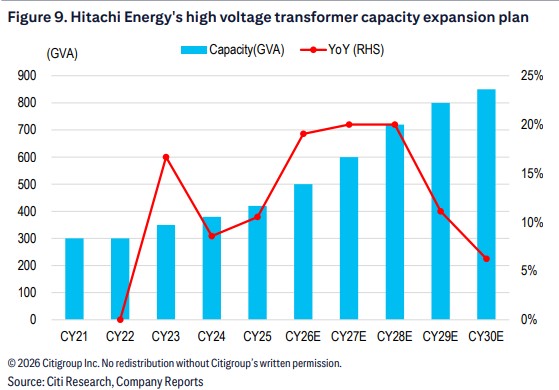
Citigroup does not deny the intensity of expansion. It estimates that global high-voltage transformer production capacity will increase by a total of 53% from 2025 to 2028, and provides annual growth rate assumptions: +17%/+15%/+13% for 2026E/2027E/2028E, respectively; extending to 2030, the cumulative increase will be about 95%
The problem is that the two types of bottlenecks are more like "slow variables":
Shortage of Skilled Workers: Citigroup highlights the "shortage of skilled workers" as a separate issue, believing it to be a barrier to supply that will take years to alleviate. Expanding capacity does not mean immediate stable delivery, as the training period will consume part of the marginal effect of increased production.
Tight Supply Chains for Key Materials and Components: The report cites industry consulting firms, emphasizing the high dependence of the U.S. on imports: Wood Mackenzie estimates that imports account for about 80% of the U.S. power transformer supply (about 50% for distribution transformers). In this structure, trade and tariffs will more directly reflect on costs and delivery times. The domestic supply of GOES (grain-oriented silicon steel) in the U.S. is highly concentrated (only one supplier, AK Steel), and copper windings may also become a production bottleneck; coupled with a 50% tariff on copper, the "friction costs" on the supply side are harder to eliminate.
Citigroup also provided a reality constraint on capital expenditure: building new high-voltage (>220kV) transformer capacity in the U.S. requires approximately $450-500 million per 1 GVA of capacity, according to their research; unit capex in Japan, South Korea, Europe, and China is relatively lower. Expansion is not off the table, but it will be slower and more expensive.
Two Forces on the Demand Side: Grid and Generation Side, Data Centers
Citigroup breaks down demand growth into two parts: "traditional rigid demand + new loads."
First, continuous investment in the grid and generation side. The report cites IEA data stating that in 2024, developed economies and China will account for about 80% of global grid investment; among them, the U.S. will invest about $100 billion, and the EU about $60 billion. Citigroup also cites estimates from Bloomberg NEF: in a net-zero scenario, global grid investment is expected to grow at an average annual rate of about 12% before 2030, potentially reaching $777 billion.
Second, data centers are raising the electricity consumption curve. Citigroup references its U.S. research team's upward revision of capex for hyperscale cloud providers: the capex growth rate assumption for several hyperscalers has been raised from 18% (CAGR) to 28% for 2025-2030. Once these assumptions approach reality, the duration of transformer shortages will not be as simple as "naturally recovering through increased production."
In a breakdown closer to order metrics, Citigroup estimates based on new orders from covered South Korean transformer manufacturers: in the U.S. power transformer demand, the grid accounts for 40-45%, power plants for 30-35%, and data centers for 20-25%. This explains why the industry is becoming increasingly sensitive to AI and data centers—they have already entered the demand structure.
Prices Are Already Trending Up: U.S. Costs and PPI Are Rising
The tight supply and demand situation is first reflected in prices and delivery times. The report cites Wood Mackenzie stating that since 2019, the unit costs of different types of transformers in the U.S. have risen significantly: power boosting transformers by about +45%, power transformers by about +77%, and distribution transformers by about +78% to +95% (depending on specifications) Citi also supplemented a more "macro" price signal: the PPI for electric power and distribution transformers in the U.S. as recorded by FRED, with an index of 366.6 in January 2026, up 6.2% year-on-year. Citi assesses that the upward price momentum will continue, with the core reason being that the shortage has not yet ended.
Citi stated that shortages determine prices, and prices determine profits and valuations. The key variables in this chain are clearly outlined:
Whether data center capex and electricity load continue to be revised upwards: This is a potential source for demand to "accelerate again," which will directly extend the shortage cycle.
The cumulative effect of tariffs and import dependence: The U.S. is highly reliant on imports, and tariffs not only raise costs but may also extend delivery times.
Capacity expansion is not effective just because it is announced: The construction of production lines, ramping up production, and training skilled workers will all make supply elasticity more rigid.
Citi also clearly believes that the impact of the Middle East conflict on global demand is limited, as the region accounts for a small share of global demand for electric transformers (the report mentions about 6%). In other words, the industry's prosperity is still determined by the speed of grid investment and data center expansion in North America, Europe, and Asia-Pacific
