UBS: If the Hormuz Strait continues to be blocked, global crude oil inventories will fall to a historic low by the end of April

UBS believes that the blockade of the Strait of Hormuz has led to a daily supply gap of 10 million barrels. Even with the use of strategic reserves, global inventories will still fall to historic lows by the end of April, at which point Brent crude oil is expected to exceed $150, with a risk of reaching $160
UBS's latest research warns that if the blockade of the Strait of Hormuz continues, global crude oil and refined oil inventories will fall to historical lows by the end of April, with Brent crude prices potentially rising above $150 per barrel, and further upward risks.
This weekend, there were no signs of easing in the Iran conflict. The U.S. military struck military facilities at Iran's main oil export hub, Hormuz Island, last Friday night, which handles about 90% of Iran's crude oil exports. Subsequently, the UAE's Fujairah terminal was attacked by drones on Saturday, reportedly damaging two oil storage tanks, causing operations to be temporarily interrupted, but operations were restored by Sunday. U.S. Energy Secretary Chris Wright stated that this war could last for several more weeks.
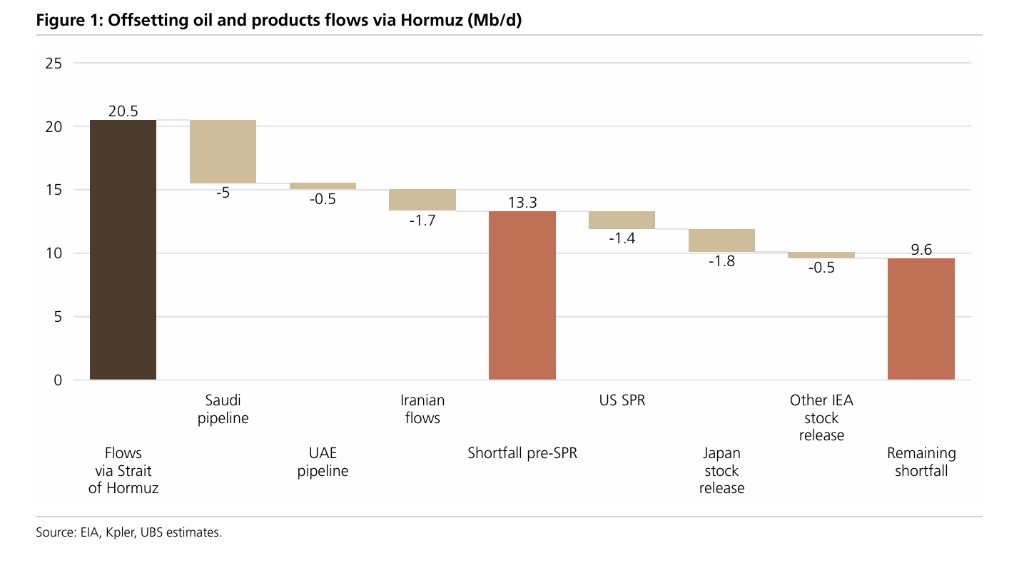
According to news from the Wind Trading Desk, UBS analyst Arend Kapteyn estimated in a report on the 16th that even with the comprehensive use of Saudi pipelines (5 million barrels/day), UAE pipelines (500,000 barrels/day), ongoing Iranian exports (1.7 million barrels/day), and the release of strategic reserves by the International Energy Agency (IEA) (approximately 3.3 to 4 million barrels/day), these measures would only make up about half of the supply loss caused by the effective blockade of Hormuz, leaving a gap of about 10 million barrels/day. Based on the current inventory consumption rate, global oil product inventories will fall to the lower third of the historical distribution range by the end of March and reach historical lows by the end of April.
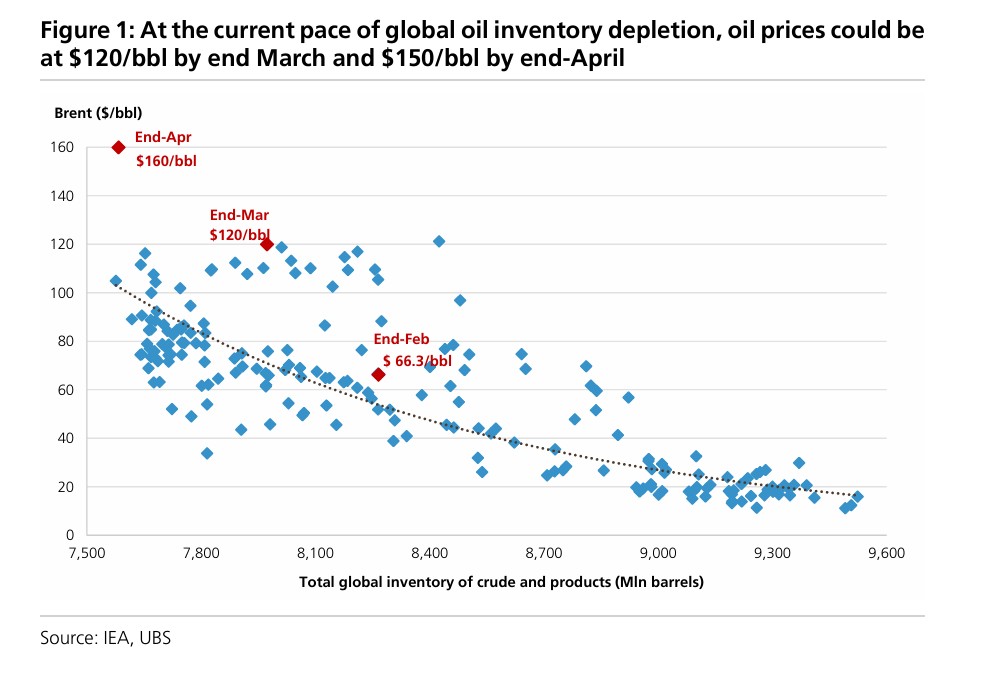
For investors, low inventory levels mean that oil prices will exhibit significant convexity characteristics—price sensitivity to supply shocks will far exceed historical averages. UBS conservatively estimates that if the situation in Hormuz does not improve significantly before the end of March, Brent crude prices could rise to around $120 per barrel, further pushing towards $150 per barrel in the second quarter; scenarios of $160 per barrel are also included in their model scenarios before clear signs of demand destruction appear.

Supply gap difficult to fill, about 10 million barrels/day still unresolved
Under normal circumstances, the Strait of Hormuz carries about 20.5 million barrels/day of oil and gas flow, and the scale of supply loss caused by a substantial blockade is enormous, with existing alternative channels and policy tools unable to fully compensate.
UBS has outlined the currently available alternative supplies: Saudi Arabia's overland pipeline bypassing the strait can deliver 5 million barrels/day, the UAE's Fujairah bypass pipeline can provide 500,000 barrels/day, some Iranian exports are still ongoing (1.7 million barrels/day), and the IEA's strategic reserve release is expected to be about 3.3 to 4 million barrels/day. Even if all these measures are in place, the total supplemental amount is only about 10.5 million barrels/day, which still leaves a supply gap of about 10 million barrels/day that needs to be filled by rapidly utilizing global inventories.
It is worth noting that the Fujairah terminal itself has also been impacted in this conflict, and its operational reliability faces uncertainty, with the actual supply capacity of the UAE bypass pipeline being variable
Strategic Reserves Accelerate Release, but Time Window is Limited
Another report released by UBS analyst Henri Patricot on the 16th shows that the IEA announced more details about the emergency oil reserve release plan of member countries on March 15, with a total scale of 400 million barrels and a planned flow rate close to 4 million barrels per day. However, the buffering effect of this scale remains limited and there is a significant time lag.
According to the IEA, crude oil accounts for 72% of this release, while refined oil accounts for 28%. Asian member countries will bear about 25% of the total release volume, which can be executed immediately; however, the logistics flow in the Americas and parts of Europe will not be fully in place until late March. The United States plans to release 172 million barrels of strategic oil reserves at a rate of about 1.4 million barrels per day, while Japan's release rate is about 1.8 million barrels per day.
Even at the IEA's latest estimate of about 4 million barrels per day, the supply gap filled by the strategic reserve release only accounts for about 30% of the total loss from the blockade of the Strait of Hormuz, which is insufficient to fundamentally reverse the trend of inventory consumption.
In addition, the global inventory distribution is extremely uneven. Data shows that many low-income oil-consuming countries in Asia have inventory coverage days far below the global average level. Once supply continues to be constrained, these countries will be the first to reach critical levels. UBS points out that this will significantly increase the probability of panic buying in the market—countries will compete to secure supplies before their domestic inventories are exhausted, further exacerbating the upward pressure on prices from the demand side.

Accelerated Inventory Consumption, Falling to Historical Low Levels by the End of March
Under the impact of a sustained supply gap of about 10 million barrels per day, the consumption rate of global oil product inventories has significantly accelerated. Based on historical data, UBS estimates that at the current rate, global crude oil and refined oil inventories will fall to the lower third of the historical distribution range by the end of March, and may reach historical low levels by the end of April.
In terms of absolute inventory volume, the current global observed inventory (including OECD, non-OECD inventories, and oil in transit) is approximately in the range of 9,000 to 9,300 million barrels. UBS's scenario model shows that if the passage through the Strait of Hormuz remains constrained throughout March, inventories will accelerate towards historical low levels.
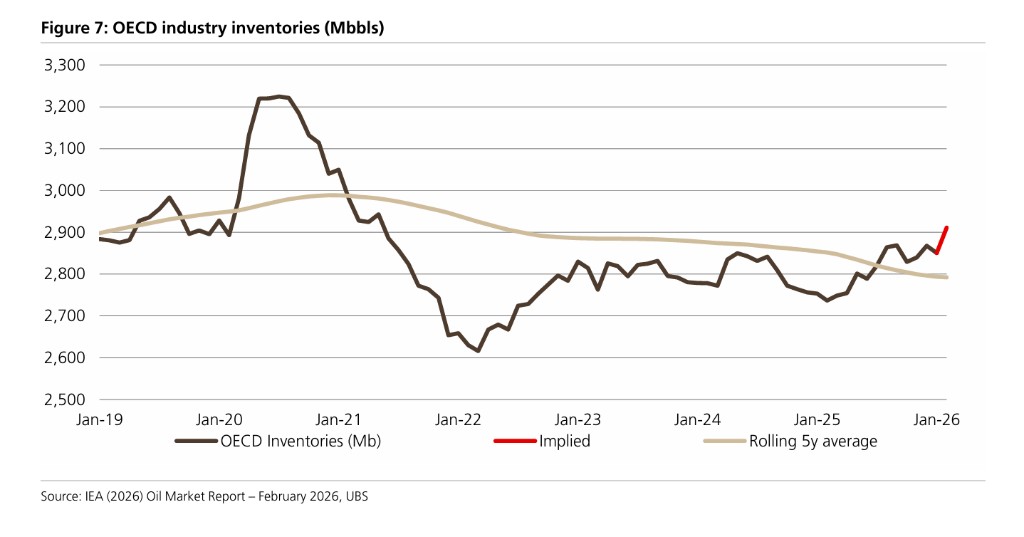
OECD industrial inventory data also shows significant downward pressure. According to the IEA's February 2026 monthly report, current OECD inventories have fallen below the rolling five-year average level, indicating that the foundation for supply tightness existed before the outbreak of the conflict.

Price Convexity Under Low Inventory: A $160 Scenario is Not an Extreme Assumption
There is a historically documented nonlinear relationship between oil prices and global inventories: when inventories fall to historically low levels, the price response to further supply contractions will be much more severe than normal levels, which is the "price convexity" effect emphasized by UBS According to the UBS model, under the scenario of a continued blockade of the Strait of Hormuz, the price path of Brent crude oil is expected to be as follows: reaching approximately $120 per barrel by the end of March, and rising to over $150 per barrel by the end of April. If demand destruction signals remain unclear at that time, a scenario of $160 per barrel is realistically possible and has been included in UBS's scenario range