


Explosive growth! Morgan Stanley: China's AI cloud market will reach a CAGR of 72% over the next five years, and Alibaba is expected to be the biggest winner
Morgan Stanley released a heavyweight research report: China's AI cloud market is expected to soar with a compound annual growth rate of 72%, surpassing 218 billion yuan by 2029; Alibaba is listed as a "preferred stock" due to its full-stack layout, with a cloud revenue growth forecast of 45%, the highest in the market; more importantly, a cloud service price increase cycle not seen in twenty years is approaching, and the turning point in profit margins may become the most underestimated variable
Morgan Stanley believes that the Chinese AI cloud market (GenAI-related IaaS + MaaS) is experiencing explosive growth.
According to information from the Chasing Wind Trading Desk, Morgan Stanley analysts predicted in a report on March 16 that driven by multiple factors such as the explosive demand for computing power at the inference end and the accelerated penetration of large model applications, the compound annual growth rate (CAGR) of the Chinese AI cloud market is expected to reach as high as 72% from 2024 to 2029, with the market size jumping from RMB 15 billion in 2024 to RMB 218 billion by the end of 2029.
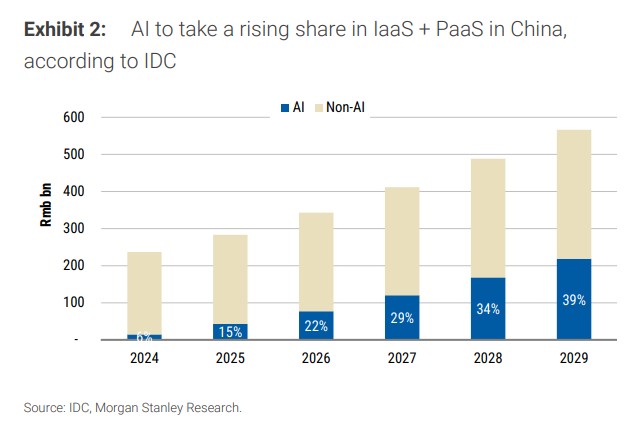
The share of GenAI in the total Chinese IaaS + PaaS market is expected to rise from 6% in 2024 to 39% in 2029, with AI cloud evolving from a marginal role to the core growth engine of the entire cloud computing market.
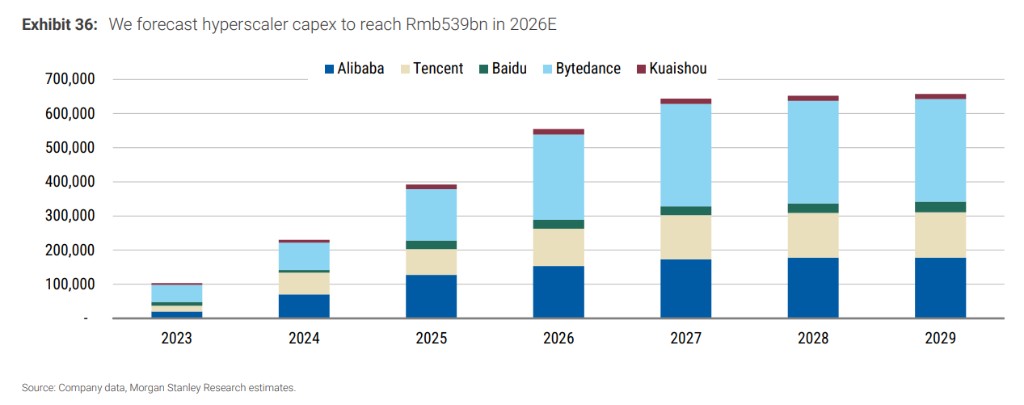
In this computing power arms race, Morgan Stanley has listed Alibaba as a "preferred stock," giving it an overweight rating and a target price of $180 for U.S. stocks. Morgan Stanley believes that Alibaba, with its "full-stack" layout from self-developed chips T-Head, GPU infrastructure, Qwen large model, Bailian model platform to 2C/2B application ecosystem, is the best target in China's AI infrastructure sector, similar to Google's position in the U.S. market. Following closely is ByteDance, whose Volcengine is becoming the most disruptive new entrant in this sector. ByteDance's capital expenditure is expected to reach RMB 250 billion by 2026, surpassing Alibaba's RMB 160 billion and Tencent's RMB 130 billion.
What is even more noteworthy is that Morgan Stanley believes the Chinese cloud computing market is entering its first price increase cycle in 20 years. Morgan Stanley estimates that for every 1% price increase by Alibaba Cloud, the EBITA profit margin can increase by 1 percentage point, or drive an 11% upward adjustment in EBITA forecasts; if the overall contract price increases by 10% (assuming 20% of contracts expire and are renewed each year), the EBITA profit margin will expand by 4 percentage points. This profit elasticity is a core variable that the current market has not fully priced in.
Market Size: AI Cloud Will Reshape China's Cloud Landscape with 72% Compound Growth Rate
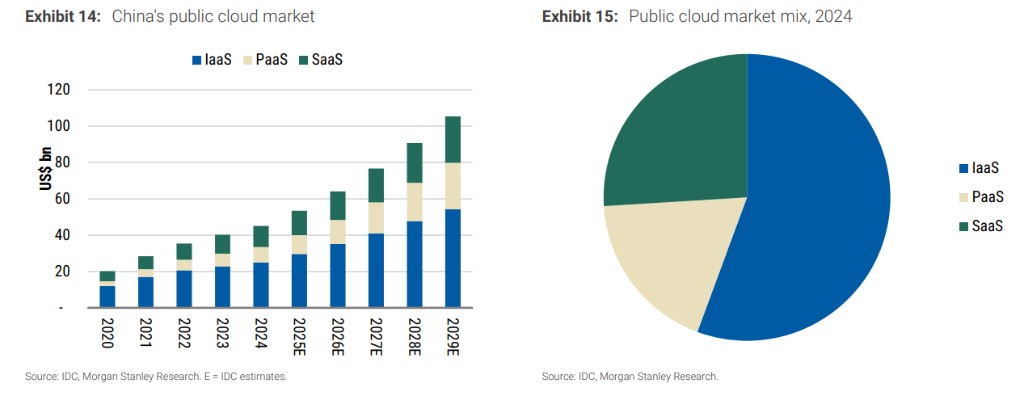
Morgan Stanley cites IDC data indicating that the overall public cloud market in China (IaaS + PaaS + SaaS) is expected to reach approximately $45 billion in 2024, expanding to $105 billion by 2029, with a CAGR of 18%. Among these, IaaS is the largest component, accounting for 56% of the public cloud market; the IaaS market size is expected to be around $25 billion in 2024, growing at a CAGR of 17% to 2029.
The expansion speed of AI cloud far exceeds that of the overall market. IDC predicts that the share of GenAI in IaaS + PaaS will rise from 6% in 2024 to 39% by the end of 2029, becoming the core engine driving the accelerated performance of hyperscale cloud providers.
From the demand side, inference is the true main force for future growth.
IDC predicts that the share of training workloads in the GenAI IaaS market will significantly decrease from 76% in 2024 to 23% in 2029, while the CAGR of inference demand will reach an impressive 103%, far exceeding the 26% of training demand.
The token usage data from Doubao, a subsidiary of ByteDance, is the most intuitive: the average daily token usage has surged from 4 trillion times in December 2024 to 50 trillion times by the end of 2025, an increase of over 12 times in just one year. Additionally, MiniMax's annual recurring revenue (ARR) has grown from $100 million in December 2025 to $150 million in February 2026, a 50% increase, with token usage growing sixfold, partly benefiting from the explosive popularity of OpenClaw.
It is noteworthy that the total scale of China's public cloud is currently only about 10% of the U.S. market (based on 2024 data), indicating a significantly low penetration rate. Morgan Stanley's CIO survey shows that the willingness of Chinese enterprises to adopt public cloud in the next 12 months has risen from 58% in previous surveys to 71%, indicating that there is still substantial long-term potential for penetration rate improvement.
Competitive Landscape: The "dual oligopoly" pattern of Alibaba + ByteDance takes shape, while state-owned enterprises' cloud share continues to be under pressure
Morgan Stanley believes that the competitive landscape of China's AI cloud era is undergoing fundamental reconstruction, with two clear trends emerging:
Hyperscale cloud vendors are reclaiming market share from state-owned enterprises.
Between 2021 and 2024, telecom operators and Huawei have continuously eroded Alibaba Cloud's market share with aggressive pricing and guarantees for state-owned enterprise clients. However, this trend has clearly reversed since the second half of 2024—Alibaba Cloud's share in the IaaS market has rebounded from 25.5% in the first half of 2024 to 26.8% in the second quarter of 2025.
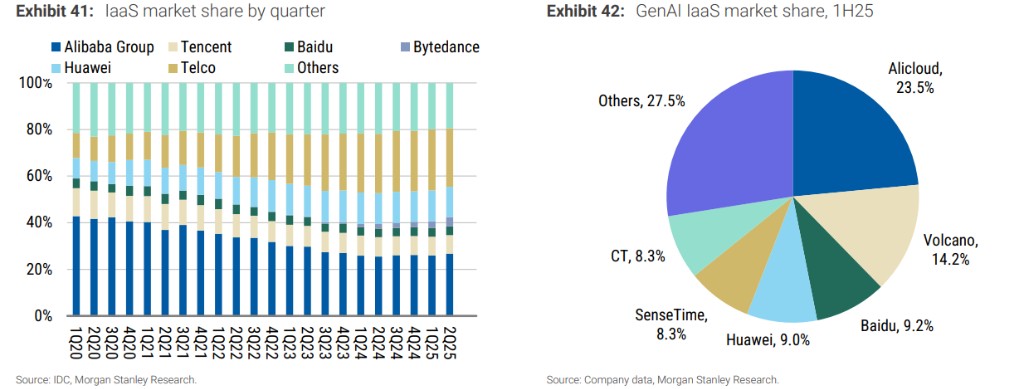
Morgan Stanley attributes this to three major advantages: more innovative AI models, stronger supply chain resource acquisition capabilities, and greater execution efficiency of private enterprises in strategic transformation. For example, in terms of capital expenditure, Alibaba, Tencent, and ByteDance have all exceeded RMB 100 billion in AI-related spending since 2025, while telecom operators have only spent about RMB 20 billion during the same period.
ByteDance is the most disruptive new player in the AI cloud era.
Volcengine's share in the GenAI IaaS market has reached 14.2% (with Alibaba Cloud leading at 23.5%), and its share in the MaaS market is as high as 37.5% (1H25), making it the industry leader. ByteDance's overall share in the public cloud IaaS market has rapidly climbed from nearly zero before 2024 to nearly 4% in the second quarter of 2025 What is more noteworthy is that ByteDance's expected capital expenditure in 2026 will reach RMB 250 billion, surpassing Alibaba's RMB 160 billion and Tencent's RMB 130 billion. The unique attributes of private enterprises allow for a more relaxed requirement for short-term profit margins, providing institutional support for their aggressive expansion.
In the evaluation of the product matrix, Morgan Stanley measures the competitive strength of various manufacturers along three dimensions: supply and capacity, product matrix, and service capability. Overall, Alibaba Cloud stands out as a full-stack solution provider from self-developed chips (T-Head) to foundational models (Qwen) to MaaS platforms (Bailian); ByteDance has made significant strides in multimodal models (Seedance 2.0) and the MaaS market; although Baidu has a full-stack solution (Kunlunxin chips + Wenxin model + Qianfan platform), its cloud market scale and model capabilities lag behind the leaders, leading Morgan Stanley to maintain a neutral rating.
Pricing Cycle: First Price Increase in 20 Years, Cloud Service Profit Margin Revaluation Critical Point Has Arrived
Historically, cloud computing has always been a deflationary industry—larger scale leads to lower costs, which drives prices down. However, Morgan Stanley points out that the AI era is breaking this paradigm, and an unprecedented price increase cycle is brewing , marking the first price adjustment cycle for Chinese AI cloud services in 20 years.
Global hyperscale cloud providers have taken the lead: On January 4, 2026, AWS will raise the price of machine learning EC2 Capacity Blocks by about 15% (for example, the price of the p5e.48xlarge instance will increase from $34.61 per hour to $39.80); on January 27, 2026, Google Cloud (GCP) announced significant price increases for network, storage, and AI infrastructure, with some CDN and data transmission rates rising by as much as 100%, with new prices effective from May 2026.
Signals of follow-up in the Chinese market have emerged: Wangsu Technology announced a price increase of 35%-40% for CDN products starting February 1, 2026; UCloud announced price increases for all contract renewals and new customers starting March 1, 2026; and some self-developed model prices on Tencent's AI platform have increased by as much as 400%. Both companies cited supply chain inflation as the core reason for the price increases.
The elasticity of profit margin calculations is noteworthy.
Morgan Stanley estimates that, for Alibaba Cloud, a 1% increase in overall contract prices could enhance the EBITA profit margin by about 1 percentage point, with the EBITA forecast increasing by about 11% (assuming 20% of contracts expire and are renewed each year, with other conditions unchanged); if overall prices increase by 10%, the EBITA profit margin will rise by 4 percentage points.
Morgan Stanley also highlighted two unique constraints in the Chinese market: First, ByteDance is currently prioritizing market share acquisition, and its aggressive pricing strategy may suppress the overall price increase space in the industry; second, China lacks independent foundational model providers with extremely high demand for computing power, similar to OpenAI, which makes the transmission efficiency of supply-side cost pressures to downstream pricing relatively weaker than in the U.S. market. **
Profit Margin Improvement: Threefold Logic Supporting Marginal Improvement through Inference Wave + Self-Developed Chips + Depreciation Policy
Currently, Alibaba Cloud's EBITA profit margin is only in the high single digits (F24-25E), which is significantly lower compared to AWS (approximately 35%), Microsoft Cloud (approximately 40%), and Google Cloud (approximately 23%). Morgan Stanley believes that this gap will gradually narrow with the evolution of the AI era.
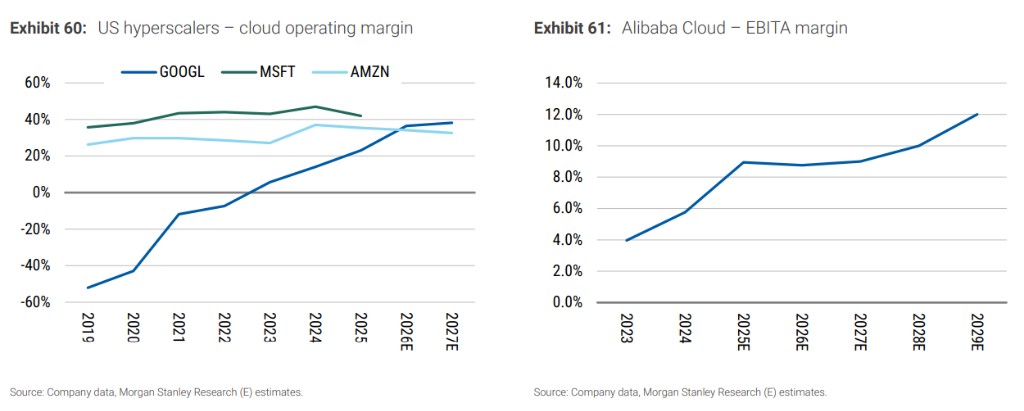
The core drivers come from three levels:
The migration of workloads from training to inference is the most important structural catalyst.
Inference workloads are billed per Token/API and can incorporate higher-value value-added services (VAS), with a single server capable of handling multiple workloads simultaneously (parallel batch processing scheduling), improving utilization while enhancing profit structure. In contrast, training workloads are priced more like commodities, with limited bargaining space.
Self-developed ASICs significantly reduce unit costs of infrastructure.
Third-party AI chip manufacturers typically have gross margins as high as 50%-60% (at the chip level) and even 60%-70% (at the server level), which means that Alibaba (T-Head) and Baidu (Kunlun), with their self-developed ASICs, can have procurement costs over 50% lower than their competitors, directly compressing inference-side costs.
Adjustments in depreciation policy provide additional elasticity for profit improvement.
Major U.S. cloud providers have extended the depreciation period for servers to 6 years, while Alibaba Cloud currently depreciates over 3 to 5 years. If it follows suit and extends the depreciation period in the future, it will lead to considerable profit margin improvement
