Bank of Japan Governor: The surge in oil prices makes policy judgment more difficult, and if the economic outlook materializes, interest rates will continue to rise
Ueda Kazuo stated that the rise in oil prices is expected to exert upward pressure on overall inflation, while potentially raising inflation expectations and core inflation; however, if oil prices remain high for an extended period, it will also create downward pressure on economic activity through deteriorating trade conditions. If the economic and price trends align with expectations and continue to improve, the central bank will continue to raise policy interest rates and emphasize that the timing of interest rate hikes will be assessed individually at each meeting
Bank of Japan Governor Kazuo Ueda reiterated on Thursday that the path for interest rate hikes remains unchanged, but admitted that the significant rise in oil prices triggered by the Middle East situation complicates the assessment of inflation and growth prospects, introducing new variables for monetary policy direction.
The Bank of Japan's interest rate decision announced today showed that the Bank of Japan maintained the interest rate at 0.75% with a vote of 8 to 1. Ueda stated at the press conference following the monetary policy meeting that the rise in oil prices is expected to exert upward pressure on overall inflation, while potentially raising inflation expectations and core inflation; however, if oil prices remain high for an extended period, it will also exert downward pressure on economic activity through deteriorating trade conditions. He candidly expressed that, influenced by the situation in Iran, it is currently difficult to clearly state whether policy should focus more on curbing inflation or supporting the economy.
Despite the increasingly complex external environment, Ueda reaffirmed the unchanged direction for interest rate hikes. He stated that Japan's real interest rates are currently at significantly low levels, and if economic and price trends align with expectations and continue to improve, the central bank will continue to raise policy interest rates, emphasizing that the timing of rate hikes will be assessed individually at each meeting.
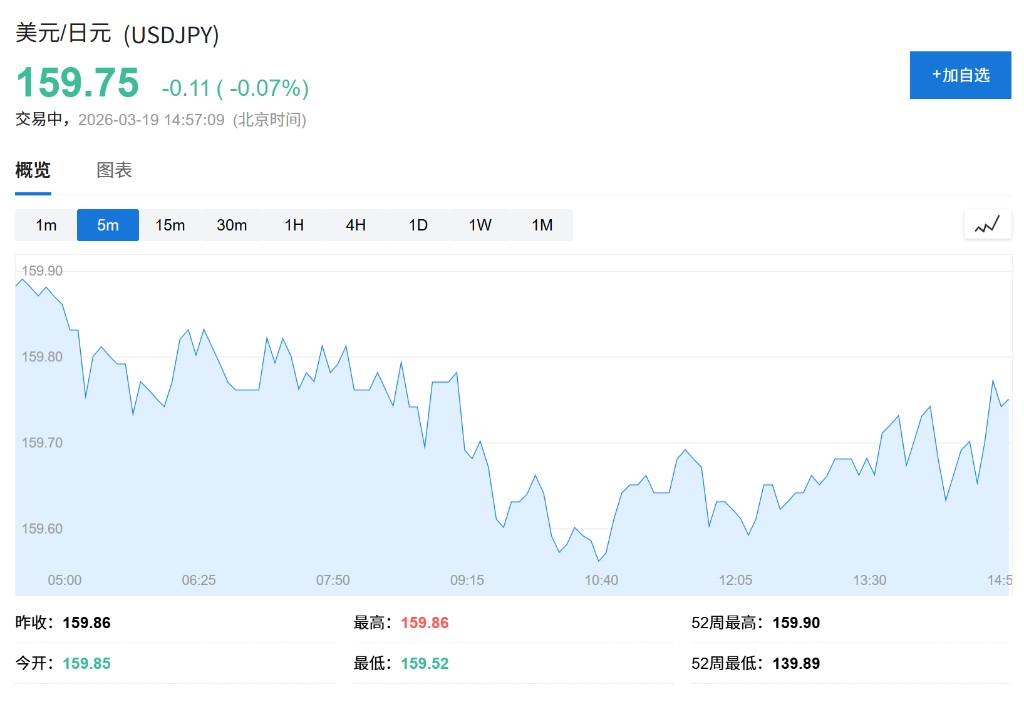
These statements have led the market to adopt a more cautious view on the pace of interest rate hikes by the Bank of Japan—the evolution of the Middle East situation has become one of the key variables influencing Japan's monetary policy path. Following Ueda's remarks, the yen stabilized around 159.75.

Oil Price Shock: Inflation and Growth Facing Dual Pressure
Ueda pointed out that global market volatility has intensified, and the tense situation in the Middle East has driven a significant rise in crude oil prices, posing a dual challenge to the Japanese economy from oil prices.
On one hand, the surge in oil prices is expected to exert upward pressure on overall prices and may raise inflation expectations and core inflation; on the other hand, rising energy costs will worsen Japan's trade conditions, and if prolonged, will drag down economic activity.
He stated that the central bank will assess the extent of the impact of soaring oil prices on the economy and closely monitor further developments in the Middle East situation and their actual effects on the Japanese economy and prices. He identified the Middle East situation, oil price trends, and dynamics in financial and foreign exchange markets as current major risk factors.
In Ueda's view, the core challenge of the current situation lies in the fact that rising oil prices may both strengthen inflationary pressures and suppress economic recovery momentum, with the two directions being contradictory, making it difficult for the central bank to simply orient its policy towards a single target; it must make more nuanced dynamic judgments at each meeting based on the latest data.
Interest Rate Path: Gradual Assessment, Real Interest Rates Still Low
Regarding the outlook for interest rates, Ueda's wording remains consistently cautious. He emphasized that judgments about the timing of future interest rate hikes will be made individually at each policy meeting based on economic and price conditions, and this stance has not changed He pointed out that Japan's real interest rates are still at significantly low levels. If the economy and price performance meet expectations, the path for interest rate hikes will continue. The central bank will decide on policy direction by continuously updating the assessment of the likelihood of achieving its outlook.
According to Bloomberg, Kazuo Ueda also revealed that the central bank is reassessing the neutral interest rate level based on the latest data and re-examining forecasts for the potential growth rate of the economy and the supply-demand gap. In addition, he stated that more detailed core CPI data will be released and that attention will continue to be paid to the progress of spring wage negotiations