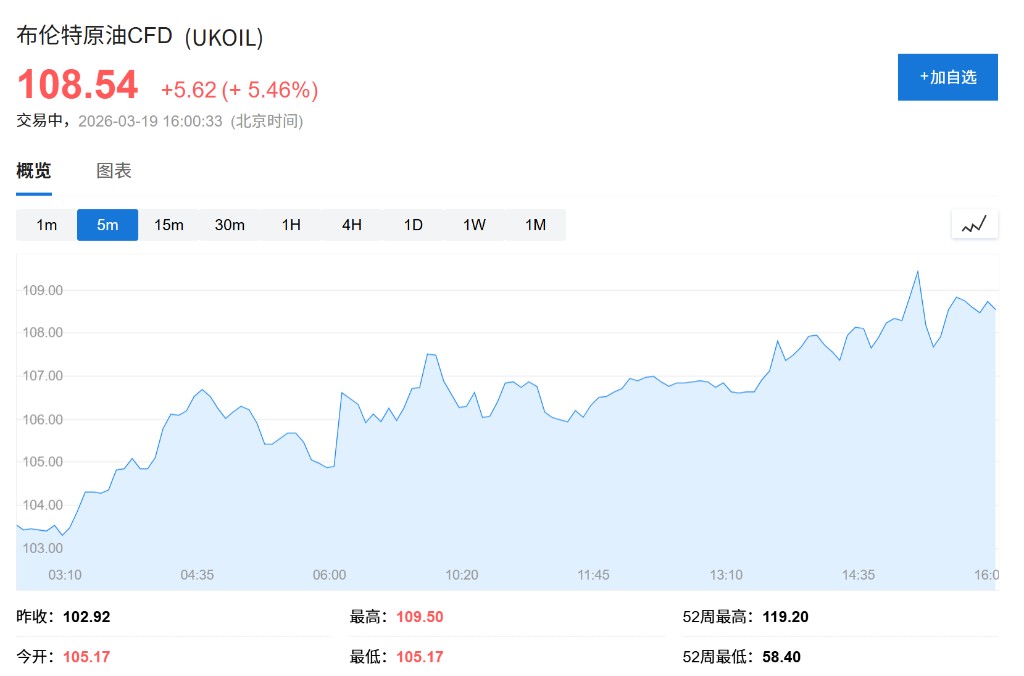
Oil prices surge to $110, significant escalation in Iran conflict, analysts warn it may continue until May!
Israel's airstrike on Iranian gas fields has triggered a seismic shift in the Middle East situation. Iran immediately retaliated by targeting U.S. and Saudi/Qatari energy facilities and continues to blockade the Strait of Hormuz, marking a "new phase" of the war. Analysts indicate that, in the absence of a clear de-escalation pathway, the likelihood of the conflict extending into May is the highest
Israel's airstrike on Iran's South Pars gas field has completely shattered the existing boundaries of the regional situation, with the intensity and duration of this Middle Eastern conflict exceeding market expectations.
Following Israel's unprecedented strike on the South Pars gas field facilities, oil prices immediately surged, with international benchmark Brent crude hovering around $108 per barrel on Thursday. Torbjorn Soltvedt, the Middle East chief analyst at risk intelligence firm Verisk Maplecroft, stated in a research report on Wednesday that the attack "reinforces our judgment that the conflict is most likely to continue until May, with no obvious de-escalation pathway in sight."
The situation has further complicated: According to Xinhua News Agency, the Iranian Islamic Revolutionary Guard Corps announced on the 19th that it has launched the 63rd wave of its "Real Commitment-4" operation, "burning" oil facilities related to the United States in retaliation. The statement claimed that the war between Iran and the United States and Israel has entered a "new phase." The Saudi Arabian foreign minister subsequently issued a strong warning, stating that they reserve the right to "take military action if necessary." Meanwhile, Iran continues to blockade the Strait of Hormuz, significantly obstructing a large portion of global crude oil supply routes, leading to a sudden increase in supply-side pressure in the market.
Late Wednesday night, Trump posted on Truth Social that the Israeli military would not attack the South Pars gas field again, "unless Iran foolishly decides to attack Qatar." This statement implies that the U.S. was aware of and approved the strike in advance; according to Axios reporter Barak Ravid, the action was indeed carried out under coordination and approval from the Trump administration.

Escalation of Conflict: Iran's Retaliation Affects Energy Facilities in Multiple Countries
Iran's retaliatory actions have a wide-ranging impact. Daniel Schneiderman, director of the Washington Global Policy Project at the University of Pennsylvania, told Axios that Tehran's targets include "Qatar's crown jewel"—the Ras Laffan Industrial City, which is the world's largest liquefied natural gas (LNG) export facility. Additionally, energy facilities in Saudi Arabia and the UAE have also been attacked.
Qatari officials contacted U.S. officials, including White House envoy Steve Witkoff, immediately after the first round of Iranian missile strikes. The Saudi foreign minister issued a stern warning, reserving the right to military action. Currently, the White House and the Department of Defense have not commented on the matter
The Hormuz Dilemma: Iran's Mobile Combat Capability Should Not Be Underestimated
Although the joint military actions of the U.S. and Israel have significantly weakened Iran's ballistic missile capabilities and drone launch capabilities, analysts warn against being overly optimistic about the situation. Schneiderman points out that this is also one of the main reasons why oil prices have not risen significantly further.
However, Schneiderman also raises a key warning—this former official who worked in the Biden administration's Department of Defense and State Department states, "The mobility of the Shahed launchers is very strong and difficult to target accurately. I believe Israel and the U.S. will continue to focus on destroying individual launchers and ammunition depots for a considerable time." He adds that Iran has deployed some missiles on truck-mounted mobile launchers, which are also difficult to eliminate precisely, "The operational flexibility of mobile launch platforms is not hard to achieve."
Schneiderman concludes, "The difficulty of Iran taking these actions has increased compared to the early stages of the war, but they still have the capability to exert significant pressure on the Strait of Hormuz."
Risk Diffusion: Saudi Arabia and the Red Sea Corridor Become the Biggest Hazards
Analysts are currently most concerned about the conflict spreading further to key facilities that have so far remained unscathed. Soltvedt warns in a research report that Israel's strikes on South Pars "could trigger attacks on facilities that have not yet been affected."
He specifically points out that "the biggest risk" lies in the Saudi Arabian east-west oil pipeline or Red Sea export facilities being attacked—these facilities, along with the Port of Fujairah in the UAE, constitute some of the few important alternative oil transportation routes outside the Strait of Hormuz. If these facilities are damaged, the global energy market will face a supply shock far more severe than the current situation.
Multiple analysts hold a conservative attitude towards the de-escalation of the conflict. Soltvedt clearly states that in the absence of a clear de-escalation pathway, the likelihood of the conflict continuing until May is highest. Schneiderman admits that "it is difficult to predict the timing of de-escalation," but given the current situation, "Iran has no incentive to de-escalate."