Carlyle Group Jeff Currie: The current scale of supply shocks is almost equivalent to that during the COVID-19 pandemic
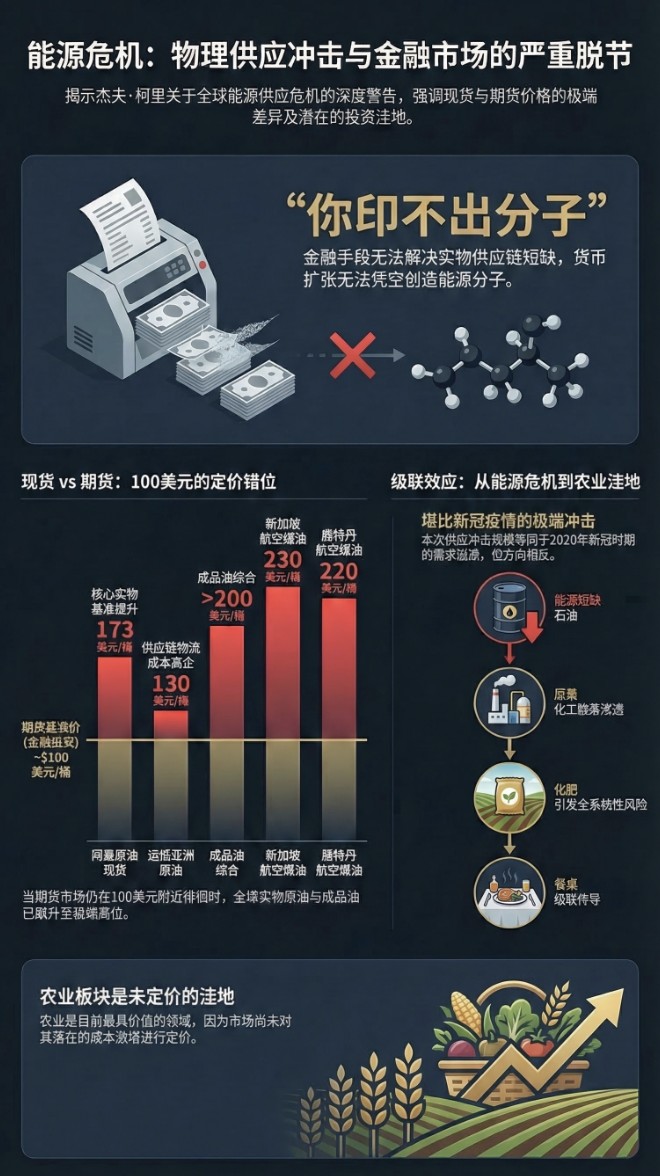
An epic energy supply crisis is coming! Jeff Currie warns: Oman crude spot prices soared to $173 yesterday, with a serious disconnection between spot and futures. He pointed out that during the COVID-19 period, crude oil needed to be at -$37 per barrel to achieve supply-demand balance, and now once inventories are depleted, extremely high prices must be used to force demand down. "The scale of this supply shock is almost equal to the demand shock during the COVID-19 period."

Jeff Currie, former global head of commodity research at Goldman Sachs and chief strategist for energy at Carlyle Group, warned that due to the geopolitical impacts in the Middle East, the global energy market is facing an extreme supply shock comparable in scale to the demand shock during the COVID-19 period, with a severe disconnection between the spot and futures markets.
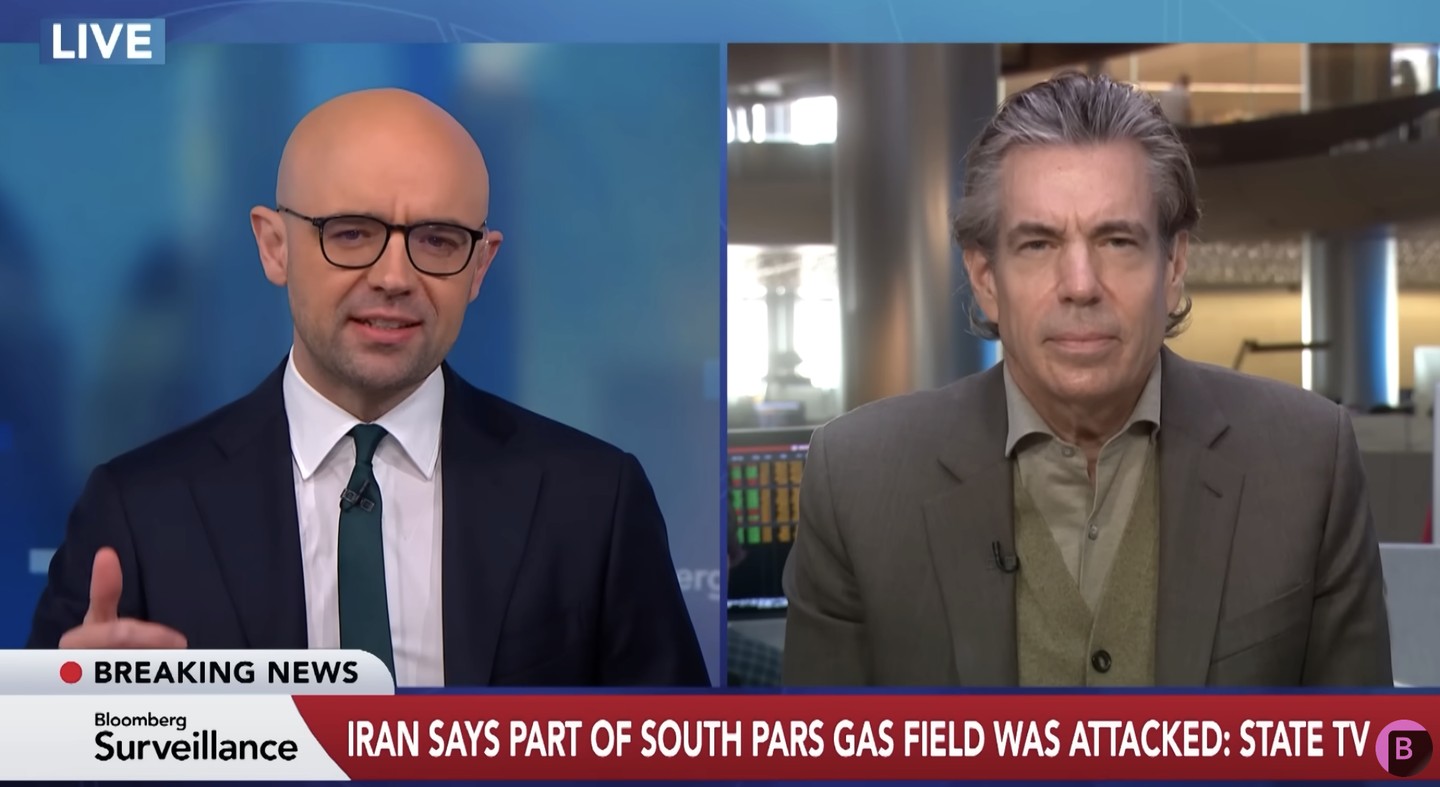
In a Bloomberg media video interview on March 18, the so-called "Godfather of Commodities," Jeff Currie, participated in a deep analysis with host Brad Clawson and others regarding the recent attacks on Iranian energy assets and the conflicts in the Strait of Hormuz and their impact on global markets.
Currie issued a strong warning during the conversation, pointing out that the current energy crisis is purely a physical supply chain issue, and financial means are powerless against it. Faced with an extremely volatile market, his direct advice to investors is: “You need to go long (on crude oil), fasten your seatbelt, hold on tight, and prepare for the journey.”

Spot crude oil skyrockets to $173, futures market severely distorted
The core risk in the market currently lies in the severe underestimation of the crisis. Currie pointed out that the futures market has completely detached from the spot market. He revealed astonishing frontline spot data:
“Crude oil based on Oman... surged to $173 per barrel yesterday. The cost of crude oil delivered to Asia is about $130 per barrel. The price of refined oil has soared to over $200 per barrel.”
However, the current paper market price is only fluctuating around $100. Regarding this huge price gap, Currie stated that the current shortage is evolving into an intercontinental "molecular-level transmission." He cited an example:
“Last week we were still discussing shortages in Singapore, and this week the price of jet fuel has soared to $230 per barrel. Yes, in Rotterdam it’s $220 per barrel... The price difference between Singapore and Rotterdam has disappeared, there is no idle capacity, and there are no policy solutions. At this point, it’s purely a physical problem.”
An extreme shock comparable to the COVID-19 pandemic: “You can't print molecules”
In assessing the destructive power of this crisis, Currie mirrored it against the COVID-19 pandemic of 2020. He bluntly stated: “The scale of this supply shock is almost equal to the demand shock during COVID.”
He recalled that when demand collapsed in 2020, global inventories were overflowing, “requiring a price of negative $37 per barrel to create that kind of supply-demand rebalancing.” Now, the market faces a completely opposite environment: once inventories are depleted, extremely high prices must be used to force demand down.
"Imagine the cost required to reduce demand to match supply. If in 2020 a price of negative $37 was needed to achieve that kind of rebalancing... you haven't seen any evidence of demand destruction that could rebalance the market, so we haven't even really started the rebalancing process."
Regarding the idea of solving the current crisis through monetary easing or financial means, Curry sharply refuted: "These are all physical supply chains, and the ability to financialize and print money is completely inapplicable here... You can't print molecules."
The crisis will create a cascading effect, and short sellers are like "picking up coins in front of a steamroller"
Faced with such drastic fundamental changes, Curry believes there is a serious mispricing in the current market. He warned those shorting energy:
"I observe the market, it is shorting energy stocks while going long on everything else that is shorting energy. I think you are picking up coins in front of a steamroller right now."
Regarding the chain reaction caused by shortages, Curry pointed out that removing oil from the global economic system will create a massive cascading effect:
"From natural gas to urea, then to fertilizers, and finally to the dinner table." In this macro context, he identified an undervalued area in the market that has not yet been priced: "I believe the best area to seek value right now is agriculture, as it has not yet been priced in."
Additionally, Curry warned the U.S. capital markets not to be blindly optimistic. He stated that once a real shortage scenario emerges, Europe will be hit first, and the earnings of the U.S. stock market (especially tech giants) are highly dependent on the global market.
When the crisis severely impacts Europe and other regions, it will inevitably backlash on U.S. stock profits, "Americans will first feel the impact in terms of wealth, and only then will they feel the impact on income cash flow."
The original interview transcript is as follows:
Brad Clossom
Kara, Jeff Curry is here, and the costs of rebuilding and recovering from the Hormuz shock will be enormous, highlighting the trend towards physical assets. Jeff now joins us with more analysis. Jeff, welcome to the show. It's great to talk to you, sir. This is a volatile environment. So, allow me to recap the headlines from the past 5 to 10 minutes. There’s a headline from Iran reporting that their energy assets have been attacked. Beyond that, I have limited information. But, Jeff, from your perspective, has the situation worsened or improved since we spoke last week?
Jeff Curry
It has worsened, I call it "molecular-level transmission." You know, last week we were talking about shortages in Singapore, and this week jet fuel prices have soared to $230 per barrel. Yes, in Rotterdam it’s $220 per barrel. Thailand, the Philippines, New Zealand, and Australia are also experiencing this. So, this is evolving into intercontinental transmission. Just look at the price difference between Singapore and Rotterdam; there is no price difference anymore, no idle capacity, and no policy solutions. At this point, this is purely a physical problem. I want to emphasize that these are all physical supply chains, and the ability to financialize and print money is completely inapplicable here. I think the title of that article says it all: You can't print molecules.
Brad Corson
Jeff, given this, where and how do you think we are still underestimating this risk in the financial markets?
Jeff Currie
The strange thing is, if you look at the paper market, it has completely decoupled from the spot market. Oil priced against Oman soared to $173 per barrel on the free side of the Strait yesterday. The oil arriving in Asia is a mix of Dubai and Oman crude, trading today at around $130 to $170. This morning, it was around $120 to $150. So, the cost of oil delivered to Asia is about $130 per barrel. Refined oil prices have surged to over $200 per barrel. Therefore, there is a disconnect between the paper market (around $100) and the spot market (showing a completely different situation).
Speaker 3
Jeff, some people speculate that this is due to some manipulation in the futures market, leading to the widening of the price gap you see. Do you think there is any truth to that?
Jeff Currie
You know, you could say that last Monday, there was a mysterious seller of 11 million barrels in the market. I don't want to delve into that. It's not enough to really change the market dynamics. I think a larger factor that may be pushing WTI and Brent crude prices lower is the price of the euro. Russian oil has rebounded to $65 to $70 per barrel after sanctions were lifted. So WTI and Brent crude are high-cost, while Russian oil is cheap. What happened? You closed that price gap, and now that you've closed the gap, there is no more idle capacity in the system, and other parts of this system are likely to start... rebounding. Yes, I want to return to the point John raised at the beginning, which is that we are dealing with a massive supply shock. By the way, the scale of this supply shock is almost equal to the demand shock during COVID, and we all know what that did to global supply chains. So, I think the price of $100 per barrel you saw earlier was mispriced. This contradicts the situation in the spot market.
Speaker 3
However, there is a feeling that this time is different from the 1970s because the world's dependence on oil has changed, especially in China, to what extent they are diversifying into electric vehicles, nuclear energy, and other areas. To what extent do you think this will become a growth trend, diversifying energy sources in countless ways, beyond what we did even during the so-called "green revolution," as people try to avoid such shocks?
Jeff Currie
Well, I absolutely believe that renewable energy and nuclear energy were born out of the energy crisis of 1973, and this time will trigger massive investments in renewable energy, nuclear energy, and other localized energy sources. The problem is, what we call the "new gem order." The issue is that we have not yet reached that transformation stage, meaning we have not achieved full electrification and localization, while the type of oil consumption that remains in the global economy is crucial Therefore, if you pull these barrels out of the system, the chain reaction and cascading effects generated by the global supply chain will be enormous. From natural gas to urea, then to fertilizers, and finally to the dinner table. Or from liquefied petroleum gas to synthetic fibers, then to cotton, you will shift from soybeans and corn to cotton. By the way, I think the best area to capture value right now is agriculture, because it hasn't been priced in yet.
Speaker 4
Jeff, regarding the exit of oil from the market, an industry consultant mentioned China, where they may reduce commercial and operational inventories by up to 1 million barrels per day in the next four to six weeks. What does this mean for crude oil prices?
Jeff Currie
I think the key point is that once you deplete these inventories, there will be nothing left. Think of it this way: demand is above this, and supply is below this. Once these inventories are exhausted, "bang," you have to bring demand down to align with supply. To do this, you need prices far above current levels.
Jeff Currie
I like to make a mirror comparison to COVID. Let's go back to the COVID period. The situation was completely opposite. At that time, demand was above... Conversely, supply was above, and demand was below. Then what happened? Demand collapsed. Ultimately, you filled up all the inventory capacity in the world, and you had to bring both supply and demand down immediately. What did it take? It took a price of negative $37 per barrel to create that kind of supply-demand rebalancing.
Jeff Currie
Now we are facing a completely opposite environment. So imagine, what price is needed to bring demand down to align with supply. If it took negative $37 in 2020 to achieve that rebalancing.
Brad Kloss
Given that, I want to ask you a question: what price is needed? What is the opposite scenario?
Jeff Currie
I mean, I stick to the same answer I gave you last week: you want to go long, buckle up, sit tight, and brace for the journey. Yes, when the system starts to rebound, we will know that point has arrived. But I want to emphasize not to underestimate the severity of this volatility. Look at European natural gas in 2022; we saw Russia cut supplies, and by the way, the market ignored this in June 2022. By August and September, prices reached $3,400 per barrel (oil equivalent). Do you know where the price was in December that year? I feel like you destroyed too much, Dan. They turned negative. So I'm not saying oil prices will go negative, but what I want to tell you is that this will be a very bumpy journey. You haven't seen any evidence of demand destruction that could rebalance the market, so we haven't even really started the rebalancing process. So I think the upside potential here is enormous. Once again, we want to go long. I observe the market; it is shorting energy stocks, while simultaneously going long on everything else that is shorting energy. I think you are picking up coins in front of a steamroller right now.
Speaker 4
Jeff. We’ve buckled our seatbelts. That’s why we invited you back this week. Can you give us a range of how high prices might go? I don’t know. I know you don’t want to give a specific number, but what level do you think Brent crude prices will reach? Just give us a range. When you say to go long, I mean, how high are we talking?
Jeff Currie
But look at Oman, jet fuel is trading at $173 per barrel. Rotterdam is $220 per barrel. Singapore is $230 per barrel. And we haven’t even started the rebalancing process yet. What we’re currently seeing is just places like Thailand and China hitting export restrictions, which then creates a chain reaction and shortages. Then you start to see stockpiling. Gasoline in Los Angeles is now $8 per gallon. So, you know, there’s upside here. I don’t want to guess how high, but you’ve already seen prices like $173 in the spot market. So that’s my point. There’s a huge disconnect between the physical world and the paper market. And the paper market includes the financial world.
Jeff Currie
I want to point out that when the COVID-19 pandemic broke out in January 2020, I thought, guys, we have to short this. You can’t deliver such a massive shock to the global economy and not expect bad things to happen. And now, we’re facing a completely mirrored shock of similar scale hitting the world, and the paper and financial markets are not signaling what they should be signaling.
Brad Kloss
So, Jeff, at some point, the market will realize the severity of the reality. During COVID, when the northern Italian cities began to lock down, people felt the situation was getting serious. The pandemic was spreading beyond China, impacting Europe, and possibly the U.S. What will make the market realize the severity of the reality this time? What can bridge the gap between the spot and paper markets?
Jeff Currie
I think it has to be a visual picture of real shortages in the U.S. and Europe. Right now, the U.S. is going to feel it, especially if they implement export controls. Europe is likely to be the first to feel the impact. I think the implication here is that the U.S. believes it is safe due to its energy dominance. This is the point I made last week from a stock market perspective, that the U.S. stock market is a global market. All those "seven giants" companies derive their earnings from Europe and Asia, from all over the world. So when this energy crisis starts to hit places like Europe, it will affect the earnings of companies based in the U.S. because the U.S. stock market is not a domestic market; it’s global. So it will feel the impact. I think Americans will first feel the impact in terms of wealth, and then they will feel it in terms of income cash flow. Unfortunately, Europeans are likely to feel it in both aspects very soon.