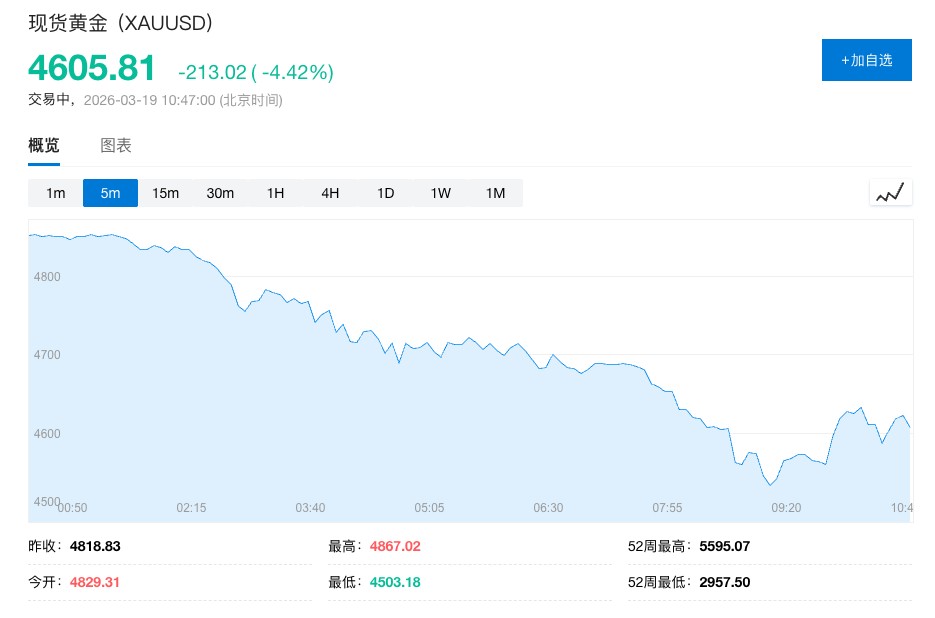
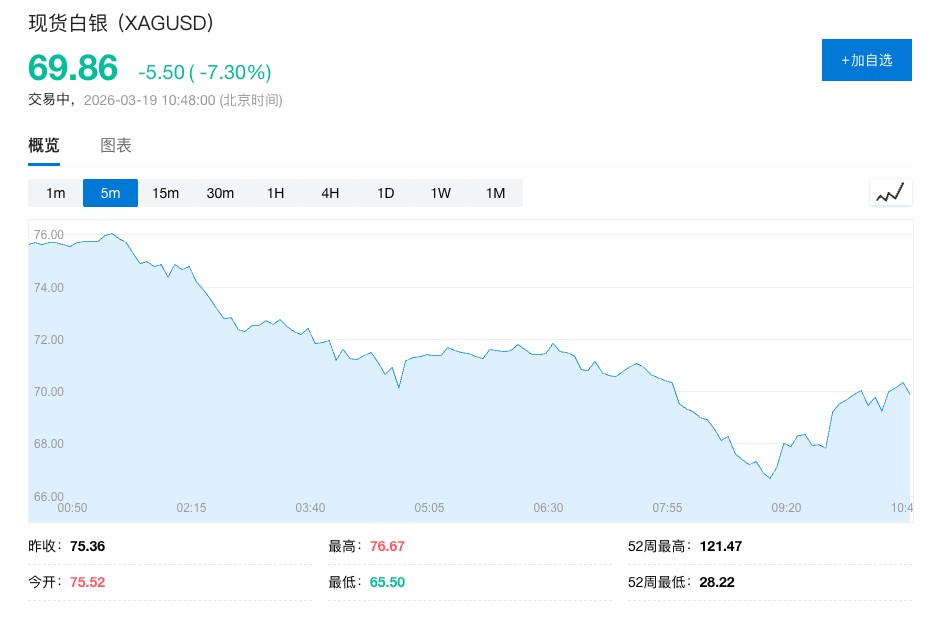
Metals fell across the board! Gold dropped over 4%, briefly falling below 4600, silver plummeted 12%, and London aluminum recorded its largest decline since 2018!

Wallstreetcn
2026.03.19 15:18

The escalation of the Middle East conflict has driven up energy prices and inflation expectations, weakening the space for interest rate cuts, leading to a simultaneous decline in gold, silver, and industrial metals. Gold has fallen for seven consecutive days, briefly dropping below $4,600, while silver plummeted over 12% at one point. LME aluminum and other industrial metals also experienced their largest declines in years; coupled with continuous outflows from gold ETFs, market demand for safe-haven assets has weakened, putting overall pressure on commodities

The conflict in the Middle East is rewriting market logic.

Gold, originally viewed as a safe-haven asset, has continued to decline, while silver has experienced a rare plunge; at the same time, industrial metals such as copper, aluminum, and tin have also seen significant drops, resulting in a rare synchronized decline of "precious metals + industrial metals." The driving force behind this is no longer a single supply-demand logic, but rather an energy shock that raises inflation and suppresses interest rate cut expectations, leading to a dual squeeze of tightening liquidity and demand concerns, causing commodities overall to enter a pressured range.

The Middle East conflict raises inflation expectations, leading gold and silver to lead the decline in commodities

The escalating situation in the Middle East has triggered inflation concerns that have severely impacted the global commodity market, with precious metals and industrial metals facing large-scale sell-offs.

On Thursday, spot gold briefly fell below $4,600 per ounce, with a daily decline of over 4%, marking the seventh consecutive trading day of decline, setting a record for the longest losing streak since 2023.

Spot silver's decline was even more severe, plunging over 12% during the day, falling below the $66 mark, and hitting a new low since February 6. The main contract for Shanghai silver on the Shanghai Futures Exchange fell 14%, closing at 16,120 yuan per kilogram. According to media reports, Iran and Israel have been striking each other's key energy facilities in the Persian Gulf region, pushing oil prices higher, which has cooled market expectations for a Federal Reserve interest rate cut, putting pressure on non-yielding gold.

International copper and Shanghai copper fell over 3%; liquefied petroleum gas rose over 4%.

War drives up oil prices, suppressing interest rate cut expectations

Since the outbreak of the Middle East conflict nearly three weeks ago, crude oil and natural gas prices have continued to soar, significantly increasing inflation risks. The Federal Reserve maintained interest rates at its meeting on Wednesday and lowered its expectations for rate cuts this year to just one, with Chairman Powell clearly stating that rate cuts must be predicated on a slowdown in inflation.

Analysts believe this statement directly dampened gold's appeal. Gold itself does not generate interest income, and holding costs are relatively high in a high-interest-rate environment; once expectations for rate cuts narrow, funds tend to flow out of gold assets.

Media reports indicate that since the outbreak of the war, gold's performance has mirrored the decline seen in the summer of 2022. At that time, the Russia-Ukraine conflict triggered energy price shocks that transmitted to global markets. Although volatility in the precious metals market has eased compared to the sharp fluctuations in January this year, frequent price swings have deterred some investors seeking safe havens.

Continued outflows from ETFs raise doubts about safe-haven attributes

According to media reports, physical gold holding tools represented by gold ETFs have seen continued net outflows in recent weeks, further suppressing gold prices. Gold ETFs are the mainstream channel for Western retail and institutional investors to hold gold, and their demand is particularly sensitive to changes in interest rates Some investors have begun to view gold as a speculative asset rather than a traditional safe-haven tool. Although the volatility in the precious metals market has subsided compared to the sharp price fluctuations in January, the ongoing price turbulence still deters investors seeking safety, and the continuous outflow of funds further weakens the support for gold prices.

Industrial Metals Experience Historic Declines

In terms of industrial metals, the LME aluminum price's single-day drop of over 8% is the largest since 2018, quickly reversing the gains accumulated since the outbreak of the Iran conflict due to regional supply risks, indicating that market concerns about the global economic outlook have spread to industrial demand.

Additionally, LME copper has fallen over 5%, recently reported at $11,765.5 per ton; LME tin's main contract plummeted 7%, reported at $42,110.0 per ton. The overall commodities market has plunged into panic selling, with several varieties experiencing declines that are rare in recent years. After the opening of the night trading session on the Shanghai Futures Exchange, Shanghai aluminum, Shanghai tin, and Shanghai gold all fell over 5%.

Analysts believe that the widespread decline in the commodities market reflects investors' comprehensive concerns about the ongoing escalation of conflicts in the Middle East, high energy costs, and the obstacles to major central banks' monetary policy shifts. Until inflationary pressures show significant relief, the market's repricing of interest rate cuts may continue to exert pressure on commodities