


BofA's Hartnett: No "Buy-Low Signal" Yet; How to Understand "Buy the Dip" Trades Including Gold?
The BofA Bull & Bear Indicator dropped from 8.4 to 7.4, ending a sell signal that had lasted for over three months, but Hartnett stated bluntly that it is "too early to buy the dip." The S&P 500 has not officially entered "correction territory," and the global breadth buy signal has not yet been triggered. Before bulls capitulate and macro data undergoes panic-driven downward revisions, the timing for contrarian buying is not yet mature. He also noted that if Trump's credibility is damaged, a dollar bear market will return, and the bull market for gold and international equities will resume
Michael Hartnett, Chief Investment Officer at Bank of America, announced the official end of the firm's long-standing sell signal from its Bull & Bear Indicator, but simultaneously warned that the market has not yet seen a true "Buy-Low Signal," advising investors against rushing into buying the dip.
Hartnett noted in the latest Flow Show report that the "policy panic" phase has begun with oil prices exceeding $100 per barrel, 30-year Treasury yields rising to 5%, and the S&P 500 falling below 6600 points.
The BofA Bull & Bear Indicator has significantly dropped from 8.4 to 7.4, its lowest level since July 2025, marking the formal end of the sell signal that began on December 17 of last year.
However, he emphasized that the time for contrarian buying is not yet mature until true bull capitulation or macro panic signals (i.e., significant downward revisions to GDP and earnings per share expectations) are observed. Regarding asset allocation, Hartnett's core view is gradually becoming clearer: a dollar bear market will make a comeback, accompanied by a resurgence in the bull markets for gold and international equities.
Sell Signal Ends, But "Buying the Dip" Is Premature
The BofA Bull & Bear Indicator sharply declined from 8.4 to 7.4, reaching its lowest point since July 2025. Contributing factors include deteriorating breadth in global equity indices, outflows from high-yield bonds and emerging market debt, and widening credit spreads for high-yield and AT1 bonds. These changes signal the official end of the sell signal that commenced on December 17 of last year.
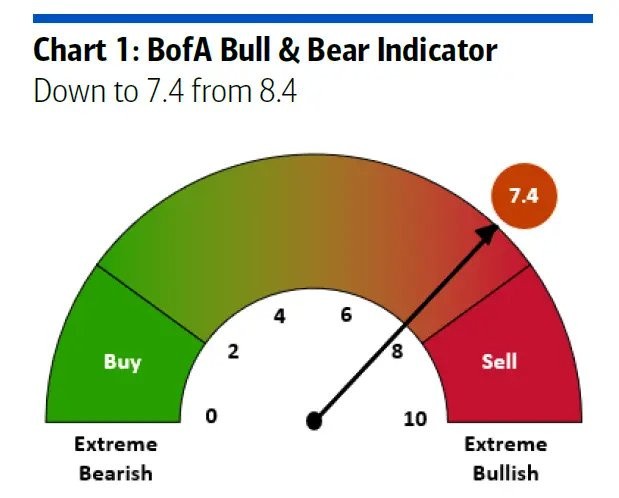
Since 2002, the BofA Bull & Bear Indicator has triggered 32 contrarian "sell signals." Historical data shows that within three months after such signals end, the average return for the S&P 500 and the MSCI ACWI (All Country World Index) has been only 1%. This implies that the end of a sell signal itself does not constitute a strong buying catalyst; the market remains in a phase of uncertain directional battles, making it premature to "buy the dip" comprehensively.
Hartnett also reviewed the "painful trades" in U.S. equities since the first quarter: short-term Treasuries outperformed AI-driven mega-cap computing bonds, the dollar outperformed Bitcoin, oil was stronger than gold, energy outperformed technology, and large-cap stocks underperformed small and mid-cap stocks. Concurrently, 67% of S&P 500 constituents (336 stocks) have fallen more than 10% from their highs, and 28% (143 stocks) have declined over 20%. Since the peak optimism in liquidity and AI capital expenditure in late October last year, structural damage beneath the index has been quite significant.
How Is a "Buy-Low Signal" Triggered? What Are the Key Thresholds?
Hartnett elaborated on the technical path from a sell signal to a buy signal. He indicated that the first indicator likely to trigger a "buy signal" is the BofA Global Breadth Rule — this buy signal is triggered when 88% of global equity indices simultaneously fall below their 50-day and 200-day moving averages.
As of last Monday, this indicator stood at -39% and may have fallen further after Friday's close. Hartnett estimates that to trigger this buy signal, Asia-Pacific stock markets would need to fall by approximately 2%, emerging markets by about 3%, and Latin America by roughly 14%. The S&P 500 has not yet officially entered "correction territory" (a 10% to 20% decline from its high), a threshold corresponding to an index level of approximately 6300 points. As of Friday's close, it was less than 100 points away from this critical level. In other words, the market is still some distance from a genuine technical Buy-Low Signal.
Until then, Hartnett clearly advises "no rush, no greed," and emphasizes that true contrarian buying opportunities require signals of "bull capitulation" and panic-driven downward revisions in macro data, neither of which has occurred yet.
Gold: The Core Beneficiary of a Dollar Bear Market and Policy Shifts
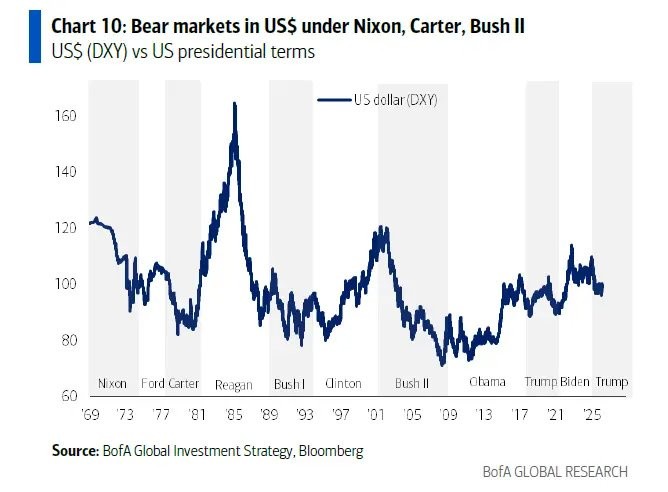
Hartnett's views on gold are particularly noteworthy. He warned that bear markets in presidential credibility are often accompanied by bear markets for the dollar — a pattern observed historically during the administrations of Nixon, Carter, and George W. Bush.
He further pointed out that if Trump's credibility suffers structural damage due to the situation in Iran, his ability to boost Wall Street through verbal intervention and attract foreign direct investment into the U.S. will be weakened. In this scenario, a dollar bear market will return, and bull markets for gold and international equities will also restart.
Looking further ahead, Hartnett believes that if policy shifts towards "AI = Universal Basic Income = Yield Curve Control," both gold and Bitcoin will benefit from this structural policy change.
Hartnett's Base Case: Policy Panic Offers a Trading Window
Hartnett outlined three market scenarios in his report. In a bear market scenario, credit spreads continue to widen, and stocks fall until the probability of recession and rate hikes no longer rises, threatening the consensus of 19% global earnings growth. If the war in Iran lingers, the market will accelerate its shift from the "prosperity trade" of Q4 to the "stagflation trade" of Q1, ultimately evolving into the "recession trade" of Q2. At that point, going long U.S. Treasuries and short cyclical stocks will become the dominant logic.
In a bull market scenario, the easing of financial conditions is the key catalyst, including global policy coordination to lower oil prices, systemic risk mitigation in the private credit system, and a steepening yield curve. Hartnett believes that the best contrarian long opportunities in the second quarter will be in software, private equity, and consumer finance — three sectors that have significantly deviated from their 50-day and 200-day moving averages.
In Hartnett's base case scenario, policy panic is highly probable to avoid economic recession. Based on this premise, he believes the best trades are to go long on the yield curve steepening and consumer stocks. Meanwhile, with the return of a dollar bear market and global fiscal expansion (especially large expenditures in defense and energy by Europe), the bull market for gold and international equities will find opportunities to resume.
Hartnett concluded with two market aphorisms that precisely summarize the current environment:
The most painful market moves are either new highs driven by private credit or new lows led by semiconductors.
In a strong market, when the index breaks below the 200-day moving average, investors tend to cover their shorts; however, in a weak market, this is when they sell their longs.
