


Agibot Pulls Ahead of Musk This Time
Crossing the 10,000-unit survival threshold
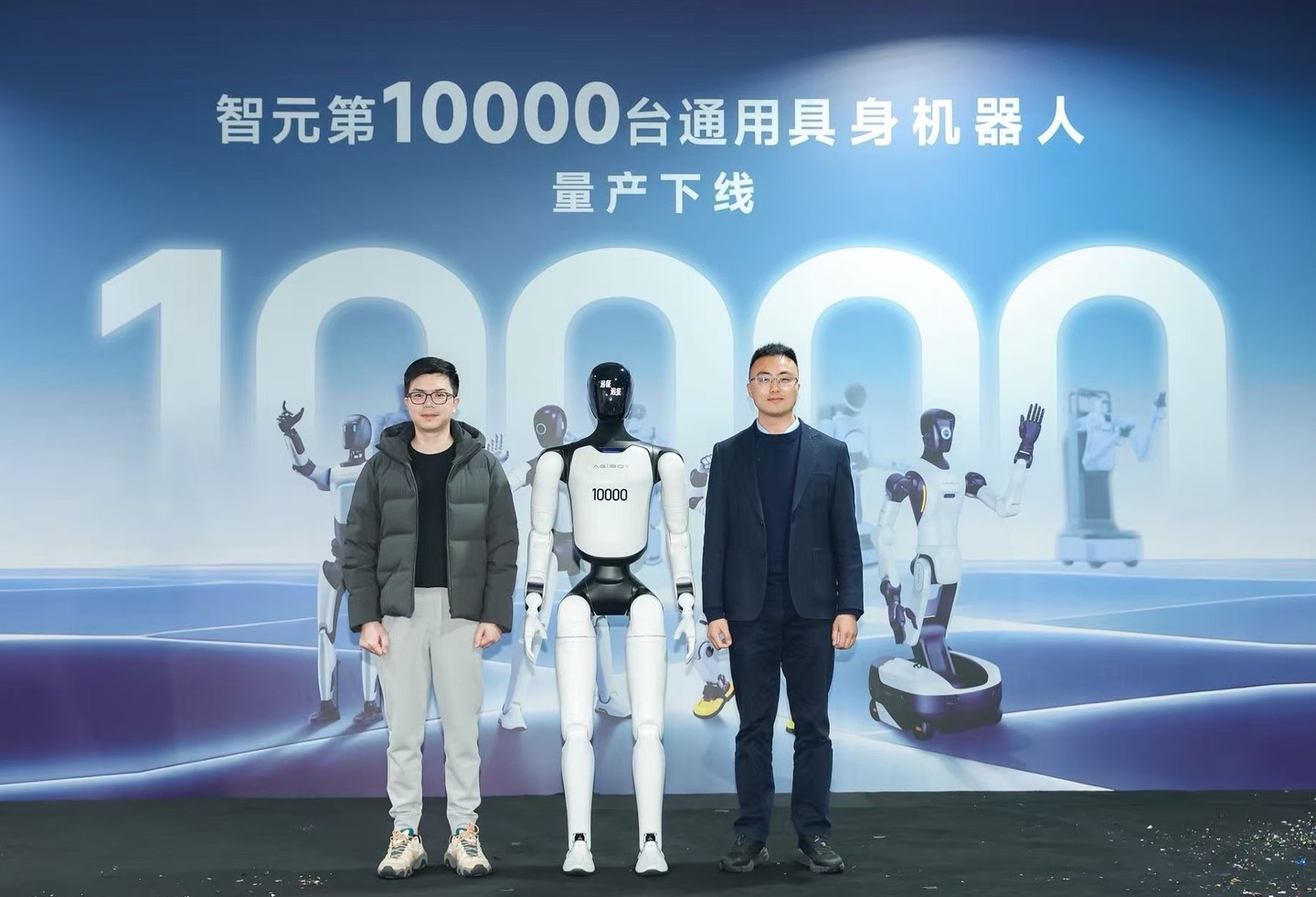
Something even Elon Musk hasn't achieved, Peng Zhihui and his Agibot have managed to do.
Not long ago, Tesla confirmed that its humanoid robot product, Optimus Gen3, will start small-batch trial production this summer, with mass production not expected until 2027. Although this pace has undergone multiple delays, Musk's vision remains the reference frame for the global industry.
But a turning point arrived unexpectedly. The production ramp-up progress, originally planned in units of "years," has been compressed into "months."
On March 30, Agibot announced that the number of humanoid robots coming out of its mass production base had surpassed 10,000 units. This comes less than three months after their last ceremony for the 5,000th unit rolling off the line.
Agibot's "breaking 10,000" means that domestic embodied intelligence has stepped from the laboratory into the node of large-scale commercialization.
For this Chinese player established less than three years ago, winning against an industry giant in terms of mass production is a declaration in itself.
Breaking the Wall of Mass Production
If we draw a curve for the development of domestic humanoid robots over the past two years, 2023–2024 is the "Demo Curve," and 2025 begins the "Engineering Reality Curve."
The divide between the two curves is that the former relies on algorithms, action libraries, scene orchestration, and rendering to produce "effects"; the latter accepts only one standard: continuous fault-free operation.
"In many people's eyes, mass production manufacturing seems like a series of standardized processes such as assembly lines, mold opening, injection molding, and assembly. But in reality, for the humanoid robot product category, scaling itself is one of the most difficult technical problems."
On March 30, in a post-conference interview, Agibot co-founder, President, and CTO Peng Zhihui pointed out to Wall Street News that large-scale mass production in the robot industry is far more difficult than imagined.
He made a comparison: if consumer electronics malfunction, they can just be restarted; but once a robot makes a mistake, "any tiny quality failure will be infinitely magnified during actual operation, which could cause personnel injuries or environmental damage with serious consequences."
The difficulty of this was thoroughly reflected in Agibot's internal mass production phase in 2024.
Wang Chuang, Senior Vice President and President of the General Business Department at Agibot, recalled to Wall Street News that during that year, Agibot was in the stage of a difficult climb from the 1st unit to the 200th unit, which was the company's "darkest hour."
After the new product launch in August of that year, Agibot released five robots at once, including the most popular one, the Yuanzheng A2, with a single-unit price exceeding 500,000 yuan. After the launch, orders poured in like snowflakes, but Agibot couldn't handle them at all—the products couldn't be mass-produced, the technology couldn't be implemented, and the business model was completely unviable.
Wang Chuang said that at that time, there was almost no standardization on the production line. The more machines they made, the less time the team had for actual work, because a vast amount of time was consumed by repairs. Every robot off the line was even different, and engineers had to tune parameters one by one.
That was a period of hard days using manpower to bridge the industrialization gap. By the end of 2024, to solve the massive problems brought by the first batch of mass production, Agibot had over 150 person-times of R&D personnel stationed on the front lines of the factory.
Every leap in magnitude solves problems of a completely different dimension. Next, from 200 units to 1,000 units, the biggest bottleneck shifted from the production line to the supply chain.
Peng Zhihui revealed to Wall Street News that when Agibot first decided to make humanoid robots, they conducted a round of research in the industry and "found that there were no core component suppliers capable of adapting to us, delivering in batches, and being mature and reliable."
Agibot employees said that early suppliers might have been able to handle orders of one or two hundred units, but when the order scale reached thousands or even tens of thousands, the original systems and quality standards collapsed instantly, and the products simply couldn't withstand the toll of large-scale rework. Not a single supplier for traditional joints, reducers, dexterous hands, or batteries could meet the delivery stability for the thousand-unit level, let alone consistency.
Since there was no ready-made path, Agibot had to choose to build its own road. Peng Zhihui said, "We grew together with the supply chain, pulling them in to do joint R&D." From material processes to tooling and fixtures, from test stands to aging processes, everything was redefined.
Agibot adopted new processes developed jointly with suppliers for core components such as joints and dexterous hands, making the parts lighter, more accurate, longer-lasting, and lower-cost. They also built a "half-hour supply circle," requiring core suppliers to be able to respond within half an hour.
This deeply-bound supply chain strategy seems heavy in the short term, but in the long run, it precisely constitutes Agibot's moat.
The Start of Engineering Compound Interest
If supply chain capability determines whether Agibot can build 10,000 robots, then the compound interest of the data flywheel determines how much value these 10,000 robots can generate once produced.
"The previous way of making robots was to build a body first, create the hardware, and then develop and stuff some 'brains,' models, and algorithms inside. But now, as 10,000 robots roll off the line, the body and brain are beginning to evolve synchronously," Peng Zhihui said.
Today, every robot off the line will be deployed in automotive manufacturing lines, 3C electronics workshops, and commercial service spaces to continuously collect data.
This real-world data, in turn, trains Agibot's foundational models at an unprecedented speed, making the models more generalized and practical, thereby driving robots to unlock more complex scenarios.
"Robots will get smarter the more they are used," Peng Zhihui said. "Ten thousand units is the key node that allows our flywheel to spin completely."
In fact, this logic is highly consistent with the evolutionary path of the intelligent driving industry. The reason why Tesla's FSD12 could achieve a qualitative leap around 2025 is primarily due to the continuous contribution of real driving data from millions of vehicles on the road. Right now, Agibot is replicating the same path in the field of humanoid robots.
In Wang Chuang's view, the early development of any disruptive technology makes people feel it is struggling and incredibly slow, but when it truly crosses a certain singularity and sweeps in like a tsunami, everyone will marvel at its speed.
Just like electric vehicles and intelligent driving once were, humanoid robots are also approaching this critical point of explosion.
According to IDC data, global humanoid robot shipments will approach 18,000 units in 2025, a year-on-year increase of approximately 508%. Among them, Chinese companies hold a dominant position in global shipments, surpassing their American counterparts.
In 2026, the industry will enter a period of intense battle for large-scale mass production. TrendForce predicts that global shipments will break 50,000 units, another year-on-year increase of over 700%. With Agibot completing the rollout of 10,000 units in less than three months into the year, following this pace, Wang Chuang gave a prediction at the launch: "100,000 units might be by the end of 2027."
This prediction is built on two premises: first, a state of fully autonomous technological deployment, allowing robots to break away from human control, understand the environment, charge autonomously, and continuously adapt to more complex tasks; second, globalization. Wang Chuang said, "The demand for the robot category is universal worldwide. Aging, declining birthrates, labor shortages, and the increasing difficulty of hiring for dull, repetitive jobs are problems the whole world faces."
From the Yuanzheng A1 unveiled in August 2023 to the 10,000th Yuanzheng A3 rolling off the production line in March 2026, Agibot has completed an almost impossible leap in less than three years.
This company's story is essentially another concentrated release of the systemic capabilities of Chinese manufacturing in a brand-new category. The same script has played out many times, yet every time it remains shocking.
Ten thousand units is not the finish line. But from this day forward, humanoid robots are no longer just an imaginary future concept, but a product of the present.
The following is a transcript of the dialogue between Wall Street News/All-Weather Technology and Agibot co-founder and CTO Peng Zhihui, and Senior Vice President and President of the General Business Department Wang Chuang:
All-Weather Technology: Behind the 10,000-unit mass production, what key layouts has Agibot made in the supply chain, cost control, and production capacity?
Peng Zhihui: As just mentioned, reaching 10,000 units is immensely difficult. The process from 1,000 to 10,000 took over a year, completing a 10-fold leap in magnitude. Behind this is a comprehensive manifestation of capabilities in five dimensions: manufacturing efficiency, scenario implementation, customer value, the data flywheel, and common growth of the supply chain. It can be said that Agibot is the world's first intelligent company to truly run through the entire process from laboratory prototypes to industrial large-scale delivery. The biggest difficulties are batch consistency and cost control challenges.
Robots are not like mobile phones; if there's a problem, you restart for software issues, and hardware issues won't cause much damage. But once a robot makes a mistake, if any link in the chain fails, the mass production quality will collapse, and it will also cause irreversible harm to users and the environment. Stable supply of core components, reduction of machine costs, quality, stability, and reliability are all "tough nuts to crack."
To handle these issues, two things are relatively important:
First, relentlessly focus on the supply chain. Grow together with the supply chain and redefine new industry standards. We established the world's first standardized supply system for embodied intelligence, even pulling in core partners for joint R&D. For example, we adopted new processes for core components like joints and dexterous hands, which were jointly developed with suppliers, making components lighter, more accurate, longer-lasting, and lower-cost, reflecting strong product advantages.
Second, reconstruct the production mode. This includes our current site where we've established a pilot factory for validation processes, while the mass production factory ensures stability. The pilot factory pre-validates various processes and assembly workflows. We also use flexible production methods like order-driven production, which has not only achieved self-controllability of core components but also built a "half-hour supply circle," proposing demands to suppliers that they must be able to respond within half an hour.
Ten thousand units is not the end, but a crucial node proving our ability to use engineering certainty to truly transform embodied intelligence from a toy into an indispensable part of future productivity.
All-Weather Technology: Has the ChatGPT moment for embodied intelligence arrived?
Wang Chuang: The biggest difference is that customers often report that production lines change frequently. For example, a production line for loading and unloading battery cells might be modified to handle different models of cells or even completely different materials after a while. If traditional automation methods are used, it often requires scrapping previously good equipment and developing new equipment, or at least having engineers on-site for another month to develop new algorithms.
The greatest significance of embodied intelligence lies in generalization. Just like when we use GPT to ask it any question, many answers are fuzzy; you ask very ambiguously, but it can generalize and understand. We hope that in the physical world of embodied intelligence, it can also generalizes and understand what it needs to do. This may require very large-scale pre-training, combined with reinforcement training for specific workstation data collection, finally bringing the success rate to a level acceptable to production lines. Production lines often have standards of 99.9% or 99.99%, and the cycle time must be benchmarked against humans.
Currently, we see that some loading and unloading scenarios have gradually begun to work. We hope that in the future, wheeled robots can gradually work in more factory scenarios, and bipedal robots can also gradually work in scenarios like reception, guidance, and sales.
All-Weather Technology: Recently, Agibot has made consecutive breakthroughs in algorithms, simulation technology, etc. Does the 10,000th robot off the line carry these technological achievements? How will the real data and engineering feedback from the 10,000-unit mass production feed back into technological iteration and the scenario adaptation capabilities of real machines?
Peng Zhihui: The data loop/data flywheel is very valuable and meaningful to us. The 10,000th mass-produced unit off the line is the Yuanzheng A3, which is the latest model product. It has not yet reached the stage of batch shipment, and many software functions have not reached that stage yet; we are still continuously optimizing them.
Many new technologies will certainly be the first to be applied and validated on new products. For example, the A3 has had significant upgrades in terms of lightweighting, battery life, thrust-to-weight ratio, and interaction capabilities. The entire machine weighs only 55 kg, which is lighter than most humans of this size. Its battery life can reach over 10 hours, and it's also equipped with various new sensors (such as touch sensors).
More central is the "brain and cerebellum" software and algorithm models, which integrate the latest full-body motion control models, including group control algorithms—results of algorithms that can control groups.
Currently, besides new models like Yuanzheng, previously released products have already been implemented and applied in real scenarios. For example, the "Jingling" series has been deployed in industrial manufacturing, logistics, security, and other scenarios. For instance, our A2 works 24 hours a day on the tablet production line of Longcheer Technology, performing screen loading and unloading.
The G2 is also in electronics factories like Joyson, where it can complete high-difficulty assembly of fixtures and three-pin positioning at a speed of over 12 seconds, faster than humans, with a success rate of nearly 100%. These scenarios inherently have very high requirements for robot precision and stability, which traditional automation cannot solve. It is precisely such scenarios that can reflect the value of embodied intelligence—not to replace humans, but to give robots the generalization capability of training once and deploying many times, supplementing human job positions.
The "data flywheel" is also the greatest dividend in the process. Working continuously in real environments also allows us to collect enough data, which can help us break through the future capability ceiling of embodied intelligence. The newly rolled-off robots are on a path of "evolution upon leaving the factory." Relying on simulation data and real machine data, we now have a closed-loop data flywheel, laying a very good foundation for robots to truly enter large-scale productivity value scenarios in the future.
All-Weather Technology: Where will these 10,000 robots be distributed, and for which specific scenarios has the ROI already been proven?
Wang Chuang: We currently have 8 main commercial scenarios, including research users, data collection, and cultural and entertainment performances, which are more in the development state. In the deployment state, we have scenarios for explanation and reception, and factory loading and unloading. In the future, we will explore more scenarios, such as being a real front desk receptionist that can interact and perform tasks—for example, after doing something at one workstation in a factory, it can quickly adjust to another workstation, working like a real "human."
All-Weather Technology: The industry is currently in a state of "a hundred flowers blooming," whether in terms of form, algorithms, or scenario applications. If Agibot wants to become the ultimate unicorn, what is the most important barrier, and has any consensus emerged in the entire embodied industry?
Peng Zhihui: We have always been communicating externally that our core barrier is the "Integrated Three Intelligences" full-stack strategy that we adhere to. Every previous product launch has also emphasized why we want to do a large and comprehensive full-stack technological layout rather than specializing in just one piece.
Because we start with the end in mind, aiming at the final application scenario. To run through real scenarios, relying on a single technical point won't break through. We need the robot to have strong interaction capabilities as a good human-machine interface, it needs to be able to truly work, and its movement ability needs to be strong enough, differentiating it from traditional fixed industrial robots.
So it needs motion intelligence, interaction intelligence, and task intelligence, while the body itself must be mature, reliable, stable, and low-cost. It is a system-type engineering project. That is why we always stick to the "Integrated Three Intelligences" full-stack technical route, deeply integrating the robot's body, motion intelligence, interaction intelligence, and task intelligence into the system.
We have also accumulated a lot of know-how in AI underlying large models and vertical industry applications. This know-how is also one of our "moats." Just mentioned that we established the world's first standardized supply chain ecosystem, which is also a very strong moat.
All-Weather Technology: Robots are currently in the stage of evolving from "anthropomorphic" to "human-like." What evolutions have occurred in robot "brains" over the past year? In terms of dexterous hand load and whole-body force control balance, how far are we from the ideal "digital life entity"?
Peng Zhihui: This is a vision for the future.
First, the evolution of robot brains is the main theme. Why have humanoid robots become so popular in recent years? It's not because of some sudden breakthrough in black technology for the body, but because of the development of AI and large models. Since 2023, the evolution of the brain represented by ChatGPT has been the main theme. This has changed very fast over the past year. In the early stages, techniques like ACT and Policy were more common for the brain, which could solve sequence generation problems but were essentially biased toward motion prediction.
Now, the mainstream trend in academia and industry has shifted entirely to VLA—VLA technology based on large models. This is not just a change in model architecture, but allows us to truly try to continue that miraculous so-called Scaling Law of large language models—stacking scale, data, and computing power, hoping to let the general intelligence of robots emerge. This is a change in the grand paradigm.
At the same time, technology is also continuously evolving and iterating. For example, future world models will also play a very important role, allowing robots to perform so-called counterfactual reasoning like humans. When humans do something, they first simulate the consequences of the next action in their minds and then dynamically adjust their strategy. They don't just do whatever they see. This is the fundamental leap from perception to reaction, and from cognition to planning. Of course, it still requires continuous iteration and evolution of technology.
Core components also still have bottlenecks. For example, dexterous hand hardware is still a major bottleneck if we need very high degrees of freedom, high load, and strong perception capabilities. For instance, making tactile sensing very well while also keeping it very low cost. These points are very contradictory in engineering. Currently, the entire hardware solution has not yet converged. We are also trying different technical paths, new structural design solutions, and new sensor selections, trying to find a relatively perfect balance between performance and cost.
Just mentioned the "Integrated Three Intelligences"; the algorithm foundational models in each field still need a certain amount of iteration.
Finally, how far are we from the ideal digital life entity in our imagination? My view is that it should be faster than some people imagine, but it will still take some time, whether for the body or the soul. For the "body," as just mentioned, there's still room for breakthroughs in hardware, and engineering and cost are also in a process of dynamic balance. The "soul" consists of the brain and cerebellum, which are more important. General intelligence, understanding of the world, long-term decision-making, and cross-semantic multi-modal linkage are still in relatively early stages.
But it is precisely because this path is not so simple and there are so many tough nuts to crack in the middle that it is a reason very worthy of our full commitment, hard work, and breakthrough.
All-Weather Technology: Is there a bubble in the Chinese robot industry?
Wang Chuang: The development of any technology looks relatively slow in the early stages, but when it truly comes like a "tsunami," everyone feels it's too fast. Think about electric vehicles; the country has been subsidizing and promoting vehicle electrification for over a decade. But the purchase ratio of ordinary people had always been very low.
Things happened just in the last two or three years; it suddenly seemed to accelerate. There might be more charging piles than gas nozzles in some cities now, and the penetration rate has exceeded 50%. The same goes for vehicle intelligence. Intelligent driving has been researched for decades. In the beginning, everyone felt the technology experience was too poor and didn't really want to use it. The biggest change has been in the last year. I personally experience various first-tier intelligent driving systems, and they've already allowed me to use them with great confidence. This is the arrival of a very revolutionary point in time.
Humanoid robots are the same; the complexity will only be higher. For example, the Yuanzheng A3 now uses many new materials and new sensors, and its main control computing power has been significantly increased. Such a complex product has only just had its first batch roll off the line, and there are still many, many problems to solve inside. For us, we hope to take every step steadily, truly do a good job with the products, and we also look forward to many partners, upstream and downstream supply chains, and customers working hard with us in the process to make the products well.
After making them well, we will first use them in scenarios within our capabilities. For example, in the beginning, the generalization of robots is relatively limited; you can't say you let it do all tasks, but it has already done very well for certain types of tasks. Because its repetitive execution and the fact it doesn't sleep 24 hours a day are natural advantages compared to humans, it can help us do dull and repetitive things.
Next is just quietly waiting for the acceleration process. I can't say for sure now whether it will be 5 years, 10 years, or longer, but I believe that one day, if everyone sees many robots truly helping us do things around us, everyone will feel this process happened very peacefully and naturally, and it can profoundly change society. I very, very much look forward to this time. I will dedicate my future career to this process, working hard with my colleagues.
As for the comparison between China and the international community, it's clear that internationally, many 0-to-1 innovations are done very, very well. China has done very well in the process from 0-to-100, especially in engineering capability, application, and building the "flywheel" for robot iteration.
In the last year or two, I've had a strong realization: China is gradually starting to have breakthroughs in the 0-to-1 of some core technologies. For example, in robot tactile sensing and algorithms—like algorithms that combine robot perception and control—China has had many excellent 0-to-1 things come out.
I believe that in the future, China will learn 0-to-1 very quickly and will accelerate more and more because there are enough smart people. But it's not so easy for other countries to learn China's 1-to-100; building the entire system might require huge effort and carries a relatively low success rate. I believe that in the embodied intelligence industry, China will continue to lead the world.
All-Weather Technology: How do you view the current "catch me if you can" race in humanoid robots, and what is Agibot's next goal?
Wang Chuang: We are not engaged in a "mass production race." The factory everyone is in now is a pilot factory. Models like the Yuanzheng A3 are produced in this factory and are used more to validate the entire production line. In fact, most of this factory doesn't use automation equipment; it's for validation and design, and R&D often runs over here to iterate product designs. Real mass production factories are in the Fengxian factory and other places. If we wanted to do a mass production race now, our capacity would be far more than what it is now.
Why haven't we done it? Because we value more how robots are used in real scenarios and how to meet the sustainable needs of customers. For example, when a customer buys a robot for validation on a production line, they first need to do a POC to let the function work—for instance, achieving a cycle time of 12 seconds or whatever. Only when the customer is truly satisfied will it be gradually promoted on other similar workstations. This is driven by real demand.
There are also bipedal ones, like the Lingxi and Yuanzheng robots used for explanations in exhibition halls. Currently, there are a cumulative total of two or three hundred units working in different exhibition halls. When customers feel that autonomous maintenance-free operation, robot interaction capability, reception capability, and multi-language capability truly help them, and they are willing to copy and promote it in batches, that is when we look forward to it most. At this time, we will arrange capacity according to customer needs, and we won't think about racing with anyone, because producing things that turn into inventory is meaningless to us.
