


S&P 500 Valuation Multiples "Peaked" First and are Falling; Goldman Sachs: Market May Be Approaching "Growth Shock" Scenario
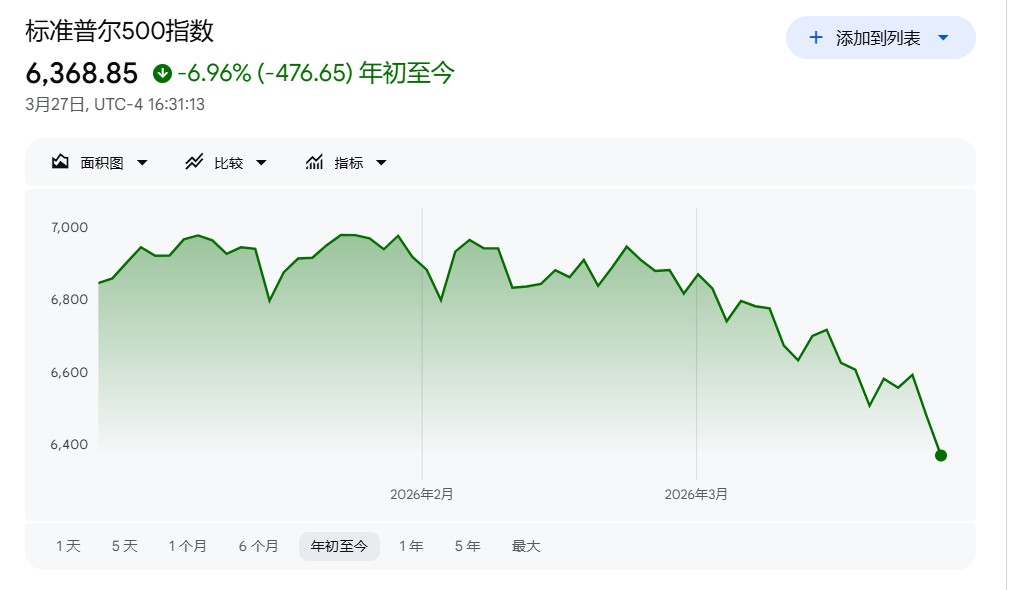
The triple pressures of soaring oil prices, rising interest rates, and geopolitical uncertainty have caused the forward 12-month P/E ratio for the S&P 500 to plummet from 22 times a month ago to 19 times, a 14% drop. Goldman Sachs warns that current market movements are increasingly approaching the previously outlined "growth shock" scenario, and if geopolitical conflicts continue to escalate, US stocks still face further downside risks. Referencing historical declines in the S&P 500 during severe oil supply shocks, the index could fall to 5400 points, about 15% lower than current levels
The S&P 500 has fallen 9% from its January high, but the contraction in its valuation multiples has far outpaced the index itself—the P/E ratio has already entered a "correction" phase.
According to Wind Information, Goldman Sachs' latest weekly strategy report warns that current market movements are increasingly approaching the previously outlined "growth shock" scenario, and if geopolitical conflicts continue to escalate, US stocks still face further downside risks.
The triple pressures of soaring oil prices, rising interest rates, and geopolitical uncertainty have caused the forward 12-month P/E ratio for the S&P 500 to plummet from 22 times a month ago to 19 times, a 14% drop. Meanwhile, the 10-year US Treasury yield has surged approximately 50 basis points, reaching a threshold typically associated with stock sell-offs, at 2 standard deviations.
Notably, despite the sharp compression in P/E multiples, the expansion in the equity risk premium has been relatively limited.
Goldman Sachs' US Equity Sentiment Indicator fell to -0.9 this week, its lowest level since August 2025, reflecting a significant reduction in equity exposure by investors. Historical data suggests that when this indicator falls below -1, it often precedes above-average equity returns, but the signal is more reliable when it drops below -1.5. Goldman Sachs points out that without an improvement in the fundamental outlook, current positioning levels are insufficient to drive the market higher.
Valuations Have "Peaked" First, Market Nears "Growth Shock" Tipping Point
The S&P 500 has fallen 9% since reaching its all-time high on January 27, but its P/E ratio has fallen more sharply—from 22 times on January 27 to the current 19 times, a 14% decline, entering a technical "correction" range. In contrast, analysts have actually raised their 2026 earnings per share forecasts during this sell-off, with a cumulative increase of 3% over the past month.
Goldman Sachs reports that current S&P 500 levels and sentiment indicator readings are approaching those set in the previous "growth shock" scenario, with the distribution of recent outcomes improving in favor of equity investors. However, Goldman Sachs' cyclicals-to-defensives ratio and dividend futures pricing indicate that the market's pricing of economic growth has only slightly decreased in recent weeks; the sharp rise in interest rates has been the primary macro driver of this sell-off.
Goldman Sachs warns that if conflicts continue to escalate and drag down economic prospects, the stock market still has room for further downside. Referencing historical declines in the S&P 500 during severe oil supply shocks, the index could fall to 5400 points, about 15% lower than current levels.
Fundamentals: AI Investment Supports 40% Earnings Growth, Oil Price Impact Limited
From a fundamental perspective, Goldman Sachs maintains its base case forecast for S&P 500 earnings per share growth of 12% to $309 in 2026. Goldman Sachs' top-down model shows that a 1 percentage point change in US real GDP growth corresponds to a 3% to 4% change in S&P 500 earnings per share, while a 10% change in oil prices only affects earnings by about 0.4%. This indicates that earnings are not highly sensitive to oil prices. The greater risk lies in severe and sustained supply disruptions that could materially hinder economic growth.
Goldman Sachs economists' current base case scenario assumes oil flow through the Strait of Hormuz remains at 5% of normal levels for six weeks, Brent crude oil prices at $80 per barrel by year-end, and US real GDP growth at 2.1% year-on-year in the fourth quarter. Even under the most adverse scenario—where oil prices spike above $150 per barrel, disruptions last until May, and production capacity is damaged—economists still expect US real GDP growth to exceed 1%. Goldman Sachs estimates the probability of the US falling into recession over the next 12 months at 30%. If a recession of historical average magnitude occurs, S&P 500 earnings per share would fall to $239.
AI investment spending is a key variable supporting earnings. Goldman Sachs estimates that AI infrastructure investment will contribute approximately 40% of the S&P 500's earnings per share growth this year. Micron's recently released forward EPS guidance was 60% higher than Goldman Sachs' and market consensus expectations, and the subsequent consensus upward revision provided an additional 2 percentage points of support for S&P 500 EPS growth in 2026.
First Quarter Earnings Season: Tech Leads Growth, Management Guidance More Crucial Than Results
Consensus forecasts show S&P 500 first-quarter earnings per share growing by 12% year-on-year, which, if realized, would mark the sixth consecutive quarter of double-digit growth, the longest streak since the earnings recovery following the global financial crisis. The earnings season officially kicks off the week of April 13, with approximately 60% of the S&P 500 market capitalization scheduled to report in the last two weeks of April.
At the sector level, the information technology sector is expected to see a 44% year-on-year increase in earnings per share, contributing 87% of the S&P 500's earnings growth in the first quarter. NVIDIA and Micron combined are expected to contribute over 50% of the S&P 500's first-quarter earnings growth. The capital expenditure trends of hyperscale cloud providers will be a key focus this quarter—analysts expect their total first-quarter capex to reach $149 billion, a 92% year-on-year increase, though growth is expected to slow sequentially thereafter. Hyperscale providers' trailing 12-month free cash flow has declined 32% year-on-year, and signals of AI investment returns will be closely watched by investors.
Goldman Sachs points out that against the backdrop of current macro volatility, management guidance and forward-looking commentary will be more informative than reported results. Drawing parallels from the first quarter 2025 earnings season, in environments of macro volatility, the stock price boost from better-than-expected results tends to be lower than the historical average, and the concentration of stock price fluctuations around earnings dates also decreases accordingly.
Beyond the Tech Sector: Margin Pressure and "Wait-and-See" Sentiment Coexist
Outside the technology sector, the key question for investors this quarter is the extent to which rising energy costs and supply chain disruptions erode corporate profit margins. The S&P 500 net profit margin reached an all-time high in the fourth quarter of 2025, but survey data indicates that even before the conflict outbreak, companies expressed concerns about rising input costs for raw materials, while pricing power expectations remained relatively subdued, posing challenges to the profit margin outlook. Consensus forecasts show that first-quarter S&P 500 net profit margins will slightly decline from their historical highs in the fourth quarter.
Based on early reports from companies that have already disclosed earnings, the signals have been positive so far. Since March, 32 S&P 500 constituent companies have reported earnings, with the median upward revision to analysts' 2026 EPS forecasts for these companies being 0.5%. Most management teams have adopted a "wait-and-see" attitude toward geopolitical uncertainty, with few companies providing clear forward guidance. Goldman Sachs believes that management commentary and guidance in subsequent reports will be more important information sources for assessing corporate earnings prospects.
