


From Safe Haven to Emergency Cash-Out Tool: Gold Quietly "Transforms" Amidst War
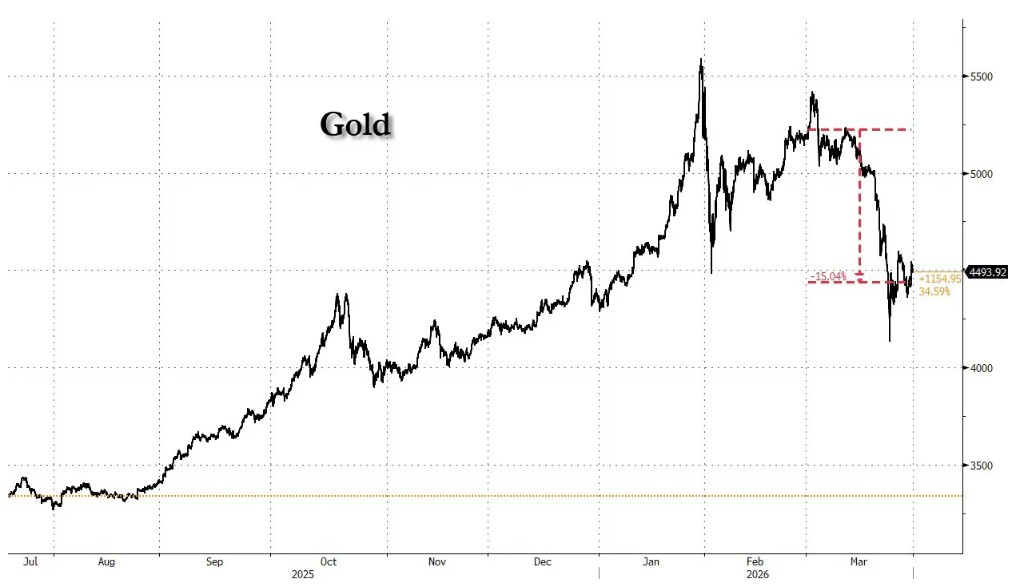
Gold prices have fallen by 15% since the outbreak of the war, contrary to market expectations. Under extreme political pressure, gold has transformed from a traditional safe-haven asset into an emergency cash-out tool for central banks. The Turkish central bank has sold or swapped approximately 60 tons of gold reserves; the Russian central bank has also been continuously reducing its gold holdings; according to analysis, oil-producing countries in the Persian Gulf may also be selling gold due to a significant drop in their energy export revenues
Gold prices have fallen by 15% cumulatively since the outbreak of the war, a trend that runs counter to general market expectations. This reveals gold's quiet role transformation under extreme geopolitical pressure—from a traditional safe-haven asset to an emergency cash-out tool for central banks and governments.
Since the attack launched by the United States and Israel on Iran on February 28, the Turkish central bank has sold or swapped approximately 60 tons of gold reserves within two weeks. Concurrently, the Russian central bank has been continuously reducing its gold holdings. According to analysis, oil-producing countries in the Persian Gulf may also be selling gold due to a significant drop in their energy export revenues.
The concentrated selling by multiple central banks is reshaping the supply and demand logic of the gold market. This trend indicates that for economies deeply mired in the quagmire of war, gold's primary function is no longer wealth preservation, but rather obtaining urgently needed funds, energy, and materials.
This "transformation" of gold is not an isolated market anomaly, but rather a microcosm of accelerating global wealth evaporation. Unlike local conflicts within a limited scope over the past few decades, the current war is destroying productive capacity on an unprecedented scale, and its impact on the global economic system far exceeds any previous crisis.
Central Bank Reductions: A Selling Spree from Turkey to Russia
The sell-off by the Turkish central bank is remarkable in both scale and speed. Selling or swapping about 60 tons of gold in two weeks indicates the urgency of its liquidity pressure.
As a net energy importer bordering a war zone, Turkey faces dual pressures: on one hand, energy import costs have surged with the escalating conflict; on the other hand, foreign exchange earnings channels have narrowed due to geopolitical tensions, forcing it to dip into its gold reserves to fill the gap.
The continuous reduction by the Russian central bank reflects broader fiscal pressures. Meanwhile, the situation for oil-producing countries in the Persian Gulf is also not optimistic—oil tankers are blockaded in the Strait of Hormuz, oil dollar revenues have plummeted, forcing some countries to consider selling previously accumulated gold reserves to maintain operations.
The aforementioned selling activities have jointly suppressed gold prices, dealing a heavy blow to long positions that had expected gold to strengthen due to the war.
The "Three States" of Gold: Geopolitical Temperature Determines Asset Attributes
Gold exhibits distinctly different forms depending on the geopolitical temperature. In the early stages when geopolitical tensions rise but are not yet out of control, gold acts as a liquidity hedging tool, the preferred choice for institutions and governments to avoid risks.
However, when the intensity of war exceeds a critical point, gold's attribute undergoes a qualitative change in the hands of its holders—gold cannot satisfy hunger, nor can it be directly used to pay bills. Holders in distress are forced to liquidate it to obtain more pressing materials and funds.
And in extreme scenarios, when the fiat currency issued by a government completely loses its credit due to hyperinflation, gold returns to its most ancient form—a store of value and medium of exchange that transcends history.
The current 15% decline precisely corresponds to the second phase of the war: liquidity crisis overrides safe-haven demand, and large-scale liquidation becomes the main theme.
Scale of Wealth Destruction: Why This War is Different
The drop in gold prices itself is a window into the scale of global wealth loss.
Over the past few decades, wars have been geographically limited, with minimal impact on overall global economic prosperity. The global economic system had ample capacity to compensate for war-induced losses through normal market mechanisms.
The current conflict is fundamentally different. Productive capacity is being destroyed on a massive scale, while concurrently, countries are racing to rebuild redundant infrastructure systems for national security reasons. The resulting capital demand coincides with accelerated capital depletion, creating a rare and dangerous superimposed effect.
Unlike any crisis in the last fifty years, when there was ample idle production capacity, fiscal expansion and quantitative easing could effectively stimulate demand and fill gaps.
Inflation Dilemma: Fiscal Expansion Struggles to Resolve Structural Contradictions
In a wartime economy with constrained capacity, the usual policy tools employed by governments face severe tests.
Fiscal expansion and quantitative easing are unlikely to play their traditional roles in this context—when production capacity itself is damaged, releasing more money will not drive output growth, but merely further increase price levels.
Under the current wartime supply constraints, inflation will become a more intractable core contradiction. For investors, this means asset allocation logic needs to adapt to a new environment characterized by higher inflation, higher capital costs, and significantly diminished effectiveness of traditional policy tools.
Gold's short-term "emergency cash-out" attribute may not negate its value preservation function over the longer term, but the scale of wealth destruction revealed by the current sell-off is sufficient to keep the market highly vigilant about the global economic outlook.
