


One Rocket, Three Satellites! Skyverse's Lijian-2 Successfully Debuts, Unit Cost Rivals SpaceX
China's commercial aerospace welcomes a new milestone with the successful maiden flight of the Lijian-2 carrier rocket, completing a "one rocket, three satellites" mission. The rocket demonstrates the commercial potential of domestic medium-sized liquid rockets with its competitive costs, with its unit cost already on par with SpaceX's Falcon 9 and expected to drop to half in the future. Lijian-2 is the first rocket independently developed by Skyverse using the Common Booster Core (CBC) configuration, featuring multiple flexible configurations to support various payload requirements
China's commercial aerospace has added another milestone. The maiden flight of the Lijian-2 carrier rocket was a success, debuting with a "one rocket, three satellites" mission while demonstrating the commercial potential of domestic medium-sized liquid rockets with highly competitive cost data.
According to Xinhua News Agency, at 19:00 on March 30, the Skyverse Lijian-2 Yao-1 carrier rocket (International Textile City) was successfully launched from the Dongfeng Commercial Aerospace Innovation Test Zone, placing three satellites—Xinzhengcheng 01, Xinzhengcheng 02, and Tianshi-01—into their predetermined orbits. This marks the 12th launch for the Lijian series of carrier rockets and the first flight for Lijian-2.
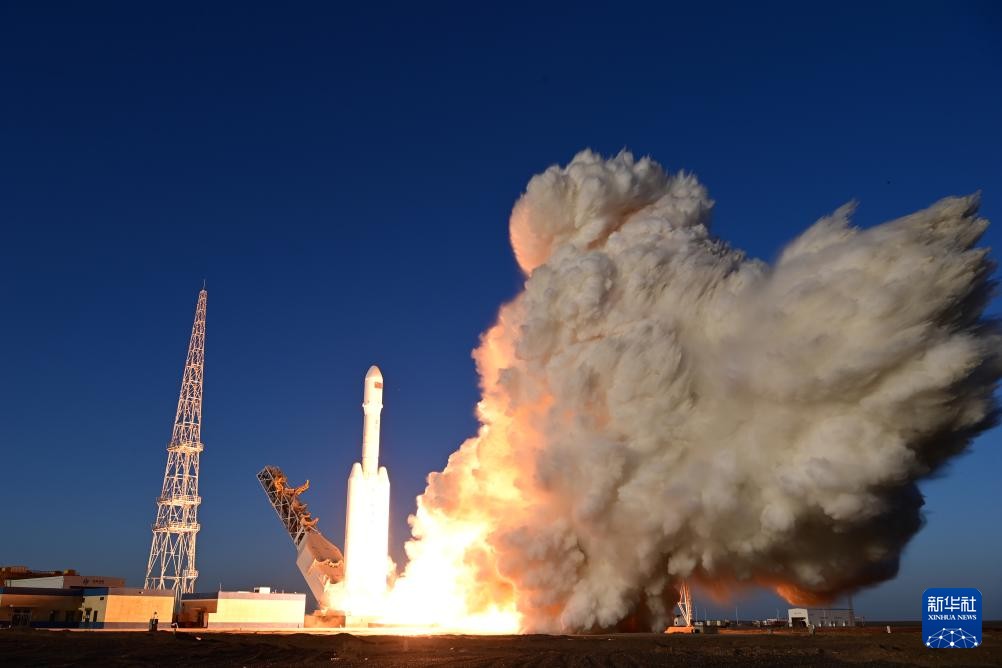
Regarding costs, Yang Haoliang, General Commander of Lijian-2, revealed a striking set of data: Currently, the unit cost of Lijian-2 without recovery is basically on par with the cost of SpaceX's Falcon 9 with recovery. He further stated that once cluster recovery is achieved in the future, the cost is expected to drop to half that of SpaceX.
Maiden Flight Mission: CBC Configuration Validates Key Technologies
Lijian-2 is a medium-sized liquid carrier rocket independently developed by Skyverse and is China's first carrier rocket to adopt the "Common Booster Core" (CBC) configuration.
In terms of specifications, the Lijian-2 rocket's common core stage has a diameter of 3.35 meters. In its maiden flight state, the fairing diameter is 4.2 meters, the total length is 53 meters, the liftoff weight is 625 tons, and the liftoff thrust is 753 tons. It has a payload capacity of 8 tons to a 500 km sun-synchronous orbit and 12 tons to a 200 km low Earth orbit.
Skyverse stated that this maiden flight primarily validated three key technologies: the application technology of the CBC configuration, the structural design and manufacturing process technology for large-diameter smooth-wall tanks, and the separation technology for large fairings using a flat-drop mechanism. Lijian-2 supports 0/2/4 strap-on configurations—meaning flexible deployment as a single-stick or with 2 or 4 liquid boosters—comprehensively covering the low Earth orbit payload range of 2 tons to 20 tons.
The three satellites carried on this mission have different focuses:
The Xinzhengcheng 01 satellite, developed under the leadership of CAS Satellite Co., Ltd., is positioned as a "mini space laboratory" and will conduct various in-orbit tests and application demonstrations using Commercial Off-The-Shelf (COTS) experimental devices;
The Xinzhengcheng 02 satellite (White Elephant space experiment spacecraft) was independently developed by the Innovation Academy for Microsatellites of the Chinese Academy of Sciences. It has a total weight of 4.2 tons, a designed in-orbit lifespan of 3 years, and features an integrated single-cabin configuration.
Cost Reduction Logic: A Dual Path from Design Origin to Batch Production
The cost competitiveness of Lijian-2 stems from a systematic cost reduction path established during the design phase.
Lian Jie, Deputy Chief Designer of Lijian-2, stated that the core logic of the CBC configuration is to "exchange design complexity for production simplicity," making it suitable for rapid batch production of commercial aerospace rockets. Through a combination of commonality and individuality in design, envelope and probabilistic design, and digitalization with experimental verification, Lijian-2 has achieved shared design, shared modules, shared testing, shared supply chains and production lines, shared assembly plants, shared technical area plants, and shared launch positions. This approach of "developing one type, expanding to three types" significantly shortens the development cycle and reduces R&D costs for multiple rocket types.
In terms of manufacturing processes, Zhang Yanrui, Deputy Chief Designer of Lijian-2, revealed that the rocket's core tanks abandoned high-cost grid-stiffened structures in favor of a smooth-wall structure with milled wall panels. This process change increased overall production efficiency by 40% and significantly reduced manufacturing costs.
Yang Haoliang further explained that the core stage and booster stage structures of Lijian-2 use a unified design. The 9 engines for the first stage and the 1 engine for the second stage use the same power module. The integrated telemetry, tracking, and command (TT&C) avionics system is completely common and interchangeable with that of Lijian-1, achieving unification of the rocket's core product line. Compared to Lijian-1's payload capacity of 1.5 tons to a 500 km sun-synchronous orbit, Lijian-2 increases this to 8 tons, positioning it to support the rapid deployment of China's low-orbit internet constellations.
Recovery Roadmap: Gradual Migration via the Lihong Series
Following the successful maiden flight, Skyverse will advance the research and verification of recovery technologies.
According to Yang Haoliang, the company will first validate recovery technologies through the Lihong series of flight vehicles to accumulate recovery data and reduce development risks. This recovery technology will then be migrated to medium and large carrier rockets. Ultimately, the goal is to recover large-capacity rockets capable of orbital insertion through common core stage bundling and cluster recovery schemes.
The company has already fully validated core technologies such as atmospheric re-entry deceleration and recovery and precise landing point control for the rocket body through the maiden flight of Lihong-1, and plans to conduct a 100-kilometer-level recovery test for Lihong-2 this year.
Yang Haoliang stated that once the cluster recovery scheme is implemented, the unit launch cost of Lijian-2 is expected to drop further to half that of SpaceX's Falcon 9. Currently, rocket recovery technology still needs to overcome core challenges such as aero-thermal protection across wide airspace and broad speed ranges, real-time online guidance under non-linear constraints, and deep variable thrust and multiple restarts for liquid propulsion.
Risk Warning and Disclaimer
Markets are risky; investments require caution. This article does not constitute personal investment advice, nor has it considered the specific investment objectives, financial situation, or needs of individual users. Users should consider whether any opinion, view, or conclusion in this article is appropriate for their specific circumstances. Investing based on this is at your own risk.
