


Goldman Sachs Lowers Japan Stock Price Targets: Hormuz Disruption May Last 6 Weeks, Japanese Corporate Profits Face Oil Price "Squeeze"
Goldman Sachs has lowered its three-to-twelve-month Price Targets for Japan's TOPIX by 100 points each. The core logic is the extension of the Strait of Hormuz disruption assumption from three to six weeks, leading to a plunge in the FY26 EPS growth forecast to 7.2%, nearly 5 percentage points below market consensus. Meanwhile, both foreign and institutional investors were net sellers, while defensive domestic demand stocks bucked the trend to lead the market
Goldman Sachs has lowered its three-month, six-month, and 12-Month Price Targets for Japan's TOPIX index to 3800, 4000, and 4200 points, respectively. The rationale cited is that the continued Middle East conflict is pushing up energy prices, which will substantially compress Japanese corporate earnings. This adjustment marks a notable cooling of market expectations for a swift resolution to the Middle East situation.
According to the Chasing Wind Trading Desk, Goldman Sachs released a research report on March 29. The firm's commodity analysts have raised oil and natural gas price forecasts, with the base case assumption being a six-week disruption of oil flow through the Strait of Hormuz, combined with the impact of increased strategic reserves.
On this basis, the firm simultaneously updated its Asian regional macroeconomic forecasts. The Japan Equity Strategy team subsequently lowered the Price Targets for the TOPIX index for each period by 100 points from the previous 3900/4100/4300 points.
On the earnings front, the FY26 (fiscal year ending March 2026) EPS growth forecast has been significantly lowered from 12.3% to 7.2%, primarily due to shrinking corporate profit margins caused by higher oil prices. This forecast is nearly 5 percentage points lower than the market consensus estimate of 12%, indicating a substantial divergence.
Meanwhile, market sentiment remains fragile. During the week of March 16 to 19, both foreign and domestic institutional investors turned to net selling, with only retail investors buying against the trend.
Hormuz Shock: The Earnings Gap from Three to Six Weeks
The core driver for this downgrade is the upward revision of the base case scenario assumption—extending the duration of oil flow disruption in the Strait of Hormuz from three weeks to six weeks.
The impact on Japanese corporate earnings differs significantly between the two scenarios. Under the three-week disruption assumption, the FY26 EPS growth forecast is 8.8%, with profit margins contracting by 0.3 percentage points compared to pre-conflict levels. Earnings growth contributions from energy and trading companies are approximately 0.7 percentage points.
In the six-week disruption base case scenario, FY26 EPS growth further declines to 7.2%, with profit margin contraction widening to 0.5 percentage points. Although the positive contribution to profits from energy and trading companies increases to 1.2 percentage points, it is insufficient to offset the overall pressure. The GDP drag in both scenarios is approximately 0.6 percentage points.
The research report points out that the market consensus for FY26 earnings growth is 12%, while the firm's top-down forecast is only 7.2%. This significant gap of approximately 5 percentage points suggests that the risk of potential earnings downgrades has not yet been fully priced into the market.
Insurance Sector Leads Gains, Defensive Style Dominates Rotation
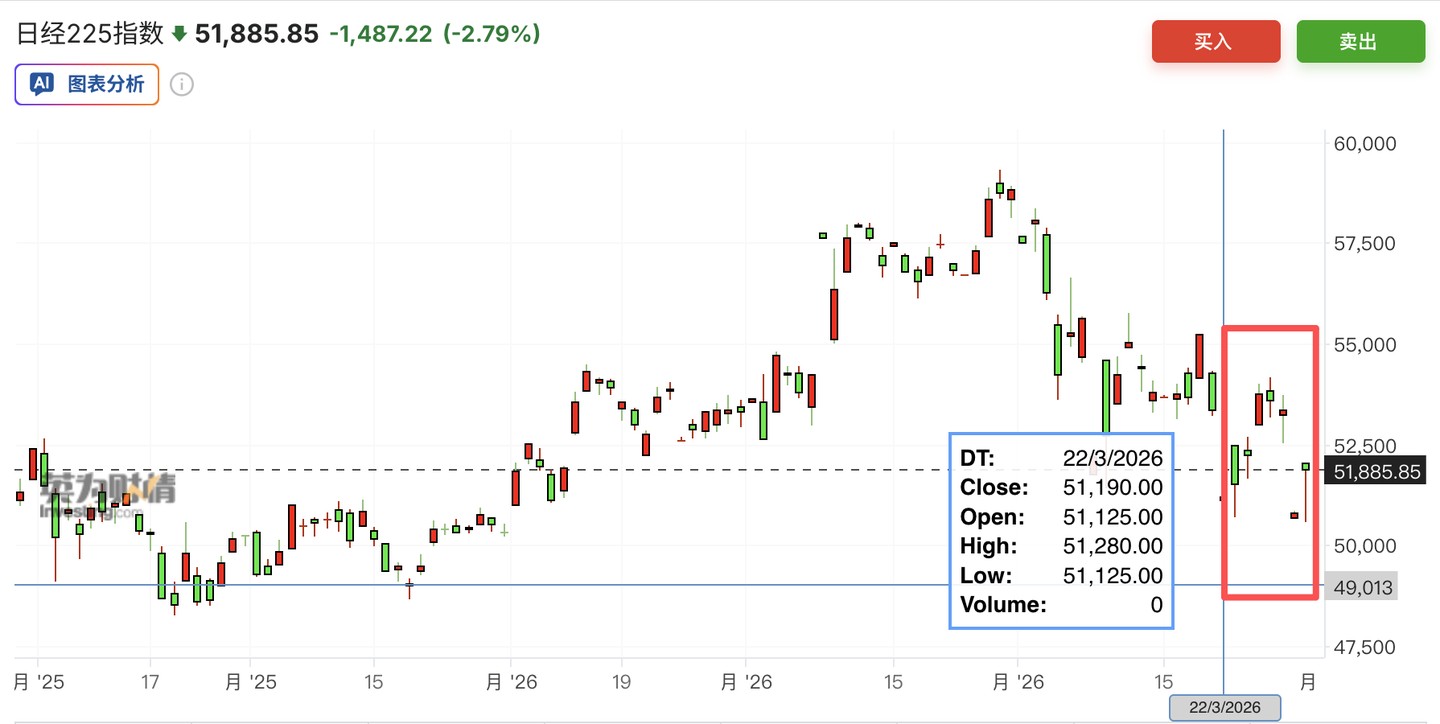
Over the past week, the Japanese stock market experienced a slight overall recovery, with the TOPIX index rising 1.1% and the Nikkei 225 index remaining largely flat. However, internal structural divergence was evident, with defensive sectors and energy-related sectors significantly outperforming the broader market.
The insurance sector, with a weekly gain of 9%, topped all sectors. This was primarily driven by news of Berkshire Hathaway's investment in Tokio Marine Holdings, which saw its share price rise by 25% during the week.
Defensive sectors such as pharmaceuticals (+5%) and healthcare (+5%) also performed strongly. The energy, oil, coal, and trading companies sectors, benefiting from expectations of rising oil prices, also achieved varying degrees of gains.
The weakest-performing sectors included Other Products (-3.5%) and Real Estate (-3.2%). The construction sector fell 4% for the week, marking the largest decline among all sectors. Real Estate is currently listed as an underweight sector.
Domestic Demand Stocks Begin to Outperform, Breaking the Weak Yen Benefiting Exports Logic
Despite the continued rise in the USD/JPY exchange rate, the report observes a noteworthy structural shift: since the outbreak of the US-Iran conflict, domestic demand-oriented stocks have begun to outperform internationally exposed stocks.
This phenomenon breaks the traditional logic that "a weaker yen benefits exporters." Amid ongoing global uncertainty, investors are clearly more inclined to avoid external risk exposure and reallocate to companies whose revenue sources are primarily domestic.
Concurrently, fund flow data indicates cautious market sentiment. According to the latest data from the Tokyo Stock Exchange (TSE), during the week of March 16 to 19, foreign investors net sold 491 billion yen in spot stocks on the TOPIX Prime market, and domestic institutions net sold 260 billion yen; only individual investors were net buyers against the trend, totaling 309 billion yen.
Global Equity Forecast Comparison: Japan's Price Target Upside in the Middle
Within Goldman Sachs' global equity forecast framework, the Price Targets for the TOPIX index still imply a certain upside potential after this adjustment, with potential gains of approximately 4%, 10%, and 15% for the three-month, six-month, and 12-month horizons, respectively.
In comparison, the report sets the 12-Month Price Target for the S&P 500 at 7600 points, corresponding to an upside of approximately 17%. The 12-Month Price Target for the MSCI Asia ex-Japan is 870 points, also with an upside of 17%. The expected return for Europe's Stoxx 600 is relatively modest, with its 12-Month Price Target corresponding to an approximately 8% gain.
In terms of sector allocation, the report recommends overweighting Machinery, IT & Services, Banks, Electrical & Precision Instruments, Construction & Materials, Financials ex-Banks, Materials & Chemicals, and Commerce & Wholesale sectors. It advises underweighting Electric & Gas, Food, Pharmaceuticals, Transportation & Logistics, Steel & Non-Ferrous Metals, Autos & Components, Energy Resources, and Real Estate sectors.
