


Loss of 4 Helicopters and Two MC-130 Transports, Penetrating 300 km into the Iranian Heartland—Was This a "Successful" Rescue Operation or a "Failed" Raid for Enriched Uranium?
Deep inside Iran, self-destructing six military aircraft just to rescue a single pilot? The US military's "one of the boldest search and rescue missions in history" has triggered a massive shockwave! Iran has pointed out abnormalities in the operation's location, claiming it was actually a "cover operation" for "stealing enriched uranium." Behind this extreme raid near nuclear facilities, was it a simple rescue or a shocking shadow war?
A US military mission, officially characterized as "one of the boldest rescue operations in history," is facing widespread questioning regarding its true objectives due to its astonishing scale, unusual location, and heavy cost.
According to CCTV News, Iranian Foreign Ministry spokesperson Baghaei stated publicly on April 6th that the rescue operation carried out by the US on April 5th constituted a violation of Iranian airspace and contained "numerous points of suspicion"—the area where the pilot was allegedly located was far from the actual area of the US military operation. He directly suggested that the mission might have been a "cover operation" under the guise of a rescue, intended to "steal enriched uranium," and called it a "disastrous scandal" for the United States.
Meanwhile, Xinhua News Agency, citing Reuters, reported that two MC-130 transport aircraft involved in the operation suffered mechanical failures and could not take off, nearly resulting in "catastrophic" personnel losses. The US military ultimately had to blow up four helicopters and the two disabled transport aircraft before withdrawing.
The scale, location, and cost of this operation have triggered a core question among analysts, former officials, and on social media: penetrating over 300 kilometers into the heart of Iran, deploying dozens of aircraft, and losing multiple military planes—was all of this truly just to rescue a single pilot?
The Rescue Operation Itself—A Perilous Evacuation
According to Xinhua News Agency, Reuters cited informed US officials reporting that approximately 100 US special forces entered Iran on the night of April 4th to execute the rescue mission. The individual rescued was the weapons systems officer from the back seat of a downed F-15E fighter jet, holding the rank of colonel. He had a sprained ankle and was hiding in a rock crevice on a mountaintop. Rescuers transferred him to the extraction point before dawn on the 5th.
However, two MC-130 transport aircraft tasked with transporting some of the personnel immediately experienced mechanical failures and could not take off, putting over a hundred US military personnel at risk. According to informed officials, the commander immediately decided to temporarily dispatch smaller turboprop aircraft into Iran to evacuate personnel in batches. Before the withdrawal, the US military destroyed four helicopters and the two disabled MC-130 aircraft to prevent equipment from falling into Iranian hands.
Reports state this was one of the most dangerous military operations conducted by the US against Iran in five weeks. Notably, throughout the entire operation, the White House, the Department of Defense, US Central Command, and even Trump himself remained unusually silent, leading some reporters to even wonder if Trump was hospitalized with an illness.
Iran's Doubts: Location Mismatch, Is the Target Uranium?
Iranian Foreign Ministry spokesperson Baghaei raised a key geographical contradiction at a press conference on April 6th: the area where the F-15E pilot was allegedly located is in Kohgiluyeh and Boyer-Ahmad Province, while the area where the US military actually conducted the rescue operation was in central Iran, a considerable distance apart.
Based on this, Baghaei suggested that the true purpose of the US operation might be to steal enriched uranium, a possibility that "should not be ignored." The Islamic Revolutionary Guard Corps (IRGC) claimed its forces intercepted and destroyed several US aircraft, characterizing the incident as a "humiliating failure" for the United States. Iranian Parliament Speaker Mohammad Baqer Qalibaf wrote on social media: "If the United States achieves three more such 'victories,' it will be headed for complete destruction."
However, the aforementioned Iranian claims have not been independently verified, nor have they been officially confirmed by the US.
Is One Pilot Worth All This Effort?
The scale of this operation has drawn the most concentrated skepticism from the outside world. According to multiple reports, US military forces penetrated over 300 miles (approximately 480 kilometers) into Iranian territory, reaching an area about 230 miles from Tehran, adjacent to the concentration of nuclear facilities in Isfahan, Qom, and Natanz. Other accounts suggest that the US military also reactivated an abandoned old Iranian airfield, showing a level of pre-planning and precision that exceeds conventional combat search and rescue missions.
Former CIA official Larry Johnson publicly questioned the official narrative, suggesting that the downed F-15 might not have been on a routine mission. "What was that F-15 doing in that area? I believe it was preparing for a ground attack on the Natanz nuclear reactor," he stated.
Retired special operations officer and former US Army Green Beret Lieutenant Colonel Anthony Aguilar provided a noteworthy analysis of the types of aircraft used in the operation from a professional perspective.
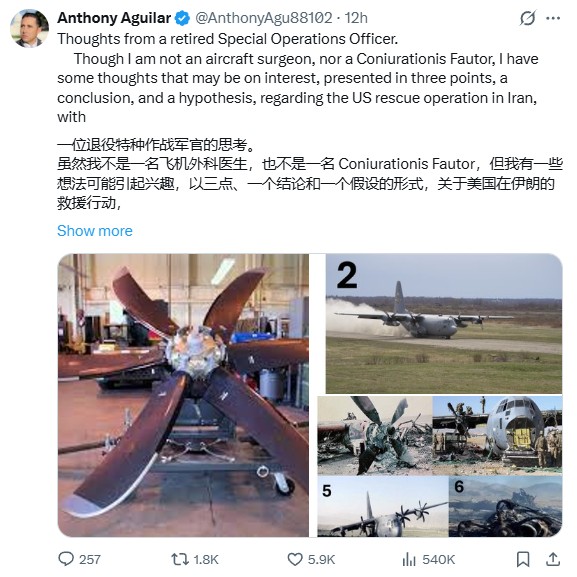
He pointed out that the aircraft used were not standard C-130 "Hercules" transports but rather MC-130J "Commando II" models—this type of aircraft is equipped with six-bladed composite propellers and is specifically designed for clandestine missions by the US Air Force Special Operations Command. Aguilar has flown such aircraft on multiple combat missions, including deep into the Kobani landing zone in northeastern Syria during Operation Inherent Resolve.
He specifically noted that, judging from photos of the wreckage at the scene, the propellers of the damaged aircraft showed signs of melting and fragmentation characteristic of carbon fiber materials, rather than the bent and broken form of metal blades after impact. This means that, on a technical level, asserting the aircraft was "definitely shot down" based solely on the state of the propellers is untenable.
Building on this, Aguilar further presented his core judgment: the rescue operation actually expanded into a high-risk operation involving elite forces such as Delta Force and the Joint Special Operations Command (JSOC), with the true intent being to seize Iran's uranium reserves. "That was the intent of the operation all along; it just failed," he wrote, believing the aircraft were likely hit upon entry and sustained further damage at the temporary forward replenishment point at the old Isfahan airfield—and the location of that airfield "just happens" to be adjacent to a suspected storage site for enriched uranium.
Another commentator, Will Schryver, also stated that "a simple pilot rescue is clearly not the whole story," noting that the proximity of the operation site to nuclear facilities "provides evidence for related theories"—even as he simultaneously described such missions as "absurd." A former Pentagon official stated that the operation sent a signal to Iran: the US military has the capability to "infiltrate any location within its territory," not just to rescue pilots, but also to "control nuclear equipment."
Battlefield Situation and Trump's Threats
This rescue operation took place against the backdrop of escalating US-Iran military conflict. According to Xinhua News Agency, a US Air Force F-15E "Strike Eagle" fighter jet was shot down over Iran's Isfahan Province on April 3rd. On the same day, two US "Black Hawk" helicopters managed to escape after being hit, and Iranian air defense systems also struck a US A-10 "Warthog" attack aircraft near the Strait of Hormuz; the pilot ejected safely, and the aircraft crashed.
Two fighter jets crashing on the same day directly punctured Trump's previous repeated claims that "Iran has lost its air defense capabilities." Trump subsequently demanded again on April 5th that Iran open the Strait of Hormuz and threatened on social media that "April 7th will be Iran's Power Plant Day and Bridge Day," hinting at large-scale bombing of Iranian infrastructure, with his phrasing even including profanity.
Currently, the US has not issued a formal response to the location contradictions and "cover operation" allegations raised by the Iranian side. The true objective of this operation remains an unresolved question.
